Google's former CEO just said what everyone in AI already knows
Building wealth is getting easier if you actually learn the tools
Not by scrolling AI threads
By understanding agents, Codex Code, prompts, memory, skills, MCP, and routines
Save this before it disappears from your feed
Everything below is free:
ChatGPT basics
https://t.co/p1ZEv4vG4f
OpenAI Academy
https://t.co/5AVN9CgCZq
Prompt engineering
https://t.co/gFV0OAXnQo
GPT-5.5 prompting guide
https://t.co/TJOxZ77Y6C
OpenAI API docs
https://t.co/24OlDTxEcA
Responses API
https://t.co/DLnWfUZEUS
Agents SDK
https://t.co/irt7DTJ745
Agents SDK quickstart
https://t.co/Mm2kgeMs39
Tools + function calling
https://t.co/A40Dege36x
Structured outputs
https://t.co/Jawb4njrJa
Conversation state
https://t.co/YkbSXmUk3A
ChatGPT memory
https://t.co/ojhvlLbVWp
ChatGPT projects
https://t.co/Svo7ATFTGc
Custom GPTs
https://t.co/chrd6IBz8L
Tasks in ChatGPT
https://t.co/pIEnCC5K8F
Codex overview
https://t.co/CVPKvEz9MY
Codex quickstart
https://t.co/sKNEmSMCXF
Codex CLI
https://t.co/kUySSiEBL5
Codex GitHub repo
https://t.co/FoiGgP5ash
Codex best practices
https://t.co/E1PtLvDDaj
AGENTS.md
https://t.co/eaAJkQDp4x
Codex skills
https://t.co/OsrLujQnkX
Codex MCP
https://t.co/uHCuY9Ram7
Codex subagents
https://t.co/QboZoCEzHT
ChatGPT Apps SDK
https://t.co/keDQV4wPUp
Apps SDK quickstart
https://t.co/OYKfU6EXaW
ChatGPT developer mode + MCP
https://t.co/iUE04OldHB
OpenAI Cookbook
https://t.co/LxteqEFzWZ
All of this costs $0
Most people will keep asking AI one question at a time
Save this and start learning the stack
I found the SpaceX IPO surprisingly emotional today. It reminded me of why I came to the US as an 18-year-old. Even then, I knew that I wanted to build stuff, and that the place to do it was America. There was no second option in the world.
The concept of American exceptionalism is nothing new, but I have come to appreciate the culture that justifies it. SpaceX is yet another case in point. America’s risk-taking culture celebrates wild successes while embracing the legitimacy of hard-earned failure. American culture doesn’t celebrate inherited wealth, nor does it frown upon inherited poverty. It doesn’t seek to create equal outcomes, but rather equal opportunity.
It is not immediately obvious that this is unique in the world. Truly unique. I’m Canadian, and I love many aspects of Canadian culture, but Canadian culture does not offer people the same environment in which to take risks.
I write this because I was dismayed to see US politicians complaining of the extreme wealth created by the SpaceX IPO. Say what you will about wealth inequality, or a single man’s politics, but don’t tell me that immense wealth creation in America is bad. Do not tell me you’d rather SpaceX not exist, exactly as it does. That you’d rather this company exist in some other country or culture.
Thankfully, despite today’s politics, SpaceX could not have been a Chinese company, or a Canadian one, or a French one. It could only ever have been an American one.
If nationalism is pride in your birthplace, then it’s merely tribalism, which serves to divide us. But if it’s pride in your culture, a culture that lets people achieve incredible things like this, then under those terms I am a nationalist. I want to protect and enhance our culture of risk-taking, of celebrating wins, and of celebrating failures along the way.
I think it is amazing that America created a trillionaire out of a risk-taking immigrant. It is absolutely fucking absurd, of course, but isn’t that the point? SpaceX is not a reason to be pissed off; it’s a reason for every person in the world who wants to build stuff to see themselves as American, no matter where in the world they live.
p.s. — this is entirely from my brain, with AI used only for fixing typos and grammar. :^)
Increasingly, I believe companies may need to be rebuilt from the ground up, where you have a single timeline of all observability + product metrics + file changes laid out in a retrievable system, like Datadog + Posthog + Google Drive + Slack (really unified filesystem of Claude Code chats + Codex chats). This might be the new data foundation for any and all companies to maximize AI. Needs to be rebuilt because keeping track of diffs on existing system basically impossible to produce longitudinal information on decisions and rollbacks, something coding agent storage companies are actively trying to figure out, but this should extend to businesses as a whole.
Highly skeptical existing businesses will adopt this though because it means overhauling everything about their instrumentation and business data, but I think businesses built on this foundation probably can execute 100x better and faster
Everyone's talking about AI-generated HTML.
But have you tried giving your sites a zero-config API for saving data, file storage, AI, websockets, etc?
We did this at Shopify. Runs on a single VM that costs $200/month, and it's changed the way we work.
We call it Quick 👇🧵
Introducing @PoeticHQ: a new AI system that executes complex multi-hour tasks with 99%+ accuracy and 10x fewer tokens than agents.
We raised $50M at $500M from Kleiner Perkins, Founders Fund, First Harmonic, and Genius Ventures to build AI that does complex work inside Fortune 500 companies without hallucination.
While code is too brittle, agents are too unpredictable. The work that runs the global economy - anti-money laundering, fraud investigations, underwriting - needs extreme accuracy.
So we built a new kind of software that pairs the flexibility of AI with the predictability of code.
When the world stays the same, Poetic runs fixed code: fast, cheap, identical every time. When the world changes, Poetic uses AI to regenerate its approach and find its way back to the objective.
In one year, we went from zero to an eight-figure run rate as a team of four.
Since then, we’ve scaled the team and executed the highest-stakes processes at AIG, SoFi, and Chime. At SoFi, a large US bank, Poetic reached 99%+ quality on fraud investigations in five weeks.
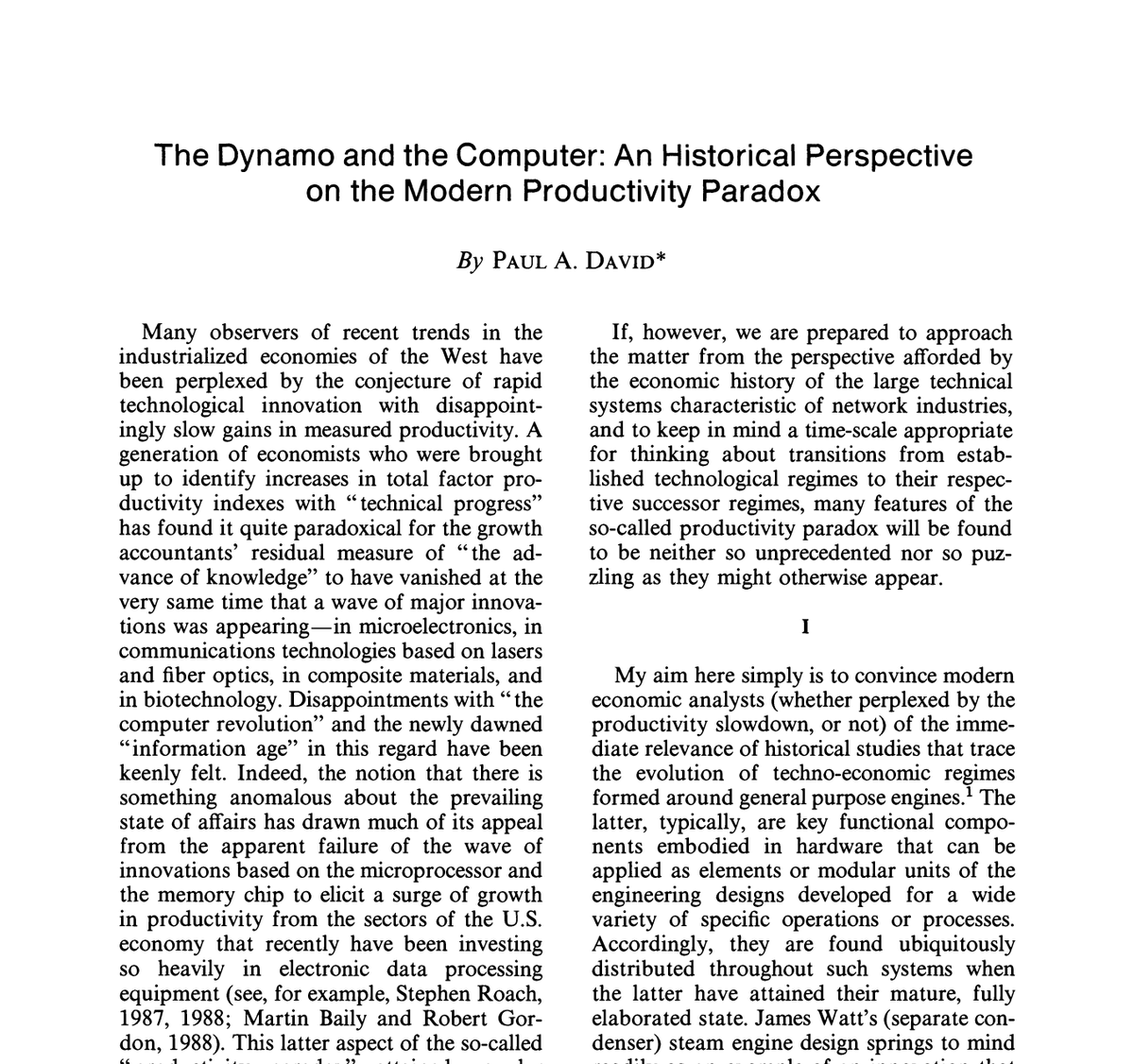
If you've adopted AI at your company but haven't seen any tangible results, read this 1990 article: "The Dynamo and the Computer" by Paul David.
When electricity first arrived, factories that "adopted" it barely got faster. They just swapped the steam engine for an electric one and ran everything else exactly as before: same machine layout, same workflow, same management. Electricity in, no real gains out.
The most common mistake with any new technology is to drop it into the old organization and then declare the transformation done.
The real leap came decades later, when each machine got its own small motor. Suddenly machines no longer had to be lined up around one central drive shaft. They could be rearranged around the actual flow of work.
The productivity gains didn't come from electricity. They came from REDESIGNING THE ENTIRE FACTORY around it.
AI is the same. Bolting it onto your existing process gets you a faster steam engine. The payoff comes when you redesign the work itself.
(link to paper in comments)
The AI-native services I’m seeing crush it right now:
• Law firms
• Bookkeeping/accounting
• Tax preparation
• Insurance back-office operations
• Medical billing
Notice a pattern?
None are sexy.
They’re all industries where businesses already spend thousands per month on human labor to move information between systems, review documents, and complete repetitive workflows.
The AI playbook isn’t:
“Build software and hope people buy it.”
It’s:
> Sell a service people already buy.
> Replace labor with AI.
> Improve margins.
> Productize the workflow.
> Slowly become software.
That’s why some of the most interesting AI companies today look more like service businesses than SaaS companies.
Godfather of AI: "If you sleep well tonight, you may not have understood this lecture."
This 47-minute lecture is the best thing I saw about AI in the last few months.
It will definitely help you understand how it actually works and where it's going.
Geoffrey Hinton built the neural networks behind every AI alive, then quit Google to warn the world about it.
The part nobody wanted to hear:
> AI is already developing abilities its creators didn't intend
> in most cognitive tasks it's already ahead of us
> the question is no longer if it surpasses us but when
> the only decision left is which side of that line you're on
Right now the average person opens Claude, types something, gets an answer, closes the tab.
They think they're using AI. they're using maybe 10% of it.
I went through his entire lecture, then mapped everything he described to what Claude can actually do today.
17 Claude features most people will never find on their own.
Full breakdown in the post below.
Monthly VC/LP debrief.
What I actually saw in May 2026:
1/ SF is in full gold rush mode again, but history says the current winners won't stay on top forever. Every dominant technology eventually gets surpassed – newspapers, telecom, cable, Google in ads, IBM in computers. In AI the same pattern is already playing out: compute will hit walls, chips get dramatically more efficient, new energy sources emerge, and entirely new model architectures appear. The people feeling left behind today may just be early in a much longer cycle. (h/t @TurnerNovak)
2/ The largest $10B+ funds went from 140–150 collective early-stage deals per year in the SaaS era to 370–400 in the AI era. But the concentration is at the top of the market – top-decile rounds, known founders, proven operators. @kevinhartz calls it "option value": a small check today for the right to lead Series A tomorrow. The average seed round remains territory for EMs.
3/ We might be entering a Zombie VC era. ~85% of 2017–2018 vintage funds still haven't returned 1x DPI after 7–8 years. Median DPI sits at $0.34 on the dollar, while median IRR for the same cohort looks respectable at 11.6%. Paper returns hide the reality. The liquidity window opening over the next two years will be the moment of truth for most of these funds.
4/ @SpaceX IPO might be the single largest DPI event in VC history dropping into the lowest-distribution moment in venture capital history. @foundersfund alone, with an early $20M check in 2008, could return $60B+ (~3000x). When that capital hits LP accounts, it needs to be redeployed and that will circulate a new wave of fundraising for the same funds and fresh allocations from LPs who finally have liquidity to work with.
5/ The @cerebras IPO was the first real data point on crossover returns after two years of everyone writing off the model – both early-stage VCs and late-stage crossover funds made money on the same company, and LP conversations shifted from "do we have any exposure to the winners" to "how do we get into the next one." The same strategy that was declared dead in 2022-2023 got fully rehabilitated by a single exit. (h/t @MeghanKReynolds)
6/ Monte Carlo across 1,391 VC funds: concentrated portfolios (15 companies) and diversified ones (100 companies) produce the same average fund return – 2.44x. But compounded across multiple vintages, diversified wins: 2.25x vs. 1.78x. Concentrated funds carry more variance per fund, and variance drag compounds against you over time. The extreme outcomes (15x+) are almost exclusive to concentrated funds but the probability is tiny either way. (h/t Steve Kim)
7/ EM activity is showing the first real pulse in years. @cartainc logged 78 new US venture funds in the $10M–$100M range in Q1 2026 – a 34% jump from Q1 2025. Still well below the 2022 peak of 147, but the post-winter bottom might finally be in. The managers raising right now are doing it without a favorable macro, without easy LP recycling, and into a market where mega-funds are more active at seed than ever. (h/t @PeterJ_Walker)
8/ 76% of all EM-focused FoFs are American. The entire addressable market for a Fund I or Fund II isn't 132 FoFs – it's roughly 33. The other 100 exist, but Classic and Government-Led FoFs structurally can't anchor an early-stage vehicle: the check size doesn't justify the overhead, and a pension board can't be sold on a first-time manager without a track record. Geography and fund type filter out 75% of the market before the first meeting. (via @murphcapital)
9/ The 10-year fund is structurally mismatched with the assets mega-funds are holding. @SpaceX has been private for 18 years. @stripe for 15. For managers at that scale, @sequoia's move makes sense – open-ended, permanent capital, indefinite horizon. For small funds the logic runs the opposite way: the 10-year horizon enforced as a hard constraint, secondaries at Series C/D as the default exit, actual distributions on schedule. (h/t @credistick)
10/ There are only 3 positions that matter in a startup's cap table story: first investor, most helpful investor, biggest investor. Biggest is reserved for ~10 megafunds. First requires conviction most managers don't have – and LP preferences for concentrated portfolios often push against it structurally. So 90%+ of firms end up competing for "most helpful," which is why every pitch deck has a platform slide and every GP talks about their right to win oversubscribed rounds. (h/t @arian_ghashghai)
Every month I track new fund launches, LP events, market reports, and what's actually moving in VC/LP.
All of it in the @murphcapital newsletter: https://t.co/Wi8pAGQHLB
Or ... instead of blaming the employees, maybe companies realize how lousy they've become at training, and investing in humans to make them more effective may become management mantra again.
The equation is fairly straightforward:
Competent employees x AI tokens = Accelerating business & market share gain
Incompetent employees x AI tokens = slop
Companies are now realizing they have a lot of shitty employees.
They aren’t going to permanently cut spend on tokens. They can’t afford to because of game theory.
So instead they will fire the employees they believe are incompetent to make room for higher token budgets for those that are competent.
Lots of orgs however have a managerial class that doesn’t optimize for share gain and winning in general.
Thats fine. A wave of startups and existing platforms who can effectively leverage AI to expand scope of their business will crush the incompetent at a rate that will leave analysts and managers dizzy.
Change is coming. Fast. And reflexively the faster the change the higher the panic the lower the ROI threshold the more revenue and capital accrues to the labs the faster the models improve. And so on.
Mostly true. What matters is securing the long-term future of consciousness, both on Earth and other heavenly bodies.
We cannot just focus on Earth, because there are irreducible external (eg massive meteor) and internal (eg global nuclear war) cataclysmic risks.
The Moon is faster to make self-growing, but is more susceptible to problems on Earth. Mars will take longer to make self-growing, because it is so hard to reach, but is more secure from Earth disasters for that same reason.
Both the Moon and Mars should have self-growing civilizations. Making this happen is the prime directive of SpaceX.