Our paper, "Efficient, Few-Shot Directed Evolution Directed Evolution with Energy Rank Alignment", has been published in JCIM! Special thanks to my co-authors @shriramc1 and @FrankWho1050502 for all their contributions, and my advisor @grantrotskoff for his mentorship.
@vikhyatk this is a good joke
but also defining problems is important mathematical work (Erdos, Hilbert, Clay/Millennium Prize, etc) and so artificial mathematicians should be able to extend the set of problems, then solve them. the y axis should be unbounded!
One of the reasons I wanted to work on ML instead of Physics was that it seemed the fastest way to make progress on the latter was to work on the former. First slowly, now quickly, it's amazing to see this start to happen.
Research at OAI is humming.
We set out to audit the RL results for IDiom, a protein language model for designing intrinsically disordered regions.
The question was simple:
Did RL learn specific localization, or did it learn sequences that score broadly well for related compartments?
The results 🧵
Protein design has been dominated by diffusions due to a "structure-first" perspective. What about intrinsically disordered proteins? We scale language-based design using the modern RL stack and our model IDiom.
Paper: https://t.co/mW0uMUBwZu
Try it: https://t.co/azcGCdqc4n
New paper! Presenting Discrete Flow Maps:
paper: https://t.co/f1RmZry2by
blog: https://t.co/Cnwgf4moY0
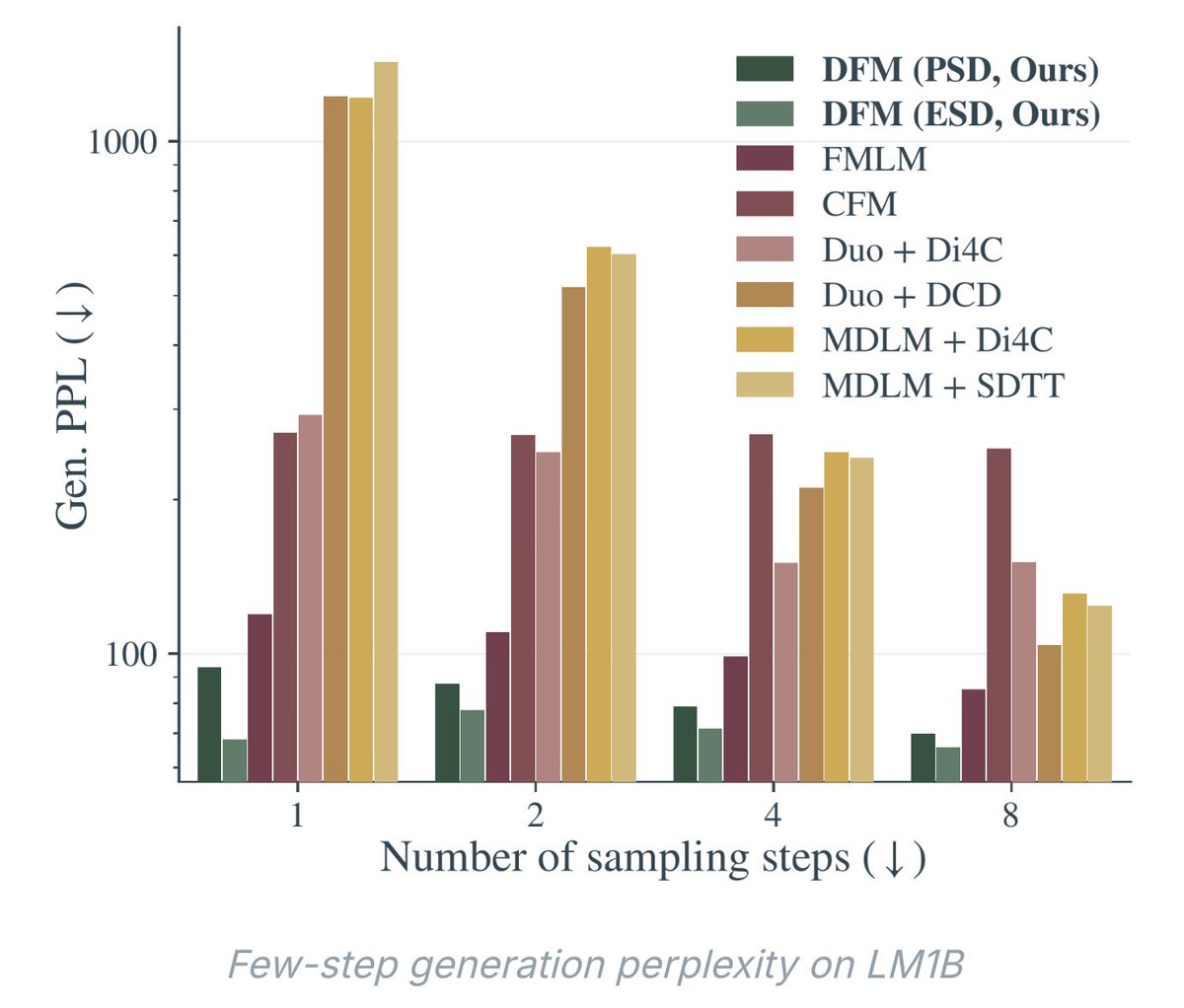
A laughable problem for me these days is that @nmboffi and I share a research brain, and we have had, time and again, a conversation that ends with “ha so I guess we’re writing the same paper.” Soon we will return to just doing it together :). Here we are doing it again with discrete flow maps and flow language models! A complete and thorough paper led by @PPotaptchik@json_yim@adhisarav@peholderrieth. We took a bit of time to post it to ensure we understood a few more things about the stability of the loss functions.
Like @osclsd , @FEijkelboom, and @nmboffi , we think this could be a very helpful paradigm for thinking about fast inference and even better alignment!
Here’s our version of the story, and I hope it makes clear how green field this research direction is — we provide a comprehensive picture of the KL losses you can write from the properties of the flow map, some nice geometric proofs about the mean denoiser and the simplex, and find that at this time, the ESD can actually be the most performant, with some caveats. Excited for everyone to work together and push this class of models to their limit!
We release Diamond Maps💎 unlocking accurate and efficient guidance for diffusion models. Our experiments show that our methods scale incredibly well. Excited to see what people will build with this!
Accurate guidance has been a notoriously hard problem, but in this work, we’re bringing TWO (!) solutions to the table. The recipe for success:
1️⃣ Speed: Use distilled models (flow maps, mean flows, consistency models).
2️⃣ Exploration: Inject stochasticity to properly explore your search space.
Because this fundamentally improves anything using flow matching and diffusion, we see a lot of potential for applications across audio, robotics, molecules, and beyond.
Paper: https://t.co/wxtWWRrnw7
Code: https://t.co/WocPtT6orn
Huge thanks to an amazing team: Douglas Chen, @LucaEyring, @ishin_shah, Giri Anantharaman, @electronickale, @zeynepakata, Tommi Jaakkola, @nmboffi, and @max_simchowitz. It was awesome bringing this to life together!
🚀 The AI4Physics Workshop @ ICML 2026 is now accepting submissions!
📅 Apr 24 (AOE)
📝 Submit via OpenReview
🌐 https://t.co/o6LvZukzAO
Join us in shaping the future of AI for science.
#ICML2026#AI4Physics
Soojung Yang @SoojungYang2 previously created approaches to identify rare protein conformational transitions and, in collaboration with Microsoft Research, to efficiently sample equilibrium ensembles at scale. As a FutureHouse Fellow with Grant Rotskoff @grantrotskoff, she will build machine learning models that unify protein structure, thermodynamics, and kinetics, and deploy agentic AI to search variant space and enable biochemistry-informed protein optimization.