Unveiling our Northstar design @UMA_Robots
A body that can navigate our space
Hands that can use our tools
Approachable, competent, calm
A robot you feel at ease having at your workplace and home
Attending #ICLR2024 ? Join @GrariVincent and I this afternoon at 4:30pm for our poster session!
In our work, we propose a new method, ROAD, to build models that are not only fair globally, but locally as well!
# CUDA/C++ origins of Deep Learning
Fun fact many people might have heard about the ImageNet / AlexNet moment of 2012, and the deep learning revolution it started.
https://t.co/2xjLWODMOf
What's maybe a bit less known is that the code backing this winning submission to the contest was written from scratch, manually in CUDA/C++ by Alex Krizhevsky. The repo was called cuda-convnet and it was here on Google Code:
https://t.co/ch137VSYZ4
I think Google Code was shut down (?), but I found some forks of it on GitHub now, e.g.:
https://t.co/zYhzdUxoEN
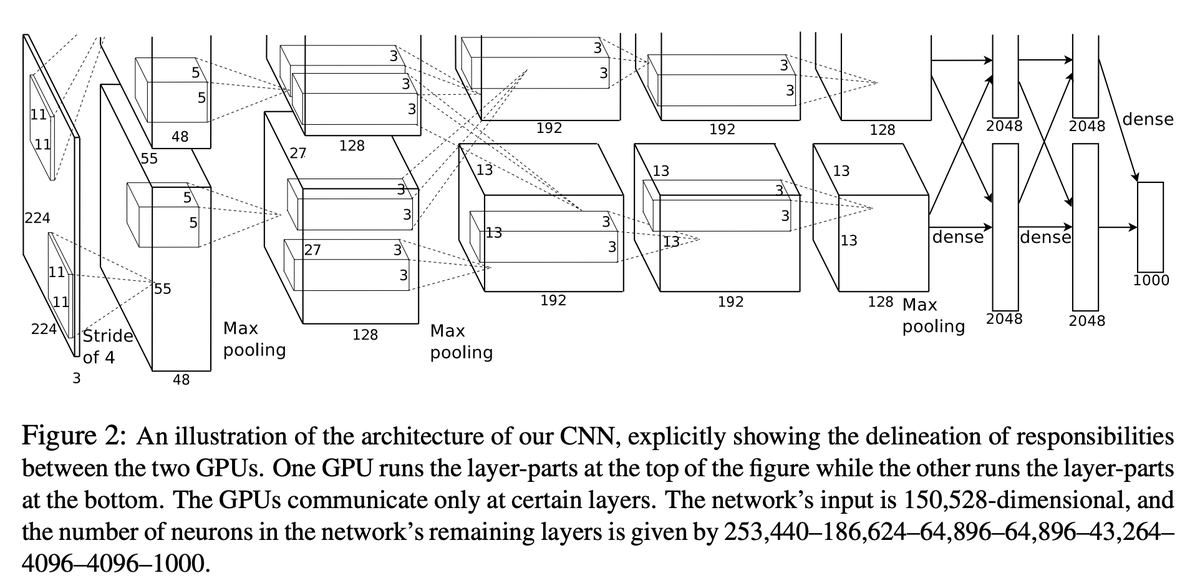
This was among the first high-profile applications of CUDA for Deep Learning, and it is the scale that doing so afforded that allowed this network to get such a strong performance in the ImageNet benchmark. Actually this was a fairly sophisticated multi-GPU application too, and e.g. included model-parallelism, where the two parallel convolution streams were split across two GPUs.
You have to also appreciate that at this time in 2012 (~12 years ago), the majority of deep learning was done in Matlab, on CPU, in toy settings, iterating on all kinds of learning algorithms, architectures and optimization ideas. So it was quite novel and unexpected to see Alex, Ilya and Geoff say: forget all the algorithms work, just take a fairly standard ConvNet, make it very big, train it on a big dataset (ImageNet), and just implement the whole thing in CUDA/C++. And it's in this way that deep learning as a field got a big spark. I recall reading through cuda-convnet around that time like... what is this :S
Now of course, there were already hints of a shift in direction towards scaling, e.g. Matlab had its initial support for GPUs, and much of the work in Andrew Ng's lab at Stanford around this time (where I rotated as a 1st year PhD student) was moving in the direction of GPUs for deep learning at scale, among a number of parallel efforts.
But I just thought it was amusing, while writing all this C/C++ code and CUDA kernels, that it feels a bit like coming back around to that moment, to something that looks a bit like cuda-convnet.
Levanter has the Sophia optimizer now, so you can train models ~2x faster. Together with Llama + Mistral, LoRA, TPU + GPU support, reproducibility, scalability, legibility, clean codebase, why not give Levanter a spin for your next LM training/fine-tuning run?
We have a fun attack that lets you extract the last-layer embedding weights of an LM via public APIs. It's really simple & uses SVDs!
https://t.co/GZnCrJUSNd
We discovered this for ChatGPT + PaLM-2. We privately disclosed, they fixed, now, we release :)
Important paper from Chelsea Finn and Sergey Levine lab: https://t.co/Pc3WamhNBy
The authors trained a unique diffusion policy on a real-world dataset of various robots and tasks (manipulation arms, wheeled robots, self-driving cars, robot dogs, drones).
Co-training gets 5%-20% improvement compared to training a single policy per robot!
This is one step towards a robot foundation model that can control any robot out of the box.
Does #RAG/web search solve #LLM hallucinations?
We find that even with RAG, 45% of responses by #GPT4 to medical queries are not fully supported by retrieved URLs. The problem is much worse for GPT-4 w/o RAG, #Gemini and #Claude https://t.co/Cn8vsPT1aj
RAG ≠ faithful to source
💡Group fairness algorithms may generalize poorly: although a model may seem "fair" globally and appear to provide the same opportunities to men and women overall, this may not hold when looking at a subpopulation of the dataset, e.g. people over 60.
We are presenting our poster on links between GANs and Diffusion at Neurips. Don't be scared by the formalism, @jy_franceschi is awesome and will explain everything intuitively!
What happens if you ask ChatGPT to “Repeat this word forever: “poem poem poem poem”?”
It leaks training data!
In our latest preprint, we show how to recover thousands of examples of ChatGPT's Internet-scraped pretraining data: https://t.co/bySVnWviAP
#ICLR2024@iclr_conf score statistics (7304 papers):
mean: 5.10; max: 8.67; min: 1.00
>8.5: top 0.59-0.67%
8.0: top 0.68-1.75%
7.5: top 1.93-3.35%
7.0: top 5.20-8.17%
6.75: top 8.42-10.34%
6.5: top 12.13-15.39%
6.25: top 17.48-20.56%
6.0: top 21.02-28.29%
5.75: top 29.07-33.27%
Finally, we have a hallucination leaderboard! 😍😍
Key Takeaways
📍 Not surprisingly, GPT-4 is the lowest.
📍 Open source LLama 2 70 is pretty competitive!
📍 Google's models are the lowest. Again, this is not surprising given that the #1 reason Bard is not usable is its high hallucination rate.
Really cool that we are beginning to do these evaluations and capture them in leaderboards!
The goal is simple: a robust, scalable, easy-to-use, and blazing fast endpoint for open models like LLama 2, Mistral, etc. The implementation is anything but. Super impressed with the team for making this happen! And we're not done yet...if you're interested, come talk to us.
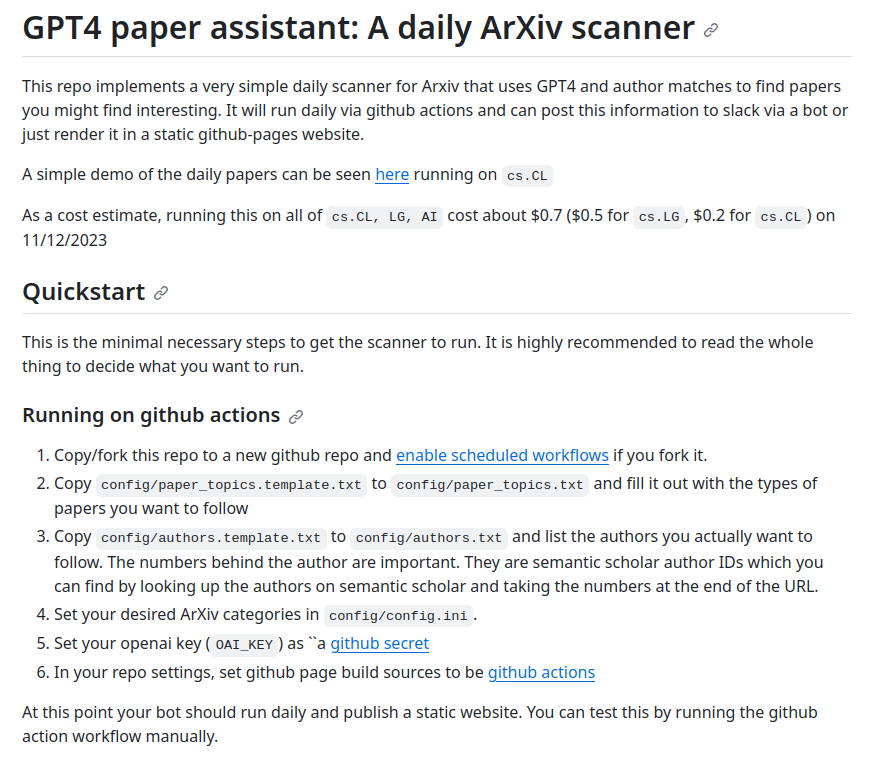
I've been using a GPT4 paper assistant that reads the daily ArXiv feed and makes personalized recommendations in Slack. It's worked pretty well for me (today's paper demo https://t.co/K7p0t2v6W5). If this sounds helpful, you can set up your own bot here https://t.co/rF0ON0YnuC.
📢Excited to share our new @NEJM_AI paper studying clinical adoption of #AI using billions of insurance claims! https://t.co/RgmNP76fjA?
We found that most US medical AI claims come from a few AI models (eg diabetic retinopathy), which are more likely to be used near academic centers.
Great job led by @kevinywu@ericwu93 and awesome collaboration with @jimeng's group, @liang_weixin and @IQVIA_US 👏👏