Electrical Engineering ->Control Engineering -> Nonlinear Dynamical System -> Chaos Theory ->History and Philosophy of Science -> Neuroscience
Chemical engineering -> Islamic philosophy -> Philosophy of science -> Formal epistemology -> Decision theory -> Formal social epistemology
Next step: turning minimally invasive (https://t.co/B85KUt6Myj) into non-invasive.
Synchron’s BCI already acts like a native input device via Apple’s HID protocol, no headgear, no special software.
🧠
#BCI#Neurotech
🧠 For the first time ever, an individual was able to control their iPad entirely by thought, enabled by @Apple’s new #BCI HID protocol and accessibility features. Thank you, Mark and to the team at Apple for driving the world of #accessibility and technology forward.
🔗 Read the full release: https://t.co/ScYrDL01cR
Watch the video: https://t.co/mn1JbUciw9
#BCI #Neurotechnology #Accessibility
Agency > Intelligence
I had this intuitively wrong for decades, I think due to a pervasive cultural veneration of intelligence, various entertainment/media, obsession with IQ etc. Agency is significantly more powerful and significantly more scarce. Are you hiring for agency? Are we educating for agency? Are you acting as if you had 10X agency?
Grok explanation is ~close:
“Agency, as a personality trait, refers to an individual's capacity to take initiative, make decisions, and exert control over their actions and environment. It’s about being proactive rather than reactive—someone with high agency doesn’t just let life happen to them; they shape it. Think of it as a blend of self-efficacy, determination, and a sense of ownership over one’s path.
People with strong agency tend to set goals and pursue them with confidence, even in the face of obstacles. They’re the type to say, “I’ll figure it out,” and then actually do it. On the flip side, someone low in agency might feel more like a passenger in their own life, waiting for external forces—like luck, other people, or circumstances—to dictate what happens next.
It’s not quite the same as assertiveness or ambition, though it can overlap. Agency is quieter, more internal—it’s the belief that you *can* act, paired with the will to follow through. Psychologists often tie it to concepts like locus of control: high-agency folks lean toward an internal locus, feeling they steer their fate, while low-agency folks might lean external, seeing life as something that happens *to* them.”
There are LOTS of exciting ARIA-Neurotech opportunities closing in the next month 🤯
🧠Cambridge NeuroWorks 17/01
🧠UK FROs @Convergent_FROs 07/02
🧠@ARIA_research Seeds Call 13/02
🧠@fiftyyears UK Cohort 17/02
Wild time to be building Neurotech. Don't sleep!
Links 🔽
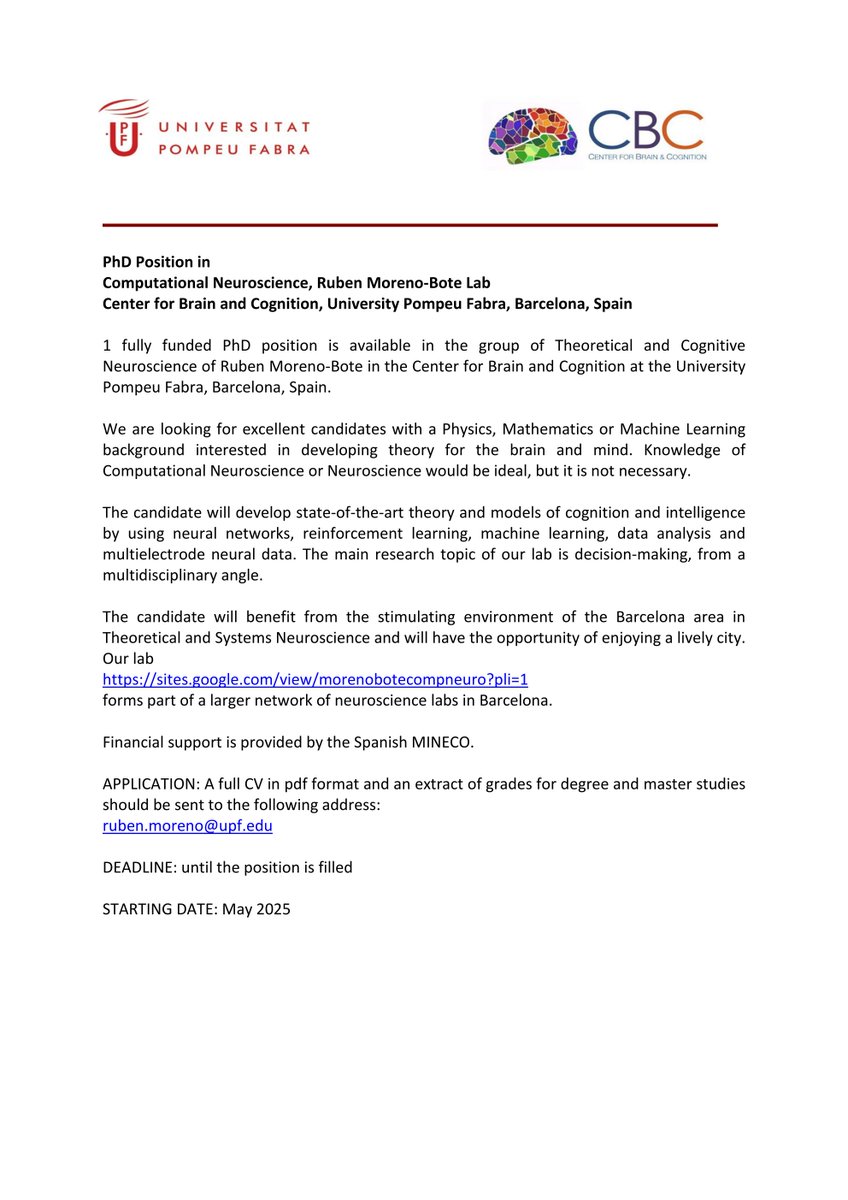
Open PhD position in Theoretical and Computational Neuroscience in my lab.
We want to discover the basis of natural intelligence. Please, spread the word, and apply if interested.
See more details below.
I tried Google's NotebookLM "radio conversation generator" on my paper about taxing robots (the irony!).
I was blown away by the results.
Are robots and AI coming for your jobs journalists? 😱
Hate to point out the obvious but many young people seem to need this piece of advice: doing science and doing "academia" are not the same thing. Often they conflict with each other, but it's probably best to treat them as orthogonal endeavors that require different skill sets
@jcponcemath@mathladyhazel The reason it caught my attention is because my PhD work was very similar to this, but perhaps with a different approach. I was surprised that I hadn't heard of it!
https://t.co/XBQulmVC87
@jcponcemath@mathladyhazel Thank you. Indeed I found this paper, but the nonlinear system, generating this chaotic dynamic, is not presented or even mentioned in this paper.
It is mainly a general paper on dissipative dynamical system analysis and specifically on the Lorenz strange attractor.
Getting fired is tough, but it’s important to handle it with dignity. Firing someone is also hard, requiring compassion and respect. Total disaster on both sides here.