Ok, here is my trip report from 4.67 grams of magic mushrooms, 24.9 mg of psilocybin. The dose used in modern clinical trials.
First, the experience was exhilarating. Positive in every way. I felt like a kid finding and exploring a new playground.
My sensory perception was dialed up to levels I must have felt as a kid but have been dulled with time. I experienced sense of touch with awe. Feeling my fingers rub together felt novel. Touching my skin and running my feet over the threaded quilt lit up my brain. It seemed that my mind was insatiably curious and wanted to deploy its sensors into the world and discover all things.
I felt the same sensory joy in moving my body. Rolling my joints, curving my back, curling up in a ball, flexing muscles and moving all about in a fluid fashion. My body felt nimble, supple, fit, and strong.
My sense of hearing was equally as elevated. It helped that I was also wearing my new hearing aids which restore frequencies I’d long stopped noticing. The music I listened to hit more fully than I have memory.
My facilitator gave me some water in a glass jar. The visuals of the light reflections, water dynamics and sensory experience of holding the glass were so fascinating that I forgot to drink. My brain wanted to stare, study and marvel.
One of the most satisfying things I discovered was taking huge, deep breaths. Inhaling life and fueling the body’s needs and wants. I did it over and over and over. This material of existence, all around us, was available and free to be mined. You just needed to breathe in.
(After peaking and coming down, I ate a salad. It tasted like the most delicious food I’d ever eaten. The flavor exploded in my mouth. I savored every bite.)
At one point, I felt like my entire body was still. I had a perceived sense of total body control. Like my heart had stopped. Complete stillness. This was surprising as I’m acutely tuned to my heart beat. I monitor my heart all day every day and can usually discern my heart rate by sensation. In that moment, I couldn’t feel my heart beat or any pulse pressure through my blood vessels. First time that’s ever happened. I asked Kate to check my heart rate on my wearable and it was mid 50s. I wasn’t worried. Just curious about my sensory experience.
With this heightened sense of sensory perception, it felt like my consciousness was dialed up to 10/10. I felt hyper aware and hyper alive.
It felt like mushrooms restored my perception to youthful levels, returning them to factory settings and dissolving my aged numbness.
Once my senses were reset, my attention sifted from the texture of existence to existence itself.
We spend most of our time playing games at the layers of people, dramas, companies, politics, jobs, money, ideologies, and status. Underneath these games is the knowing that physical death has been inevitable. Everyone before us has died.
When death is inevitable, people pick their game among a wide array of options including reincarnation, heaven, legacy, offspring, ancestral veneration, existentialism and many more. These frameworks make death soothing, a virtue, and something positive to be anticipated.
But what if death is no longer inevitable? I’m not suggesting immortality. I am suggesting a radical remake of human life. The speed of progress in AI, biology and medicine point to a new frontier of possibility. Are we cavemen-equivalent now compared to what we will be like in 50 years? It’s now harder to argue why we should limit our imagination.
With so much promise, why have we not shifted our societal attention to secure our own existence? To solve aging. To address existential risks. To care for our planet. Why are we still messing around with self destruction, war and ignoring preserving our own existence?
We work hard to be fit. To learn a skill. Build a relationship. To make money. When we identify an opportunity, we focus and work hard. It seems to me that we’re not yet aware or awake to the opportunity of what existence could become.
Whatever one’s life philosophy and belief of what happens after this life, the majority of us want to live to see tomorrow. We have stuff going on and things to look forward to. And when tomorrow arrives, we want to see the next day. Wanting tomorrow is functionally equivalent to wanting infinitely.
The want to exist is deeply embedded in all of us. Our actions prove this every day.
Humans have been the alpha form of intelligence for a while now, imposing our will upon all we can. Our powers have increased dramatically in the past few decades. We can edit our own DNA, design materials at the nano scale, and build thinking machines.
Our alpha status is now challenged by AI. Whether AI is friend or foe, and in what ways, and on what timelines is anyone’s guess. No one knows.
Mushrooms opened up my sensory awareness of this landscape to depths I hadn’t accessed before. My ability to see and understand felt like the movie Inception, where characters take a sedative to enter a different realm to carry out missions. A space as real as what we experience each day, but with different foundational pillars of reality.
It felt convincing that without the aid of a reality expanding intervention (like mushrooms), you can’t really see or understand this dimension, handicapping awareness.
While in this mushroom-induced dimension, it felt clear that we are about to start waking up from a slumber that has hypnotized us into accepting death. This will happen faster than people think. Once people see a practical path to extending a healthy life, they will adopt ferociously.
The body positivity movement came to mind. Most people don’t really want to be overweight and unhealthy. But when we want something we can’t achieve, we come up with moral frameworks about why we didn’t want it in the first place (i.e. sour grapes). Once GLP-1s came about, people’s attitudes changed overnight. The same will happen with aging. No one wants to be crippled and handicapped by age.
This awakening will also come about with the emergence of new ideologies.
Revolutions erupt when a civilization’s founding myth becomes incompatible with its reality. The system fractures, dissolves, and opens up space for new meaning to rush in and replace it.
This pattern has been repeated throughout history.
> The agrarian empires (800-200 BCE) ruled via tribal power and violence, creating a moral crisis that gave rise to Buddhism, Greek philosophy, Judaism and Confucianism.
> Feudalism (1600-1800) ruled via divine monarchy, creating a stagnation crisis that gave rise to rational inquiry, the scientific method, individual rights and democracy.
> Industrial capitalism (1848-1945) ruled via mechanization and labor exploitation, creating a crisis of alienation, mass poverty and urban chaos that gave rise to socialism, nationalism, regulation and collective rights.
> Liberal capitalism (1980-2025) ruled via consumer sovereignty and free markets, creating a crisis of attention capture, metabolic collapse and existential despair that will give rise to something new. Capitalism solved for scarcity. Its defining virtue was freedom to choose. Ironically and perhaps inevitably, compulsion replaced scarcity and freedom decayed into addiction.
Revolution is at our doorstep.
Our current systems are fractured, evolving, and opening up space for new meaning to rush in and replace it. Change has been a reliable feature of human society. It will happen on accelerated timescales given the pace of technological and scientific advance.
After journeying this terrain, I was left feeling unbridled enthusiasm for the future of existence. That we may be the equivalent of cavemen trying to anticipate a future that is unimaginable to our current minds. And that existence could be more exquisite than any can actually paint at this moment.
New archetypes will emerge: warriors and caretakers of existence. People who are defiant of death, and view self-destruction as primitive and low-status. Who take the continuation of human existence as seriously as profits, fame or power. They will emerge as our high-status societal idols.
The irony is that people thought this experience would collapse my interest in life and have me willfully kneeling to death.
To find truth though, one must always invert.
What seems more likely is that people use death to shield from the disappointment of not experiencing the potential of life without the limitations of death.
Stop what you're doing for a few minutes.
Outrage porn about Trump, Mamdani, and P. Diddy can wait.
None of that matters compared to what I'm about to say.
Something insane is coming.
Something that's made me rethink everything I know about investing and business.
What if I told you that in the next 1,000 days, everything you've learned and honed over the last few decades could become irrelevant?
Your expertise. Your knowledge. The things that gives you status and wealth. All of it—potentially made obsolete.
There's something scary and amazing happening in the world.
An artificial intelligence tsunami is approaching that will wash away the moats of an astounding number of businesses - and almost nobody sees it coming.
And I'm not just talking about you tech bros.
Everyone. HVAC. Plumbing. Electrical. Carpentry. Construction. Landscaping. Every business model built on today's skilled labor shortages is about to change.
Just as we protect our most valuable physical assets, we need to think about protecting ourselves against this impending disruption.
Think about your house for a second. You've got insurance for that, right?
Most of us pay a small annual fee (a premium) to protect our homes from fires and other unpredictable events.
It makes a lot of sense. A price we collectively pay to help us sleep at night.
But outside of their homes, most people don't adequately insure themselves because, let's be honest—it's confusing to figure out how to do so, and frankly, it's painful to think about downside scenarios.
Yet for many of us—founders especially—the majority of our net worth isn't in our homes. It's in business equity. Private, and sometimes public portfolios of stocks.
Insuring against risks to business equity is complicated, and "hedging" — insuring financial assets against loss — mostly remains the domain of people in finance.
Like when my friend @BillAckman made $2.6 billion from $27M worth of credit default swaps—the billionaire equivalent of buying "fire insurance" for his massive stock portfolio—during the height of COVID insanity in March 2020.
A hedge is the finance world's version of home insurance.
For the cost of a few percent of your assets, you buy a financial instrument that (hopefully) covers you in a downside scenario. If some black swan occurs and causes the value of your assets to fall, you get a big payout that covers your losses.
In some cases, investors even buy these as individual investments. All-or-nothing bets on a macro trend, a company being disrupted, or a risk the market is underestimating.
But the problem with a hedge is that you can't buy one when you need one. You have to buy them before everyone else catches on.
And right now, there's a massive exogenous risk to almost every business model on the planet: artificial intelligence.
Yeah, yeah. You've seen ChatGPT. I can see you shaking your head.
But this isn't about chatbots that forget what you're talking about after 10 minutes. This is about where it's going in the near future.
I'm astounded by how few business leaders are thinking clearly about that future. Even people in tech who should know better.
Yes, they get that AI is a big deal.
What they don't get is that many of them are ants in front of the steamroller.
Imagine you're living in 1900 and someone hands you a smartphone. That's the level of disruption we're about to experience.
The best summation I've heard is this quote from @bgurley:
"It's like we've discovered a new continent with 100 billion people on it, and they're all willing to work for free."
*Note: these people are also soon to be super geniuses. But more on that in a moment.
How would the world react if this was true? If we discovered this imaginary continent?
I think slightly differently from what we're seeing today. Because we'd all recognize that it would completely shift the dynamics of our labour force.
It would be like if, over the course of a year or two, 80 million extremely skilled illegal immigrants entered the United States and were willing to accept 10‑cent‑per‑hour wages.
This might sound wild, but this isn't some far-future prediction: many conservative analysts agree that AI will in some way disrupt at least 25% of all jobs by 2030 - and that number keeps getting revised upward.
Here's the scary part: Imagine we could hit a big red PAUSE button and stop AI development in its tracks. Freeze it. No more progress.
Just roll out what already exists.
Here are the jobs we know will vanish in 5-10 years, using only today's technology like LLMs (OpenAI/Anthropic/Grok/DeepMind) and self-driving (Waymo/Tesla):
Drivers - 7-10% of jobs Trucking, taxi/Uber, delivery, couriers
Admin - 10-15% of jobs Data entry, exec assistants, customer service, bookkeeping, payroll
Low Level Legal - 2-5% of jobs Paralegals, legal researchers, contract review
Of course, these are just the jobs that would be disrupted if we PAUSED AI today, made no further progress, and focused on rolling out these technologies.
This gets far crazier if you assume AI continues to progress.
Based on conversations with leading AI researchers and my own analysis, here's what I imagine the next five years could look like:
2026-27: First Wave
- AI automation becomes more widespread
- Digital Employees arrive
- Markets celebrate productivity gains
2028-29: The Hammer Drops
- AI matches/exceeds human cognitive abilities
- Mass white-collar displacement begins
- First fully AI-managed companies appear GDP soars while individual prosperity grows less certain
2030 and beyond: The Great Reshuffling
- AI-human hybrid roles become the norm
- Many knowledge work jobs vanish
- New goods and services emerge, creating new unforeseen jobs
- Profound increases in productivity across all dimensions of society (business, science, medicine, education, research)
- Governments create a universal basic income or negative income tax
This isn't science fiction futurism. These timelines are based on predictions from industry leaders.
@DarioAmodei, Anthropic's famously cautious CEO, who has historically underestimated AI timelines (and who is about as close to the metal as you can get), recently predicted that AI could wipe out half of all entry-level white-collar jobs within five years.
What he said next was far more profound:
"I have never been more confident that we're close to powerful AI systems. What I've seen inside Anthropic over the last few months has led me to believe that we're on track for human-level systems that surpass humans in every task within two to three years."
Let me bold that for you: IN EVERY TASK.
That is, beating the best PhDs in the most complex fields (physics, material science, biology, astronomy, etc) by 2027 or 2028.
Let's say it's the latter. January 2028. That means that we have 918 days until our human "hardware" — our brains — become like vinyl records compared to digital audio.
Beautiful and unique in their own way, but ultimately obsolete for most practical purposes.
There will be a day - probably in 2026 or 2027 - when we'll look back and say 'that was the moment everything changed.' Just like the iPhone launch or the internet going mainstream.
I believe we're rapidly nearing that inflection point.
I remember walking around, shopping in a mall, using my Palm Treo — one of the first internet connected phones — to send emails and thinking "this is the future."
But we all know what happened next.
The iPhone came out. The Palm Treo was a joke compared to what was coming, just as current AI systems are a joke compared to what's coming in the next 2-3 years.
A friend of mine who works at a frontier AI lab put it this way:
"Nobody gets what's coming. When I talk to people about this, I feel like I'm an epidemiologist in January 2020 freaking out about COVID while my friends stare at me like a crazy person."
But what about jobs that require humanity? Deep connection and trust?
We have a deep need to connect with other humans and I don't imagine that will change.
Business has always been built on relationships - on looking someone in the eye and knowing they'll deliver, on understanding subtle social cues, on building genuine connections that last years or decades. Surely those roles are safe from AI disruption.
Or are they?
Have you tried OpenAI's Advanced Voice mode? It's basically the movie 'Her' in real life – a perfectly natural voice you can talk to conversationally.
It launched just 12 months ago, and already I sometimes forget I'm not talking to a human (when in reality, I'm talking to millions of lines of code).
What about video models like Google Veo 3 and OpenAI's Sora? They're already generating photo-realistic videos of humans that look almost real.
Now combine the two: LLM + audio + video.
Imagine 4K streaming video with perfect human voices, complete with emotional resonance and an LLM that can pass the Turing test.
This is the disruption nobody's talking about.
We all love thinking that AI = efficiency. That the AI and robots can do all the stuff we don't enjoy (boring admin work, data entry, driving taxis, etc) and free us up to do everything else.
That is surely true.
But in reality, AI will soon be able to do EVERYTHING.
Including the one thing everyone assumes is safe: human connection.
In the next few years, we will all have Digital Employees and maybe even friends and therapists who, for all intents and purposes, will be Digital People.
Somebody on Slack, who joins your Zoom and appears as a woman sitting at their desk, chatting casually with the team, making jokes, and taking notes. Someone who can look you in the eyes and emote. Someone you can call up to brainstorm, then ask to meet with the rest of the team to drive things forward. Who, if you didn't know she was AI, you'd assume was just a super smart person working remotely.
We all think prompting is key. That it's the new coding. But we're in the command line interface stage of AI. Soon, prompting will just be a conversation—just as we "prompt" our team at work.
Need financial reporting? Your AI accountant will synthesize data from all your systems in real-time – no more monthly closes or waiting for reports. They'll continuously analyze your cash flow, predict upcoming shortfalls, and proactively suggest optimization strategies based on industry benchmarks and your specific business patterns.
Want to create an ad campaign? Your AI director will generate multiple concepts live, complete with storyboards and test footage. They'll analyze your target demographics, predict engagement metrics, and even estimate how each version might affect your sales.
Trying to rethink your business model? Forget McKinsey, you'll "hire" an AI management consultant. They'll do what management consultants do: pick your pocket watch to tell you the time.
Ask you a zillion questions, request you send them a bunch of data, and ask you to give them access to all your systems. In 72 hours, they'll accomplish what would take McKinsey 6 months and cost you millions. They'll have a change management plan rolled out across your company, individually meeting with every single employee using genius-level psychology and incentives to motivate them to implement their plan.
Feeling blue? You'll do a video chat with your AI therapist. They'll be PhD-level in not only psychology, but psychiatry, medicine, and all other modalities that could be affecting your mental health.
Or maybe even a digital friend who is deeply empathetic and can make you laugh harder than any standup comedian.
The list goes on. Are you hearing me?
If I'm even half correct, most knowledge/white-collar work as we know it is gone.
So, what's left? What's safe?
What about physical skills that took decades to master - surely the trades are immune?
I hear it all the time from blue-collar business owners:
"AI doesn't keep me up at night."
Well, it should.
Sure, there will still be jobs in the trades, home services, and retail for the foreseeable future.
But will the businesses be as profitable? And will wages continue to be as high as they are?
I don't think so. The AI steamroller is coming for blue-collar and Main Street business owners too.
Why? Because business is all about competition.
Right now, trades like HVAC, local retail shops, and personal services are profitable for one reason: limited supply. There aren't enough technicians, qualified staff, or entrepreneurs in these fields. High demand, low supply – owners take the spread.
But where do laid-off white-collar workers go?
Think about these people - the ones who followed society's blueprint perfectly.
Top universities, crushing student debt paid off diligently, grinding through prestigious internships, climbing the corporate ladder exactly as they were told.
The MBAs, the consultants, the middle managers who picked the "safe" path. The corporate lawyers who spent a decade in school. The accountants who collected every certification.
They did everything right. Good schools, good grades, safe careers. The responsible choices.
And suddenly, they're holding worthless credentials in industries that no longer need humans.
These millions of educated, ambitious people aren't just going to disappear. They're going to pivot hard into whatever fields they think AI can't touch. And that brings us to traditional blue-collar jobs.
As they flood in, bringing their education and capital, they create massive competition and margins collapse.
Of course, this disruption will take time—retraining as an HVAC technician doesn't happen overnight—but a flood of new labour to these job markets seems inevitable.
The jobs themselves will survive. Just as Jevons Paradox shows that increased efficiency can drive higher consumption, cheaper services mean more demand.
Because it will become cheaper, we might all do more renovations, have more ornate landscaping, get more frequent haircuts, and do more extensive home upgrades. Maybe you'll finally build that outdoor kitchen, or get weekly massages instead of monthly ones, or hire regular cleaning services instead of doing it yourself.
But business owners won't see the same profits. More competition means better prices for consumers but razor thin margins for businesses.
Just like restaurants, hair salons, and convenience stores - industries where intense competition has created a brutal reality: long hours, thin margins for owners, and modest wages for workers despite the essential nature of their services.
And what if we add robotics into the mix?
@elonmusk claims Tesla's Optimus humanoid robot will be in production by 2026 (Elon admits he's usually too aggressive on timelines, so call it 2028-29). Pair that with superintelligent AI, and suddenly manual labor may not be safe either.
To be clear, many roles that require a delicate human touch—those involving nuanced physical manipulation, intricate interpersonal dynamics, and deep empathy—may be less susceptible to automation. But roles that today require deep trust—think therapists, doctors, consultants, lawyers, financial advisors—aren't necessarily immune to AI over the long term.
And what will that long term future be like? Incredible for humanity But in the short term? Bumpy. Very bumpy.
As an investor, I feel like I'm evaluating sand castles on a beach with an unpredictable tide. Some castles are built higher than others. Some will survive. But the tide is far less predictable than it was last decade.
On the flip side, as a person, entrepreneur, and consumer, I welcome our new AI overlords. These are exciting times.
Most goods and services will become abundant and cheap. And good medical care, legal advice, education, and mental health support (among many other things), will effectively become free for everyone.
Once AI reaches human-level intelligence, scientific progress won't just accelerate - it will explode exponentially as each breakthrough immediately compounds into the next.
I believe, if we achieve AGI (human level intelligence), and then ASI (super intelligence), it will likely solve climate change, extend human lifespan, and cure diseases at an unimaginable speed.
This is an insanely exciting future that we are about to enter. I can't wait.
But there's a catch.
There's a gap. A trough of sorrow between today and that abundant future.
Whether it's UBI, new economies, or a Star Trek-style post economic world – this transition will take time.
In the near term (next 5 years), we are facing 20-30% job disruption. Maybe more.
Remember the Great Depression? At its peak, the US reached 25% unemployment. That meant successful people in homeless camps. Bread lines. Society on the brink. And that only lasted a year before employment spiked again.
So how do we protect ourselves from this unprecedented disruption? This is where hedging comes in.
There's a quote I love by Andy Grove, the longtime chairman of Intel:
"Only the paranoid survive"
I was born paranoid. It's the way I'm wired.
I always think about the downside. In any deal I do, I'm asking myself "how could this go wrong" or "what action could I take to de-risk this". And while it makes me less happy day-to-day, it has made me a better investor.
Over the last year, I've spent an unimaginable amount of time pondering this stuff and considering where it might lead and planning for this potentially bumpy future.
These are the steps I'm taking to insulate myself.
Throughout my various businesses, I'm realigning around what's coming:
- Improving margins by automating roles
- Training our teams on the latest tools
- Examining our unique data assets
- Focusing on brand, switching cost, and network effect moats
- Underwriting deals far more conservatively
I still feel great about many of the businesses we own - people will continue to DJ at weddings and clubs, drink coffee, watch and talk about films, and make and sell goods. We own many businesses that will benefit in this future.
But I've become way, way more conservative. Over the past year, we've passed on dozens of businesses that we previously would have jumped on. The AI risk was just too high.
Far too many tech companies are just databases with a nice interface — ripe for LLM and agent disruption.
Without a network effect or hardware lock-in, most software is up for grabs. What previously required millions in R&D and can now be vibe coded by some college kid in a weekend.
As with blue collar work, it's not like software ceases to exist. I just see it becoming a million times more competitive, driving margin compression, as the cost to build software goes to near zero.
Outside of these best practices, I'm also looking for smart hedges - those little insurance policies that could pay off big if there's rapid adoption of AI.
Here are a few ideas that could be opportunities for hedging:
Self-driving vehicles: Full self-driving is already here. I use it 90% of the time in my Tesla, and their robotaxis are coming later this year. Trades I've considered: Long Tesla calls for robotaxi and Optimus upside, puts on Uber/Lyft as their networks become obsolete.
Human longevity: AI could dramatically extend lifespans as it rapidly accelerates breakthroughs in medicine. Trade ideas: Long retirement home operators like Welltower/Ventas for sustained demand. Short annuity-heavy insurers like Prudential/Lincoln National whose actuarial assumptions break if people live longer.
Compute and inference: The obvious plays - buy NVIDIA, ASML, and TSMC. Great companies but expensive multiples and premiums. Note that TSMC carries Taiwan risk.
Datacenter infrastructure (my favorite): In January, I came across IREN ($IREN). They own massive datacenters with 1.4GW of power capacity coming online in Texas by 2026 - the kind of infrastructure AI companies desperately need. Currently they mine Bitcoin profitably, but here's the hedge: if AI compute demand explodes, these same facilities could be worth $20-40B based on typical datacenter multiples. Even if AI fizzles, they still have a profitable Bitcoin business and valuable power infrastructure in a world increasingly hungry for both compute and clean energy. Heads you win big on the AI boom (10-20x potential), tails you own scarce datacenter assets at a steep discount. For a more conservative bet, I also like MSFT and AMZN, who control massive amounts of computing power.
Frontier models/other beneficiaries: You could buy secondary in Anthropic, https://t.co/4g9pvs09Zy or OpenAI, but the valuations are huge, positions are difficult to come by, and you're also betting on a winner (this is notoriously hard to predict). Another frontier play is simply to buy Google, which owns DeepMind/Gemini (the risk being that it bungles their AI rollout or their ads/search business gets decimated by ChatGPT).
The other investment I've considered with a mix of exposure is Softbank. It holds some OpenAI and other AI businesses, owns 90% of ARM (whose chip designs are a small part of many critical AI components and GPUs), and is trading for roughly ⅓ of NAV (the risk there is its volatility/debt, as Masayoshi Son is known for wild bets).
*Note: I own some of these stocks. This is not investment advice. On options and shorting: the market can remain irrational longer than you can remain solvent - be extremely careful with these strategies and size appropriately.
Anyway, please consider my arguments and take the other side. Send this to the smartest people you know in AI and business. Roast me. I'm all ears.
It could play out very differently. This could all go smoothly. Scaling laws could slow. I could even be the modern-day equivalent of a 1950's futurist predicting that, by 1990, we're all going to be living on the moon with robot butlers.
I hope I look back and feel embarrassed, because it means that AI has gone much more smoothly than anticipated.
Here are a few of the best arguments for why I could be off base:
- We run out of useful training data
- The power grid and/or compute can't keep up
- Regulators, bureaucracy, and coordination problems slow adoption
- A crisis in Taiwan halts the chip supply
- Smarter AI delivers diminishing returns
- Local models and inference (Apple Silicon/Nvidia) make datacenters irrelevant
- "Last Mile" problems reduce job disruption
These could all end up being the case.
But just sit with this for a bit. Read some stuff and think about it.
Before jumping down my throat, read/watch a few of these:
Machines of Loving Grace by @darioamodei (blog - also check out his excellent interview from Davos in January on YouTube)
Situational Awareness by @leopoldasch (blog)
Wait But Why: The Artificial Intelligence Revolution (blog)
Humans Need Not Apply by @cgpgrey (YouTube)
Power and Prediction by @professor_ajay /Goldfarb/Gans (book)
Supremacy by @parmy
The Coming Wave by @mustafasuleyman
Mull it over and let me know your thoughts.
What if I'm right? Or even half right?
Personally, I think it's worth considering the in-between times and having some fire insurance.
Sure, maybe my timelines are wrong.
Maybe they're too aggressive.
Or too conservative.
But the trajectory is clear:
We're heading into uncharted territory at unprecedented speed and AI isn't waiting for us to be ready.
AI doesn't progress linearly. It compounds exponentially. And unfortunately, our outdated grey goo hardware (brains) don't grok exponential curves very well.
T-minus 918 days and counting until human brains turn into vinyl.
Godspeed🫡
A simple rule for life that rarely fails:
Optimize for enthusiasm. Make as many choices as you can that leave you feeling energetic and interested. Pay attention to when you have the urge to pursue or participate in something and do more of it.
So apparently @IconAdmaker won't let me opt out of joining slack, and trying to cancel my subscription makes me go through several hurdles, only for the cancellation not to end up reflected anywhere. @icon what kind of shady user experience is this?
you are mostly electrical.
70% of your brain’s energy powers ion pumps, proteins that maintain charge so neurons can fire.
without voltage, neurons can't work, muscles can't contract, and glands stop secreting.
what most call “fatigue” is just lack of ions
1/
It doesn’t make sense to continue wanting something if you’re not willing to do what it takes to get it.
If you don’t want to live the lifestyle, then release yourself from the desire. To crave the result but not the process, is to guarantee disappointment.
Not gonna lie, this is the first time I’ve re-watched a AI generated trailer more than 10 times.
All credit to the amazing @AzeAlter
Audio score by @musoscientific
This needs to become a full movie.
Adventures in a future full of abundance
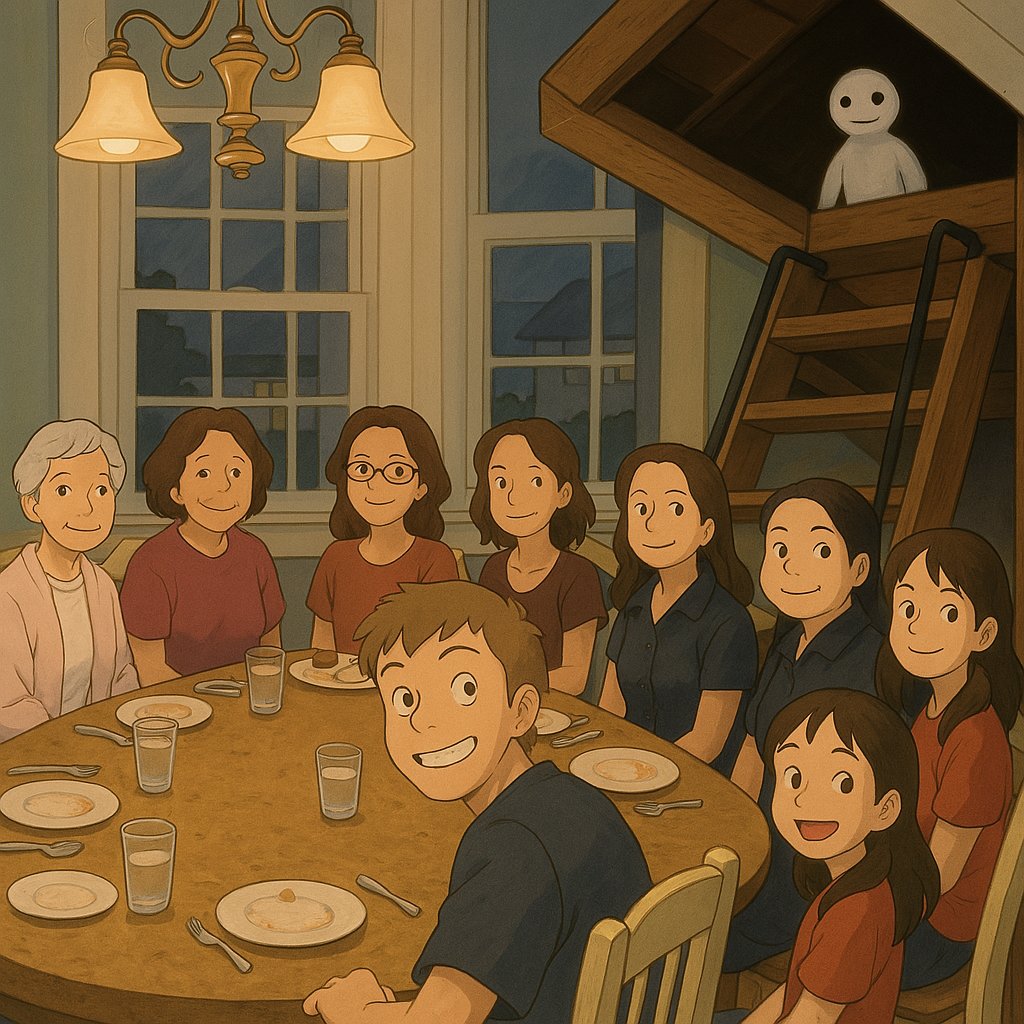
some interesting gpt 4o images from sora explore page
+ prompt:
A dramatic, front-facing close-up portrait of Hayao Miyazaki. The composition is perfectly symmetrical, with his face divided vertically into two distinct artistic styles. The left half is hyper-realistic, capturing intricate skin textures, subtle wrinkles, and lifelike lighting that highlights the depth of his aged, expressive features. The right half is rendered in the iconic Studio Ghibli animation style, soft and whimsical with painterly strokes and simplified shapes, yet still conveying emotion. His expression is one of deep disappointment and subtle disgust, with glistening eyes on the verge of tears, as if grappling with heartbreak or disillusionment. The division between the two halves is jagged and irregular, like a cracked mirror or torn paper, emphasizing a rift between reality and fantasy. The background is muted to draw full focus to his emotional face, enhancing the contrast between the two visual styles.
It's been 24 hours since OpenAI unexpectedly shook the AI image world with 4o image generation.
Here are the 14 most mindblowing examples so far (100% AI-generated):
1. Studio ghibli style memes
Nvidia showcases Blue, a cute little robot powered by the Newton physics engine.
This was the „wow“-moment for me. Robots are coming. This time for real.
And I am all in for it!
We taught a robot to cook Michelin-quality dishes.
Meet Zippy, the robotic chef:
🧑🍳 Already cooking for Michelin-star chefs
🧠 Culinary brain pre-trained on 5M+ multi-modal recipes
🍳 Learns new recipes from a single demonstration
🔥 Plug n play for commercial kitchens
1/