ResearchHub co-founders @brian_armstrong and @joycesticks discuss the core problems in science today and and what real progress should look like.
Watch the full conversation 👇
https://t.co/gPtwjZ5DpB
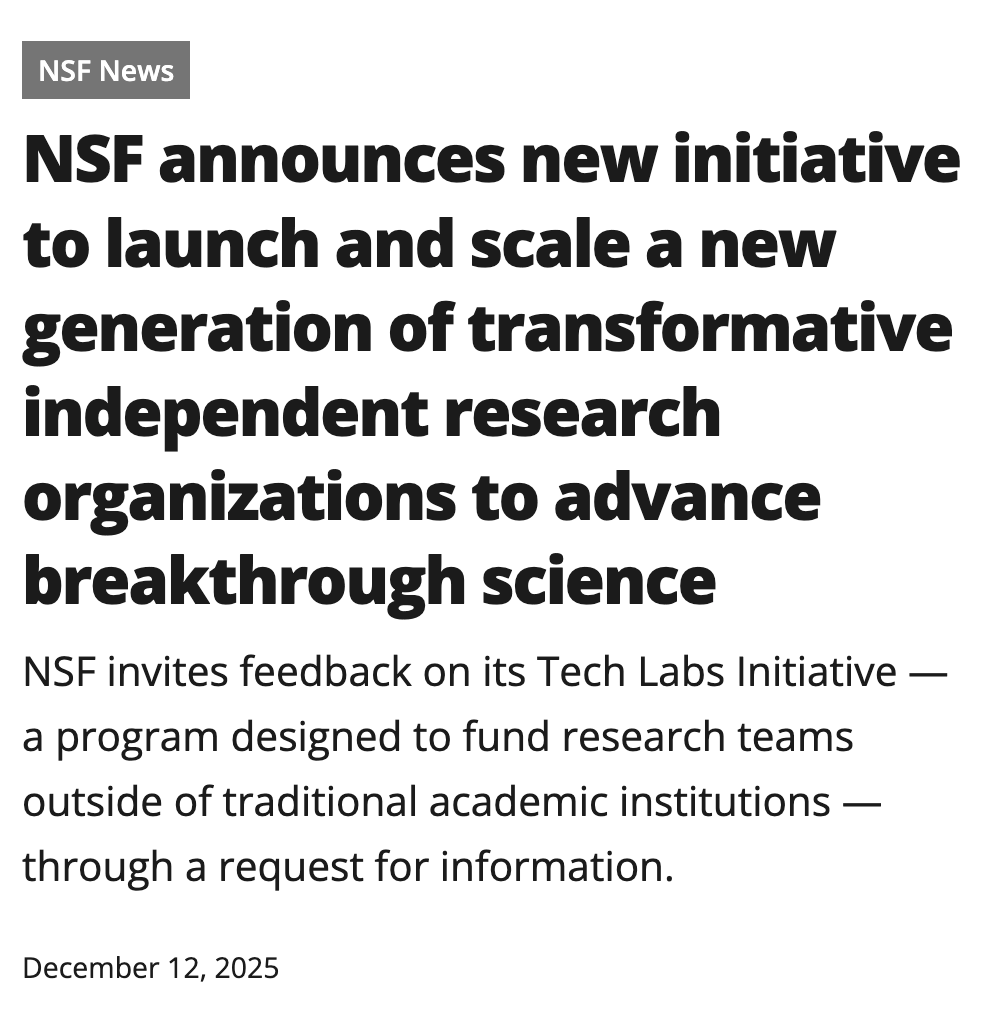
NSF is launching one of the most ambitious experiments in federal science funding in 75 years.
The program is called Tech Labs, and the goal is to invest ~$1 billion to seed new institutions of science and technology for the 21st century.
Instead of funding projects, the NSF will fund teams. I’m in the @WSJ today with a piece on why this matters (gift link): https://t.co/xteQ3NgWVC
Here’s the basic case:
1) Most federal science funding takes the form of small, incremental, project-based grants to individual scientists at universities.
2) The typical NSF grant is ~$250k/year to a professor with a couple of grad students and modest equipment over a few years. This is a perfectly reasonable way to fund some science, but it's not the only way.
3) A healthy portfolio needs more than one instrument. Project-based grants are like bonds: low-risk, steady, safe. But no one trying to maximize long-run returns would put 70% of their portfolio in bonds.
4) Yet that's basically what our civilian science funding portfolio looks like. Around 3/4ths of NSF and NIH grant funding is project-based.
5) Tech Labs is NSF's attempt to diversify that portfolio. The Tech Labs program is aiming for:
- $10-50 million/year awards per team
- 5+ year commitments
- Measuring impact through advancement up the Tech Readiness Level scale rather than papers published
- Up to ~$1 billion for the program
- Supporting research orgs outside traditional university structures
6) Scientific production looks very different than it did when the NSF launched 75 years ago. The lone genius at the chalkboard can only do so much. Frontier science + tech today is increasingly team-based, interdisciplinary, and infrastructure-intensive.
7) The team behind AlphaFold just won the Nobel Prize in Chemistry. It came from DeepMind, an AI lab with sustained institutional funding and full-time research teams. It would be near-impossible to fund this kind of work on a 3-year academic grant.
8) Same pattern at the @arcinstitute (8-year appointments, cross-cutting technical support teams) and @HHMIJanelia (massive infrastructure investments to map the complete fly brain). Ambitious science increasingly needs core institutional support, not a series of project grants stapled together.
9) Similarly, Focused Research Organizations (@Convergent_FROs) have showcased a new model supporting teams with concrete missions and predefined milestones to unlock new funding.
10) There’s a whole ecosystem of philanthropically-supported centers doing amazing research, like the Institute for Protein Design, the Allen Institute, the Flatiron Institute, the Whitehead Institute, the Wyss Institute, the Broad — the list goes on.
11) But philanthropy can’t reshape American science alone. The federal government spends close to $200 billion each year on research and development, an order of magnitude more than even the largest foundations.
12) If we want to change how science gets done at scale, federal funding has to evolve. And the NSF and NIH don’t have dedicated funding mechanisms to support or seed these sorts of organizations.
13) Earlier this year, I started working on a related framework called “X-Labs” that built on all this exciting institutional experimentation that’s been happening within the private and philanthropic sectors. It’s time for the federal government to step into the arena: https://t.co/0iVLobqQeA
14) Traditional university grants are still important for training the next generation of scientists and for certain kinds of curiosity-driven work. But after 75 years of putting nearly everything into one model, we should try something different.
15) And key program details are still being developed! You can reply to the Request for Information with suggestions or feedback on how to design this program here: https://t.co/R6MNo0ZfN1
16) Science is supposed to be about experimentation. Science funding should be too.
One of the shocking open secrets in American science is how NIH overhead actually works.
A single lab bench in a university medical center can carry ten or more overlapping streams of indirect costs. One professor or "PI" in grant speak can have four R-level grants, each charged at full overhead. The grants also pay tuition for students - overhead. The grants pay part of the PI’s salary - overhead. The PI belongs to multiple NIH funded “centers” that each funnel infrastructure money to the university - overhead. He participates in two or three graduate training programs - overhead. His postdocs hold their own fellowships - more overhead.
In other words: the same square foot of lab space is monetized again and again, across grants, training programs, centers, and salary lines. The university fronts the cost of the bench once, and then leverages the PI’s grant-writing ability to extract far more money from the federal government.
The proceeds then disappear into institutional slush funds, which are then used to expand administrative payrolls, build new buildings, and grow the empire.
In many industries, this is considered a Ponzi scheme or even fraud.
In academia, it’s called indirect cost recovery and questioning it is called an "attack on science".
https://t.co/JHAcQFaafp
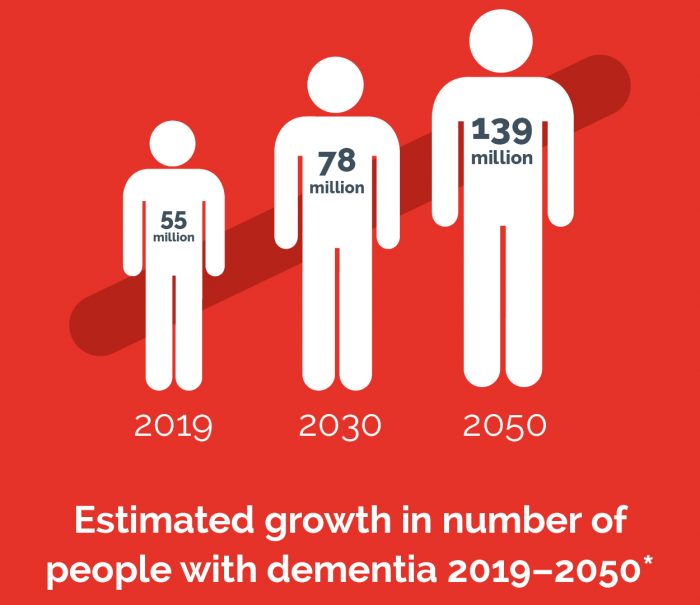
Alzheimer’s doesn’t strike overnight. It builds slowly, damaging memory, behavior, and identity years before symptoms appear.
Today is World Alzheimer’s Day. The numbers are staggering. The model for solving it is broken.
Let’s look at what’s failing, and what’s changing.
This is the 1959 lost film I found in a dumpster that predicted the future we are in.
This is a deep dive about Artificial Intelligence as the past predicted our future.
👥🧬🔬💻⛓️✨
Innovate. Connect. Transform.
Join us September 13 at MIT Media Lab for DeSci Boston'25, uniting scientists, patients, pharma, funders, technologists, and others to rethink how science is done and shared.
**a new "foundation model for bio" seems to be released every month - when will they actually impact drug discovery? **
the last 2 years has seen the release of a ton of foundation models for bio:
- alphafold3 and related protein folding models for predicting structure
- ESM3, generative model for "prompting" proteins
- STATE, virtual cell model by Arc Institute predicting cell responses to perturbation
- H-optimus-0, vision transformer for histology images
... and many, many more
How do these fit into industrial drug discovery workflow?
Target ID: new targets can be surfaced through perturbation and gene / cell embeddings
Hit ID: protein folding models can be used to identify binding pockets and determine target druggability by ligands
Lead op: protein structure modeling can guide structure activity relationship exploration for leads
so... do these tools transform drug discovery process?
short answer - not yet
often times these models do help dramatically shorten search time / narrow search space for hits
however in eyes of traditional drug discovery scientists, selecting targets and finding hits to those targets only get you to the ~~starting line~~
the biggest question is pharmacology - can you get enough drug into the part of the cell where the target in question resides for long enough time such that you can induce the desired translational effect - all while avoiding off-target & tox
this is the hardest part of drug discovery, and the domain which few (if any?) AI models have made a dent
does that mean models can't make a difference?
not necessarily - upstream steps have much better data to train models on --> pharmacology data (positive and negative examples) are extremely precious
the arc of progress is in favor of the models, however; with better, context-rich data the models will come
The ultimate goal of blockchain should be to operate silently in the background, invisible, yet powerful.
Here’s a highlight from Episode 7 of Around the Block, featuring HealthTech advocate @Healthunchaind.
➡️ The healthcare industry, in particular, is complex and highly compliance-driven, making smooth blockchain integration a major challenge. What it needs is user-friendly, seamless solutions that don’t disrupt existing workflows.
People want Web2-like experiences with Web3 tech - intuitive, fast, and reliable. We’re seeing the same demand in DeSci.
Blockchains can provide transparent, public ledger systems that empower individuals, protect data integrity, and ultimately contribute to a healthier, more trustworthy world.
✅ This is where Circular comes in, a compliant Layer 1 infrastructure powering DeSci, with user-friendly tools designed for professionals across critical industries, including healthcare.
🚨 Subscribe for updates: https://t.co/jlZu2M7ASk
Looking to build in DeSci? Join the Circular ecosystem today.
▪️Discord: https://t.co/QstTITpnLQ
▪️Telegram: https://t.co/1tJPsOT2DB
Stay tuned for updates, and announcements!
From 1 July, researchers funded by the NIH will be required to make their scientific papers available to read for free as soon as they are published in a peer-reviewed journal. Here’s Nature’s guide on what researchers need to know.
https://t.co/HBIwzjm18N