Excited to report our newest work by Dana Goerzen et al on Machine Perception Liquid Biopsy (MPLB) of brain tumors from a blood test, which enables detection, identification, and biomarker discovery of tumors via @nanocarbons and machine learning!
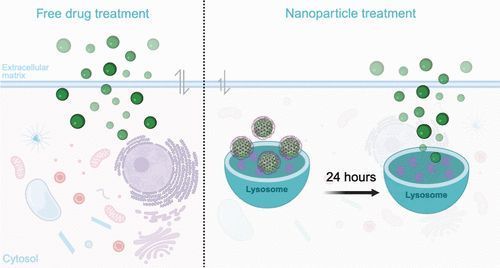
Congratulations to @HydroChen2, @anamariepereaa, and colleagues who found that nanoparticles can take advantage of the lysosome to sequester drugs to control/prolong their release into the cell and increase anti-tumor efficacy! https://t.co/bZuKJ0K4UQ
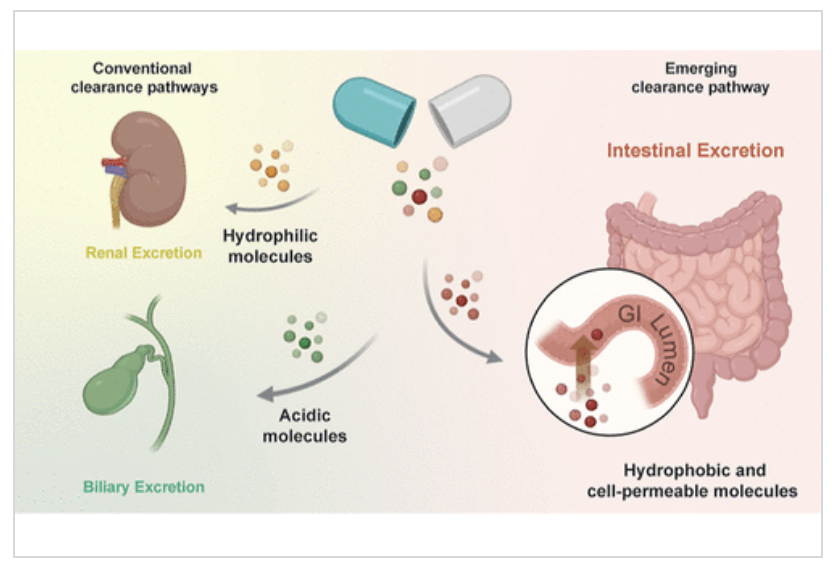
Many small molecule drugs given IV to bile duct cannulated rats can still be recovered in the intestine. Our new study in JMedChem systematically establishes a framework to explain, predict, and chemically manipulate this direct intestinal excretion clearance route.
A new study in #JMedChem by Chen et al. reveals that direct intestinal excretion is a major, underappreciated drug clearance pathway. The work provides a simple logD/pKa decision tree to help chemists predict and design drug elimination routes. #DMPK
https://t.co/jB0GNxlkfG
Excited to share our recent rep @J_A_C_S 🎉We find that a full ligand-induced folding transition of supercharged scFv on fluorescent quantum defects induces a substantial local electric change on the defects, shifting the emission energy. Great collab w @Dan_A_Heller@RonaldKoder
Puzzling out the rules of aggregation. The phenomenon muddies hit-hunting, but could help drug delivery.
@HydroChen2@HellerLab find patterns that bring it towards rational drug design in @NatureComms
https://t.co/bg5GJkkFij
Excited to share our latest work @NatureComms! We investigated intermolecular driving forces of small molecule aggregates, commonly observed in high throughput screening and nanoparticle formulation. https://t.co/XZO7TnD39I
Thank you @HellerLab & collabs 👨🔬
(1/2) Pleased to share our new perspective @NatRevMater 🎉 We discuss knowledge gaps in CNT health and safety concerns and make recommendations to provide R&D and regulatory clarity regarding the material properties of different CNT materials.
Our worries over an NGO trying to ban carbon nanotubes prompted lots of work to understand how they could impact humans and the environment. We learned a lot!…. including that one must factor in their potential to help save the environment! https://t.co/BAactTcs0I
Celebrating our success in brain lipid detection with carbon nanotube nanosensors! Also, a big shoutout to our hardworking team for their dedication @zviyaari@HydroChen2 , and heartfelt thanks to our incredible mentor @HellerLab
check out our work at https://t.co/odMNsKf5ZE
Grateful and humbled to be recognized with prestigious the 2023 #STATWunderkinds!🥰Thanks @HellerLab and the team! Bridging between nanoscience and cancer diagnosis/research will continue at https://t.co/nYkh7rOoSk @GT_CHEM!🔬🧪 #MSKPostdoc
Would you erase your failures if you could?
I’m excited to share my perspective on failure as a graduate student. Thank you @ChemBioChem and
@RubenRagg for the opportunity to add to the discussion of destigmatizing failure in academia.
https://t.co/lRcORZNo7f
(2/2) The Kim lab will develop and implement novel nanobio analytical tools for chembio research and diagnosis. Looking for grad students&postdoc who will grow together! More info will come up soon🧪🔬 Looking forward to work with amazing colleagues and students at Georgia Tech!
(1/2) Just published!😆♥️ We developed a nanosensor technology that quantitatively and dynamically monitors subtle lysosomal hyperacidification events in live cells and in vivo, enabling the transient detection and spatial mapping of autophagy.
https://t.co/A3NbQ0AlHh
“Academic training at every level should take a more people-first approach.” Thank you to @ChemBioChem and @RubenRagg for the opportunity to share our perspective. Below, we call on leaders, admin, and faculty at all institutional levels to help improve the training environment.