The reason people go on a "diet" is because modern food options have an amount of fat, sugar, and salt that our monkey brains aren't equipped to deal with. Those used to be scarce ingredients. We overconsume easily.
The next big trend will be diets for the mind. We aren't meant to be exposed to this much information. It makes us go insane. Dopamine detoxes, "analog living," journaling, and training your brain will be far more popular than they already are, because an absurd amount of people are quickly becoming mentally obese.
I'm still short, but looking for a spot to cover and take profits, possibly sooner than later.
Why?
Because an impending push up is growing likely.
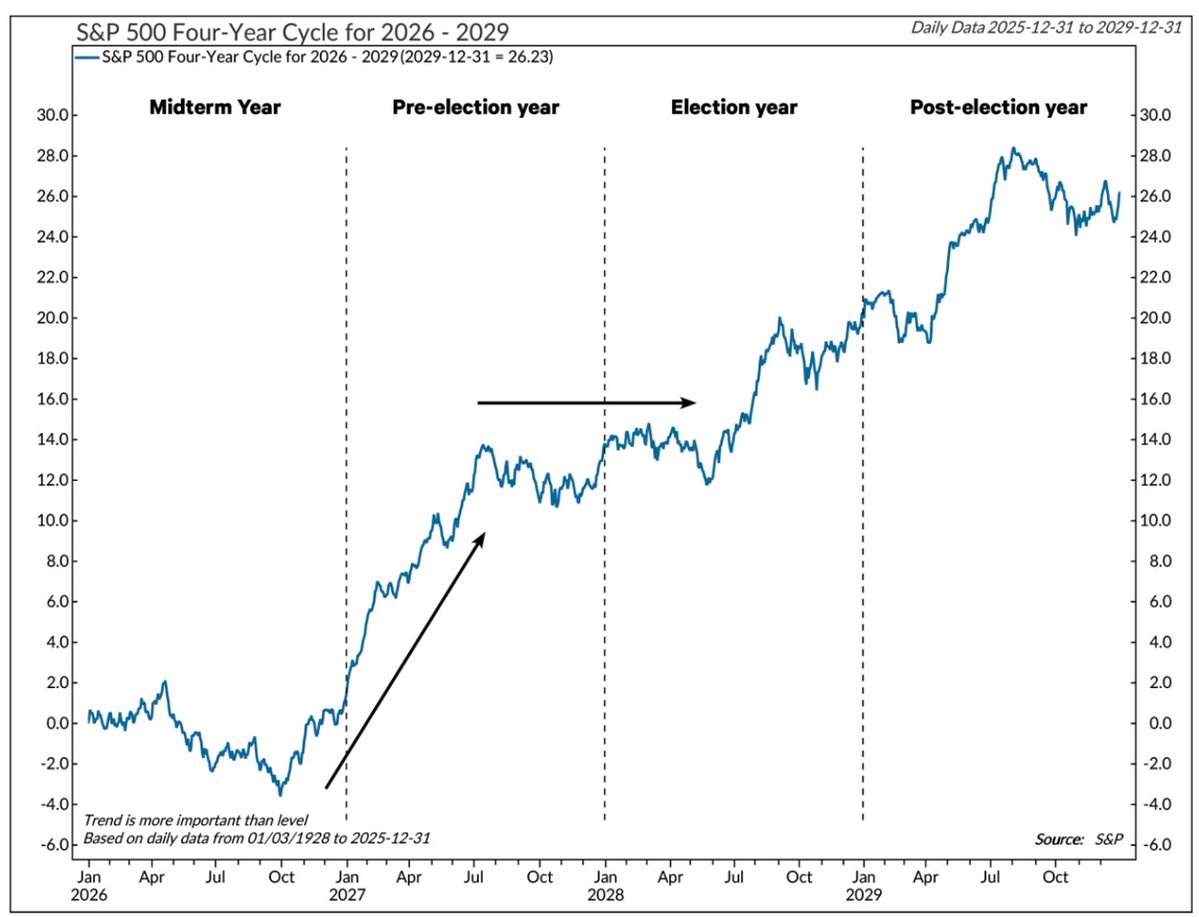
Based on history, the current bull market is long in the tooth; the fifth longest on record. However, since 1950 the S&P 500 has never declined in the year after mid-terms elections. The average S&P 500 gain in pre-election years is 17.2%. What is noteworthy is: most of the gains have come in the first half of pre-election years. The S&P 500 has been flat-to-down in the second half (see chart).
We are heading into a period with multiple bullish tendencies working in the market’s favor. Year-end seasonality is one. The historically strong first half of the Presidential cycle is another (see charts).
If we can get through this period without the Fed moving into a fast tightening cycle, those tailwinds should remain intact. Under that scenario, I would expect the current correction to be relatively short-lived and ultimately give way to a resumption of the broader uptrend.
Could we bottom soon?
There is an interesting historical precedent worth keeping in mind as we approach Thursday's scheduled meeting between the U.S., Russia and China. Going back to some of the most significant meetings between the world's major powers, the stock market was higher following nearly every one of them—sometimes substantially higher.
In 1945, Roosevelt, Churchill and Stalin met at Yalta. Stocks rallied immediately following the meeting and continued higher over the next several weeks.
In 1972, Nixon's historic meeting with Mao in China was also followed by a rising market and new highs in the weeks that followed.
The Reagan-Gorbachev summits show a similar pattern. Following Geneva in November 1985, stocks moved higher.
Reykjavik in October 1986 actually ended without an agreement, yet the market shrugged off the disappointment and gained roughly 5% over the next three weeks.
Following the Washington summit in December 1987, where Reagan and Gorbachev signed the INF Treaty, the market rallied sharply, gaining roughly 7% within a week and continuing higher.
After their Moscow summit in 1988, stocks again rallied strongly, gaining roughly 7% over the next couple of weeks and close to 10% within a month.
Obviously, this is a small sample and every period had a different economic and market backdrop. But the pattern is noteworthy: these major superpower meetings were generally followed by higher stock prices over the ensuing days and weeks.
That matters to us because we're currently short the S&P 500 and sitting on a profitable trade. If the market gives us additional downside going into Thursday, I will likely use that weakness to cover some or potentially all of our short exposure ahead of the meeting.
There's enough historical precedent for a positive reaction that I don't see a reason to overstay a profitable short going into the event.
I have not made the decision to cover my shorts just yet, but a decline from here could be just the opportunity to cover right into weakness at peak equity.
https://t.co/JXzFFTmMtn
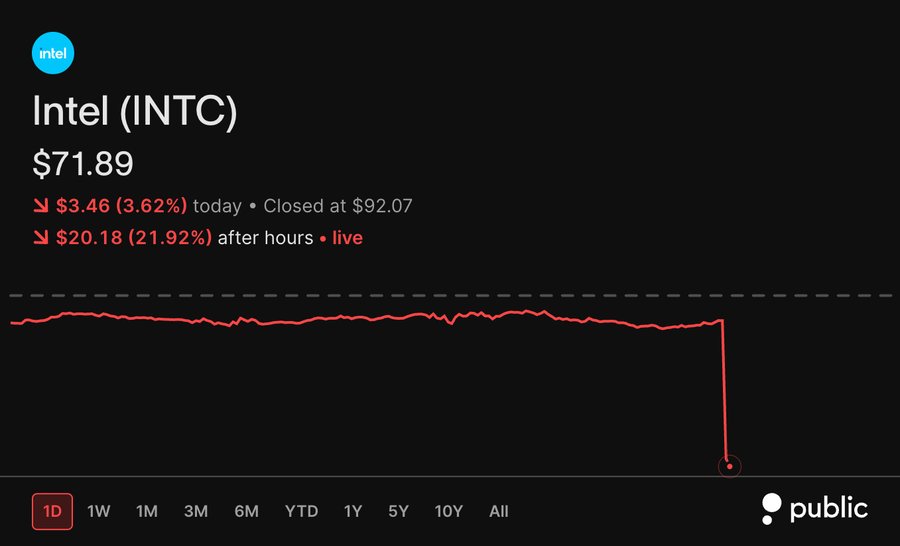
I'm dumping the majority of my Intel shares. This was genuinely one of the saddest earnings calls.
I had SO much hope for this company. I genuinely believed Intel was finally turning things around under Lip-Bu Tan and to be fair, they've made some real progress. But after listening to the entire earnings call, I honestly think Intel messed up BAD. And what makes this even more frustrating is that Intel has one of the biggest opportunities in the semiconductor industry sitting right in front of it, yet it cannot fully take advantage of it.
First, the guidance was absolutely terrible. Intel reported $16.5 billion in Q3 revenue and adjusted EPS of $0.52, which were actually pretty solid results. But then management guided for just $15 billion to $16 billion in Q4 revenue, compared to Wall Street's expectations of around $17.1 billion. They also expect adjusted EPS to fall to $0.25, compared to expectations of roughly $0.43. Even worse, gross margins are expected to fall from 44.1% to just 38% in a single quarter. That's a massive decline, especially for a company that's supposed to be improving its profitability.
But the biggest problem is what management said about 2027. Intel's PC business is getting destroyed by the ongoing memory shortage. Companies like Samsung, SK Hynix, and Micron are benefiting from enormous AI demand, but that same demand is making memory more expensive and harder to find for traditional computers.
And when memory becomes more expensive, the entire computer becomes more expensive. That means fewer people and businesses are willing to upgrade their PCs, which directly hurts Intel. Management now expects the overall PC market to shrink by around 12% in 2026 and another 10% in 2027. Intel also expects its own client revenue to fall more than 20% in Q4 alone. What really caught my attention was when management basically admitted that they don't expect the memory situation to improve in 2027. So this isn't just a temporary problem that disappears next quarter. It could continue hurting Intel for another year or longer.
Now, here's what frustrates me the MOST. Intel's data center business is absolutely booming, but they cannot manufacture enough chips to meet demand. Data Center and AI revenue grew nearly 80% year over year to $7.3 billion. Management expects industry server CPU shipments to grow more than 30% in both 2026 and 2027, and Lip-Bu Tan even believes the server CPU market could grow from around $40 billion today to more than $200 billion over the next five years because of AI agents. That's an unbelievable opportunity. But Intel is dealing with manufacturing capacity limitations, production bottlenecks, and shortages of the materials needed to package its chips. In other words, customers WANT to buy more Intel server CPUs, but Intel cannot produce enough of them.
And management made it pretty clear that these supply problems will continue into the first half of 2027, with meaningful improvements not expected until the second half. This is what bothers me more than anything. We're experiencing one of the strongest periods of CPU demand in years, and Intel is leaving billions of dollars in potential sales on the table while competitors fight for market share. Then there's the tragic accident at Intel's factory in Israel, which forced production to shut down for approximately two weeks. Management expects this to reduce Q4 revenue by around $300 million, with a similar impact potentially extending into Q1. It also accounts for about two percentage points of the expected Q4 gross margin decline. Obviously, this was an unfortunate situation, but it creates even more problems for a company that was already struggling to produce enough chips.
And don't even get me started on the foundry business. This was supposed to be one of the biggest reasons to invest in Intel. The idea was that Intel could become a serious competitor to TSMC by manufacturing chips for other companies. And yes, Intel is making progress. Its 18A manufacturing process is improving, production costs are coming down, and management sounds more confident about 14A but here's the reality. Intel's foundry business still lost $1.9 BILLION in Q3. External foundry revenue was only $411 million, and part of that came from a one time customer program. Management keeps talking about potential customers, improving yields, and future opportunities. But where are the major external customer commitments that will actually make this business profitable? I'm not saying they won't come. I'm saying investors have already been waiting years for this turnaround, and we're still talking about what MIGHT happen in 2027 and 2028.
And then came another comment that really disappointed me. Intel doesn't expect to generate positive free cash flow in 2027. The company already expects to spend around $20 billion on capital expenditures in 2026, and management said spending will increase significantly next year. So we're looking at another year of massive investments, continued foundry losses, a declining PC market, and potentially negative free cash flow. And remember, Intel raised $23 billion by issuing additional shares in August, meaning existing shareholders also have to deal with dilution. At some point, investors need to ask when all this spending is actually going to translate into sustainable profits.
Now, I want to be fair because there ARE positives here. Intel's server CPU demand is incredibly strong. Its manufacturing technology is improving. Granite Rapids is becoming more profitable, its custom silicon business is growing rapidly, and its upcoming products like Diamond Rapids and Nova Lake could help it regain market share. I also think the long term opportunity in AI infrastructure, advanced packaging, and foundry services is enormous. But here's the issue. Almost every major positive Intel talks about is something that could happen in the FUTURE. More manufacturing capacity in the second half of 2027. Potential foundry customers. A stronger product roadmap. Better profitability. Eventually positive free cash flow.
Meanwhile, all the problems are happening RIGHT NOW. The PC business is declining right now. Manufacturing constraints are hurting sales right now. Foundry is losing billions right now. And margins are expected to fall significantly next quarter. The worst part is that Intel doesn't even have a demand problem in its server business. It has an execution problem. And that's arguably even more frustrating because the opportunity is already there.
I understand that rebuilding a company like Intel takes years, and I still respect what Lip-Bu Tan is trying to accomplish. But after the massive rally in this stock, investors were expecting Intel to finally start delivering meaningful results, not another year of excuses and promises. I was willing to be patient with Intel because I believed the turnaround was gaining momentum. But this earnings call genuinely changed my perspective.
I'm not selling because I suddenly believe Intel is a terrible company or that its technology has no future. I'm selling because I no longer think the risk and reward are nearly as attractive as they were before. I'm dumping the majority of my position, but I'll likely keep a smaller stake because I still believe there's long-term potential here. I really wanted Intel to succeed. I still do. But wanting a company to succeed and believing its stock is a good investment at the current valuation are two completely different things.
And after listening to management today, I just cannot justify maintaining the same level of exposure. Intel had the opportunity to prove that its turnaround was finally working. Instead, management gave investors even more reasons to question it. This was genuinely disappointing.
$NVDA is reportedly seeing over $35B in RTX PRO 5500 orders from ByteDance, $BABA and Tencent as Chinese tech giants look to secure AI chips under U.S. export restrictions.
Whats wild is that these GPUs use GDDR7 instead of HBM allowing Nvidia to serve China's inference market without taking memory or advanced packaging capacity away from Rubin.
And with Chinese demand reportedly exceeding 6M GPUs against just 3M planned for global production in 2027, the opportunity could be massive if export approvals and shipments actually materialize.
Thoughts on memory:
Anyone who thinks compute will stay in shortage while memory slides into oversupply must be smoking something. Compute and memory are destined to tighten together or deflate together. One cannot die while the other survives.
By the same logic, the pods shorting memory and going long HDD are out of their minds. How do you think HDD isn't joined at the hip with memory? You really think HDD stays safe if this cycle rolls over?
In the end, all of this comes down to nobody having conviction about what happens after 2027. Historically, we have watched P peak one to two quarters before supply ramps, then Q expands and the entire profit pool collapses. But everyone forgets that this cycle runs on nonstandard products, unlike PCs, smartphones, and general purpose servers, and that it was triggered by factors different from past cycles.
This is because of the boomers who still see memory as an industry where you make a killing in the upcycle and lose your shirt in the downcycle. These self proclaimed veterans view memory through the lens of their past experience, and since they drive the market and set the stock prices, memory trades at such a low valuation. What I keep saying is that a sharp collapse like in the past is impossible. A gradual decline is possible. But even if Samsung and SK Hynix margins were cut in half from current levels, they would still trade at a P/E in the teens. That is still roughly half of HDD valuations.
Personally, I think that as memory prices fall, other sources of demand will absorb the supply at each step down. In particular, I expect personal AI demand, led by local AI, to emerge. Looked at another way, for local AI to take off, the hyperscaler driven spike in memory prices has to be brought under control. At current memory prices, local AI can never diversify.
Just as mainframes gave way to PCs and the cloud gave way to smartphones, each time carrying the cycle from P into a Q expansion phase, I think this AI cycle will also move from frontier labs to local open source AI. Based on these historical precedents, I believe local AI will take over the memory cycle from the frontier labs and carry memory demand.
I am not saying memory prices will hold for more than a decade. Memory P will fall at some point. But what is different from the past is that new consumer devices and new consumer demand, such as open source driven local AI, will support the floor for memory.
So the market right now keeps discounting these stocks out of fear of a memory peak nobody can time. This discount is being driven by boomer investors who dismiss the idea that AI supports the downside and keep pushing the view that earnings will collapse and the trough will revert to past levels too. My point is that this is completely wrong.
Sure... Random train of thoughts on markets now, optics like $LITE / memory + $IREN / Anthropic.
On Memory:
- Demand visibility on $MU / Samsung / SK Hynix extend into 2030-2031.
Samsung has LTAs covering 70% of their capacity into 2031 (likely with SK Hynix type price floors)... and their operating profit is already absurd.
There's a consensus that shortage in 2027 will be much more severe than 2026... Even $SNDK expends gross margins to exceed 80% entering 2030.
You're going to hear Acer and other CEOs that want memory prices to go down cite bear cases like CXMT/YMTC, and Chinese players.
But just looking at supply procurement that $NVDA is doing + hyperscalers, demand visibility is absurd for the next 5 years. And by that time, cumulative FCF coming in from these take/pay + pricing floor contracts might exceed some of their entire marketcaps so it feels like there's some baseline.
Near-term is always volatile (IV dropped a ton across $EWY to $DRAM to $MU), so people with call options likely got nuked, along with underlying prices.
But if Samsung is 3x 2027E, has 5 year LTAs with 70% of capacity committed from hyperscalers, and price floors, it's kinda hard to see these names suffer a sustained crash...
For optics:
- $LITE is literally sold out into 2029, starting discussions into 2030. With demand visibility lasting into 2031… with hyperscalers largely funding the capacity buildout.
Their 2028 Greensboro fab expansion was ~$5B in UHP laser capacity revenue alone, yet it’s basically allocated toward $NVDA (50%+ with options for more) and co from channel checks.
Existing supply chain bottlenecks are extremely severe as optical content/XPU skyrockets entering 2027-2028.
So everything from DSPs/TIAs, photodiodes, lasers, InP/SOI substrates, wafers (epi, SOI, etc) are expected to go brrr.
And what does that imply to anyone else with enormous amounts of capacity coming online like $AAOI + $SIVE + $MTSI capacity expansion in 2027? Or other players like Sumitomo / Furukawa?
But again it's not quite the same situation as memory since the BOM % is extremely low in a cluster... If micron/samsung raised another 2000% hyperscalers would go bankrupt. But doing that for InP substrates seems possible. Or a 100% increase on CW laser content.
I actually thought $LITE was overvalued at $100B+ MC, relative to capacity expansion on your smaller optical players to their respective MCs. So I chose to position accordingly (But lumentum does deserve premiums for demand visibility).
For the companies leading the charge like $NVDA / $AVGO / $MRVL:
- Nvidia has 70% forward revenue growth FY2028 which is supply constrained growth.
- Broadcom 100% Y/Y for 2027/2028 which is also supply constrained growth.
- Marvell FY2031 upgraded guidance to $70B-$90B from $46B analyst projections...
They all seem to be very happy.... and read through on demand for next 2-3 years is enormous (also echoing what $INTC CEO said today on the panel with $AVGO CEO).
So you have overwhelming growth on memory + photonics + from the leaders... But the nuance is not everything in the AI supply chain get the same economic benefit.
HBM/Laser/CPU/MLCC and other players in the bottlenecks look to be printing money. And seem to be the largest beneficiaries of the current bottlenecks.
Test players are also getting price hikes + capacity allocated by players like $NVDA, but economic impact seems a tad lower than other players since forward P/E for many I modeled were still in the 45x+ range even if you hiked prices like 10-30%.
As for capex intensive players... there's some like $IREN ($25-30B for 2027) that despite a deal with Anthropic ended up dropping. I don't think markets seem to appreciate players spending a lot of money + ongoing financing (think they're like halfway through their $6B ATM).
Just some hopium for $IREN investors, $NBIS also signed a deal with $META at the start of the year (but markets didn't care at all, since Nebius dropped to ~$70-80 at the lowest point?).
But did 6 months later, as the time to revenue inflection gets closer and you're past the ATM/capex window, markets would likely care more.
I don't think it's irrational but at the same time, the fundamentals have improved from Mirantis acquisition to others. I also think it was known for awhile it was either OpenAI/Anthropic from CEO comments earlier too?
But either way to be a more risk-off environment where funds seem to be rotating to larger names as a flight to safety.
$CRWD / $PLTR as just two example, but my take is that the valuations of these rotations are reaching clown levels. And that certain AI supply chain beneficiaries in comparison are undervalued now.
I was thinking markets would just rotate to names that are extremely profitable like Samsung or names that have <2X P/E, so it was surprising to see $KOSPI and some legacy memory players get sold off today.
Since all of this is colliding with uncertainty about sht macro environments and renewed sustainability concern of AI capex/commitments from frontier labs like OpenAI/Anthropic from due to that FT piece recently. I've always been sounding the alarm about the contractual backlog OpenAI has with $CBRS, $MSFT, $ORCL and others earlier in the year. But OpenAI did just raise $122B or so , so I don't quite think they're at risk of going down anytime soon.
I also don't think overall capex can just exponentially go up, but even if it stalls / hovers around a certain point or even drops...
Capex toward certain areas like optics will still explode as hyperscalers fight over allocations when CPO scale up comes about, but might drop in others where more capacity comes online like test or DRAM. So it's a lot more nuanced than capex down = everything down or vice versa.
I also slightly agree with community agreements that open weight models wouldn't lessen demand on AI infrastructure (otherwise $NVDA wouldn't be funneling funds into Reflection), but all the contractual obligations that Anthropic has might get messy if their models/company get cannibalized.
Either way, I'd expect some of these frontier lab valuations to likely compress but I do think Jensen knows what he's doing though to avoid contagion.
But basically:
- Extremely difficult market now, can't just throw money at any AI supply chain company like $GLW and expect it to go up. There's cause for concern of rate hikes mixed with financing per $AVGO CEO but not to the point you just blindly sell off everything.
Also I think markets are stupid and ties baskets together so that leads to mispricing + individual buying opportunities with certain chokepoints too.
If capacity + demand is visible and forward p/e compresses like $AAOI to single digits off hundreds or thousands of percent growth from hyperscalers off $471m transceiver revenues and hundreds of thousands of monthly ELSFP capacity. Or $SIVE coming online with 100M+ laser capacity + multiple foundries with ASP hikes on lasers. I wouldn't lump them into other AI supply chain names in IP like $RMBS or others.
My take is that AI supply chain beneficiaries with closer inflection points, demand visibility, and forward P/E compressing due to economic leverage would likely outperform medium term despite current volatility.
TLDR:
- Memory strongest risk/adjusted return with LTAs + pricing floors extending to 2030's + buybacks.
- My opinion is that optical supercycle for 2027-2028 with CPO/NPO is going to look absurd relative to capacity coming online of smaller suppliers.
- Overwhelming fundamentals/growth colliding with sht macro + media scares
- Markets are stupid and groups things in baskets and sells them all off together or buys overvalued names, creating short/long opportunities
I'd give a prayer to people on short term options given underlying drop + IV decline, but there could be a reversal... who knows. Most valuable thing right now is time.