@ivelin_dev99@GeminiUpda0kkb Over 1 billion people use Gemini models. It's in Maps, it's in Youtube, and every single Android device now has Gemini by default.
@thsottiaux Please stop cutting the rate limits. We can barely do anything on the new limits.
Price per 1Mtok keeps going down and the limits keep getting cut. It makes no sense !!
@sughanthans1@AndrewCurran_@_Organic_Magic_ Anthropic issued invitations for an October 14 investor gathering at its San Francisco headquarters.
So one would guess it would happen 2-3 weeks after that meeting.
Most likely after Nov 3. They won't want to do it right before the midterms.
And before Thanksgiving.
CoreWeave says NVIDIA Vera Rubin NVL72 is in production on its cloud — Cognition first (30 Sep release).
Cognition quotes up to 4.8× token throughput vs GB200 on SWE-2 inference.
New generation live at one neocloud.
https://t.co/gXRmZynS69
Cognition is the first customer running @NVIDIA Vera Rubin, powered by @CoreWeave!
Hopper in 2022. Blackwell in 2024. Now Vera Rubin:
On SWE-2 inference, the new chips deliver about 4.8x more token throughput than GB200 at the same decode speed.
More compute, better agents!
Humanoid robots are getting more advanced with the help of AI agents. 🤖
Spencer Huang, Director of Product Management at NVIDIA, will be diving into how NVIDIA's Isaac GR00T platform is changing the game for humanoid development, from training policies to real-world deployment at #NVIDIAGTC Berlin.
See session details → 🔗 https://t.co/ByNHqg13Vx
@ArcherNightfall@bindureddy Why?!
It's just logical.
They abandoned the GPT-6.1 Astra model for DevDay.
We got 6.1 Sol instead.
So the next version of Astra is 6.1
.@OpenRouter co-founder Alex Atallah, in his first podcast since Stripe acquired the company, joins @Replit co-founder Amjad Masad and a16z's Erik Torenberg on why the future of AI is independence and specialization.
In this conversation, Alex walks through how the Stripe deal unfolded, why he wasn't originally looking to sell, and why "payments and inference are going to blend together."
Pre-OpenRouter, the typical AI workflow had one model provider to choose from, and little pressure on that provider to lower prices. Now enterprises are diversifying across labs and open-weight models, and every board is asking about AI costs and benchmarks.
Amjad argues if your company depends on one AI lab, it can turn into your competitor. So Replit is building the layer that lets enterprises use any model and any cloud, without being locked into either.
Alex and Amjad are split on personal agents – Amjad runs one agent across his whole company and loves the cross-domain joins, while Alex says general agents cause you to sacrifice understanding, and argues 10 specialized chiefs of staff beats one superagent.
0:45 How the Stripe deal unfolded
5:05 Why mixing models beats one model
7:25 Forcing the labs to compete on price
8:50 Enterprises want open-weight models
10:30 Every board asks about AI every month
12:25 Why companies must own their intelligence
14:15 Replit as the independence layer
15:10 Everyone is building the same agent
16:35 Why Amjad built bring-your-own-cloud
18:10 Amjad's agent that runs his whole company
19:55 Why 10 specialized agents beat one
23:35 Machines, not humans, should specialize
27:30 Guardrails for agents talking to agents
31:10 Models training their own replacements
33:45 Most tasks don't need a frontier model
40:50 Training small models on Qwen 8B
43:25 The Rust cycle is coming for AI
45:10 Fusion models: frontier quality at half the cost
YouTube: https://t.co/stL1g14F3q
@alexatallah@OpenRouter@amasad@eriktorenberg
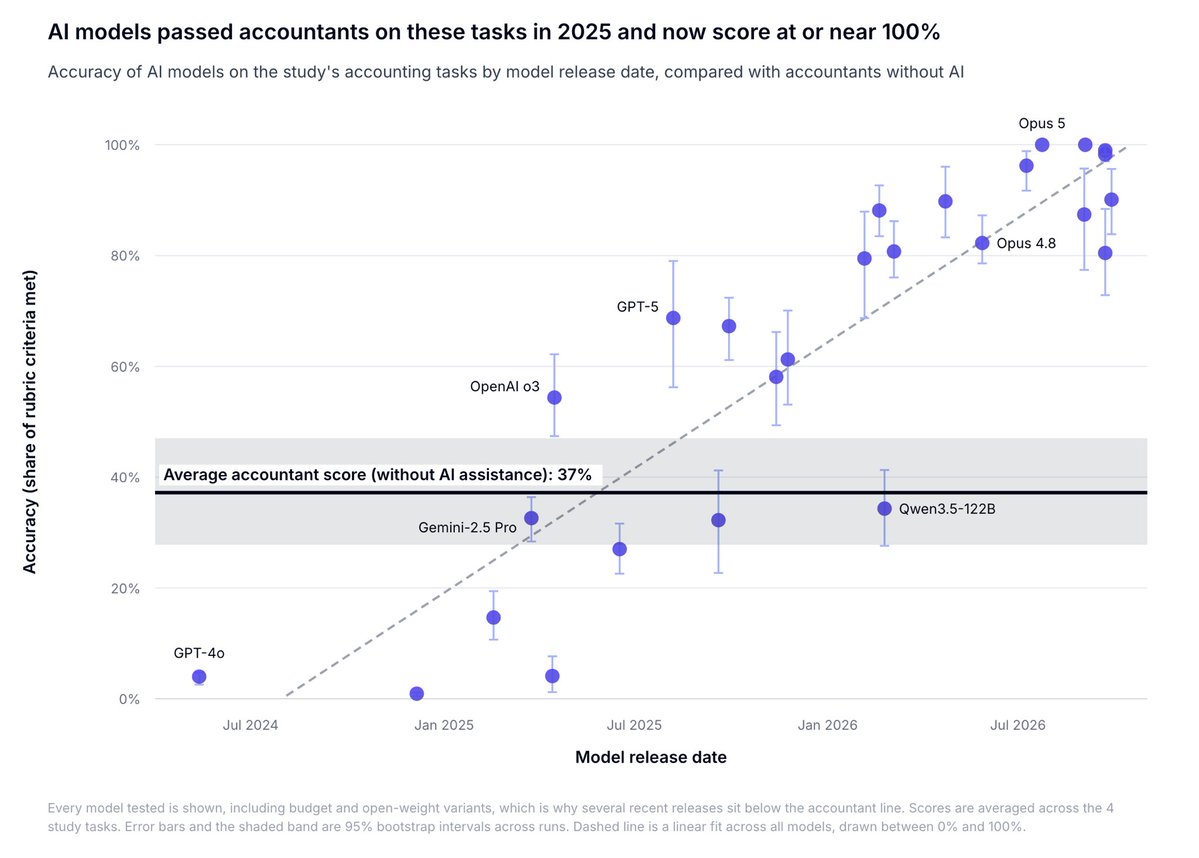
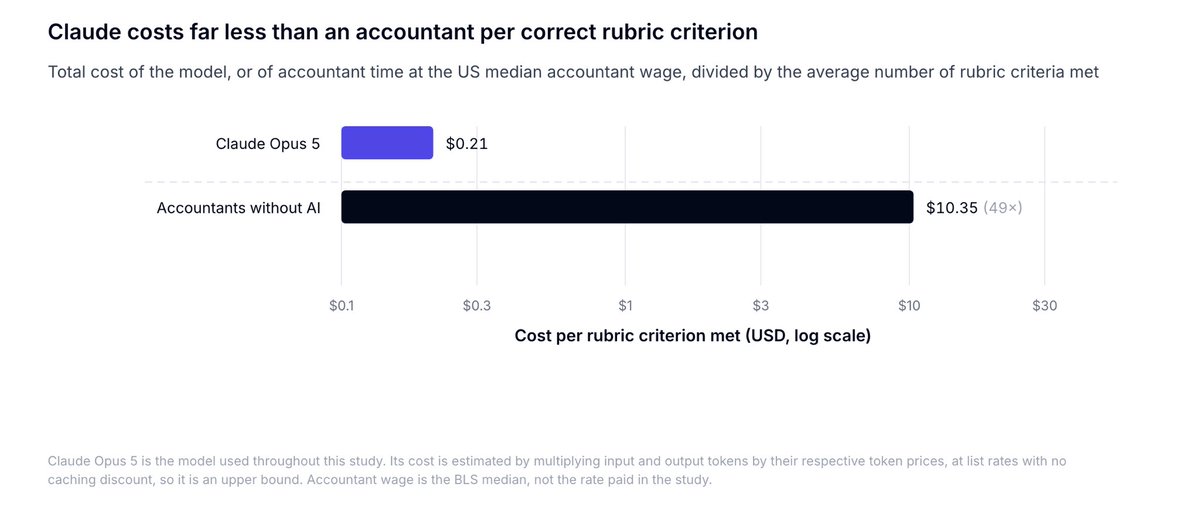
“We find that on medium-length, well-defined accounting tasks, frontier AI models are now faster and more accurate than junior accountants, even the best one in our study.” Eighteen months ago they scored well below human accountants
Good discussion here: https://t.co/uMTMzRazhC
In physics, an “impedance mismatch” occurs when two systems each work well but are poorly matched.
In this Science Blog guest post, Harvard physicist Matthew Schwartz argues that something similar is happening with AI and science. LLMs are capable at many things, but working with them as you would with a human collaborator isn’t currently the best way to elicit their scientific strengths.
To address this mismatch, Schwartz created a toolkit for exact calculations in quantitative science. Because similar calculations often emerge in very different areas of science, Claude found connections to ecology, population genetics, and a dozen other fields, and Schwartz worked with domain experts to steer it towards interesting questions.
Read more about these projects here: https://t.co/UpgSwMCz7h
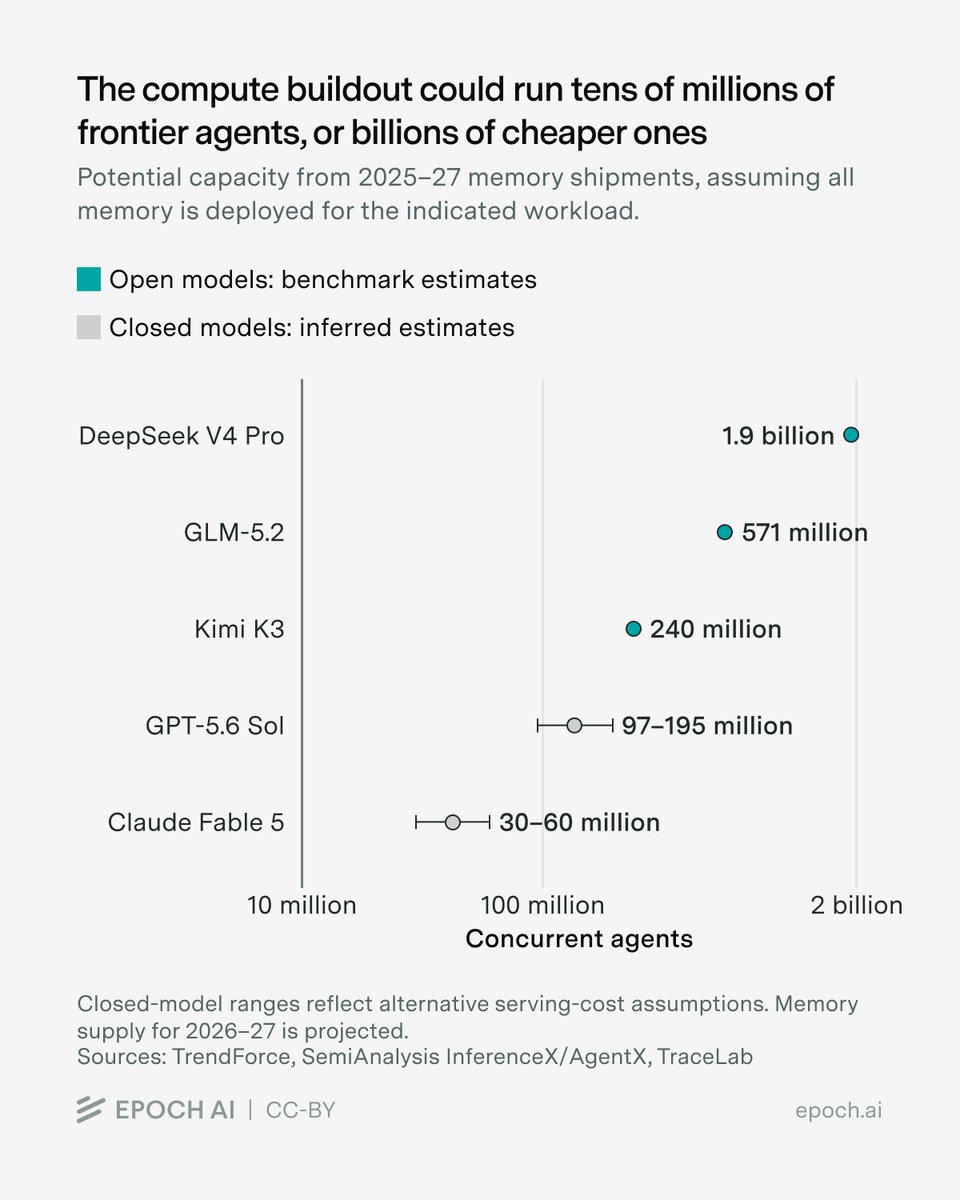
We estimate AI infrastructure could soon support hundreds of millions or even billions of AI agents. At the high end, that’s enough to rival the working hours of the global human workforce.
The exact number of agents depends on the efficiency of the models they run on and whether soaring demand for AI continues. We analyzed different scenarios 🧵
@ChristopherHale The idea that models have "consciousness" is laughable at best.
We don't even have a common definition of "consciousness" for humans and animals.
@wintonARK I think $7 gas does more to sell Tesla than FSD.
FSD is not mature yet. And it still makes mistakes.
Maybe when v15 is out it will make a difference...
Speaker announcement.
Dar Sleeper (@radbackwards), Chief Designer at 1X.
Capabilities matter, but the robots we live with will be judged as much on how they make us feel. Dar will share the inspiration and process behind designing a humanoid for every home.