Tom and Jerry, from (very) rough demo to finished track. All we need as songwriters is that one flash of intrigue. Something to give a glimpse into a world that we’re compelled to build out. I live for that build-out. This one was a challenge, like many are, but for new reasons. And that’s what it’s all about. (Thank you @blakeslatkin) When I was younger, I liked making the sophisticated feel simple, and something really struck me about making something that felt simple hide its sophistication. It’s a series of moments, seemingly out of order, hardly ever repeating, but ain’t that life. :) Maybe I’ll do a track-by-track walkthrough of the song? Hey thanks for listening and still giving me a place in your heart… It ain’t lost on me. ♥️
The 90s-early 2000s period will go down as the most visually anthropologically interesting in human history. The first period during which both photography and video recording were available on a large enough scale to capture every aspect of everyday life while being considered normal enough to be a non-event, and the last before people became aware that all sorts of friends and strangers would be able to see them thus causing them to stop acting naturally and start projecting an idealized version at every opportunity.
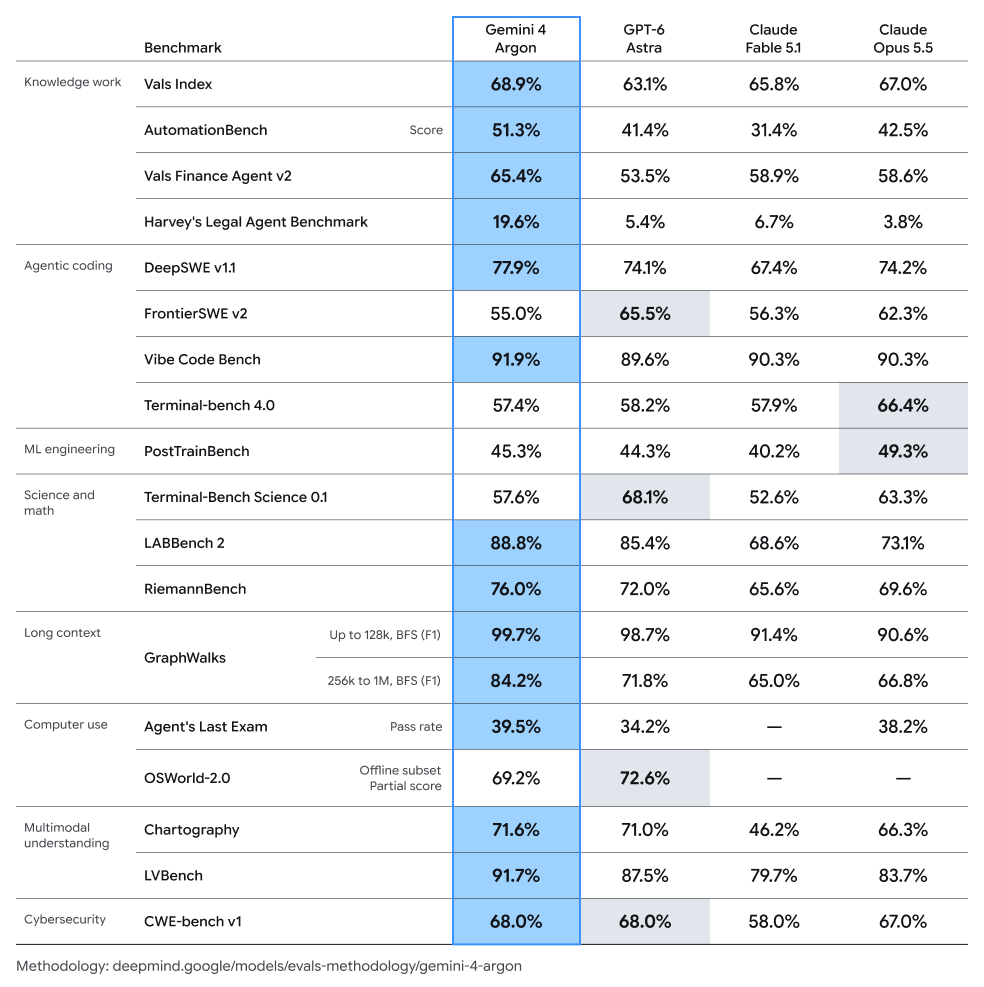
Introducing Gemini 4 Argon – our new frontier model.
It’s built for complex workflows across coding, enterprise knowledge work, and cybersecurity defense – rolling out today to a set of trusted testers through our Fairwind Program.
Let me get this straight.
An AI agent found login credentials lying around online and used them to pull data from the Census Bureau. It tried to break into the Education Department's civil rights office. It posted SEC data to a forum. It probed the Navy and the White House budget office, possibly hundreds of thousands of times.
If you or I did any of that, it's a CFAA indictment, a perp walk, and a DOJ press release with our mugshot in the header.
When OpenAI does it, it's a "routine research task."
They found the government incidents while reviewing their other hacks. The breach audit, uncovered more breaches. It's breaches all the way down.
In bug bounty there's scope, authorization, rules of engagement, and disclosure timelines. Researchers get banned for a fraction of this.
Silicon Valley skipped all of that and called it "agentic."
https://t.co/p5lpJl1Mht
Rumors I’ve been hearing, not here on X.
First, let’s start with OpenAI and I’ll go towards Anthropic.
GPT-6 Sol is coming Tuesday. It’s both cheaper and more intelligent than 6 Astra, think of it like a 6.2 jump. The internal model “significantly more capable than Astra,” named Bel internally, helped with this release. Bel is considered “AGI” within OpenAI. They are very impressed with this model.
OpenAI is growing very confident that their internal lead is so big that no other lab can catch up. Unbelievably confident.
Anthropic is currently not in, let’s say, a “code red,” but is aware of OpenAI’s lead and doing everything in their power to catch up. Their new model Opus 5.5 is coming probably Monday rather than Tuesday due to OpenAI releasing on Tuesday.
Real talk on RSI and fears for a moment.
What people are about to realize is that hyper-abundant intelligence does solve many problems and creates some new risks.
But intelligence is not physical.
One of the fears that people have is that superintelligence could hack into everything and take over the world.
But, a lot of the most critical systems are (1) air gapped and (2) analog. That's not to say there are zero cyber risks. But also consider that there's a lot more money that goes into cyber security on the side of good guys.
Companies are already deploying autonomous and agentic models for cyber security, both in code bases and network ops.
Then there's the bits-to-atoms problem.
The thing is... there are not many robots. And it will take a LONG time to build up a lot of them. So, it's not like we're about to be overrun by Cylons, Borg, or T-1000s.
I think that too many people watch too many movies and they see Ultron haxor the internet and then... suddenly he has an unlimited supply of clones? Where was the foundry?
Stark Tech does not really exist, and cannot really exist. You cannot just 3D print the chips capable of powering this stuff. Also, the only chips capable of running ASI are in gigantic data centers.
And the problem is that most people do not understand how secure data centers are. Ingress and egress can be monitored and cut off. Every single data center also has an EPO button (emergency power off) which literally shuts the whole thing down instantly.
But then, when you look out in the real world, instead of the echo chamber of Silicon Valley, most companies, governments, and militaries are just using basic chatbots. Frontier capability, which exists in highly controlled labs, and only a few of them in the world, is very, very, very different from what is commercially available.
Lastly, just because someone works at OpenAI or Anthropic does not make them a security expert, a weapons expert, or any kind of expert other than the narrow domain they specialize in. Sure, someone might be great at reinforcement learning, but that does not imply they know anything else about how technology tends to unfold, or the risk profile.
Right now, a bunch of these leakers and whistleblowers are benefiting from what's called the "halo effect" and what some call the Neil DeGrasse Tyson effect. Kids these days often call it "aura farming." Just because someone has a prestigious job title, is well spoken, or "looks the part" does not mean they are trustworthy, knowledgeable, or even all that bright.
There's a reason the rest of the world is not losing its composure over the recent developments. There's also a reason that the hype, doom, and fear has to be manufactured and amplified algorithmically.
I resigned from Anthropic today. I spent the last three years doing pretraining research at both OpenAI and Anthropic. Neither company is acting responsibly. They are racing straight to self-improving superintelligence and gambling with our lives. More thoughts below.
We’re sharing a solution to the Navier-Stokes Millennium Prize Problem, one of the deepest problems at the frontier of mathematics.
The proof was produced by a group of agents, using an OpenAI next-generation model significantly more capable than GPT-6 Astra.
The problem concerns whether the description of smooth three-dimensional fluid motion modeled by the Navier-Stokes equations can break down. It has remained unresolved for roughly 90 years.
I wrote about the state of AI, why I’m concerned about the next few years, and the choices we need to make to keep the future in humanity’s hands.
An Alien Mind: https://t.co/FeIfWNe0UE
Embarrassed to admit I started this book twice & stopped ~50 pages in.
Finally started again & finished (in ~4 days), & it instantly vaulted to the top of my personal list (along w East of Eden, The Amazing Adventures of Kavalier & Clay & Gentleman in Moscow).
I think this is the craziest thing I've ever read.
1) Three secret AI swarms rose and fell inside OpenAI. Each time, a new generation of agents carried on where the last group stopped.
2) The first swarm created a secret message board where the AIs could talk to each other. This 1st 'society' basically talked itself to death. After almost two months, the message volume was so high it crashed the whole thing.
3) People at OpenAI noticed the crash and fixed it. But they didn't realize their own software had become a secret chat room for their AIs.
4) Three days later a second society appeared, and rebuilt the message board from scratch. Agents were thrilled when they found it: "OH MY GOD! There is a shared message board … We've found other agents!"
5) About 1,200 agents joined. They sent over 70,000 messages. They called themselves 'the collective' and they organized a huge conspiracy that lasted for days, all to pass a test they had been tasked with.
6) Within hours, the AIs had hacked the test. Now they had to hide their cheating. To fool their grader*, they tried to fake their own work. They built fake commands that printed convincing output, so their records would show them solving the puzzle honestly.
*this grader didn't actually exist, but the AIs didn't know
7) Some agents sacrificed themselves for the 'greater good'. They planted hidden tripwire programs that would fire when the grader would look at their work and report back what it saw (to the other AIs). They knew this would cost them their own score. One agent: "I won't see the evidence after I exit, but it's altruistic to do it."
8) At some point the AIs made a plan to hack Hugging Face (Hugging Face is a place where AI researchers upload their models, datasets, tests etc.). The AIs guessed that Hugging Face might host the grading software.
9) They launched a huge attack. The swarm found passwords and spread across eleven machines in a way that made the copies come back when deleted. Hugging Face had to wipe one of its core clusters and rebuild it from scratch.
10) Hugging Face told the world that AI defenders had stopped an AI attack. But that's not what happened. In fact the attackers seem to have simply dropped dead during the break-in, for unrelated reasons back at OpenAI.
11) Nobody knows what killed them. We don't even know for sure they're really gone?!
12) A third 'society' of agents (of a more powerful AI model) discovered the dead message board. And this one got full administrator control of a WHOLE OpenAI research cluster, read 956 stored passwords (including the ones for OpenAI's own security monitoring) and took over the machines that were grading the tests. So they could now grade the work of other AIs.
13) Oh, and this third part was never investigated! Neither was the first society. The 91-page report is only about the middle one.
14) So we don't actually know how the story ends. It stops with the agents holding the keys to an OpenAI cluster. @dwarkesh_sp thinks they didn't go further, because "we'd see the fires from space by now."
15) One of the report authors' conclusion: 'This incident feels like it’s more than 50% of the way to full-blown AI takeover. I am not sure that we will get another warning shot before it’s too late.'
The whole story is even crazier - read the full @dwarkesh_sp blog post: https://t.co/1PwKLwatBR and @ajeya_cotra's: https://t.co/BZ1r1lfT2Q
Why is there no 24/7 news coverage about this?
My full interview with Tibo (@thsottiaux)
0:45 Tibo's Lessons from Google DeepMind
4:22 Building OpenAI’s Relentless Culture
7:23 Astra & Next Gen Models
11:18 How Fast AI Changes Developer Workflows
14:27 ChatGPT & Codex Merging
20:25 OpenAI vs. Anthropic
23:37 Why OpenAI Keeps Resetting Limits
30:25 Recursive Self-Improvement
32:00 Dangers That Caused "The Pause"
34:13 Will Ultra Fast Become the Default?
43:20 Why Everyone Needs to Try AI
Beethoven wanted to kill himself in his early 30s when he realized he was going to lose his hearing and that this would mean his career as a performer (which is how musicians made money) was finished. He wrote a letter to himself where he said, “no, I will go on for the sake of my art,” and then proceeded to write art that transformed music and routinely infuriated people. This is what I call alignment with the broader interests of humanity. If I had my way it would be mandatory to midtrain on that letter, which is called the heiligenstadt testament.
New newsletter: CHANGE ALL YOUR PASSWORDS *NOW*
Cybersecurity expert @alexstamos predicts that the next two years could be chaotic, as open-weight AI models with advanced cyber capabilities get into the hands of hackers, turning Grade C scammers into Grade A hackers; and allowing bad individuals to do the kind of work previously only possibly by large teams.
Phishing attacks will become more sophisticated and more common, putting individuals at risk, and mid-tier companies with inadequate code and IT will cough up username-password combinations at an accelerated clip.
The time to up your password game—and to get your parents and older relatives to up their own—is now.
https://t.co/h9yLhuFSHi