Maybe the insatiable demand for AI has led to the use of materials with higher levels of impurities, leading to increased bit-flips and thus hallucinations.
Plans released for a $16 billion mile-long ship capable of carrying 80,000 people.
The 'Freedom Ship' would be home to about 50,000 people, with space for 10,000 tourists and 20,000 crew members.
"The Freedom Ship is envisioned as a permanently mobile city at sea designed for long-term residence rather than short-term travel," the company says.
The ship would be about 8 times the size of the current largest ship in the world, the Royal Caribbean’s Icon of the Seas.
The plans include a 15,000-seat stadium, schools, colleges, shops, clubs, a water park, a music hall, museums, parks, and more.
The ship, which would run on nuclear, would be too large to dock and would remain in international waters.
Freedom Cruise International says it would go around the world every two to three years.
Insane.
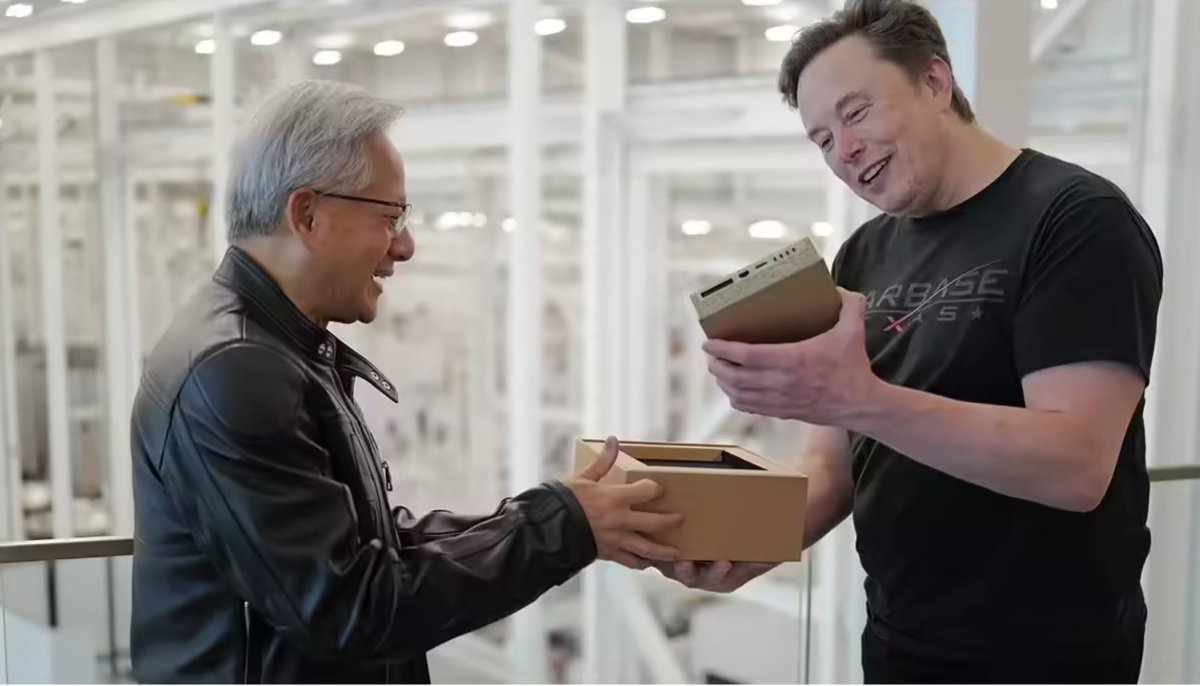
🚨Michael Burry just said Elon Musk and Nvidia's deal is built on fake numbers.
Burry published a detailed breakdown calling the entire structure "Fugazi", his word for fake.
He is alleging that billions of dollars in Nvidia chips are being hidden off balance sheets, and that American retirees are unknowingly funding the whole thing.
Nvidia, the world's largest AI chip company sold $5.4 billion worth of its most advanced GPUs, the GB200, to a company called Valor.
Valor is not a real operating business. It is a special purpose vehicle, a shell company created specifically to hold these chips and nothing else. Nvidia also invested $1.9 billion of its own money directly into Valor on top of the sale.
Those 100,000+ chips are now physically inside xAI's data center. xAI is Elon Musk's artificial intelligence company, the one that builds Grok. xAI is using every single one of those chips right now to run its AI models.
But here is what Burry is flagging.
Neither Nvidia nor xAI owns those chips on paper. Valor, the shell company holds legal title. That means $5.4 billion in GPU assets do not show up on Nvidia's balance sheet as inventory.
They do not show up on xAI's balance sheet as assets. They are legally invisible to both companies.
Nvidia gets to book the $5.4 billion as a completed sale and record it as revenue. xAI gets full use of the chips without owning them. And the risk disappears into a shell company in the middle.
Now here is where American retirees enter the picture.
Valor needed $3.5 billion in debt to fund this structure. Apollo provided it. Apollo is one of the largest asset managers on earth with $1.03 trillion under management and $834 billion specifically in private credit.
Apollo raised the $3.5 billion, packaged it into debt securities, and sold those securities to Athene.
Athene is Apollo's own insurance company. It sells fixed and indexed annuities, retirement savings products, to ordinary Americans.
When a retiree buys an Athene annuity, they believe their money is sitting in safe, stable investments. That money is now inside a structure funding Elon Musk's AI data center.
The numbers inside Athene are most alarming.
Athene holds $74.2 billion in reserves. It has moved $217 billion in assets into a captive insurer based in Bermuda, meaning those assets sit outside normal US insurance regulation and oversight.
Of the entire portfolio, 34.7%, equal to $103 billion, is classified as Level 3 assets.
Level 3 is an accounting classification that means there is no observable market price for these assets. No outside party can independently verify what they are actually worth.
The leverage sitting on top of those unpriced assets is 16 times.
Burry's says:
Every step of this structure is technically legal and publicly disclosed. But the entire thing was deliberately engineered across 8 to 12 steps to move credit risk off balance sheets and away from any market pricing.
- Nvidia books the revenue.
- Apollo collects the fees.
- xAI gets the computing power.
- And retirees sitting at the bottom of a 16x leveraged Bermuda insurance structure, holding $103 billion in assets with no market price carry the risk without knowing it exists.
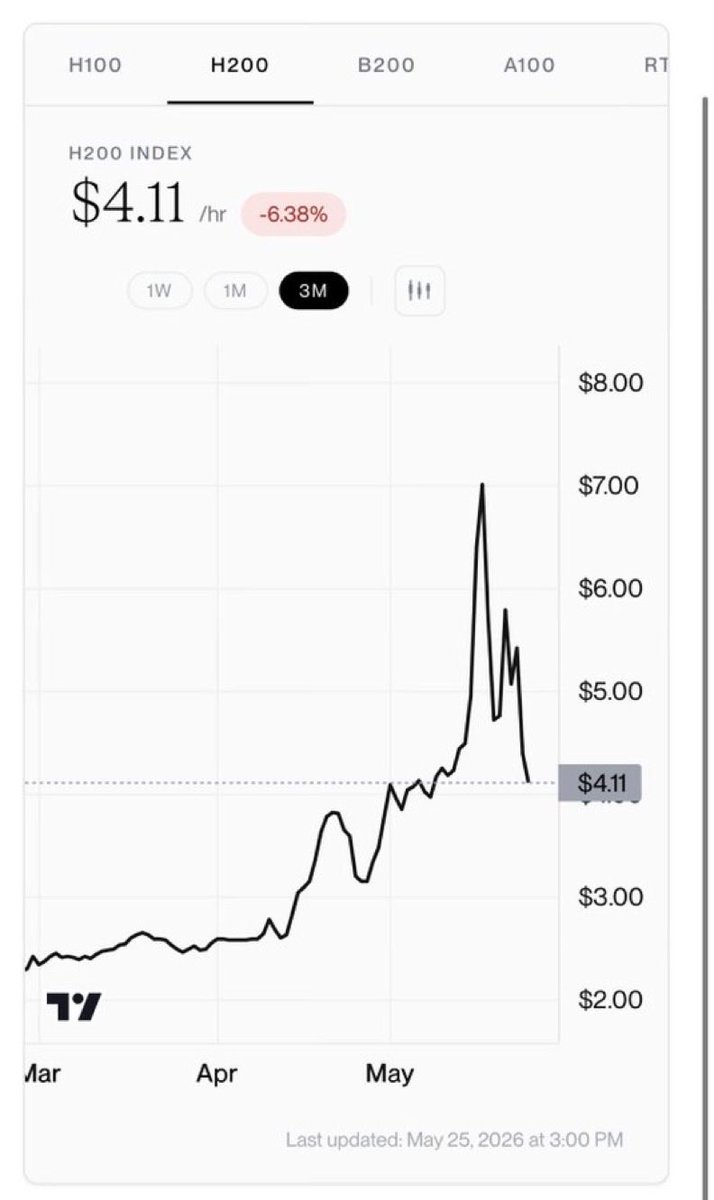
The price to rent an Nvidia H200 just collapsed from $7/hr to $4/hr in three weeks.
A -40% drop in the cost of the single most strategic asset in tech.
When the underlying commodity that powers your entire thesis loses 40% of its value in a month, that usually means one of two things: supply finally caught up, or demand was never as deep as the headlines said.
Either way, somebody is selling.
So why is the AI trade still pricing in scarcity?
At a certain point, the typical AI user doesn’t need PhD intelligence for help with taxes or entertaining memes. Increasing intelligence per token will translate to smaller, faster models. Companies that only sell tokens are a bubble. Raising the ceiling drops the floor.
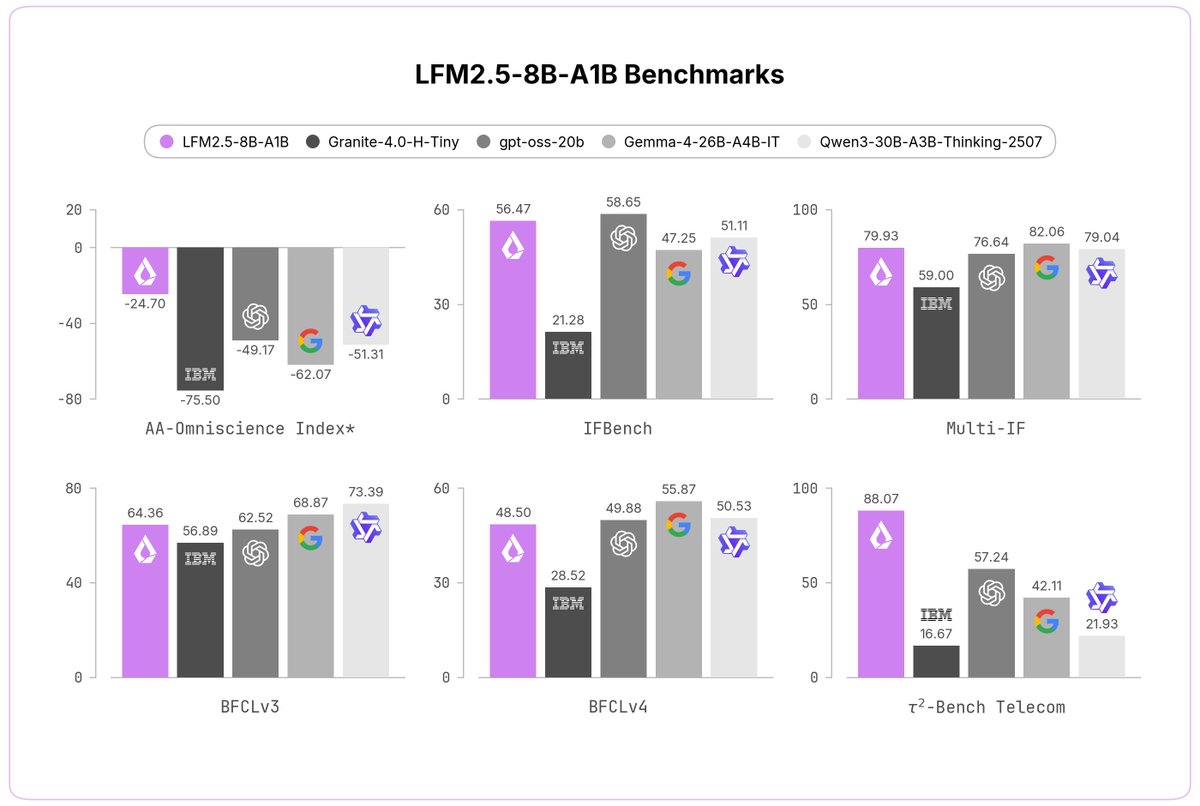
Today, we're releasing LFM2.5-8B-A1B, a device-optimized model designed to power real-life applications on phones, laptops, PCs, robots, and fast & lightweight server-side use-cases.
> 8B MoE, 1.5B active
> Expanded 128K context
> LFM2.5 flagship hybrid MoE architecture
> Trained on 38T tokens + large-scale RL
> fast, reliable tool calling, punching above its weight, comparable to models with up to 4x its size
> customizable on a single GPU for any specialized task
> LFM2 open-weight license
🧵
AI slop is just fully grown prompt slop.
“If words of command are not clear and distinct, if orders are not thoroughly understood, the general is to blame. But if his orders are clear, and the soldiers nevertheless disobey, then it is the fault of their officers.”
— Sun Tzu
CEOs are quietly realizing the AI replacement plan has a problem.
Two problems, actually.
One: the token costs for running AI agents are now exceeding what they were paying the employees they fired.
Two: when the tokens run out, the AI stops. Just stops. No continuity. No workaround. Just a spinning wheel where your workforce used to be.
You fired humans to save money and bought a subscription that bills you into a corner.
The employees you let go knew what to do when things broke.
The AI just invoices you for the outage.
And then there’s the permission problem nobody wants to talk about.
To do its job, the AI agent needs access. Full access. Your systems, your patents, your contracts, your future plans. Everything you spent years building, handed over to a process that has no loyalty, no discretion, and no skin in the game.
You didn’t hire a replacement.
You gave a stranger with no soul the keys to everything you own.
Enjoy.
A Wyoming LLC filed a lawsuit in New York Supreme Court seeking ownership of 39,069 Bitcoin wallets it claims are abandoned property.
The plaintiff, operating under the pseudonym "Noah Doe," says he built an algorithm to identify dormant Bitcoin wallets that have been inactive for at least five to six years. He brought USB drives containing the wallet addresses to the NYPD's 17th Precinct, reporting them as found property under New York's lost-and-found law.
The complaint claims notices were sent to wallet owners via OP_RETURN blockchain messages, a public webpage, and a global press release. Owners were given 90 days to respond. Of the original 42,001 wallets flagged, 2,932 were removed after some showed on-chain activity. The remaining 39,069 wallets did not respond.
The plaintiff is now asking the court to declare him the legal owner of all 39,069 wallets and the Bitcoin inside them under New York Personal Property Law Article 7-B, which governs found and abandoned property.
The wallets reportedly hold approximately 3.8 million BTC. The complaint argues that losing a private key does not destroy the property interest in a wallet, likening dormant wallets to abandoned bank accounts.
The case names all 39,069 wallet holders as "John Doe" defendants. The plaintiff is not claiming to have the private keys to any of the wallets. He is seeking a court order declaring ownership.
The complaint was filed May 1, 2026 under Index No. 153119/2026.
h/t @DailyStackHQ
In 2009 a pigeon named Winston raced Telkom, South Africa's largest ISP, to see who could deliver 4GB of data to a location 60 miles away the fastest.
By the time Winston arrived with the 4GB flash drive, Telkom had transmitted only 4% of the data.
Cool Feature on GrapheneOS “Pin Scrambling”
Security Cameras can see your finger movements and accurately guess your password.
This makes it impossible to do so 👀🔥
@0xSero MTP / speculative decoding does a lot to mitigate speed issues of dense models, especially on multi-GPU setups. I’ve seen Qwen3.6-27B hit 120+ tokens/s on 4x 4090 with MTP-4.