@Alice01493132@OptimusRealm@MyLordBebo As far as I could tell, it's more of an issue in certain cities, focused specifically on some houses with historical value. In my city - Sofia - there is no ban whatsoever and no requirement to ask anybody.
@OptimusRealm@MyLordBebo I don't know if that's a real thing in the UK, but I live in the EU and we have neither bureaucratic hurdles, nor any other issues when installing ACs.
@DrSamuelBHume Well, yes, but even current 100+ year olds spent most of their lives before modern medicine really moved from improving your odds to survive childhood to improving your odds in mid and late life.
@terziev Това е много положително развитие, но много скоро и новите тротоари ще бъдат опропастени, ако няма мерки за ограничаване и санкциониране на автомобилите, които непрекъснато спират върху тях.
@davidasinclair@Nature What do you mean when you say "rare"? Is that something that already exists outside of trials? Is the price the sole or most important reason it's not common or there are other issues?
@jpsenescence I don't think you necessarily need a single intervention that's better than what lifestyle could provide to push longevity medicine forward. Stacking multiple modalities seems to me the more likely road ahead.
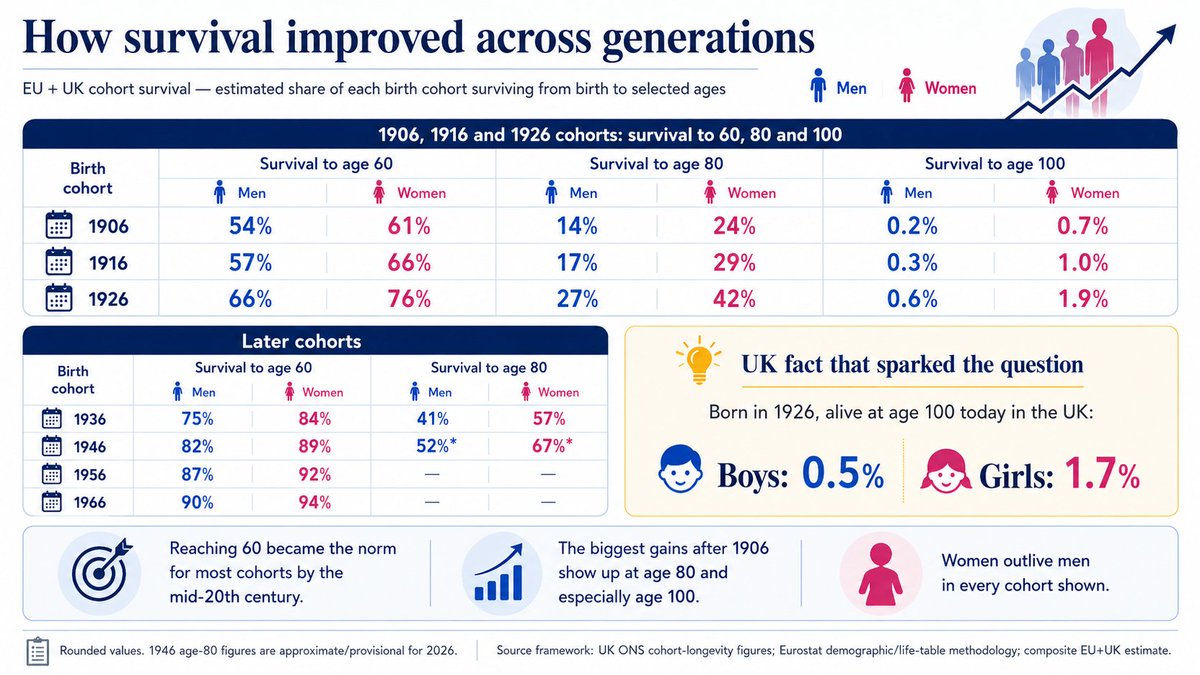
@statto Your post prompted me to check how does the 1926 cohort compare to the ones before and after it (and also see if Chat GPT can draw a cool infographic). It looks like at least in one meaningful sense 80 is the new 60 now.
@siimland ASCVD mortality has been falling since the 1950s and given how good our understanding of the disease and its risk factors is, it would very likely be the next big one. Cancers are just too heterogeneous and too complex and will take at least several more decades.
@KarlPfleger Do you consider the "replacement" approach (lab-grown organs, plasmapheresis, hair cloning, etc.) a part of one of these two fields, or something separate from (and presumably complementary to) both?
@siimland The problem with these estimates is that they come from cause-delete life table calculations. Real-life impact could (and possibly will) be much higher than the 5-10 years that those imply.
@statto I recently started wondering though, how accurate is the 90 percent really? For example, if a person dies at 20 from a brain tumor, we still count them towards it because cancer risk is clearly age-influenced, but their particular death is not 'caused by aging' per se.
@rand_longevity Given the fact that there are only 5 individuals older than 115 now, it's safe to say that not a single person would have gotten to 130 in 15 years. This will not turn into something we routinely do for at least 50 more years even if solve ageing tommorow.
@Dr_Singularity That's cool, but this therapy usually decimates your B-cell population for good, making you immunocompromised, so it's not free. We are still far from curing such diseases with no consequences at all.
@DrSamuelBHume If seemingly over 90 percent of the people treated with Teclistamab-Daratumumab go over four year progression free, what is the rationale behind subjecting them to any other lines of treatment?