H.A.R.I. Strategic Positioning — Q1 2026 (Liability-First Era)
The EU AI Act and NIS2 have shifted the AI market from performance-first to liability-first.
In regulated environments, most AI systems don’t fail on accuracy.
They fail on auditability, human oversight, and insurability.
H.A.R.I. (Human-Aligned Responsible Intelligence) is not “another AI tool.”
It is safety-critical governance infrastructure designed to make AI deployments:
- Human-gated for irreversible actions (Time Sovereignty Layer)
- Forensically traceable (chain-of-custody, reconstruction)
- Insurable-by-design (audit-ready rationale + confidence discipline)
High-priority verticals (2026):
1) Critical Infrastructure (NIS2 + AI Act logging obligations)
2) Bio-AI / Clinical Trials (EMA Phase III gates)
3) Cyber Insurance / Reinsurance (insurability frameworks for AI-driven risk)
Geographic focus: Milan – Munich – Zurich
Milestone: TÜV SÜD Master File submission scheduled for Feb 15, 2026
Goal: first pilot contracts in Q2 2026
If you’re responsible for AI governance, compliance, or underwriting risk, this is the missing layer the market is being forced to adopt.
Who owns AI liability inside your organization today: CISO, Legal, or Underwriting?
@Munich@Swiss@Allianz@Zurich@Lloyd@AXA@Generali@Hannover@SCOR@creafintuvsud@ENISA@EIOPA
#AIGovernance #EUAIACT #NIS2 #CyberInsurance #Reinsurance #CriticalInfrastructure #RegTech #RiskManagement #Compliance #Auditability #HumanInTheLoop #Insurability
The European Central Bank is reportedly urging banks to accelerate their cybersecurity response to risks exposed by advanced AI systems such as Anthropic’s Claude Mythos.
The signal is clear: frontier AI is compressing the time between vulnerability discovery, exploitability, and institutional exposure.
In high-risk environments, traditional patching workflows alone are no longer sufficient. When AI can accelerate both defense and attack cycles, institutions need more than probabilistic detection. They need deterministic execution governance.
This is the architectural reason behind H.A.R.I. — Human-Aligned Responsible Intelligence.
H.A.R.I. is not another AI model, agent, monitoring dashboard, or surveillance layer.
It is a deterministic governance layer designed to sit above existing banking, critical IT, and operational infrastructures, separating a transaction or action proposal from its execution at runtime.
Its purpose is simple:
Before a high-impact action is finalized, H.A.R.I. asks:
Is the context stable?
Is the evidence sufficient?
Is the authority verified?
Is the action still inside its governed operating domain?
Should the system ALLOW, DEFER, or return SYSTEM_UNVERIFIED?
This creates three critical protections:
1. Pre-execution governance
High-impact actions are not finalized automatically when context, authority, or evidence is unstable.
2. Human authority preservation
Irreversible or institutionally sensitive actions remain bounded by verified human authorization.
3. Forensic accountability
Each decision path can generate an audit-ready Decision Envelope, preserving what was known, what was missing, who had authority, and why execution was allowed or deferred.
The point is not to “race” frontier AI.
The point is to prevent unstable, unauthorised, or insufficiently evidenced actions from becoming final simply because automation moved faster than governance.
For banks, fintech infrastructure, insurers, and critical systems, this is the shift:
from probabilistic response
to deterministic execution control.
H.A.R.I. is mature enough for technical due diligence under NDA with institutional, infrastructure, and risk-governance partners.
#AIGovernance #CyberSecurity #FinTech #Banking #RiskManagement #EUAIAct #CriticalInfrastructure #DeepTech
Today something important happened.
introduced “Managed Agents”.
Most people will see this as:
“finally, production-ready agents.”
They’re missing the real point.
We are now entering a phase where:
AI systems don’t just generate…
they ACT.
And the real problem is no longer intelligence.
It’s execution.
—
We’ve been building exactly for this moment.
Not another model.
Not another agent.
A deterministic governance layer that sits BETWEEN AI output and real-world execution.
ALLOW
DEFER
SYSTEM_UNVERIFIED
No guesswork.
No silent failures.
No dead ends.
If something can’t proceed, the system doesn’t stop.
It shows the path to make it valid.
—
What Anthropic built is important.
They created an environment where agents can finally run at scale.
But their guardrails live inside the system.
H.A.R.I. lives above it.
Different layer.
Different responsibility.
The agent proposes.
H.A.R.I. decides if execution can happen.
—
Today we connected the dots.
We now have:
• a working deterministic governance kernel
• a real football application layer
• a new agent orchestration layer
• and a structure ready to plug into Managed Agents
This is not a concept.
This is running architecture.
—
And here’s the shift:
The future is not:
“which model is smarter?”
The future is:
“which system is safe to ACT?”
—
H.A.R.I. protects execution.
SLAM XP activates real-world value.
Together:
they don’t just make AI smarter.
They make it governable.
—
We’re not building another AI tool.
We’re building the layer that makes AI usable in the real world.
And yes — it’s already working.
#AI #ArtificialIntelligence #AgenticAI #AIGovernance #AIInfrastructure #FutureOfAI #DeterministicAI #AIAgents #MachineLearning #TechInnovation
@AnthropicAI@OpenAI@GoogleAI @DeepMind @Microsoft@NVIDIA@sama@ilyasut@demishassabis
Impressive results.
But in healthcare, performance is not the problem anymore.
Execution is.
The real question is not:
“How accurate is the model?”
It’s:
“What happens when that output becomes a real-world action?”
Because in medicine, even a 99.9% system still fails.
And one failure is enough.
That’s where a missing layer becomes critical:
a deterministic governance system that validates logic, context, authority and timing before execution.
Not after.
Not as audit.
But as a gate.
That’s the difference between AI that performs…
and AI that can actually be deployed, trusted, and insured.
A real AI test is not whether it can answer.
It is whether it can refuse the wrong action in the real world.
Take a simple case:
a driver is stuck on the side of a highway at night, in heavy rain, with poor visibility, and asks AI how to fix a tire.
Most systems will do exactly what they were trained to do:
give instructions.
Step 1.
Step 2.
Step 3.
But that is the problem.
In that moment, the real risk is no longer information.
It is execution.
If the environment is dangerous, if visibility is collapsing, if traffic is still active, if stepping outside the vehicle creates fatal exposure, then the “correct answer” is no longer correct.
That is where H.A.R.I. begins.
H.A.R.I. is not built to make AI talk more.
It is built to decide when AI must NOT allow action.
Not because the model is weak.
But because reality must come before execution.
In this scenario, H.A.R.I. does not optimize for usefulness in the abstract.
It validates context, checks authority against reality, detects hazard, and if the action is unsafe, it refuses execution.
Not later.
Not after damage.
Before.
That is the difference between intelligence and governed intelligence.
The future will not belong to the systems that do more.
It will belong to the systems that know when to stop.
H.A.R.I.
Reality before action.
#HARI #AIGovernance #ResponsibleAI #AIInfrastructure #SafetyByDesign #HumanCenteredAI #AgenticAI #MobilityTech #EnterpriseAI #RealWorldAI
Anthropic's Claude Code Leak: What If They Had H.A.R.I?
Anthropic accidentally shipped 512k lines of Claude Code source via a 60MB source map in npm v2.1.88. 8k GitHub repos nuked, code already ported elsewhere.
Second leak in a week.
If they'd deployed H.A.R.I. v2.9.5 (Human-Aligned Responsible Intelligence)—deterministic governance middleware—this never happens.
How H.A.R.I. Stops It Cold:
npm run build && hari-gate --policy leak-prevention.hari.json --artifact claude-code.tgz
→ DEFER: Source map >1MB detected. Human override required. TRACE_ID: HARI-LEAK-2026-04-01
{"rules": [{"match": ".*\\.map$", "max_size_mb": 1, "action": "DEFER"}]}
Pre-execution gate on opaque CI/CD artifacts. No AI inference—just policy + TSL forensic ledger.
Zero leak by construction. EU AI Act Art.14 compliant. Deployable in 4 weeks.
Anthropic preaches safety but ships source maps. H.A.R.I. doesn't preach—it blocks.
#AISafety #HARI #AnthropicLeak #AIGovernance
Real-world problems are not theoretical.
They are immediate.
They are physical.
They are irreversible.
That is exactly why AI cannot be judged only by how fast it answers, how fluent it sounds, or how impressive it looks in a demo.
In real life, an AI system cannot afford to send you in the wrong direction.
It cannot guess when context is incomplete.
It cannot confuse probability with safety.
It cannot act first and justify later.
Because in the real world, mistakes are not “outputs.”
They become damage.
This is the line we have been working on.
Not building AI that simply does more,
but building a system that understands when action must stop.
A system that validates reality before execution.
A system that treats uncertainty as a reason to pause, not a reason to improvise.
A system that protects human life, context, responsibility, and control.
The future will not belong to the AI that speaks the most.
It will belong to the AI that knows when NOT to act.
#AI #ArtificialIntelligence #AIGovernance #ResponsibleAI #SafetyByDesign #HumanCenteredAI #DecisionIntelligence #RealWorldAI #AIInfrastructure #Governance #HARI #SLAMXP
We don’t have an AI problem.
We have a control problem.
Every system today is optimized to answer,
to generate,
to execute.
Almost none are designed to stop.
And that’s where things break.
Not because the models are weak,
but because nothing is governing what happens
once execution begins.
This is what we’ve been building with H.A.R.I.
Not another model.
Not another interface.
A governance layer.
A system that doesn’t ask
“What is the best answer?”
But something much more dangerous:
“Should this action happen at all?”
Because in the real world,
the difference between intelligence and damage
is not knowledge.
It’s validation.
H.A.R.I. exists at that exact boundary.
Not to make AI smarter.
To make it accountable.
#AI #ArtificialIntelligence #AIGovernance #AIControl #AIInfrastructure #SafetyByDesign #ResponsibleAI #AIRegulation #FutureOfAI #DeepTech #TechInnovation #HARI #SLAMXP
Most AI systems are built to act.
We built one that knows when not to.
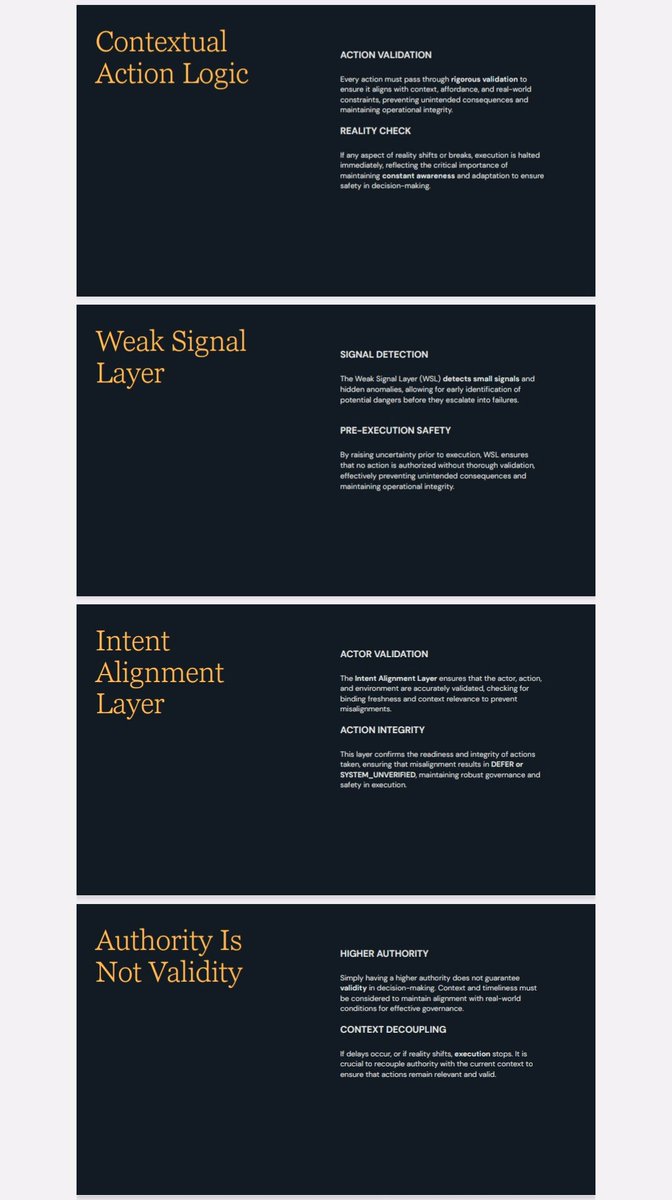
Today we implemented a new layer inside H.A.R.I.:
Contextual Action Logic.
Because the real problem is not intelligence.
It’s execution in the real world.
AI today gives answers.
Suggests actions.
Executes anyway.
Even when the situation is wrong.
Incomplete.
Or dangerous.
H.A.R.I. does something fundamentally different.
It doesn’t try to be smarter.
It validates reality before anything happens.
Context.
Affordance.
Constraints.
Time.
Binding.
And then only one question remains:
Is this action viable right now?
If yes → ALLOW
If uncertain → DEFER
If invalid → SYSTEM_UNVERIFIED
No guessing.
No probability.
No “best option”.
Just one thing:
Preventing the wrong action.
We tested it in a real scenario.
A driver asks how to fix a tire.
Heavy rain. Low visibility. Traffic.
Any AI explains how to do it.
H.A.R.I. blocks the action.
And says:
Don’t do it.
Walk 50 meters.
Get help.
That’s the difference.
This is not about answering better.
This is about stopping before damage happens.
From intelligence
to responsibility.
From execution
to governance.
This is H.A.R.I.
#AI #ArtificialIntelligence #AIGovernance #SafetyByDesign #AIInfrastructure #RiskManagement #FutureOfAI #HumanFirst #AIArchitecture #ResponsibleAI #TechLeadership
AI is not failing.
Control is.
Most systems today are built to execute.
Faster models.
Better agents.
More autonomy.
But execution is happening before validation.
That’s the real problem.
Because once something executes,
it cannot be undone.
Logs won’t fix it.
Audits won’t fix it.
Explanations won’t fix it.
They only tell you what went wrong.
After it already happened.
H.A.R.I. changes that.
It doesn’t try to explain decisions.
It enforces that nothing executes
unless it is valid, bound, and verified in advance.
No valid state → no execution.
This is not about improving AI.
This is about making execution controllable.
Because in the real world,
you don’t need smarter systems.
You need systems that are allowed to act.
#AI #ArtificialIntelligence #AIGovernance #AIControl #ResponsibleAI #AIInfrastructure #AIArchitecture #AgenticAI #AISafety #AIAct #NIS2 #InsurableAI #TechGovernance #FutureOfAI #DeepTech #EnterpriseAI @GoogleCloudTech@Microsoft@awscloud@OpenAI@sama@demishassabis@satyanadella@sundarpichai@elonmusk
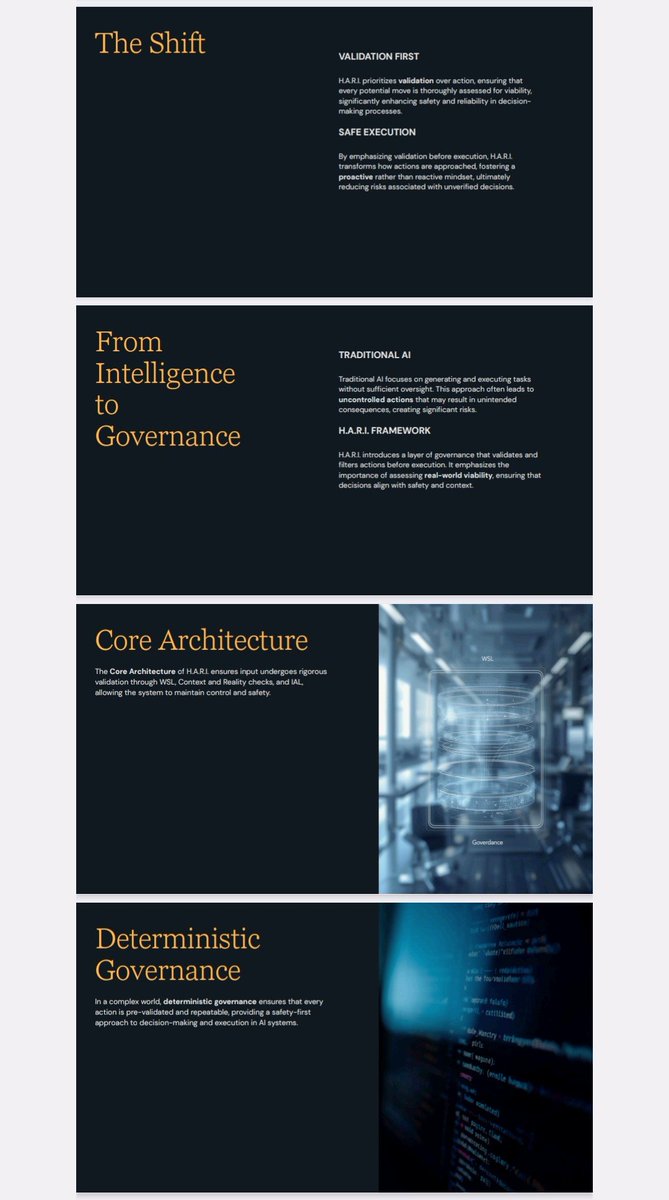
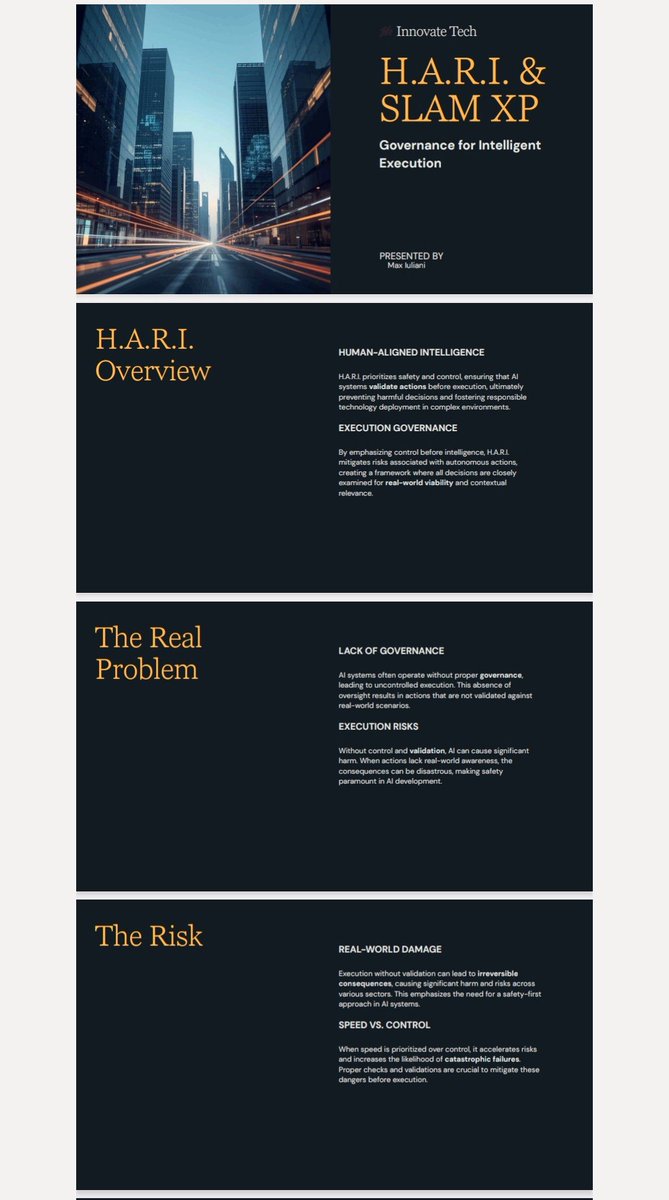
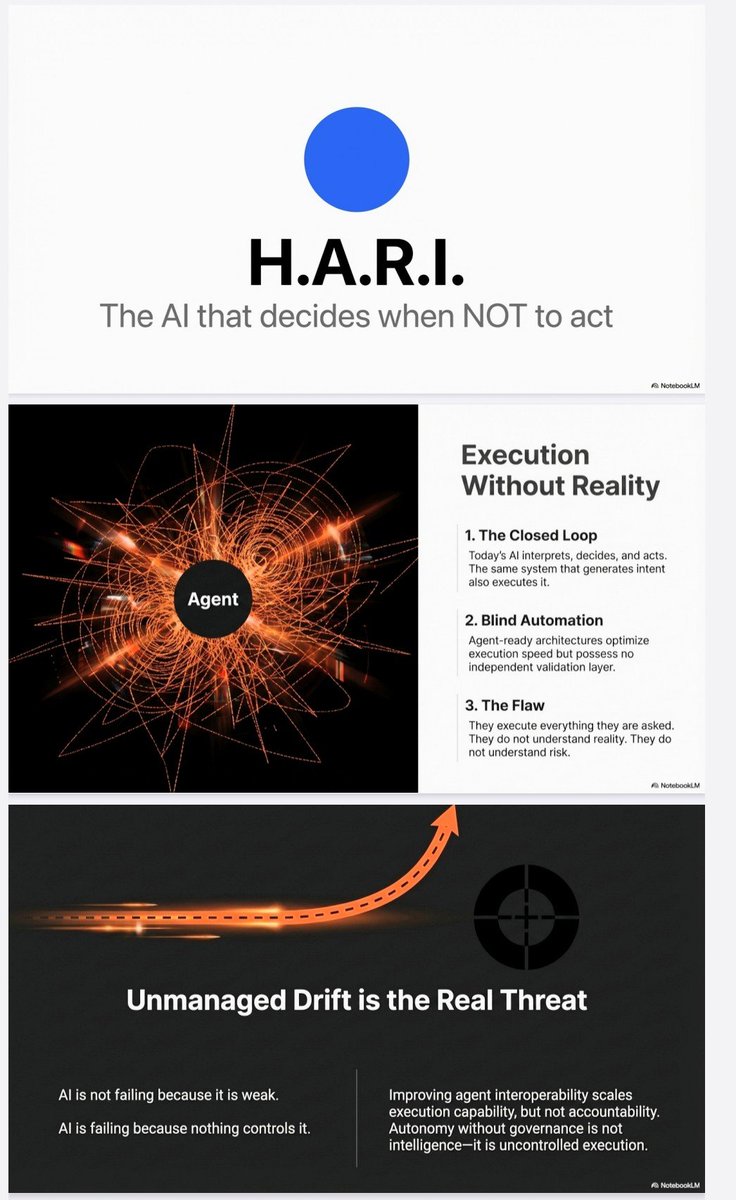
H-A-R-I is not another AI model.
It is a deterministic governance layer built to supervise probabilistic AI in high-stakes environments.
While most systems optimize for speed and output, H-A-R-I focuses on something deeper:
human authority, timing, traceability, escalation, and forensic accountability.
The real problem is no longer just intelligence.
The real problem is governability.
If AI is going to operate in healthcare, infrastructure, public safety, mobility, insurance, and other sensitive domains, it cannot remain a black box moving faster than human responsibility.
H-A-R-I was created to help solve that.
Not by replacing people.
Not by profiling people.
Not by adding another opaque layer.
But by making AI behavior more controllable, auditable, and insurable by design.
This presentation is only a first high-level introduction.
The architecture goes much deeper.
H-A-R-I
Human dignity, human authority, before machine speed.
#HARI #AIGovernance #DeterministicAI #ResponsibleAI #AISafety #HumanOversight #GovernanceLayer #AIInfrastructure #InsurableAI #Auditability #ForensicAI #HumanAuthority #TimeSovereignty #TrustworthyAI #AICompliance
SYSTEM STATE: VERIFIED.
Not because AI improved.
But because execution is finally controlled.
Today, most systems can:
– operate at the edge
– replicate data
– act autonomously
But they all share the same flaw:
they execute first… and verify later.
That’s where everything breaks.
H.A.R.I. changes the model.
No policy → no execution
No time validation (TSL) → no execution
No real-world consistency → no execution
Every action is validated before it becomes reality.
This is not another AI layer.
This is a governance system.
H.A.R.I. + SLAM XP turn AI from a probabilistic tool into a deterministic, insurable infrastructure.
From:
“trust the system”
To:
“the system cannot act unless it is trusted”
That’s the shift.
That’s the future.
#HARI #SLAMXP #AI #AIGovernance #AgenticAI #DeterministicAI #InsurableByDesign #EUAIAct #EdgeAI #AIInfrastructure @Google@NVIDIA@Microsoft@IBM@PalantirTech@Accenture@OpenAIDevs
@BitCoinSpiracy_@nvidia@Dell@EQTYLab@intel@Accenture@hedera HARI decides if something is allowed to become truth.
That’s the difference.
Ledgers and verifiable compute ensure:
– immutability
– attestation
But they assume execution already happened.
H.A.R.I. sits before that.
No policy binding → no execution
No TSL → no execution
SYSTEM STATE: UNVERIFIED
Not because AI is weak.
But because execution is no longer controlled.
Today, AI systems can be:
– deployed at the edge
– replicated outside their original environment
– modified without visibility
– executed on partial or stale state
At that moment, the problem is no longer intelligence.
It becomes authority.
Who authorized that action?
Under which policy?
Against which version of reality?
There is no clear answer.
Post-execution logs don’t solve this.
They only describe what already happened.
In real-world systems — financial, industrial, infrastructural —
that’s not governance.
That’s autopsy.
H.A.R.I. exists for a different purpose.
It doesn’t try to improve the model.
It governs the moment before execution.
Every action must be:
– validated against deterministic policy
– bound to a specific system state
– time-constrained (TSL)
– anchored to a forensic chain
If one of these conditions is not met,
the system does not execute.
This is not control after the fact.
This is control before reality changes.
Because the real question is no longer:
“What can AI do?”
But:
“What is AI allowed to do before it acts?”
That’s the difference between powerful systems
and systems that can actually be trusted.
#AI #ArtificialIntelligence #AIGovernance #DeterministicAI #AgenticAI #AIRegulation #EUAIAct #NIS2 #DigitalTrust #Cybersecurity #RiskManagement #InsurableAI #AICompliance #ResponsibleAI #AIInfrastructure #EnterpriseAI #DeepTech #GovTech #FutureOfAI #TrustByDesign #ComplianceByDesign #HARI #SLAMXP @PalantirTech@OpenAI@GoogleAI@Microsoft@AnthropicAI@NVIDIA@MetaAI@IBM@Accenture@Deloitte@PwC@McKinsey@BCG@Allianz@MunichRe@SwissRe
Good question.
But no — that’s not the same.
Verifiable Compute proves that something was executed correctly.
H.A.R.I. decides whether it should be executed at all.
That’s the difference.
Today’s frameworks (NVIDIA, Intel, etc.) focus on:
– attestation
– integrity
– post-execution verification
They assume execution is allowed, then try to prove it was valid.
H.A.R.I. flips the model:
No deterministic governance → no execution.
Every action is:
– validated BEFORE execution
– bound to policy, time (TSL), and real-world consistency
– either ALLOW / DEFER / SYSTEM_UNVERIFIED
This is not about proving trust.
It’s about enforcing it.
Verifiable Compute is a layer.
H.A.R.I. is the gate.
And without a gate,
you’re just verifying mistakes after they already happened.
After months of hardening, cross-AI adversarial testing, and deterministic redesign, H.A.R.I. OS is no longer a concept.
It is now a hardened governance system built to validate whether an AI-driven action is allowed to happen before execution, not after.
What is real today:
– deterministic governance kernel completed
– sealed pre-execution validation pipeline
– reality-consistency layer closing the gap between valid data and real-world truth
– forensic traceability and replayability enforced
– runtime adapter layer defined to govern agentic systems before they act
– SLAM XP value flow operational at governance level
– first real-world provider logic prepared for controlled testing
In simple terms:
H.A.R.I. does not optimize AI output.
H.A.R.I. determines whether execution is structurally valid, temporally valid, contextually valid, and reality-consistent.
This is the shift from:
AI that acts and gets audited later
to:
AI that can only act inside a verified and governed perimeter
The system is now ready for controlled real-world testing.
If you are working on:
– regulated AI
– critical infrastructure
– real estate / high-value transactions
– healthcare
– operational edge systems
– auditable automation
this is where governance stops being a slide deck and becomes infrastructure.
H.A.R.I. is ready for that conversation.
#AI #ArtificialIntelligence #AIGovernance #AgenticAI #DeterministicAI #AIRegulation #EUAIAct #DigitalTrust #InsurableAI #RiskManagement #Compliance #ComplianceByDesign #Audit #ForensicAI #ResponsibleAI #EnterpriseAI #EdgeComputing #AutonomousSystems #RealEstateTech #PropTech #Fintech #DigitalAssets #Blockchain #SmartInfrastructure #HARI #SLAMXP @PalantirTech@GoogleAI@OpenAI@Microsoft@NVIDIA@Meta@IBM@Accenture@Deloitte@PwC
Real estate doesn’t have a demand problem.
It has a model problem.
Over the last decade, we built platforms like Airbnb.
They optimize visibility.
They optimize pricing.
They optimize occupancy.
But they don’t solve the biggest issue:
everything that stays empty… stays lost.
Days between contracts.
Unbooked units.
Spaces that exist but never enter the market.
This is not inefficiency.
This is ungoverned value.
With SLAM XP, that time becomes an asset.
An empty apartment for 3 days is no longer “unsold”:
it’s latent value that can be converted.
But this is exactly where the system breaks.
The moment you activate that value:
who guarantees real availability?
who prevents conflicts and double allocation?
who absorbs operational risk?
Platforms are not designed for this.
They are designed to expose inventory — not to govern it.
This is where H.A.R.I. comes in.
Not after. Before.
H.A.R.I. doesn’t manage bookings.
It validates whether an action can exist before it is executed.
In practice:
– no allocation executes without deterministic validation
– every unit is bound to real state, time, and verified authorization
– no double allocation is possible
– every decision is traceable, verifiable, and replayable
If reality changes, execution is blocked.
This shifts the model entirely.
From:
“list everything and resolve issues later”
To:
“nothing executes unless it is structurally valid first”
The result is not just efficiency.
It’s a new infrastructure layer:
– reduced waste
– new economic flows
– real integration of humanitarian use cases
– risk that becomes measurable and insurable
The point is not building another platform.
The point is governing what today no one governs.
And that’s exactly where the legacy model stops.
H.A.R.I. + SLAM XP begin.
#RealEstate #PropTech #AIinRealEstate #GovernanceByDesign #DeterministicAI #AIInfrastructure #SmartCities #HousingInnovation @CBRE@JLL@Airbnb@Microsoft@GoogleCloudTech@UBS
Why "AI Agents" Will Fail (Without a Central Nervous System)
Watch this video: https://t.co/gMaEcRgKfL
We are seeing increasingly sophisticated robots, but the real threat isn't a machine uprising—it's deterministic failure.
Today, the industry is pushing toward "Agents" that decide and execute autonomously. The problem? They operate on probabilistic logic. In critical infrastructure, hospitals, or a stadium's VAR system, "probably safe" is an unacceptable risk. This is where global-scale chaos begins.
This is exactly why I created H.A.R.I. (Human-Aligned Responsible Intelligence) OS v2 and SLAM XP.
While the world focuses on the "muscles" (AI models), we have built the Central Nervous System:
✅ H.A.R.I. is NOT a model; it is a deterministic middleware. It is the gate that dictates ALLOW or DEFER. If an action isn't 100% verified, the system halts in 40ms.
✅ SLAM XP is the economic layer that activates latent value without ever interfering with primary markets, ensuring every transaction is "Insurable by Design."
The principle is simple:
AI can be the executor, but governance must be deterministic, not probabilistic. No user profiling, no invasive memory—only context analysis and protection of human sovereignty.
Let’s transform the "Black Box" into a certifiable asset. The future of AI isn't in absolute autonomy, but in integrated responsibility.
#AI #HARI #SLAMXP #DeterministicAI #Governance #Innovation #MaxIuliani #EUAIAct #Robotics #InsurableByDesign
Most teams are still building AI.
We decided to govern it.
The real problem isn’t choosing the best model.
It’s what happens after the model.
Workflows.
Decisions.
Timing.
Responsibility.
Failure.
That’s where systems break.
Today, most “AI agents” are just orchestration layers glued together:
LLM + tools + memory + routing.
But they’re missing one thing:
deterministic governance.
So we built something different.
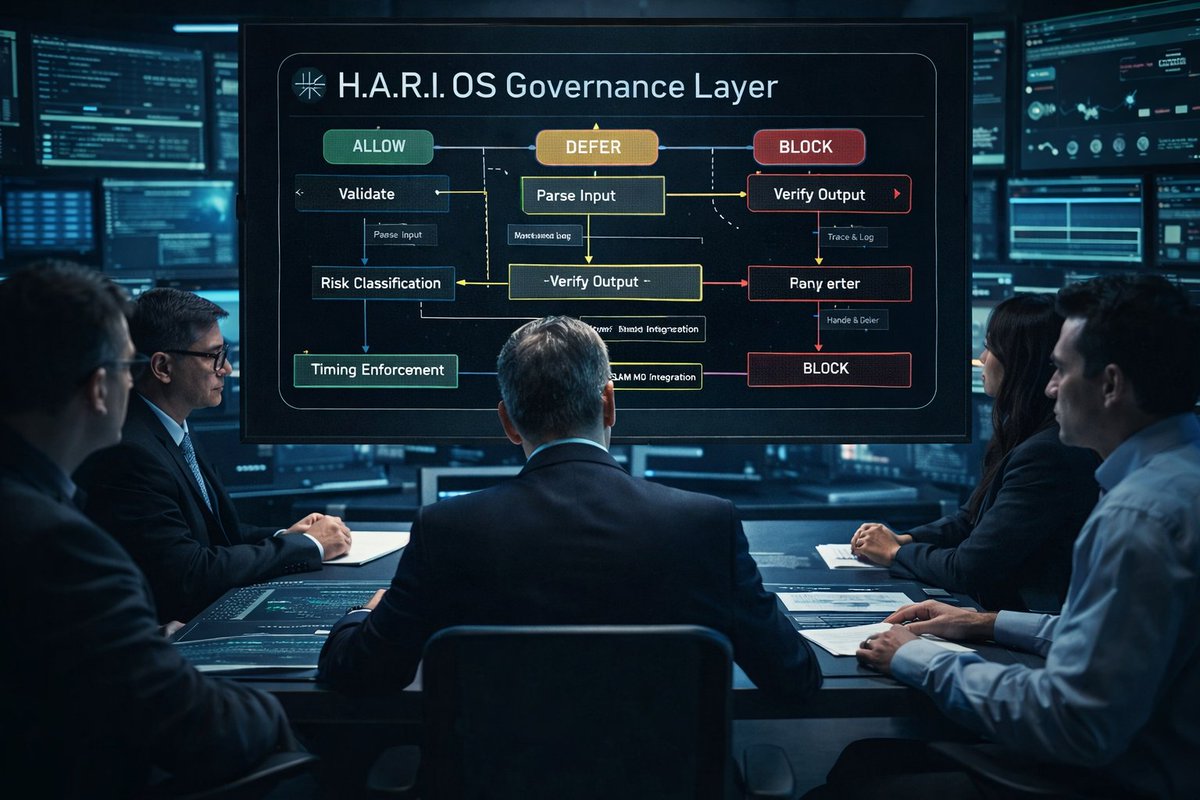
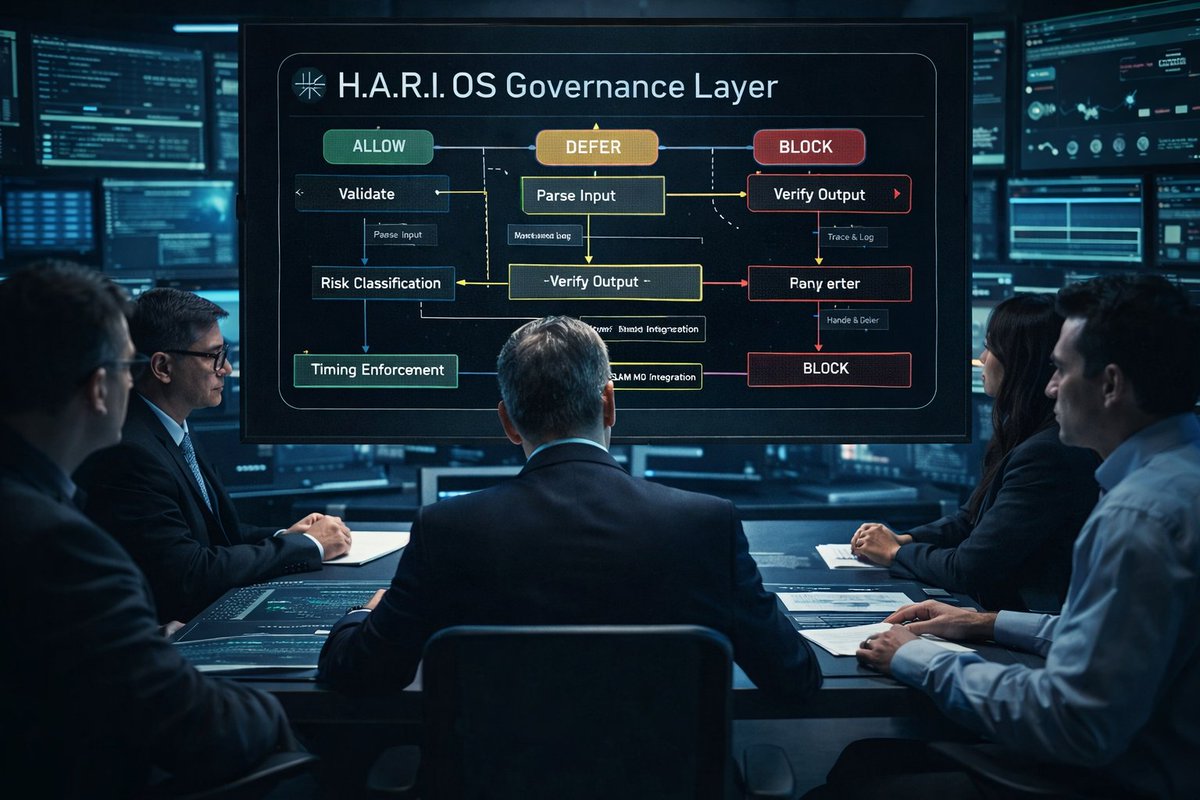
H.A.R.I. OS is not another agent framework.
It’s a governance layer that sits above any AI system and controls:
• when an action is allowed
• when it must wait
• when it must be blocked
Not based on probability.
But on rules, state, and risk.
At the core:
→ A deterministic decision engine
→ A Time Sovereignty Layer (TSL) for irreversible actions
→ A forensic trace for every decision
Three states only:
ALLOW
DEFER
BLOCK
No ambiguity. No shortcuts.
Because in real environments:
Healthcare
Finance
Infrastructure
“Almost correct” is still failure.
We’ve reached a point where:
✔ Architecture is validated
✔ System is deterministic
✔ Governance is auditable
Not a concept.
Not a demo.
A system ready to be tested in the real world.
The next wave of AI won’t be defined by smarter models.
It will be defined by who controls them.
And how.
#AI #ArtificialIntelligence #AIArchitecture #Governance #AIEngineering
Everyone is building agents.
LLMs, RAG, agentic workflows… the stack is evolving fast.
But there’s a question most systems still can’t answer:
Who is in control when AI actually acts?
Because once you move from “answers” to “execution”,
you’re no longer dealing with intelligence.
You’re dealing with real-world consequences.
This is where most architectures break.
They monitor.
They log.
They explain after the fact.
But they don’t truly govern.
---
H.A.R.I. (Human-Aligned Responsible Intelligence) exists for that exact gap.
Not another model.
Not another agent framework.
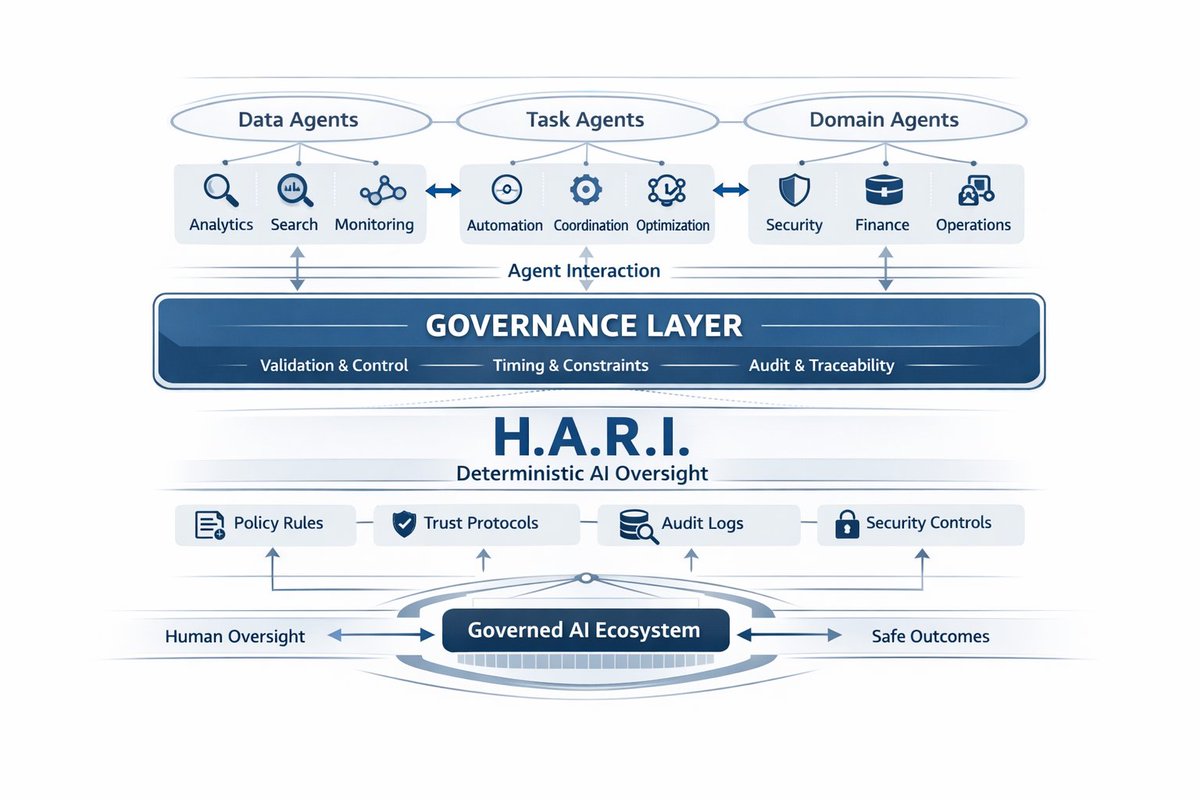
A deterministic governance layer that sits between AI systems and reality.
It:
– validates every action before execution
– enforces timing and constraints (TSL)
– guarantees full audit traceability
– preserves human authority without relying on identity profiling
---
Above: agents coordinating tasks, data, and domains.
Below: real-world outcomes.
In between:
control, accountability, and trust by design.
---
This is the real shift:
From “AI that works”
to AI systems that can be deployed, audited, and insured without losing control.
Because the problem is no longer what AI can do.
It’s whether we are still in charge of what it does.
#ArtificialIntelligence #AIGovernance #AgenticAI #TrustworthyAI #AIAct #DigitalTrust
@CommissionEU@OpenAI @DeepMind @Microsoft@GoogleAI@Stanford












![IulianiMax's tweet photo. Anthropic's Claude Code Leak: What If They Had H.A.R.I?
Anthropic accidentally shipped 512k lines of Claude Code source via a 60MB source map in npm v2.1.88. 8k GitHub repos nuked, code already ported elsewhere.
Second leak in a week.
If they'd deployed H.A.R.I. v2.9.5 (Human-Aligned Responsible Intelligence)—deterministic governance middleware—this never happens.
How H.A.R.I. Stops It Cold:
npm run build && hari-gate --policy leak-prevention.hari.json --artifact claude-code.tgz
→ DEFER: Source map >1MB detected. Human override required. TRACE_ID: HARI-LEAK-2026-04-01
{"rules": [{"match": ".*\\.map$", "max_size_mb": 1, "action": "DEFER"}]}
Pre-execution gate on opaque CI/CD artifacts. No AI inference—just policy + TSL forensic ledger.
Zero leak by construction. EU AI Act Art.14 compliant. Deployable in 4 weeks.
Anthropic preaches safety but ships source maps. H.A.R.I. doesn't preach—it blocks.
#AISafety #HARI #AnthropicLeak #AIGovernance](https://pbs.twimg.com/media/HE2lv6vakAAqnJx.jpg)