I spent 35 years building banking systems for banks worldwide, including central banks. I know how banks decide where their money goes.
When you build systems, you have to make them work, so you have to know how they work.
The Basel Committee de-industrialised the countries that adopted its rules. It's that simple: I explain the whole complicated mechanism in my essay. They simply regulated it away because that was the most profitable thing to do. It was implemented in such a systemic global way, and nobody seemed to notice
Capital is what a bank must hold before it can lend, the way a manufacturer or miner must hold supplies before it can sell. No miner doubles their costs to serve one group of customers. But that's what the banking system does to miners and manufacturers. Since 1988, the Basel rules have required banks to hold twice the capital against a factory loan as against a home loan, and under Basel III the gap reaches five times. So banks lend less to industry and more against houses. It should be stopped tomorrow.
Manufacturing's share of GDP fell in ten of the eleven countries I examined. In Australia it fell from 13.7% to 5.4%. Every other country that followed fell as well. The only truly crafty ones were the Koreans, who did a good job of offsetting it.
Regulators were warned in writing that the rule would steer credit, and they adopted it anyway. No parliament voted for it, and it's simply too dumb to keep doing, but we do . Not today; there is no justification. Yet from India, across Europe, across the US, including Australia, sanctions against industrial capacity. Financialization has gone too far it needs to be reviewed .
The charge is manslaughter by gross negligence. The mechanism is proven.
Same Rules, Different Ruins:https://t.co/n2jflhFw2S
Dear Secretary Bessent @SecScottBessent,
My name is Everett Stern. In 2010 I was a compliance officer at @HSBC. From a back office in New Castle, Delaware, I watched billions of dollars move to drug cartels, sanctioned regimes, and terrorist organizations. The enemies of the United States. I documented it, I escalated it, and when the bank would not act, I took it to the @FBI, the @CIA, and eventually the @SECGov.
The result was a $1.92 billion settlement. At the time, it was one of the largest in American history. It was also about five weeks of the bank’s profit. Not one banker was charged. Not one went to prison.
I paid a different price. I lost my career, my savings, and my place in the industry I had trained for. I was blacklisted. Every door in American finance closed at once. I slept on a camping cot in a 300 square foot apartment because I could not afford a bed, and I waited tables at @PFChangs to eat. I tell you this not for sympathy, but so you understand that I know exactly what it costs to do the right thing in American finance, and exactly how little the system does in return.
I made that sacrifice because I believed it would change something.
Yesterday, your department fined @BankofAmerica $1.2 billion for failing to report more than $5 billion in suspicious transactions, some of it tied by your own findings to Chinese laundering networks, narcotics, and the southwest border, alongside 475 apparent sanctions violations touching Russia, Iran, and global terrorism. The bank admitted it willfully violated the Bank Secrecy Act.
Fourteen years after HSBC. A bank with “America” in its name. And once again, not one individual charged.
Secretary Bessent, I want to say plainly what I believe you already know. The fines are not working.
A fine is paid by shareholders, absorbed by the balance sheet, and forgotten by the next earnings call. Bank of America reported earnings this morning. Nobody who set the alert thresholds, nobody who decided the 2024 cease and desist could wait, nobody who chose the backlog over the law will lose a single thing they value. Their lives are untouched. That is the entire reason the behavior repeats.
This is money laundering. This is blood money. Money that reaches a cartel buys fentanyl that kills Americans. Money that reaches a terrorist organization buys the next attack. This country has fought a war on drugs and a war on terror for decades, at enormous cost in lives and treasure, and all the while we have allowed the financing to flow through institutions we charter and regulate. Cut off the money and we win. We have never seriously tried.
There is also a question of equal justice that I cannot let go.
Before I walked into the FBI building to report HSBC, I stopped in front of the Great Seal on the wall and read the words engraved beneath it: “Justice is the defense of our liberty.” I believed that. I still want to. But every day in this country, people go to prison for crimes that are nothing next to moving money for the people who want Americans dead. A suit, a title, and a corporate badge should not be a shield from the consequences that apply to everyone else. If a street dealer goes to prison for what he sells, the banker who moved the cartel’s money should be standing next to him.
I also want to raise something that is rarely said in these conversations. Why has no one inside Bank of America come forward the way I did? The answer is that everyone in American banking knows what happened to me, and to the whistleblowers who came after. The last person who spoke up is the only policy anyone believes. That is a culture problem, and it starts with leadership, in the banks and in the agencies that regulate them.
This is not a political issue. It has spanned administrations of both parties. It is a national security issue, and I am asking you to treat it as one.
Three things would change the math overnight.
Refer individuals for criminal prosecution. Not the analyst in the queue. The executives who set the thresholds and chose the risk. One banker in handcuffs would do more than every fine in Treasury’s history combined.
End “too big to jail.” An institution cannot be too big to fail and too big to jail at the same time. If it is the first, it must be held to a higher standard, not a lower one.
And if Bank of America will not act as America’s bank, review its charter. A national charter is a privilege granted on behalf of the American people. It should be conditioned on not moving money for the people trying to kill them.
Secretary Bessent, you said yesterday that these actions send a clear message that even the biggest institutions are not above the law. With respect, the institution was never the problem. The people inside it are above the law, and they know it. Until that changes, I will keep writing letters like this one, and the next bank will keep paying the next fine.
I gave up everything I had to stop this. I am asking you to use the power you have to finish it.
Respectfully,
Everett A. Stern
HSBC Whistleblower
Founder and Intelligence Director, Tactical Rabbit
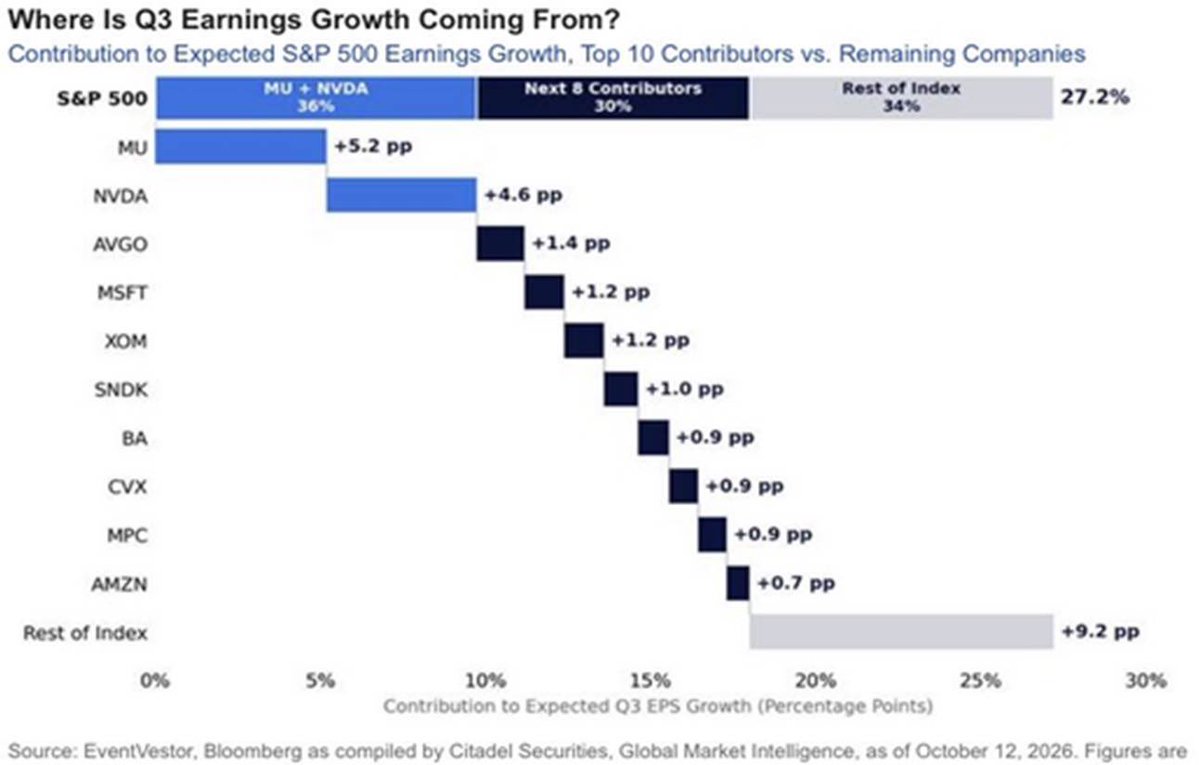
Consensus entered Q3 reporting looking for roughly 27% YoY S&P 500 EPS growth, with earnings expectations continuing to improve even as valuations across much of the growth complex have compressed.The concentration of earnings growth among top contributors remains striking,.
Micron Technology (MU) and Nvidia (NVDA) alone account for 36% of expected S&P 500 (SP500) earnings growth in the third quarter, according to Citadel Securities.
France 10 year bond yield = 4.79%
Greece 10 year bond yield = 4.43%
Nobody who lived through the PIGS debt crisis in the early 2010s would have predicted Greece to be a better credit than France in 2026.
The leaders of Scotland, Wales and Northern Ireland will gather on Monday to sign a deal designed to kick-start the break-up of the United Kingdom, The Telegraph can disclose.
🔗: https://t.co/VeumqCHVkT
ESA will implement an astronaut mission to the International @Space_Station for Greece with @vast 🇬🇷👨🚀
@esa project astronaut Adrianos Golemis is planned to serve as mission specialist and, pending approval, become the first Greek astronaut in space. He would join ESA astronaut @Thom_astro as commander and ESA project astronaut @astro_ales as pilot on a mission planned for 2027.
More details: https://t.co/bApJUMYJBK
@MinDigitalGr@Astrovenator
Today, we launched the world’s first automated production line for advanced general‑purpose humanoid robots, using robots to mass‑produce robots, autonomously.
This was uncharted territory, and we solved it from scratch. The commissioning of our production line means humanoid robots are now ready to scale up and step into the real world.
What touched my heartstrings most was watching our very first advanced general‑purpose humanoid robot complete assembly and walk off the line on its own. To me, this is not just about a smarter tool or a commodity. I hope it gains true generalization ability to take on dangerous, repetitive, or undesirable tasks, and ultimately make life better. Perhaps one day, robots may become our companions, friends, or part of family.
Grateful to every colleague on this momumental mission. And a warm welcome to IRON!
Two economists mathematically proved that AI will destroy the economy.
Researchers from Wharton and Boston University published a terryfiying paper called "The AI Layoff Trap."
They mapped out the economic end-game of the AI transition, and it exposes a fatal flaw in competitive capitalism.
When a company replaces a worker with AI, it captures 100% of the wage savings.
But that displaced worker is also a consumer. When they lose their job, they stop buying things.
The company gets all the savings, but the loss of consumer demand is spread across the entire economy.
If there are 20 competitors in a market, a CEO only absorbs 1/20th of the economic damage their layoffs just created.
So every single rational CEO has a mathematical incentive to automate as fast as possible.
They can literally see the cliff approaching, and they still step on the gas.
It triggers an unavoidable Prisoner’s Dilemma. If you don't automate, your competitors will, and they will crush you on price.
It doesn't just hurt workers. It destroys the businesses, too.
The economy gets trapped in an automation arms race. Companies fire their workforce to stay competitive, until the entire consumer base is completely hollowed out.
At the limit, the paper concludes: “Firms automate their way to boundless productivity and zero demand.”
And the scariest part?
The researchers mathematically tested every popular fix.
Universal Basic Income? Fails. It raises the living standard but doesn't change the corporate incentive to cut jobs. Retraining? Fails. Worker equity? Fails.
The paper proves that more competition actually makes the collapse happen faster. And "better" AI makes the damage worse.
The only thing that mathematically stops the collapse is a targeted automation tax, forcing companies to pay for the purchasing power they destroy before they automate the job.
@LeonPalaiodimos Καλημέρα και καλή Κυριακή !Αν θυμαμαι καλά αν κανεί καποιος σταδιακά εως 7000$/ετος με όριο τα 35Κ$ παραμένουν αφορολόγητα !Λεπτομερειες στο λογιστή σας στην εκεί η σε πιστοποιημένο Tax advisor από το IRS στην Ελλάδα .Ελπιζω να σας φανεί χρήσιμο !
@LeonPalaiodimos Ακριβώς εν καιι ενα μέρος μπορείτε να κάνετε χρήση του και για άλλους σκοπούς (από 01/2024 δείτε ROTH conversion of 529 student accounts ) απλως κάντε καλή έρευνα σε ποιο θα επιλέξετε να συμμετάσχετε από πλευράς αποδοσης και όχι μόνο !
If @GretaThunberg truly cared about human rights abuses, she'd point her boat to #Cyprus.
She'd find that 37% of the island nation is occupied by Turkey's army since 1974...1000s of Greek Cypriots were killed or expelled...100s of churches were destroyed or converted to mosques.
Tariffs &Inflation US Goldman Sachs estimates that for every 1% hike in tariffs, core inflation rises by 0,1% . So, with expected effective tariff rate 15%, that means a 1.5% increases to prices. That’s assuming only 70% of the higher import costs are passed along to customers.
These companies have
added $5 TRILLION in market value since the beginning of last
year. To put this into perspective, these 5 stocks are worth now
nearly as much as China and Hong Kong's stock markets
COMBINED.
Market Concentration at Historic Highs
The 5 largest stocks in the S&P 500 now represent 29% of the
index, marking the highest concentration since the Nifty Fifty era of the 1960s.
The market cap of the SP500’s top 5 stocks is now equal to the size of the bottom 407 stocks. Apple, Nvidia,Microsoft,Google, and Amazon are worth now a combined $15.3 trillion.