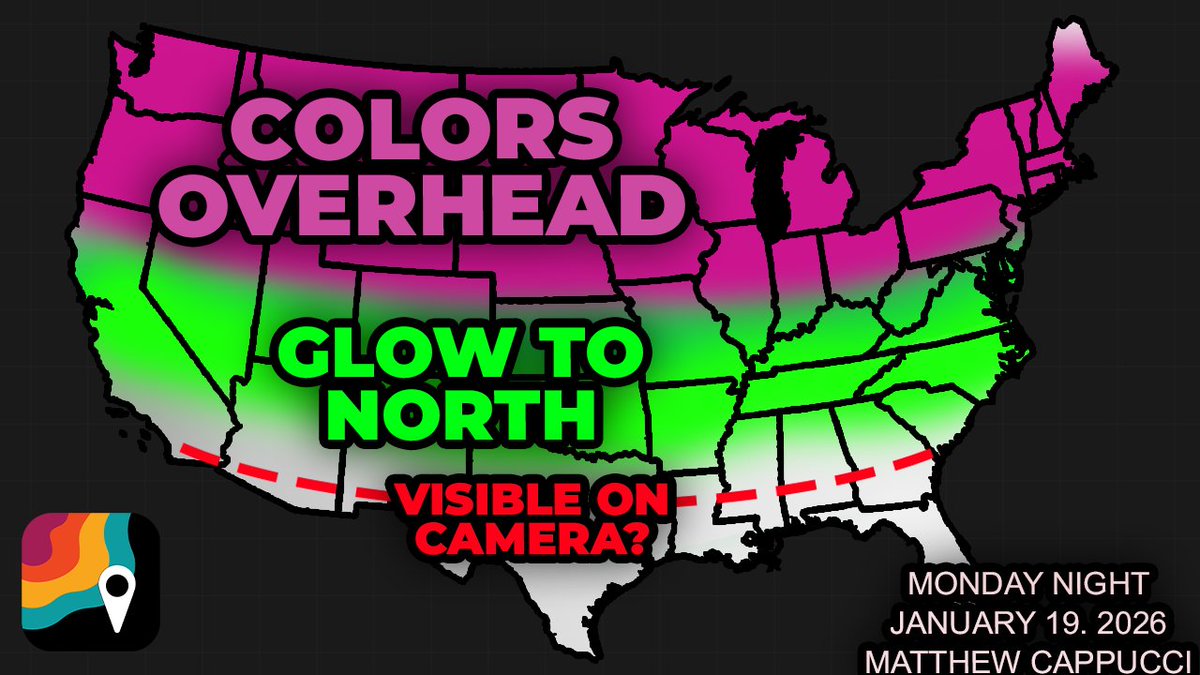
UPGRADE! A SEVERE or G4 geomagnetic storm is now predicted by the Space Weather Prediction Center ! This *could* bring widespread auroral displays to the United States *if* things ensue as modeled. This is anticipated TONIGHT, Monday night, January 19!
We are awaiting a magnetic shockwave called a CME, or coronal mass ejection. A NASA model shows the CME may be stronger, and faster, than originally modeled, meaning it could slam Earth's magnetic field around 8 p.m. Eastern time Monday night. That impact will spark auroral displays.
The northern U.S. may see some colors overhead, primarily green and/or purple, whereas areas to the south might notice a reddish or green glow on the northern horizon. The colors won't appear quite as vibrant to your eyes as they do on camera, but an impressive display remains possible.
NOTE: there remains uncertainty regarding the timing, and realistically the impact could ensue any time within 6 hours either side of that time frame.
Also note that, while we believe the CME will hit Earth, a more glancing blow can't be ruled out. That would reduce impacts.
This is all associated with an X2-class solar flare, which launched off the sun around 11:09 a.m. Eastern time Sunday. It originated from sunspot 4341, a large, bruise-like discoloration on the surface of the sun throbbing and pulsating with magnetic energy. It's also a cooler region on the sun's surface.
Solar flares are flashes of light and electromagnetic radiation that expel high-energy particles through space at the speed of light. This particular flare caused a degradation of radio wave propagation and partial radio blackout over western South America and the eastern South Pacific.
The flare was followed by a CME, or coronal mass ejection, accompanied the flare. CMEs are slower waves of magnetism and ejected solar plasma that surf through space like a shockwave. They take a couple days to reach Earth (when they’re Earth-directed). Stronger ones are usually faster.
CMEs interact with Earth’s magnetic field, which transforms potentially harmful energy and magnetism into visible light — the aurora.
This CME is set to reach us within about 36 hours, which is very fast. That means a heftier impact.
Isolated yourself from city lights and find a clear, unobstructed view of the northern horizon. Check the weather forecast first too... and stay tuned here for updates.
Also note that we do NOT HAVE A SPECIFIC TIME. Space weather forecasting is still in its infancy, and timing your observation with the occurrence of an auroral “substorm” is purely a game of luck. 10 p.m. Eastern time/9 p.m. Central may be a good time to attempt viewing.
@kareem_carr Im wondering if under this framework, multi author publications count as peer reviewed, or does the reviewer have to be external to the process of creating the science?
“I am the Ghost of Christmas Future Imperfect Conditional” said the Spirit. “I bring news of what would have been going to happen, if you were not to have been going to change your ways.”
@MatthewCappucci I'm trying to understand the semi-truck one. Did the semi get toppled by an invisible tornado, or is that coincidental/affected by nearby high winds.
Any other overpriced reagents or buffers in your lab? Or something crucial that you are using that’s not even sold?
Let me know—I may be able to cut costs in half or more.
Beginner or Advanced R User? 🤔
➡️ This cheat sheet is gold.
It summarizes all the best practices R developers should apply.
If some of it isn’t familiar, the first module of my https://t.co/wK6l6vXJe9 project explains exactly this!
Thanks so much @_wurli 🙏
What's missing?
Proud to announce that I was awarded an NSF CAREER grant (!) to study Fe nutrient adaptation in Synechococcus #cyanobacteria Seeking #PhD student for F25. Lab and field-based transcriptomics and physiology experiments. Dusting off my lab webpage w/ info but feel free to email me
JL is a visionary informaticist and a great mentor. I encourage anyone looking for a postdoctoral opportunity, who wants to take their computational -omics to the next level and learn to develop new tools, to consider working with them.
Two research technician positions are now available in my lab at Wellesley College - come help us learn more about microbial communities, extracellular vesicles, and viruses in the oceans! Happy to discuss opportunities in more detail. Please share! https://t.co/ZEnUuroFtv
Our lab is looking for a postdoc on Planktonic Fungi here @BIOSstation! Focus on fungal ecology and processes; maintaining the cultures alive and clean! And opportunities to network and develop. Reviewing applications will start after July. Please repost!
https://t.co/qkwna8YNAc
We're going to have a new position for a MSc-holding researcher (IE) to join our #MicroRescue@ERC_Research project in fall '24
We'll be looking for someone who has skills in executing plant experiments and in environmental bacteriology
Feel free to ask for info!