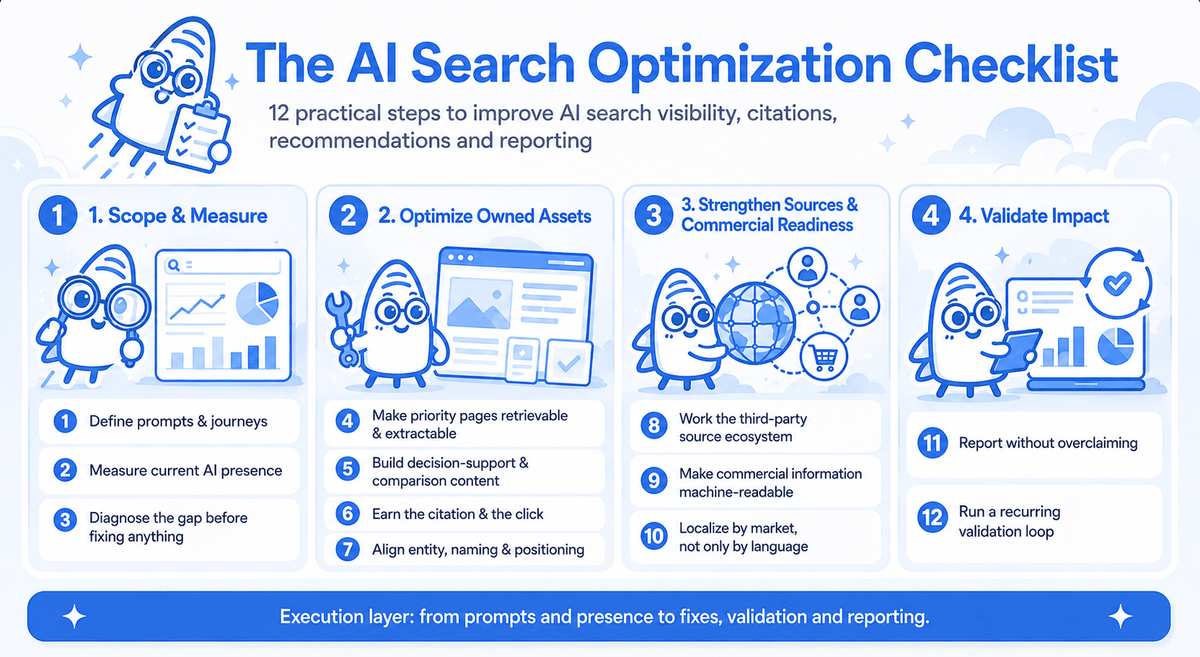
🚨 I’ve just updated my AI Search Optimization Checklist (and worksheet) 👇
Following a workflow for a strategical AI search optimization process:
✅ Which prompts and journeys do we actually want to influence?
✅ Where are we visible, cited, recommended or missing?
✅ Which owned pages and third-party sources are shaping the answers?
✅ What needs to be fixed: content, accessibility, entity clarity, source ecosystem, commercial data, localization…?
✅ How do we validate if the changes moved the needle?
✅ How do we report progress without overclaiming AI impact?
It now includes:
⭐️ 12 practical AI search optimization steps
⭐️ Examples and “what good looks like” sections
⭐️ Prompt and presence measurement guidance
⭐️ Gap diagnosis and prioritization examples
⭐️ Source ecosystem mapping
⭐️ Commercial and transactional readiness checks
⭐️ International/local AI search considerations
⭐️ Reporting guidance to separate observed, proxy and modelled signals
⭐️ A recurring validation workflow
⭐️ A downloadable checklist worksheet to use it in practice
The biggest point I’d emphasize: AI search optimization should start with understanding which AI-assisted journeys matter, how your brand appears across them, which sources influence the answers, and what you need to improve to be selected, cited, recommended and accurately represented.
Guide + checklist worksheet here:
https://t.co/e87HMPhDce
Launching https://t.co/36UBUXMmiq.
A platform-agnostic spec of what a good website does: SEO, accessibility, security, agent-readiness, performance, privacy, i18n.
Every claim cites a source. Ships with a checklist, llms.txt, MCP server, and Agent Skill.
Free. Open Source.
No, Google search is not suddenly going away. Everything Google announced at I/O has already been happening, so there won't be a sudden decrease in traffic.
However, the new features Google shared, which may eventually launch, do show that Google is developing new ways to keep people in search results rather than clicking off to websites.
The hot takes on social media will create strong demand for websites that will still need creative marketers to drive what will be a more limited pool of clicks from both traditional search and LLMs.
Here's what you should not do right now:
➡️ Do not suddenly run out and buy an LLM tracking tool. Most of the tools have inaccurate data and will certainly not help you get more traffic.
➡️ Do not give up on SEO, there will always be traffic from the ten blue links, it's less than it used to be, but giving up means you will now have zero.
➡️ Do not fire your SEO team because they don't have the answers you think they should have on AEO. Empower them to get the answers. Starting over with a new team (and a very limited talent pool) guarantees that you will be behind your competition.
➡️ Do not start chasing a tactic for LLM visibility that sounds too good to be true. Spam is spam, and it's not worth the complete loss of traffic when it gets nailed.
➡️ Do not assume that your users are only going to use LLMs to find your vertical. Who uses LLMs and how they use them are very category-dependent.
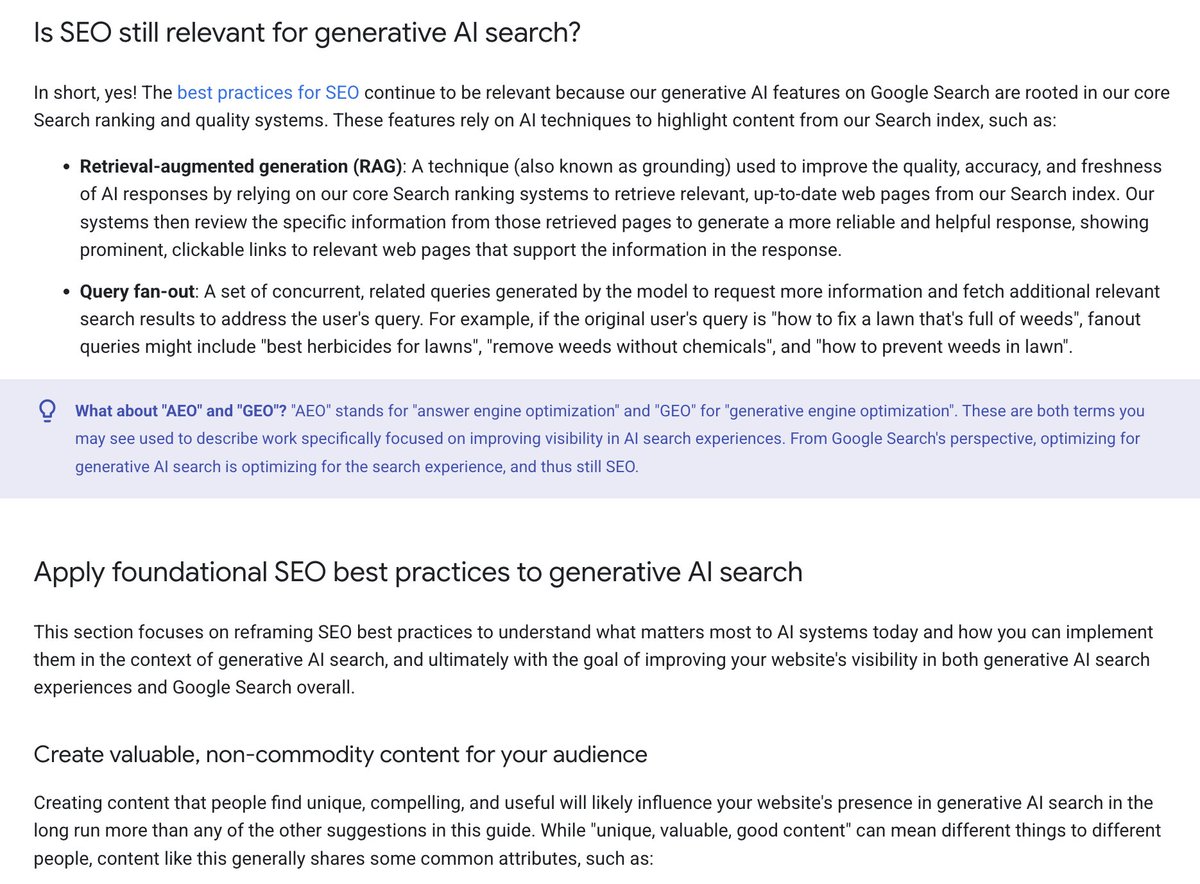
🚨 Google has published its official guidance on optimizing for generative AI experiences in Search, including AI Overviews and AI Mode 👇 Going through:
1. How SEO is still relevant for generative AI search:
The best practices for SEO continue to be relevant because their generative AI features on Google Search are rooted in our core Search ranking and quality systems.
2. How to Apply foundational SEO best practices to generative AI search:
** Creating valuable, non-commodity content for your audience: Providing a unique point of view, Creating non-commodity content that's helpful, reliable, and people-first, Organizing content in a way that helps your readers, adding high-quality images and video, focusing on what your users want, and avoid overdoing it.
** If you're using generative AI tools to assist in content creation, be sure that your work meets the standards of the Search Essentials and our spam policies.
** Building and maintain a clear technical structure: meeting the Search technical requirements, following crawling best practices, focusing on human readability and don't worry about perfect HTML code, if you're using JavaScript, be sure to follow JavaScript SEO best practices, providing a good page experience, reducing duplicate content.
3. Mythbusting generative AI search: what you don't need to do
Things you can ignore for Google Search:
** LLMS.txt files and other "special" markup
** "Chunking" content:
** Rewriting content just for AI systems
** Seeking inauthentic "mentions"
** Overfocusing on structured data
4. Explore agentic experiences
AI agents are autonomous systems that can perform tasks on behalf of people, such as booking a reservation or comparing product specifications, they can take many forms; for example, browser agents may access your website to gather the data they need to complete these tasks, such as analyzing visual renderings (like screenshots), inspecting the DOM structure, and interpreting the accessibility tree.
Check out the available agentic experiences and review the guide to agent-friendly website best practices recently published here: web(.)dev/articles/ai-agent-site-ux
Read the full Google guide here: developers(.)google(.)com/search/docs/fundamentals/ai-optimization-guide
PS: This is by far the most in-depth, actionable guide that Google has published so far for AI search, tackling some of the major misunderstandings and myths SEOs face in the day to day... thank you @googlesearchc team 🙌
Google just put out its first official article on optimizing for AI search (AEO/GEO)!
TL;DR:
⭐️ SEO is still the foundation for AI search.
⭐️ Create non-commodity, "people-first" content.
⭐️ Ignore most "GEO/AEO hacks like chunking and llms.txt.
https://t.co/RbUOOPFl2I
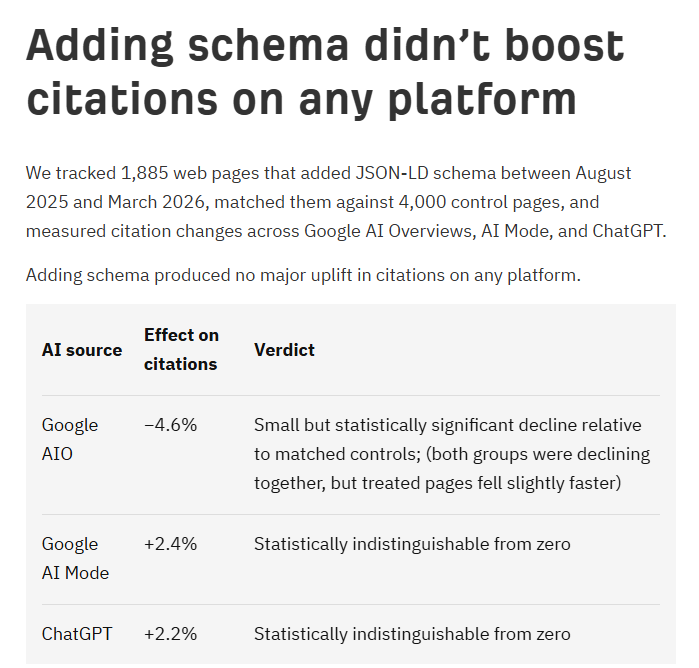
Interested in Schema impact on AI citations? Here's the latest study from @ahrefs -> We Tracked 1,885 Pages Adding Schema. AI Citations Barely Moved
"We tracked 1,885 web pages that added JSON-LD schema between August 2025 and March 2026, matched them against 4,000 control pages, and measured citation changes across Google AI Overviews, AI Mode, and ChatGPT. Adding schema produced no major uplift in citations on any platform."
https://t.co/cinIs15p9M
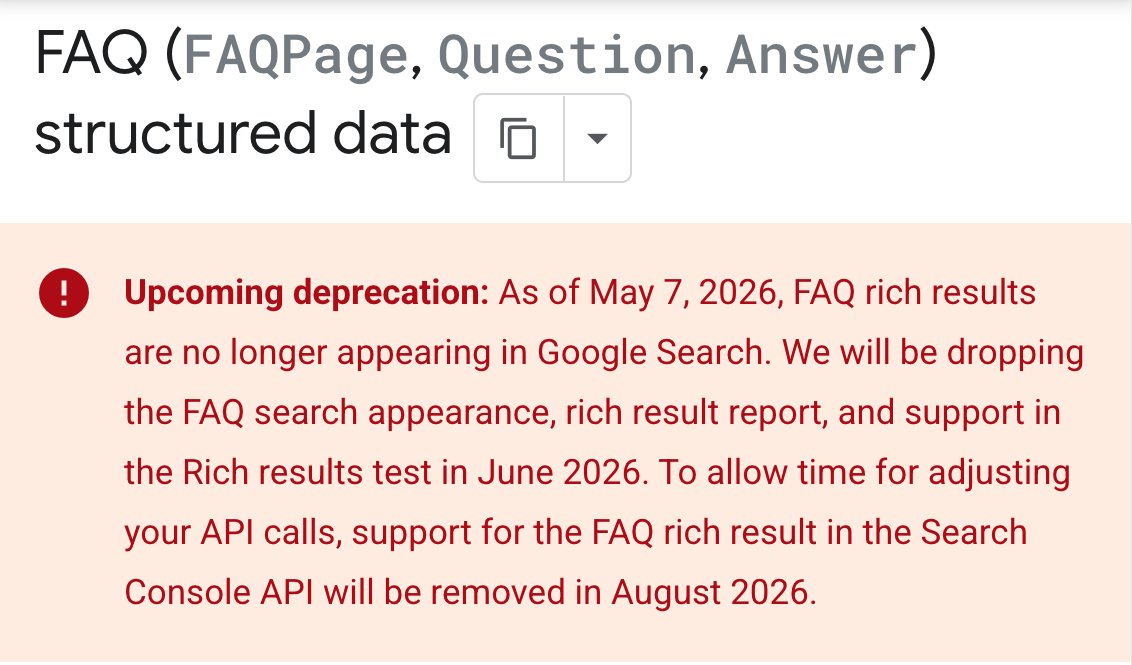
You may have heard by now that Google is dropping support for all FAQ rich results
So, should you remove all FAQs from your content?
No. No. And probably not.
Google previously stopped showing FAQs for the vast majority of publishers in August 2023, except for a handful of high-authority government and health sites. This means most of us weren't seeing the search results benefits from FAQs for ages now.
That said, there's plenty of evidence that *answering relevant questions with helpful content* CAN help your SEO visibility:
- A recent experiment by @SearchPilot showed a 9.7% increase in organic traffic after adding page-specific FAQs
- A study last year via @AlsoAsked found a strong, positive correlation between Google ranking and pages that fully answer "People Also Ask" questions. Note: this isn't exactly the same thing as FAQ, but the concept is similar
- Related but relevant: An earlier 2024 study from SearchPilot removed FAQ Schema—but kept the content—and found no negative impact on ranking
In the past, we favored the FAQ rich results to drive extra traffic. But if the content is good and solves user problems, that can be a benefit too.
My 2¢: Remove the FAQ Schema if you want. SEO plugin vendors should remove it as an option.
But by all means, LEAVE THE CONTENT IF IT'S HELPFUL. In fact, consider answering additional questions if you don't already.
Happy FAQ'ing
🔥 Great news for Websites: @Google is releasing new updates to AI Mode and AI Overviews to find relevant websites, deep insights and original content from across the web 👇
1. Explore new angles: You’ll start to see suggestions for where to go next at the end of many AI responses. This section links to unique articles or in-depth analyses on different facets of your topic.
2. See links right where you need them: To help you dig deeper into useful websites as you’re reading, you’ll now also see more links directly within AI responses — right next to the relevant text.
3. More UGC! Get advice from people who have been there: AI responses will now include a preview of perspectives from public online discussions, social media, and other firsthand sources. They're adding more context to these links, like a creator’s name, handle, or community name, etc.
4. Get more context on linked websites: They're now giving you a quick preview of a website when you hover over an inline link in AI experiences on desktop. You’ll see helpful information, like the name of the website or title of the web page, so users have a better idea of the site to help click through.
5. Easily access your news subscriptions: A new feature that highlights links from your news subscriptions in AI Mode and AI Overviews. Subscription linking information for publishers can be found here: https://t.co/cE8MrTaR2M
--- These look like useful new releases that should improve referrals towards sites 🙌
Read more here: https://t.co/zS33qsilwH - can't wait to see the impact 👀
/ht @rmstein
I am excited to share a virtual recording of my talk from #MozCon last week titled:
GEO, AEO, LLMO: Separating Fact from Fiction & How to Win in AI Search
Check it out!
https://t.co/Q7wqcDghRE
Definitely one of Google’s most aggressive and deceptive updates in terms of how much sponsored results now look exactly like organic results
And that’s saying a lot
Def will lead to even lower CTRs.
Not to mention AIO, Web Guide etc.
@GoogleMyBiz we've got the wrong postcode showing, but it's correct in our admin dashboard. I've tried contacting support and messaging on the forum many times but getting nowhere. Any advice?
AI-generated content without human value-add is a dead end strategy!!! especially as search engines and users get better at detecting it.
The most successful content approaches are treating AI as a tool rather than a replacement for human expertise. It might help identify topics, or create outlines, but the unique insights; experiences, and perspectives need to come from real people.
The fundamental question content creators should ask is: "What am I offering that someone couldn't get directly from ChatGPT?" If there's no good answer, the strategy needs rethinking.
Another great reminder is that AI-generated content is a Mediocre Engine!!! It generates the average, most middle-of-the-road content on a particular topic. AI content is the ultimate averageness machine. <--Producing what neither search engines nor humans value: content that adds nothing new to the conversation. It regurgitates the same information, perspectives, and structures already saturating the internet.
Hot take: AI writing is LLMs' worst capability, LLMs are way better suited for other tasks like sentiment analysis, summarization, topic identification, Q&A, etc.