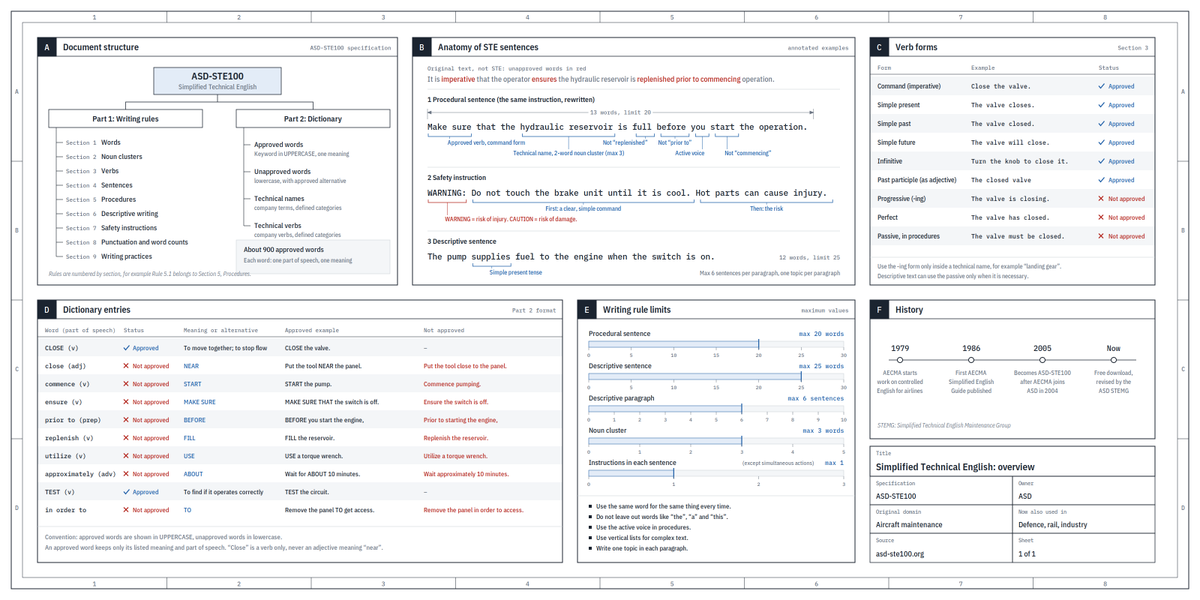
I had no idea what ASD-STE100 was.
So I asked Claude to make me an explainer video. Script, animation, voice. I didn't edit a thing. This is what it made 👇
We'll be spending a lot more time trying to understand the outputs of language models. A few thoughts, tips & tricks:
Writing. Something I've had success with: Ask your LLM to explain something in ASD-STE100, it's a controlled language specification originally developed for aerospace maintenance documentation. LLMs well-versed in this language and it comes with heavy constraints on clean writing style that I often find a lot more readable. Sometimes I've tried to soften it a bit e.g. ask for "80% of the way to ASD-STE100" because the spec is quite stringent. But even better:
Diagrams / images. Instead of writing, ask your LLM to create a diagram. These can be a lot easier to process, parse, and understand. But even better:
Web pages. Ask for output "in HTML" to get a beautiful, interactive webpage. LLMs are getting really good at frontend and can create beautiful experiences, animations, etc. But even better:
Explainer videos. The output format I am most bullish on is fully custom / bespoke explainer videos generated on any arbitrary topic. Experiment with things like "Create a 3b1b style video explainer on X. Use my ElevenLabs API key for audio narration". (you'd need an API key for the latter or you can ask your LLM to find you decent free alternatives that use your local compute). This is actually starting to work!
In summary:
- As LLMs get better, they will do more and more of the legwork autonomously, and a lot more of our work will rise up the abstractions into oversight and understanding.
- Luckily, LLMs can help here too because as intelligence and code are increasingly abundant, you can ask for large, custom, discardable software artifacts (e.g. web apps, video explainers) that would have never made sense to create before. Push the boundaries here and you'll be surprised.
Dota 2 is 13 years old.
But what keeps people coming back?
I made a 5-minute video tracing its history from a Warcraft 3 map to Valve’s longest-running battles.
https://t.co/I7HSdH6cpn
Announcing dots. Dots work 24/7 for you, learn from your feedback, have their own computer, browser and can be connected to over 4k apps in our ecosystem.
They’re powered by Astra our best model yet. Included in your Pro plan, without drawing down on any of your usage. You can even call a dot while it’s working.
We’re getting you started with your primary dot today and soon you’ll be able to create entire teams of them.
Facts in the video: Booster 21 + Ship 41 on Pad 2, 124 m stack, 33 × 250 tf Raptor 3s (~8,250 tf), 5,000+ t of propellant, ~6 orbits in ~10 hours, Starbase now ~8,100 acres after this week's annexation.
Voice: ElevenLabs. Script + visuals: Claude.
I asked Claude to explain Starbase before tomorrow's launch.
It researched Flight 14, wrote the script, and wrote the code that drew every frame of this.
124 m tall. 33 Raptor 3s. 26 Starlink V3s on board. First try for orbit.
Monday, 7:15 AM Central 🚀
@SpaceX@elonmusk
Facts in the video: Booster 21 + Ship 41 on Pad 2, 124 m stack, 33 × 250 tf Raptor 3s (~8,250 tf), 5,000+ t of propellant, ~6 orbits in ~10 hours, Starbase now ~8,100 acres after this week's annexation.
Voice: ElevenLabs. Script + visuals: Claude.
Here, the edge of my understanding of suffering:
As I've worked to dismantle psychological conditioning, I've noticed the following cycle. First, a sense of stuckness or badness arises, due to a particular combination of external circumstances and internal conditioning. If this is approached using some therapeutic technique (eg IFS, imaginal dialogue), and the underlying emotions are resolved, then the badness tends to dissipate and leave a sense of blankness. I interpret this as an old, fixed structure in the mind dissolving, and the systems that generate meaning, motivation, and action struggling to figure out what to do in a new emotional landscape. Eventually (hours to days) the blankness passes, and leaves a raging energy and impulsivity. This too fades in hours to days, leaving a sense of liberation from the need to do anything at all.
After fifty or sixty of these cycles, some strange things started to happen. Unpleasant memories started to arise spontaneously, one by one every hour or two for days at a time. Many of these were things I had “forgotten”, and often they would make me flinch when they arose. I guess this is memory reconsolidation happening spontaneously? Probably because after so much inner work the mind starts to feel that it’s safe to bring up those things, as it expects the conscious mind will meet them compassionately. The really strange thing is that these memories, upon arising, distinctly feel like they’ve always been there, coloring the way I view the world but hidden from conscious awareness. As this progresses I became noticeably less reactive (from a baseline of already feeling fairly non-reactive). My memories of the past became really fuzzy, which is strange because I used to have video-like play by play memories of all kinds of things. Also I started to notice my vision becoming very detailed and colorful and expansive - not more focused or clearer, but more luminous, saturated, and beautiful. Even looking at a leaf has become deeply pleasurable. This feeling comes and goes but corresponds especially with the end of the “blank” phase in the cycle above. Finally, the sense of self-consciousness or embarrassment has basically vanished, which gives me much more range of expression in social settings.
As this progressed I started to recognize that when I experience suffering, it always leads to a related memory coming up later. So I guess the suffering is caused by the memory being combined with or overlaid on the present. But it’s not just the expectation that something bad will happen in the real world because it happened in the past - I think a large part of it, or possibly all of it, is the expectation that something bad will happen internally, most commonly some form of self-betrayal or self-coercion.
Why betray oneself? I think probably because one comes to the reasonable conclusion that compromise is necessary in order to bring about desirable external conditions. But since it seemed like betrayal or internal fracture was the root of suffering, I got interested in what would happen if I just committed to always doing what felt right all the time. Disclaimer I have really excellent impulse control and executive function and self-awareness at this point so I have no idea if this is going to lead to positive outcomes in general. But it turned out that as I made a point of not managing my life every time the impulse to manage it arose, the above cycle continued. Instead of energy, though, it led me in a direction of devotion, or submission, to things that matter more than me. Simultaneously the sense that I am doing anything in my life, and the sense that I have to do anything, is noticeably diminished. It’s a bit of a paradox - if something matters more than you, shouldn’t you be going to great lengths to express that? But I don’t see that happening. The kind of devotion that arises naturally is simple and quiet. It seems that as long as I make choices that are internally aligned as they come up, I am not really “on the hook” for anything else, and as I get more aligned, the parts of my mind that are controlling and planning and managing just drop away. The future feels unreal and insubstantial.
This all sounds great but to me it’s a powerful indictment of our society and overall philosophy of life. We take for granted the notion that you’re supposed to be able to formulate and execute plans, behave consistently, and operate as part of large, rigid systems. In fact not being able to do that is often classified as pathology. But rigidity and regularity are often the source of self-betrayal and self-coercion, which (at my current level of understanding) form the core of suffering. You can have all the freedoms you want on paper but if you’re not free to act according to moment-to-moment feelings I don’t think it matters. The bait and switch is creating a “free” society but installing guardrails within peoples’ minds instead. The cool thing is that you can still develop that freedom, but of course it’s a lot of work to undo social conditioning, and it could result in terrible consequences.
The inner investigation has reached a natural conclusion now because it seems to be running in the background - the memories come up, less often now; I get random insights into how some big thing in my mind was a story constructed from smaller things, and that goes away; and so on. I think the open question for me is “what now?” - what is worth doing? is this all there is? should I become a monk? (mostly joking) and various things along those lines.
o yes… we’re back in action and we’ll reset usage limits for all paid users across codex and ChatGPT work
sorry about the brief disruption!
(and yes we have a special spare codex when things are down to help us out)
v42.20 just dropped some long-asked UEFN / Creative wins:
• Unarmed punch + shove (1st & 3rd person — no more melee workarounds)
• Channel API: custom voice/text channels, mute squads, trigger events on speech
• Widget Preview in-editor — test UI without launching a session
• Player Movement Device limits way up (sprint 2k → 11k)
• Like/Dislike on the Discover details page
• Consoles can finally join PC Live Edit sessions
Notes: https://t.co/Hk0XinA2T4
After co-inventing ChatGPT, I kept asking myself: why have superhuman chat models not led to AGI?
I’ve spent the last 2 years in stealth building a new way to train models (RLCD), and a new type of frontier AI model that we are releasing today: Jev
• 20-200x faster
• 40-400x cheaper (w/ output tokens free)
• Frontier composable intelligence optimized for decisions
AFAICT the shortest path to AI-based economic revolution
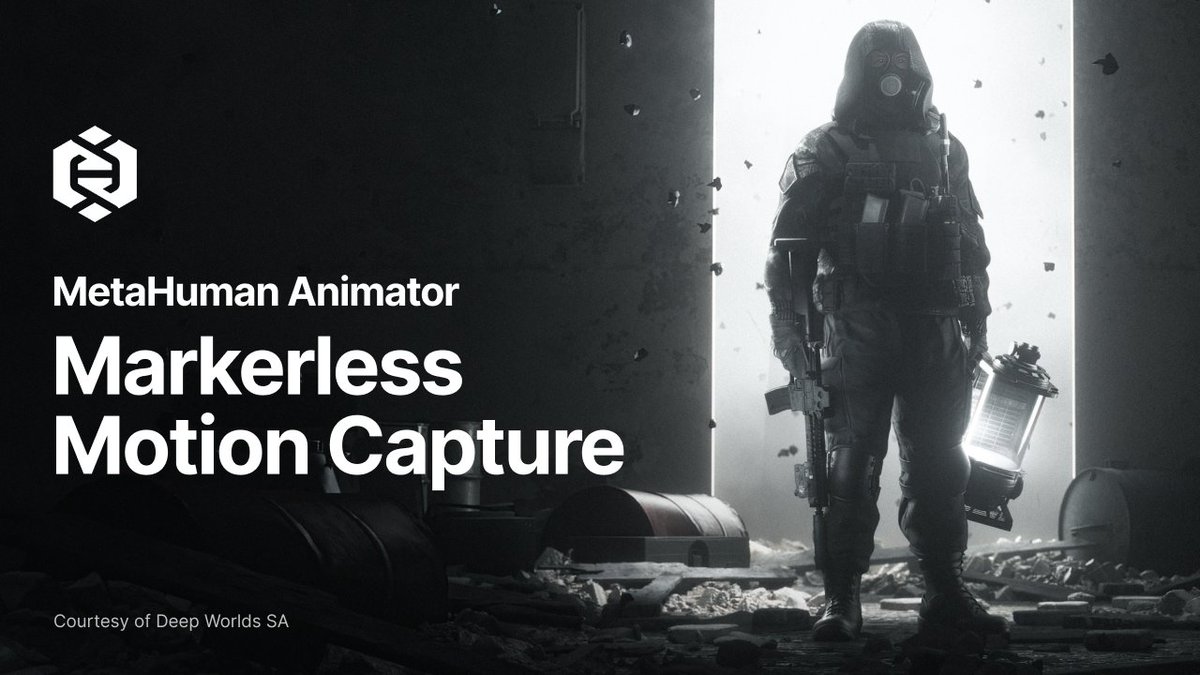
Learn how to turn your own video footage into high-quality MetaHuman animation in Unreal Engine with Markerless Mocap 🎥
From preparing your footage to generating and refining your final animation, follow the complete workflow with the Epic Games Education team and get more out of your character animations.
Watch the full session here: https://t.co/dBYWT6ioPF
Learn how to turn your own video footage into high-quality MetaHuman animation in Unreal Engine with Markerless Mocap 🎥
From preparing your footage to generating and refining your final animation, follow the complete workflow with the Epic Games Education team and get more out of your character animations.
Watch the full session here: https://t.co/dBYWT6ioPF