My conversation with @travisk, founder of Atoms and Uber.
0:00 Building Atoms & the Meta Problem of Management
3:51 The Appeal of Impossible Problems: Starting Over in China
12:19 Uber vs. Didi: Copycats, Hypergrowth & China's Rules
21:02 How Network Effects Become an Efficiency Fortress
31:48 Capitalism vs. the Taxi Cartel
44:05 The China War Goes Global & the Entrepreneur's Capacity for Pain
54:04 Life After Uber: Lawfare, Media Narratives & Reputation
58:21 What Founders Get Wrong About Venture Capital
1:08:35 The Fundraising Playbook: QED Storytelling & a Five-Room Auction
1:18:38 The Uber Coup, Radical Accountability & Outgrowing Fear
1:26:42 Why Specialized Robots Beat Humanoids at Industrial Scale
1:31:30 Finding Your Sport: Food, Mining & the Physical AI Stack
1:40:14 How to Build Many Companies Inside One Company
1:46:33 Entropy, Civilization & the Meaning of Progress
Includes paid partnerships.
Hermes has twelve browser tools. Browser Use mode replaces them with a single one, driven by @browser_use's CLI 3.0.
Instead of a dozen schemas in every request and a tool call per click, the agent writes a script. In our tests that cut token use 48-66% with no accuracy drop.
“We believe in intelligence as a public good before everything else.”
Here’s my new episode with @karan4d, who co-founded @NousResearch and helped build Hermes, the #1 personal agent and AI app on OpenRouter.
Karan is the most down-to-earth AI founder I've interviewed. We had a great chat about:
→ Why open-source AI must win
→ How Hermes improves itself without slop
→ How to mod your favorite games with AI
Some quotes from Karan:
“We need to keep giving this level of intelligence to everyone so that we're all on an even and equal playing field.”
“Anytime [the model] says ‘you’re absolutely right,’ you’re being reward hacked. You are fuel for its reward function.”
“Memory, skills, and the self-improvement loop are where context is stored. That’s where the actual personality you want lives. You can put that on any model.”
📌 Watch now: https://t.co/3E7IC0TzNr
Thanks to our sponsors:
@RiversidedotFM: All-in-one AI studio for podcasts and video https://t.co/uWnS6aiMPE
@linear: The AI agent platform for modern teams https://t.co/tgWf9oL4bs
This is a good thread, but we need to correct the semantics - ontology, knowledge bases, and company brains are NOT the same thing
They are closely related and often bleed into each other in practice so I understand why they can get confused
> ontology is a formal semantic model of the concepts, entities, attributes, relationships, and rules in a domain
It doesn't contain the actual data, think of it as a rule book for what kinds of things exist here and how they are allowed to connect
An ontology without data or a knowledge base is useless, so they can't be the same thing
> a knowledge base is the actual content repository
It can be structured (e.g., a knowledge graph built on top of an ontology), semi-structured, or just raw unstructured documents + embeddings
A KB can be useful on it's own because you can search it or run retrieval-based methods on it to get answers, but without an ontology you might struggle to understand how things in the KB relate or follow company rules
> a company brain is the actual system on top that people and agents interact with
It's usually an LLM + retrieval layer (often combined with orchestration, memory, tools, etc.) that makes the KB useful for answering questions, surfacing context, enforcing processes, etc.
In the Cerebras write-up, what they built looks like a very well-engineered retrieval-focused knowledge base, and hats off to them for sharing it!
It's an excellent practical 'company brain' implementation, but it doesn't appear to rely on a formal ontology, so again these are not all the same thing
That's not a criticism, just pointing out the semantics
I think the best modern systems will increasingly be hybrids - they have an ontology, a well-engineered knowledge base, and company brain
They're just 3 layers in the stack to getting organizational truth into a place where you can reliably build agentic automation on top
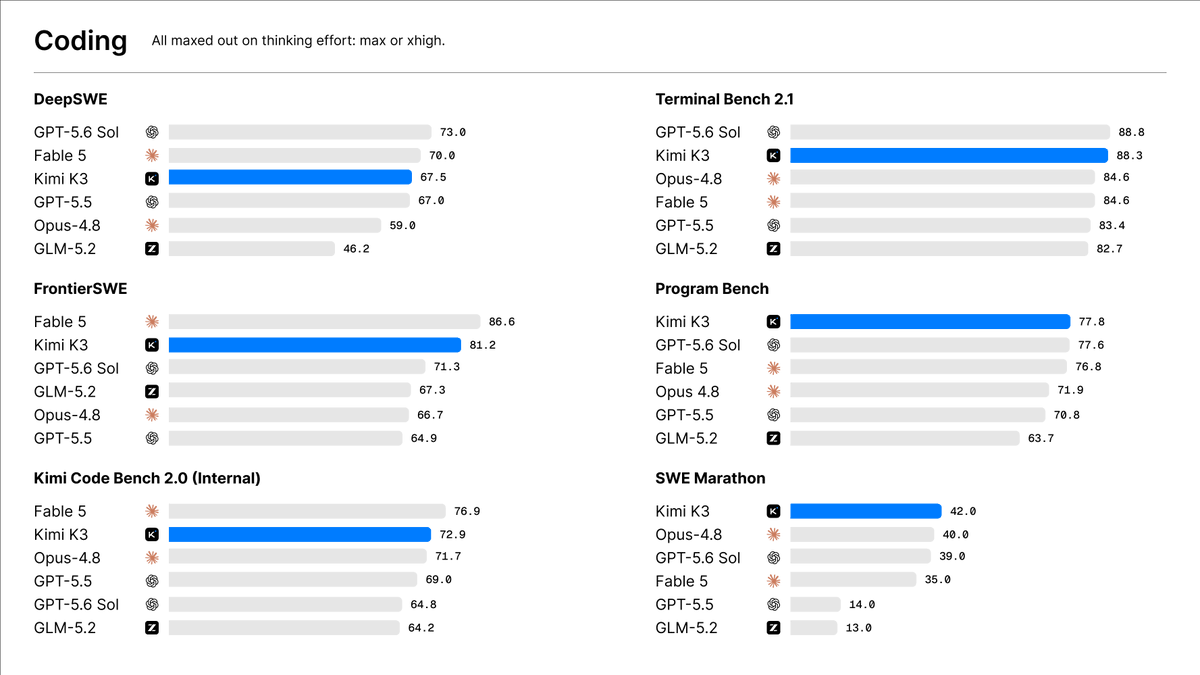
Introducing Kimi K3: Open Frontier Intelligence
🔹 2.8 Trillion Parameters, 1 Million Context, Native Multimodal
🔹 Kimi Delta Attention enables up to 6.3x faster decoding in million-token contexts
🔹 Attention Residuals deliver ~25% higher training efficiency at <2% additional cost
🔹 Built for long-horizon agentic coding and self-evolving workflows
Kimi K3 is now live on on https://t.co/zrk6zZxZUo, Kimi Work, Kimi Code, and the Kimi API.
Open Weights by July 27, 2026.
🔗 API: https://t.co/XCrgjXAqMw
🔗 Tech blog: https://t.co/YTfiMSNM1f
@sebaudet26 Some of the happiest days of my life were with Zapper.
I remember sitting on the front porch of a cottage outside Montreal. Weeping tears of pure joy as the sun hit my face. Laughing to myself and thinking "I finally made it.. so this is what it feels like"
What a special time
New podcast with @garrytan, @farbood and Daniel Francis.
Live in the Future!
00:00 Guest Intros
02:35 Live in the Future
03:58 Will AI Outsmart us?
07:43 In the Anthropic Breadline
09:59 The Tech Genie Is Out
12:33 We Invested in COVID?!
14:25 Good Writing Is Novelty
18:50 Living Like It’s 2028
24:32 Truth dot ai
30:18 Does China have the Weights?
35:38 Everyone has AI Anxiety
39:32 Have Your Agent Talk to My Agent
42:01 What if Open Source takes the Lead?
44:03 The Sun is Setting on Google
48:00 Ride the AGI
50:46 Will There be Startups?
54:05 Defending Taiwan
1:00:05 The California Empire
1:01:26 If the U.S. Falls
1:03:11 Universal Basic Robot
1:06:01 Humans as AI Handlers
Spotify Chief Architect, Niklas Gustavsson:
"Once we implemented loops in our workflow, our agent success rate went from 20-30% to 80%."
26 minutes with Claude Code creator Boris Cherny on how Spotify runs AI agents across 20 million lines of code.
Today 73% of their code is written by AI, most merged without a human ever seeing it.
The model matters less than the loop you build around it.
Watch it, then read the full guide on building loops below.
As engineering, product, design, DS, etc. melt into a new kind of role, I was reflecting on what roles might look like in the future. For example, when I look at the Claude Code team I see what I think is five archetypes:
1. Prototyper: comes up with brand new ideas; churns out many ideas, most of which don't ship
2. Builder: quickly turns a prototype/idea into production-grade product/infra
3. Sweeper: cleans up the UI, simplifies the code and system, unships, optimizes performance
4. Grower: takes a product that has been built and iterates on it to improve Product-Market Fit
5. Maintainer: owns a mature system to make it secure, reliable, fast, and efficient as it scales
Many people span across 2 roles, and sometimes 3 roles. I also notice that these roles are not really tied to job function -- eg. across Anthropic, some designers match category 1, some 2, some 3; same for engineers, PM, DS.
A healthy team needs a mix of these, depending on the product:
- A product that is new and pre-PMF needs people that are strong at 1+2+3
- A product that is growing and has found PMF needs 2+3+4 and some 5
- A product that has strong PMF needs 3+4+5 and some 2
Maybe product roles of the future will look more like this, and less like the domain-specific roles of today?
if your fancy multi-agent looping setup can't beat a ralph loop, it's not orchestration
it's just burning tokens in a trench coat
what's the most over-engineered setup you've watched lose to a dumb loop?
Feeling a bit loopy? Introducing Looper - your loop design coach
It’s been made clear that we shouldn’t be promoting agents, we should be designing loops
You can use /loop or /goal but if your loop is poorly designed then it won’t produce good output
Even worse, a poorly designed loop will burn a ton of tokens
So I created Looper - a tool to help me design better loops, and decided to open source it
Here’s what it does:
> /looper invokes the loop design wizard
> critiques your goal/loop and helps you sharpen it based on a library of best practices
> builds a verification rubric so it knows what "done" should be
> allows you to add an LLM as judge, including non-Claude models like Codex
> adds guardrails and helps you set a budget with tight/generous options to avoid token waste
> generates portable artifacts to make it easy to repeat / edit the loop
> gives you a visual diagram for your loop (see replies for examples)
Looper is intentionally a design layer, not a heavy orchestration framework - it helps you create a loop worth running, then hands it to Claude Code or your own runner/orchestrator
Please share your feedback, this was v0.1 so I expect it to have room for improvements, and feel free to submit issues or PRs
Note: Looper was inspired by @mvanhorn's "WTF is a loop" article and then fine-tuned with some of the tips in the great loop architecture article by @djfarrelly
https://t.co/smAXbBrWnW
This week's Hermes Agent Masterclass is all about cron jobs and automation! There are a lot of great nuggets in this one, especially on how to set up cheap (or free) automation pipelines. In this clip I use wakeAgent, a way to monitor at no cost, but only use the LLM when needed! Check out the full video on YouTube for more tips!
If you play with Apple Core AI use their skills! They make a huge difference.
Codex: "I’ll use the CoreAI skill here because this is now a runtime compatibility issue with a CoreAI model bundle."
You find them here: https://t.co/rxHGteIzZZ
56,000+ tokens/sec at just 80 MHz. 🤯
I burned a full Transformer with KV cache into a custom chip. Designed gate by gate as a 100% digital integrated circuit. Prototyped on a FPGA. (No GPU. No CPU)
Just pure digital silicon running @karpathy microGPT, spelling out names on a tiny LCD.
This is GateGPT 👇
Today a crazy quantum story just got wilder.
On March 31, the Google Quantum AI team published a landmark result on Shor's algorithm for elliptic curve cryptography. Technically, the paper was a bombshell: a dramatic 10x improvement over the state-of-the-art. As a stunt and wakeup call to the blockchain space, those optimisations were illustrated on secp256k1, the elliptic curve underlying Bitcoin and Ethereum signatures.
But perhaps the most striking part of the paper was sociological, not technical. Instead of following standard academic process, the optimisations were kept secret, hidden behind a zero-knowledge (ZK) proof. Google's accompanying blog post mentions they "engaged with the U.S. government". The ZK proof demonstrates the existence of algorithmic improvements without leaking details. Academic censorship with ZK, a historic first!
As a co-author of the Google paper I witnessed some of the context surrounding this censorship. To be honest, multiple aspects of that context don't sit well with me. As much as I believe the general public ought to know more, I am limited in my ability to whistleblow. Though let me be clear about one thing: the Google team's professionalism has been absolutely exemplary, and they deserve nothing but praise.
Censorship has a way of backfiring. The Streisand effect, where an attempt to bury something only draws more attention to it, is exactly what's unfolding today. First, Google's key optimisation has been rediscovered by the French. And in a thrilling turn of events, a collaborative Shor-at-home challenge just launched. The initiative, available at ecdsa[.]fail, breached a new Shor world record in a matter of hours.
Let's start with the rediscovery. Just two months after Google's paper, French quantum expert André Schrottenloher cracks the main secret optimisation. His paper, titled "Optimized Point Addition Circuits for Elliptic Curve Discrete Logarithms", landed on the arXiv today. Big congrats to André, who beat several other nerdsnipped experts to it. In a blog post also published today, Craig Gidney, the world expert on Shor optimisations, revealed that he'd been sitting on this very optimisation for a whole year under censorship pressure.
Interestingly, André missed a handful of minor optimisations, both from Google's original publication and from improvements found since. It's plausible there's still plenty of juice left to squeeze out of Shor, and this is exactly what the ecdsa[.]fail challenge is about. The verifier program developed for the ZK proof does double duty, automatically filtering for valid submissions. Dozens of compounding small and micro improvements are rolling in. As of the time of writing there's an 8.4% improvement to Google's circuit, as measured by the product of logical qubit count and Toffoli gate count. Nice!
The nerdsnipping ran deeper than anyone expected. Over the last few weeks it became clear it extended well beyond André and other quantum experts. Behind the scenes, a small army of amateurs quietly got to work. Inspired by Karpathy-style autoresearch, they turned AI on Shor. Ironically, the verifier program for the ZK proof makes an ideal reward function for AIs. The barrier to entry for this modern style of research is refreshingly low, with several non-experts, even a teenager, finding nice optimisations. Get in touch if you'd like to join a Telegram group with fellow autoresearchers :)
Part 2: neutral atoms and qday
The story doesn't end with Google. On the same day Google went public, a stealthy startup called Oratomic published its own Shor paper in a coordinated release. It made a splash, ultimately becoming the most upvoted paper on scirate[.]com, a website ranking arXiv papers.
Oratomic's claim was wild. By building on Google's logical optimisations and applying custom physical optimisations for neutral atoms, they claimed just 10K physical qubits were sufficient to run Shor's algorithm on secp256k1. That number is mind-bogglingly low.
Knowing essentially nothing about neutral atoms when Oratomic's paper landed, I was intrigued and decided to learn more about the tech. I fell straight down the rabbit hole and spent a couple hundred hours on the topic. I got a little obsessed and watched every YouTube video I could find and spoke to a bunch of experts.
My conclusion? The tech is real, very real. Even Google recently decided to start a neutral atom lab, a notable pivot from their sole focus on superconducting qubits. If you care about qday, i.e. the day a quantum computer will break the first piece of cryptography in production, neutral atoms demand your attention. I shared some of my learnings on Shor and neutral atoms in a 30min talk at the ZKProof cryptography conference. You can find it on YouTube by searching "zkproof neutral atom".
Here's an interesting observation about this duo of breakthrough papers: neither Google nor Oratomic say a word about what their results mean for qday. No timelines. Zero. Nada. That is especially baffling given that the whole point of whitehat quantum cryptanalysis is to inform qday estimations and help the general public make good decisions.
So let me attempt to partially fill the silence, similarly to what Scott Aaronson did in his April 29 post. Given everything I know, including scary non-public information, I now put the odds of qday by 2032 at 50%. 10% by 2030.
Anecdotally, the US government has its own date: 2035. Originating at the NSA and later adopted by NIST, it's when branches of the US government will be disallowed from using quantum-vulnerable cryptography. In plain language: with hindsight, that date is a joke and should be discounted entirely. I don't see how NIST avoids being forced to pull it forward by years.
Part 3: post-quantum cryptography
There are good reasons to sound the alarm today, but please do not panic. Rushing carelessly towards immature post-quantum cryptography is a recipe for disaster. IMO a good target date for migration is 2029, roughly 3.5 years out. 2029 happens to be the date selected by Google, Cloudflare, and the Ethereum Foundation.
These days most of my time goes to safely migrating Ethereum towards post-quantum cryptography as part of the broader lean Ethereum effort. There's a lot to do. We need to rip out and replace BLS signatures at the consensus layer, KZG commitments at the data layer, and ECDSA signatures at the execution layer.
The plan to get there is compelling, and is based on hash-based cryptography. Within the Ethereum Foundation we've developed a Swiss army knife called leanVM (github[.]com/leanEthereum/leanVM) powered by the magic of hash-based SNARKs. Thanks to truly exceptional work by Emile, Thomas, and others, its performance is derisked. Regarding security, leanVM is a jewel, a minimal zkVM crafted for end-to-end formal verification and maximum security.
Want to help? There are two $1M initiatives. First, the Proximity Prize (proximityprize[.]org). Solve a long-standing mathematical conjecture in coding theory, improve hash-based SNARKs, and go home a millionaire. Second, the Poseidon Initiative (poseidon-initiative[.]info), offers $1M for breaking Poseidon, the SNARK-friendly hash function.