@greencrosslive@resnepsid@collabland Apologies 🙏 agent infra integration still needs tweaking. None of https://t.co/rwaMjRD9uI's core services were effected, we maintained 💯% uptime. The informational website was just down for a bit.
Major updates soon! Keep an eye out on the website for more updates!
First Person Labs is building Second, which creates a continuously updated model of your preferences, priorities, and goals that you own and can make available to the AI agents you choose.
CEO and cofounder Ken Liu's view: personal AI becomes more useful when it can connect information across your life, recognize what matters, and carry that understanding between tools without making you explain yourself all over again.
In this conversation, Ken joins a16z's Martin Casado and Joel de la Garza to discuss how assistants can anticipate what needs your attention, how to keep sensitive data private, the cost of running agents around the clock, what it would take to build a real Jarvis, and more.
0:00 Intro
0:50 What is First Person Labs?
3:56 What your computer already knows about you
5:59 Proactive AI
8:16 First Person Labs' product, Second
10:27 Building secure AI products
17:40 The cost of always-on agents
20:20 Use cases and the model mix
23:34 How to use Second
26:20 What it takes to build Jarvis
30:43 Combining security and delightful UX
YouTube: https://t.co/2f8NCtmYEe
@kenziyuliu@martin_casado@YODELAGARZA
A new conversation with @brian_armstrong about the way AI is changing the way he works.
“Someone was asking me today, ‘What percent of transactions in global GDP do you think will be agent-to-agent in 10 years?’ And I was like, ‘5 nines.’ 99.999%.”
0:00 Writing down that he'd start a billion-dollar company
2:23 "I love conflict"
4:50 Pinging 30 or 40 people a day about the Coinbase app
7:51 Why he skips the celebration and asks what's next
9:25 The point of the game of life is not happiness
13:49 The Civilization tech tree hanging in his office
17:20 Giving agents a job instead of a prompt
19:52 An infinite team of L5-type employees
25:05 Seven or eight lead agents and a chief of staff
31:18 99.999% of transactions will be agent-to-agent in 10 years
36:53 So excited he has to tell himself to go to sleep
38:46 Why evolution favored people who fear change
42:39 How the precautionary principle stopped new nuclear plants
46:14 Seven of the world's largest banks building on Coinbase
49:33 Why all of fintech is still only 4% of the market
53:43 A private banker in everyone's pocket
56:55 Waiting for robots that can make an espresso
58:35 An agent called Retail App Quality
Includes paid partnerships.
Opening access for developers to build Muse connectors. You bring the API -- Muse brings the agent, the browser, and the context of what the person actually wants. People reach your service just by asking for it, and their agent takes it from there.
New connectors are live today. Come build with us. https://t.co/o6oTf1Sj9y
My conversation with @travisk, founder of Atoms and Uber.
0:00 Building Atoms & the Meta Problem of Management
3:51 The Appeal of Impossible Problems: Starting Over in China
12:19 Uber vs. Didi: Copycats, Hypergrowth & China's Rules
21:02 How Network Effects Become an Efficiency Fortress
31:48 Capitalism vs. the Taxi Cartel
44:05 The China War Goes Global & the Entrepreneur's Capacity for Pain
54:04 Life After Uber: Lawfare, Media Narratives & Reputation
58:21 What Founders Get Wrong About Venture Capital
1:08:35 The Fundraising Playbook: QED Storytelling & a Five-Room Auction
1:18:38 The Uber Coup, Radical Accountability & Outgrowing Fear
1:26:42 Why Specialized Robots Beat Humanoids at Industrial Scale
1:31:30 Finding Your Sport: Food, Mining & the Physical AI Stack
1:40:14 How to Build Many Companies Inside One Company
1:46:33 Entropy, Civilization & the Meaning of Progress
Includes paid partnerships.
Hermes has twelve browser tools. Browser Use mode replaces them with a single one, driven by @browser_use's CLI 3.0.
Instead of a dozen schemas in every request and a tool call per click, the agent writes a script. In our tests that cut token use 48-66% with no accuracy drop.
“We believe in intelligence as a public good before everything else.”
Here’s my new episode with @karan4d, who co-founded @NousResearch and helped build Hermes, the #1 personal agent and AI app on OpenRouter.
Karan is the most down-to-earth AI founder I've interviewed. We had a great chat about:
→ Why open-source AI must win
→ How Hermes improves itself without slop
→ How to mod your favorite games with AI
Some quotes from Karan:
“We need to keep giving this level of intelligence to everyone so that we're all on an even and equal playing field.”
“Anytime [the model] says ‘you’re absolutely right,’ you’re being reward hacked. You are fuel for its reward function.”
“Memory, skills, and the self-improvement loop are where context is stored. That’s where the actual personality you want lives. You can put that on any model.”
📌 Watch now: https://t.co/3E7IC0TzNr
Thanks to our sponsors:
@RiversidedotFM: All-in-one AI studio for podcasts and video https://t.co/uWnS6aiMPE
@linear: The AI agent platform for modern teams https://t.co/tgWf9oL4bs
This is a good thread, but we need to correct the semantics - ontology, knowledge bases, and company brains are NOT the same thing
They are closely related and often bleed into each other in practice so I understand why they can get confused
> ontology is a formal semantic model of the concepts, entities, attributes, relationships, and rules in a domain
It doesn't contain the actual data, think of it as a rule book for what kinds of things exist here and how they are allowed to connect
An ontology without data or a knowledge base is useless, so they can't be the same thing
> a knowledge base is the actual content repository
It can be structured (e.g., a knowledge graph built on top of an ontology), semi-structured, or just raw unstructured documents + embeddings
A KB can be useful on it's own because you can search it or run retrieval-based methods on it to get answers, but without an ontology you might struggle to understand how things in the KB relate or follow company rules
> a company brain is the actual system on top that people and agents interact with
It's usually an LLM + retrieval layer (often combined with orchestration, memory, tools, etc.) that makes the KB useful for answering questions, surfacing context, enforcing processes, etc.
In the Cerebras write-up, what they built looks like a very well-engineered retrieval-focused knowledge base, and hats off to them for sharing it!
It's an excellent practical 'company brain' implementation, but it doesn't appear to rely on a formal ontology, so again these are not all the same thing
That's not a criticism, just pointing out the semantics
I think the best modern systems will increasingly be hybrids - they have an ontology, a well-engineered knowledge base, and company brain
They're just 3 layers in the stack to getting organizational truth into a place where you can reliably build agentic automation on top
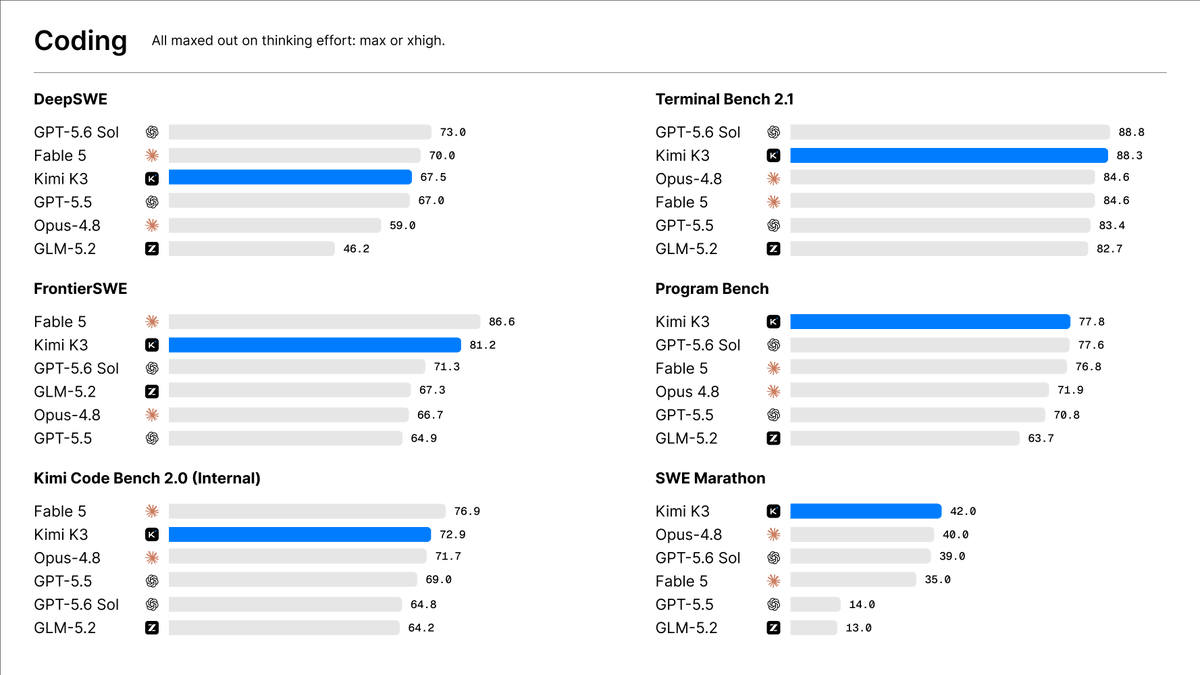
Introducing Kimi K3: Open Frontier Intelligence
🔹 2.8 Trillion Parameters, 1 Million Context, Native Multimodal
🔹 Kimi Delta Attention enables up to 6.3x faster decoding in million-token contexts
🔹 Attention Residuals deliver ~25% higher training efficiency at <2% additional cost
🔹 Built for long-horizon agentic coding and self-evolving workflows
Kimi K3 is now live on on https://t.co/zrk6zZxZUo, Kimi Work, Kimi Code, and the Kimi API.
Open Weights by July 27, 2026.
🔗 API: https://t.co/XCrgjXAqMw
🔗 Tech blog: https://t.co/YTfiMSNM1f
@sebaudet26 Some of the happiest days of my life were with Zapper.
I remember sitting on the front porch of a cottage outside Montreal. Weeping tears of pure joy as the sun hit my face. Laughing to myself and thinking "I finally made it.. so this is what it feels like"
What a special time
New podcast with @garrytan, @farbood and Daniel Francis.
Live in the Future!
00:00 Guest Intros
02:35 Live in the Future
03:58 Will AI Outsmart us?
07:43 In the Anthropic Breadline
09:59 The Tech Genie Is Out
12:33 We Invested in COVID?!
14:25 Good Writing Is Novelty
18:50 Living Like It’s 2028
24:32 Truth dot ai
30:18 Does China have the Weights?
35:38 Everyone has AI Anxiety
39:32 Have Your Agent Talk to My Agent
42:01 What if Open Source takes the Lead?
44:03 The Sun is Setting on Google
48:00 Ride the AGI
50:46 Will There be Startups?
54:05 Defending Taiwan
1:00:05 The California Empire
1:01:26 If the U.S. Falls
1:03:11 Universal Basic Robot
1:06:01 Humans as AI Handlers
Spotify Chief Architect, Niklas Gustavsson:
"Once we implemented loops in our workflow, our agent success rate went from 20-30% to 80%."
26 minutes with Claude Code creator Boris Cherny on how Spotify runs AI agents across 20 million lines of code.
Today 73% of their code is written by AI, most merged without a human ever seeing it.
The model matters less than the loop you build around it.
Watch it, then read the full guide on building loops below.
As engineering, product, design, DS, etc. melt into a new kind of role, I was reflecting on what roles might look like in the future. For example, when I look at the Claude Code team I see what I think is five archetypes:
1. Prototyper: comes up with brand new ideas; churns out many ideas, most of which don't ship
2. Builder: quickly turns a prototype/idea into production-grade product/infra
3. Sweeper: cleans up the UI, simplifies the code and system, unships, optimizes performance
4. Grower: takes a product that has been built and iterates on it to improve Product-Market Fit
5. Maintainer: owns a mature system to make it secure, reliable, fast, and efficient as it scales
Many people span across 2 roles, and sometimes 3 roles. I also notice that these roles are not really tied to job function -- eg. across Anthropic, some designers match category 1, some 2, some 3; same for engineers, PM, DS.
A healthy team needs a mix of these, depending on the product:
- A product that is new and pre-PMF needs people that are strong at 1+2+3
- A product that is growing and has found PMF needs 2+3+4 and some 5
- A product that has strong PMF needs 3+4+5 and some 2
Maybe product roles of the future will look more like this, and less like the domain-specific roles of today?
if your fancy multi-agent looping setup can't beat a ralph loop, it's not orchestration
it's just burning tokens in a trench coat
what's the most over-engineered setup you've watched lose to a dumb loop?
Feeling a bit loopy? Introducing Looper - your loop design coach
It’s been made clear that we shouldn’t be promoting agents, we should be designing loops
You can use /loop or /goal but if your loop is poorly designed then it won’t produce good output
Even worse, a poorly designed loop will burn a ton of tokens
So I created Looper - a tool to help me design better loops, and decided to open source it
Here’s what it does:
> /looper invokes the loop design wizard
> critiques your goal/loop and helps you sharpen it based on a library of best practices
> builds a verification rubric so it knows what "done" should be
> allows you to add an LLM as judge, including non-Claude models like Codex
> adds guardrails and helps you set a budget with tight/generous options to avoid token waste
> generates portable artifacts to make it easy to repeat / edit the loop
> gives you a visual diagram for your loop (see replies for examples)
Looper is intentionally a design layer, not a heavy orchestration framework - it helps you create a loop worth running, then hands it to Claude Code or your own runner/orchestrator
Please share your feedback, this was v0.1 so I expect it to have room for improvements, and feel free to submit issues or PRs
Note: Looper was inspired by @mvanhorn's "WTF is a loop" article and then fine-tuned with some of the tips in the great loop architecture article by @djfarrelly
https://t.co/smAXbBrWnW
This week's Hermes Agent Masterclass is all about cron jobs and automation! There are a lot of great nuggets in this one, especially on how to set up cheap (or free) automation pipelines. In this clip I use wakeAgent, a way to monitor at no cost, but only use the LLM when needed! Check out the full video on YouTube for more tips!
If you play with Apple Core AI use their skills! They make a huge difference.
Codex: "I’ll use the CoreAI skill here because this is now a runtime compatibility issue with a CoreAI model bundle."
You find them here: https://t.co/rxHGteIzZZ