Ohio Republican gubernatorial candidate Vivek Ramaswamy slammed attorneys for an East Palestine, Ohio, settlement following reporting from NewsNation. Last week, residents told the lawyers representing them in the class action lawsuit suppressed reports to convince them to take a settlement. "When lawyers make promises to desperate people, conceal critical information, & collect nine-figure fees while clients are left exposed, that is not justice," Ramaswamy said. "The people of East Palestine deserve better."
More: https://t.co/6QeDRV4vUq
@fred_warner Please turn this ugly headline into something good. Use your platform to expose the bigger story: East Palestine residents are sick, ignored, and still seeking answers and accountability.
https://t.co/pEfcCP9gGo
@49ers 49ers: Turn this ugly headline into something good. Use your platform to expose the bigger story: East Palestine residents are sick, ignored & still seeking answers. Give them a voice. #EastPalestine
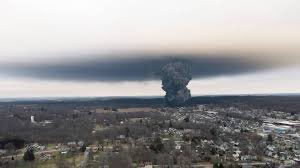
Newly uncovered documents show authorities had more severe projections for the toxic cloud released by the controlled burn of chemicals following the 2023 train derailment in East Palestine, Ohio, but the information was never shared with residents. NewsNation's @RichMcHugh has the details.
@WeWillBeFree24@VivekGRamaswamy He was here! I updated his staff weekly, we took him to the creeks, he met with us before the first anniversary, he sent his new OH Director to my house so I could catch him up on the derailment, he wrote four letters of support for us… as soon as he hit the White House, cricket
East Palestine residents participating in class action settlement say their lawyers suppressed their expert’s environmental report to convince them to take the money. Some are now trying to rescind the settlement as the report is revealed for the first time. @RichMcHugh
MORE: https://t.co/YumYJQEn9m
“It’s great that they’re taking care of our future needs," Jami Wallace with the Unity Council for the East Palestine Train Derailment said, "but we have needs right now that are unmet.” @Ideastream https://t.co/p0blOMfYeB
Dear @SecKennedy@RobertKennedyJr after you reached out to me in Feb-2024, this video is from our meeting at #eastpalestine OH train derailment victims' home of Lori and Wayne O'Connell in PA. Wayne's rare form of breast cancer (as we discussed that day) has now spread to his lymphatic system and his bones. He requests to speak with you and needs your help. The testing you witnessed me doing that day at the O'Connell home helps to show what appears to be mixtures of chemicals that may have contributed to his now tragic health situation. We need the @CDCgov to step in and support the community.
Also, in Feb-2023 at the home of Courtney Miller, now Sen @berniemoreno was at Courtney's house when I was doing my initial testing that found dioxins and other toxic chemicals. Key residents from East Palestine OH (Jami Wallace and Shelby Walker) are going to Washington DC this week and have meetings set up with Sen @HawleyMO , Sen @michaelrulli , and have been unable to reach Sen Moreno.
Furthermore, there are numerous people coming forward now with more serious health symptoms in and and around East Palestine OH. The Biden @EPA @EPAGreatLakes deceived the public and smeared and defamed anyone that was trying to get the truth out from 2023 through 2025. One individual from EPA Region 5 lied to the staff of then Senator Vance now @VP and we can prove it. This individual from EPA Region 5 needs to be held accountable as he has blood on his hands.
Also, more to follow on the facts of how the Biden administration used a scheme of NGO/Non-Profits tied to former EPA administrator Michael Regan and multiple people in the Biden White House to silence residents like Lori and Wayne O'Connell, Jami Wallace, and many many others. Instead of helping the victims of East Palestine OH train derailment, the Biden administration granted money to corrupt NGO's / Non-Profits.
@epaleezeldin@leemzeldin@ferrisfriends@abonafidepirate@lesleyfpacey@GovAcctProj@JordanChariton@smiddendorp22@RichMcHugh@ChrisCuomo@marthamaccallum@FoxNews@DOGE@elonmusk@POTUS@realDonaldTrump@MarioNawfal@bennyjohnson@SkyeWallin@BrianSmallbrook@NoFrankingWay@pettypodcast1@KristenMeghan@Tammy_K_Clark@dagenmcdowell@dougmastriano@SenatorMuth@jwserrano@TheLexiCiccone@MehekCooke@Funkwrite@c_m_dangelo@livinlifepa5 @blushirtjustice
One year after the toxic train derailment, is East Palestine safe? Depends on whom you ask.
If there hadn’t been construction planned for the bridge that crosses over Leslie Run, one of the creeks that runs through the middle of East Palestine, Ohio, Rick Tsai and Randy DeHaven might not have noticed the worst contamination they’d seen in the creek in weeks.
A backhoe had hoisted a chunk of earth from the bank of the creek, leaving a pool about eight feet across and deep enough to come up to the knees of Tsai’s rubber fishing waders. What it also left, in Tsai’s words, was an opportunity for a sort of “geological sample”—evidence that oil and chemicals still lingered in the soil and in the creeks six months after a catastrophic derailment.
On February 3, 2023, a Norfolk Southern train carrying thousands of gallons of toxic chemicals derailed and spilled its contents in the town of East Palestine, on the Pennsylvania border. Three days later, in an effort to prevent a dangerous explosion, Norfolk Southern supervised a controlled vent-and-burn of hazardous vinyl chloride, which produced a toxic cloud that spread for miles over the surrounding area.
On a late August morning, Tsai asked me to stand on the freshly created edge of the pool, while he shook some dirt and rocks loose from the bank with a metal rod. As they tumbled into the water, an iridescent web spooled out across the water’s surface, emanating from the point Tsai had disturbed. He exclaimed into his respirator, declared the water as bad as he’d ever seen, and gestured for me to lean down and look closer. The simple fact of my body’s weight on the creek bank elicited a new burst of oily sheen, billowing into the still pool.
“It looked like ‘Starry Night,’” Tsai, referring to the Vincent van Gogh painting, later described to a few community members gathered in the lobby of his chiropractic office. “It would be beautiful if it weren’t so toxic and deadly.”
As the one-year anniversary of the derailment approaches, Tsai, DeHaven, and many other residents across East Palestine and its surrounding towns have not accepted federal regulators’ assurance that the water, air, and soil are safe for its residents. In rubber boots and waders, smartphones strapped to their chests to document the pollution, they wield shovels and rods to dislodge rocks and earth that harbor reserves of substances persistently leaching into the creeks. By DeHaven’s estimate, he spends as many as 15 hours a week wading through the waterways.
At the beginning of August, when construction on the bridge began, DeHaven found a pool that had been dammed off in Leslie Run, thick with oil that carried a chemical stink. Dead fish littered the bottom of the creek. That week, Tsai took a water sample from Sulphur Run, upstream of its juncture with Leslie Run, using a kit approved by the U.S. Environmental Protection Agency. He sent it to a Eurofins lab in Cleveland to test for the presence of volatile organic compounds, or VOCs.
I asked Tsai, when I met him at the construction site, how he knew the substance pouring out of the bank was more than oil. He told me that it was how he felt, physically, when he spent time in the creek without a gas mask: burning nostrils, faintness, acid reflux, diarrhea. He showed me a smattering of red spots on his forearm, where the water had splashed onto his bare skin.
“Me getting these symptoms, proving there may be something in there, all the bullshit—why would we have to do it?” he said to me later, over the phone. “It’s because we never get any straight answers from the EPA.”
Tsai got the results back from Eurofins in the middle of September. His sample showed elevated levels of three VOCs: isopropylbenzene, cyclohexane, and methylcyclohexane, all of which are related to petroleum.
It’s no secret that there’s still oil in the creeks. First of all, you can see it. But in the middle of October, the EPA published a report that detailed derailment-related compounds—benzo(a)pyrene, toluene, and acetone, among others—detected in water sampling. The agency ordered Norfolk Southern to conduct additional analysis and cleanup of creek sediment.
The EPA reports having taken over 100 million samples of soil, air, and water in and surrounding East Palestine since the night of the derailment. The crux of the agency’s argument that local homes are safe to inhabit is that derailment-related chemicals in those samples have measured below levels considered dangerous to human health since April. And if the outdoor environment has ostensibly been free of dangerous contamination for several months, said Mark Durno, the EPA emergency response coordinator for East Palestine, in an interview with Grist, there’s no scientific rationale for concerns about the air indoors.
But other scientists who have been researching East Palestine have conflicting opinions regarding how contamination has lingered—whether it has persisted in carpets and walls and foundations of homes while it’s cleared outdoors, or if disturbance of the soil and creek water during the monthslong cleaning process stirred up chemicals into the air, polluting buildings anew. Andrew Whelton, a professor of environmental engineering at Purdue University, has been conducting studies to explore those possibilities.
“Four months after the derailment, we went back to contaminated buildings, and they still smelled like the acrid chemical contamination odor that was associated with the spill,” said Whelton. “And after we came back to Purdue, we were contacted by several other commercial building owners around the site who said they got sick being inside within one minute. Four months after the disaster.”
That suggests, as he shared in a panel hosted by the National Academies of Science, Engineering, and Medicine, that “a number of the exposures occurred not just from the initial crash or the open burn, but the actual contamination leaving the creeks and finding its way to people either outside or inside.”
Indoor air quality is both a complicated and critical factor in post-disaster remediation. There are already a litany of chemicals from common sources—cleaning products, cigarette smoke, gas stoves—that pollute the air in a home well before a toxic explosion devastates your town. The ways in which emissions from that explosion can settle into a home and interact with each of those chemicals are also numerous and difficult to predict.
An EPA instruction guide on indoor air monitoring after an incident of contamination notes that, due to the wide variety of pathways through which a chemical can enter a building, “the amount of chemical arriving at the building then becomes a complex function of meteorological conditions and soil properties.”
There’s also debate surrounding the definition of “levels of concern,” particularly in a chemical spill with at least a dozen different pollutants mixing and intermingling with each other. Stephen Lester, cofounder of the Center for Health, Environment, and Justice in Falls Church, Virginia, has been counseling the greater East Palestine community on the risks of dioxin exposure. Lester was hired by the state of New York in 1978 as a science advisor to the community of Love Canal, where a landfill in the town of Niagara Falls leached upwards of 20,000 tons of toxic chemicals into the neighborhood surrounding it.
“Scientists and public health officials are largely making statements based on an analysis of risk of one chemical at a time,” he said. “We don’t have any analysis, any tools, or a way of judging what’s going to happen to people who are exposed to 15 chemicals.”
Almost a year has passed since the derailment and vent-and-burn. Still, residents continue to report physical ailments that they can’t explain: nosebleeds, headaches, growths, dizziness, gastrointestinal issues. (“It’s not really the stuff of polite conversation,” said one business owner in town.)
So whom do you trust? The government agency that maintains that everything is fine, or those who suggest that the danger has not fully passed?
At a town meeting a couple of weeks after the derailment, “The frustration that I was feeling in the room and hearing in the room was very much similar to the frustrations of my experiences at Love Canal,” said Lester, “where government was just openly saying one thing and people knew that just couldn’t possibly be the case, because their firsthand, personal experiences were so much different.”
And the very nature of the pollution generated by the derailment makes those personal experiences highly variable.
First, the environment in which the exposure takes place—including all the other chemicals in that environment—affects whether it has a toxic effect on a person.
“Toxic effects often add up or synergize, even if the individual chemical levels are safe,” explained Dr. Beatrice Golomb, a professor of medicine at the University of California San Diego who is conducting a study on the toxicity of the East Palestine derailment. Two people can be exposed to the same chemical—or even the same mix of chemicals—and have entirely different reactions, based on their genes and the incalculable quantity and mixture of other chemicals they’ve been exposed to in their life.
And chemicals from the spill and the subsequent burn-off seeped into the surrounding region through many different paths, concentrating around some homes while sparing others. Butyl acrylate carried down the current of the creek could settle into sediment under one house, and never touch a property far from a waterway; the cloud of incinerated vinyl chloride could rain down on one farm and blow clear over the next.
Whether you suffered or not, it seemed, was just a matter of chance.
One Halloween, when Krissy Ferguson was about 12, a bunch of neighborhood boys on Rebecca Street in East Palestine talked her into corning old man Snyder’s house. Corning, she explained, is when you fill a sock with the hard field corn that’s left after a harvest and throw it at someone’s house so that all the grains pelt against the windows like buckshot.
The way Ferguson told it on an afternoon in October, more than 30 years later, the group of them got caught and Snyder jumped on his moped and chased them down the street as if he had every intent of running them down. Terrified, she ran into the culvert under Rebecca Street, a wide stone tunnel containing a stretch of Sulphur Run. It was the first time she had set foot in it.
Many old East Palestine houses still have the remnants of century-old sewer systems, and an uncapped pipe runs directly from the Fergusons’ basement into that culvert, essentially funneling evaporation from Sulphur Run directly into her house. The creek itself rises quickly with a heavy rain, where it can flood her basement. Ferguson showed me wet patches on the concrete floor around the drain filter that tops the old pipe.
In the days after the derailment, Ferguson felt dizzy and nauseous whenever she set foot in her house. Her eyes stung and her vision got worse. She couldn’t keep her balance walking from one end of her living room to another. The smell that permeated the house was like “sweet paint thinner” that left a strong metallic taste in her mouth and dried out her lips.
Nine months since the night the train crashed a few hundred yards from her home, Ferguson is still dealing with health complications. She suffers from headaches, her vision hasn’t fully returned, and in September, a set of growths appeared around her groin. CTEH, the emergency environmental remediation firm contracted by Norfolk Southern, has told her that everything is safe in her home, but she gets sick every time she visits.
“I can’t get out of February 3,” she said, perched on the couch in the living room she no longer lives in. “I have no more answers now than I did that night.”
Ferguson, along with her parents, daughter, and husband, evacuated that weekend. They spent several months in two hotel rooms in the town of Chippewa, Pennsylvania, and now live in a rental house paid for by Norfolk Southern in the town of Columbiana, 15 minutes away from East Palestine.
“What I keep saying to [Norfolk Southern],” said Ferguson, “is that a pocket of chemicals sat soaking into a home built in 1930 with a sandstone foundation. You can’t get chemicals out of a sandstone foundation.”
In the vernacular of toxicology, this is what’s called “a pathway to exposure.” Jami Wallace first heard the term when a toxicologist from CTEH pointed out creek water pooling next to her basement wall, which faces Sulphur Run. (CTEH has been repeatedly criticized by environmental groups for implementing faulty data to determine health risks to the victims of environmental disasters, including the Deepwater Horizon spill. The company has responded to these accusations in the FAQ section of their website.)
He told her that any water from the creek that’s contaminated is going to emit a chemical gas as it evaporates; Wallace wanted to know who would come test the air quality in her basement every day. The next day, she said, Norfolk Southern offered to pay to move her into another home.
“So I could have kept quiet, took my little check, and left,” she said. “But that’s not the kind of people that we are, my husband or I. That night was the first town hall meeting in East Palestine, at the high school auditorium. EPA said, ‘Everything’s fine.’ Mayor said, ‘Everything’s fine.’ So I get the mic and I say, ‘Well, did you know that they said my house was contaminated and offered to move me today? I have a video of it.’ The mayor never called me back.”
For a number of East Palestine residents, the foundation of their mistrust in federal and state public health and environmental agencies comes from repeated assurances that homes showed no signs of harmful contamination, while residents like Wallace and Ferguson have received payment from Norfolk Southern for their temporary relocation—and why would they have to move if the homes weren’t contaminated? A spokesman for Norfolk Southern says that the railroad paid for relocation for those who wanted it during the cleanup process, which does not constitute an acknowledgment of contamination of those homes, and that that program would be coming to an end in February.
Testing mechanisms used by CTEH—and approved by the EPA—have also been criticized by independent scientists as insufficient, relying on inappropriate technology and thresholds of contamination higher than what is considered a risk to human health.
Whelton, the engineering professor at Purdue, said that the handheld photoionization detectors that CTEH used to measure indoor contamination in the months after the derailment weren’t sensitive enough to detect low levels of butyl acrylate and vinyl chloride that are still dangerous to human health. Furthermore, Whelton and a team of engineers conducted a study on these devices that found that they did not provide reliable readings outside of a controlled lab setting.
“We published this, we talked with the National Institute for Occupational Safety and Health seven years ago on this issue, the Centers for Disease Control 10 years ago,” said Whelton. “It was well known that these devices should not be used how they were applied.”
In June, E&E News reported that the EPA had been aware of CTEH’s use of inappropriate equipment to conduct indoor air testing for weeks before making a public statement about it. Many residents complained that they never heard about this mishap directly from the EPA, finding out about it on social media or from friends. And they never got follow-up indoor air testing, either.
An air monitoring report from CTEH for one East Palestine building, for example, found no detection of dangerous levels of VOCs on the devices used but noted a chemical odor so “unpleasant and overwhelming” that the testing team left after 10 minutes. (In response to this claim, CTEH referred Grist to its FAQ section, which reads: “While some individuals may experience psychosomatic effects from the presence of a strong odor (e.g., headache, nausea, etc.), there is a difference between that temporary, transient experience and the significant health impacts against which exposure guidelines and standards are protective.”)
In an interview, EPA emergency response coordinator Mark Durno said that butyl acrylate has such a strong odor even at extremely low concentrations that it can be detected by scent alone at levels below those considered dangerous to human health—which is why the agency is confident that that particular chemical has ventilated out of buildings, because it can no longer be smelled.
But what constitutes harmful levels of exposure in a case like East Palestine is actually very difficult to establish, because there is such a dearth of research on the health consequences of potentially continuous exposure to multiple chemicals at once.
“It’s a real indictment of the scientific community that we haven’t done the research to begin to really answer these questions,” said Lester, the toxicologist with the Center for Health, Environment, and Justice. “And it’s also an indictment of the EPA, to go before the public and say to them that everything is fine, we don’t have any evidence that your health will be affected by this.
“And that’s such a disingenuous statement, and a misstatement of reality and truth, that it’s very frustrating for someone like myself to hear that—because there’s just not data that is collected that can support it.”
Wallace and I spoke at the house she and her husband and 4-year-old daughter, Kyla, are renting in East Liverpool, Ohio, about 20 miles south of East Palestine on the Ohio River. She furnished their new home with finds culled from yard sales and thrift stores. Before moving into the hillside bungalow in May, Wallace’s family was living in hotels with little sense of how long they’d be there.
On Facebook, she noticed that many of her neighbors and contacts in East Palestine had a lot of the same questions and concerns about the EPA and Norfolk Southern’s repeated assertions that homes were safe, while the physical symptoms they were experiencing implied otherwise. She started to organize, forming a group of concerned citizens under the name Unity Council.
“It just started with us coming up with a list of demands, things like Governor Mike Dewine asking for a State of Emergency declaration, air testing, health monitoring, relocation,” said Hilary Flint, the council’s vice president. “A lot of those demands we made in that March-April time period. We’re still making the same demands.”
Flint had moved back to her family home in East Palestine’s neighboring town of Enon Valley, Pennsylvania, after a battle with cancer in 2022, and wants to know whether she’s facing exposures that could take her out of remission. In March, a research team at Wayne State University found ethylhexyl acrylate, a volatile organic compound associated with the derailment, in the air filter in Flint’s bedroom. In August, follow-up testing confirmed that the same chemical was still present in another home near Flint’s.
Continued indoor air testing is the most prevalent demand that concerned residents continue to make of the EPA. In June, members of Unity Council visited Washington, D.C. to meet with a number of congressional representatives and their staffers. That’s where they learned about the criteria for Superfund site designations.
“To go from having a number to being on the registry is a point system, and one of the ways to get the most points is if you have bad indoor air,” said Flint. “And if we went on the registry, from my understanding, they’d have to relocate a lot of people and it would possibly unlock federal benefits. I believe they’re just trying to avoid that economic burden.”
But the EPA has not offered or performed indoor testing in homes since April of 2023. In an interview, EPA emergency response coordinator Mark Durno gave several reasons for that: Testing in February and March did not show dangerous levels of derailment-related VOCs in any homes; those VOCs have short half-lifes and would be expected to ventilate out of homes by now; and the agency sees testing for the “peace of mind” of residents as not recommended due to the difficulty in distinguishing household VOCs from potentially derailment-related VOCs.
“I could see a scenario where some biological monitoring suggests that some environmental exposures that are specifically train derailment-related may be recommended,” he said. “In that case, then I could see some research dollars going towards evaluating that. But in its current condition, there’s just no feasible scientific reason to believe that there are any indoor continued exposures going on in homes.”
Misti Allison, for one, is not satisfied by those explanations. In September, she co-organized a collaboration with the local nonprofit The Way Station to distribute over 70 indoor air monitors to households across the town in homes, churches, and businesses to track VOC levels for one week. If the EPA won’t test to see if there are still toxic chemicals lingering in our homes, they said, we’ll do it ourselves.
Most of the monitors showed low levels of VOCs, but some locations scattered throughout town consistently measured in the “moderate,” “bad,” and “very bad” ranges. Allison has shared the results with the mayor, the village council, the village manager, academic researchers, and Mark Durno of the EPA.
“[Durno] was very complimentary of the community-based assessment project,” she said. “I was grateful for the support because I wasn’t sure about how the EPA would feel about us doing this citizen science.”
The problem is that these readings only tell total levels and activity of VOCs and indicate how safe that overall level is to breathe—they can’t distinguish which VOCs are present. So while residents are looking for evidence of VOCs released in the February 3 derailment, like butyl acrylate and vinyl chloride, the monitors are also picking up VOCs emitted by common household cleaners, shampoos, and other products.
Erin Haynes, chair of the department of epidemiology and environmental health at the University of Kentucky, has distributed 15 devices to append to the indoor air monitors that Allison helped distribute. Judy Westrick’s lab at Wayne State University will analyze the results from those devices to discern the presence of specific chemicals and compounds related to the train derailment, including butyl acrylate and ethylhexyl acrylate. Additionally, 20 residents of East Palestine volunteered to provide Haynes with samples of blood and urine. The blood will be analyzed by the Centers for Disease Control and Prevention for the presence of dioxins, and Westrick’s lab is measuring for a specific metabolite produced when the body processes vinyl chloride and acrylates.
The results from these tests could help answer the question of whether chemicals from the derailment have persisted in homes, months later.
“Were they exposed? Absolutely,” said Haynes. “If they were anywhere near that derailment, there was an exposure.” But the question she’s investigating is the duration of the exposure, if chemicals have lingered in indoor spaces or if pockets of chemicals in the soil and water erupted and exposed residents anew. When creeks were aerated in February and March to remove VOCs from the water, for example, there’s a possibility that those chemicals were absorbed into culverts and foundations like the one under Ferguson’s house. As of early December, the EPA was still performing cleanup in culverts across East Palestine.
In April, Beatrice Golomb, the medical professor at the University of California San Diego, launched a pilot project to analyze exposure and health effects after the derailment. Golomb previously studied the impacts of environmental pollution on veterans from the Gulf War, and found that even a few days’ worth of exposure to toxic chemicals from explosions, burn pits, and other sources of pollution can affect the mitochondria of human cells, leading to a wide and difficult-to-predict variety of health problems. When she read about symptoms being reported from East Palestine, she hypothesized that residents there might be experiencing the same thing.
“The fact that it’s multiple symptoms, spanning many different organs, that it differs from person to person—all of these are classic for impairment of mitochondria,” she said, referring to many of the reported persistent conditions.
(continued)
@ScottAdamsSays


![OwenGregorian's tweet photo. One year after the toxic train derailment, is East Palestine safe? Depends on whom you ask.
If there hadn’t been construction planned for the bridge that crosses over Leslie Run, one of the creeks that runs through the middle of East Palestine, Ohio, Rick Tsai and Randy DeHaven might not have noticed the worst contamination they’d seen in the creek in weeks.
A backhoe had hoisted a chunk of earth from the bank of the creek, leaving a pool about eight feet across and deep enough to come up to the knees of Tsai’s rubber fishing waders. What it also left, in Tsai’s words, was an opportunity for a sort of “geological sample”—evidence that oil and chemicals still lingered in the soil and in the creeks six months after a catastrophic derailment.
On February 3, 2023, a Norfolk Southern train carrying thousands of gallons of toxic chemicals derailed and spilled its contents in the town of East Palestine, on the Pennsylvania border. Three days later, in an effort to prevent a dangerous explosion, Norfolk Southern supervised a controlled vent-and-burn of hazardous vinyl chloride, which produced a toxic cloud that spread for miles over the surrounding area.
On a late August morning, Tsai asked me to stand on the freshly created edge of the pool, while he shook some dirt and rocks loose from the bank with a metal rod. As they tumbled into the water, an iridescent web spooled out across the water’s surface, emanating from the point Tsai had disturbed. He exclaimed into his respirator, declared the water as bad as he’d ever seen, and gestured for me to lean down and look closer. The simple fact of my body’s weight on the creek bank elicited a new burst of oily sheen, billowing into the still pool.
“It looked like ‘Starry Night,’” Tsai, referring to the Vincent van Gogh painting, later described to a few community members gathered in the lobby of his chiropractic office. “It would be beautiful if it weren’t so toxic and deadly.”
As the one-year anniversary of the derailment approaches, Tsai, DeHaven, and many other residents across East Palestine and its surrounding towns have not accepted federal regulators’ assurance that the water, air, and soil are safe for its residents. In rubber boots and waders, smartphones strapped to their chests to document the pollution, they wield shovels and rods to dislodge rocks and earth that harbor reserves of substances persistently leaching into the creeks. By DeHaven’s estimate, he spends as many as 15 hours a week wading through the waterways.
At the beginning of August, when construction on the bridge began, DeHaven found a pool that had been dammed off in Leslie Run, thick with oil that carried a chemical stink. Dead fish littered the bottom of the creek. That week, Tsai took a water sample from Sulphur Run, upstream of its juncture with Leslie Run, using a kit approved by the U.S. Environmental Protection Agency. He sent it to a Eurofins lab in Cleveland to test for the presence of volatile organic compounds, or VOCs.
I asked Tsai, when I met him at the construction site, how he knew the substance pouring out of the bank was more than oil. He told me that it was how he felt, physically, when he spent time in the creek without a gas mask: burning nostrils, faintness, acid reflux, diarrhea. He showed me a smattering of red spots on his forearm, where the water had splashed onto his bare skin.
“Me getting these symptoms, proving there may be something in there, all the bullshit—why would we have to do it?” he said to me later, over the phone. “It’s because we never get any straight answers from the EPA.”
Tsai got the results back from Eurofins in the middle of September. His sample showed elevated levels of three VOCs: isopropylbenzene, cyclohexane, and methylcyclohexane, all of which are related to petroleum.
It’s no secret that there’s still oil in the creeks. First of all, you can see it. But in the middle of October, the EPA published a report that detailed derailment-related compounds—benzo(a)pyrene, toluene, and acetone, among others—detected in water sampling. The agency ordered Norfolk Southern to conduct additional analysis and cleanup of creek sediment.
The EPA reports having taken over 100 million samples of soil, air, and water in and surrounding East Palestine since the night of the derailment. The crux of the agency’s argument that local homes are safe to inhabit is that derailment-related chemicals in those samples have measured below levels considered dangerous to human health since April. And if the outdoor environment has ostensibly been free of dangerous contamination for several months, said Mark Durno, the EPA emergency response coordinator for East Palestine, in an interview with Grist, there’s no scientific rationale for concerns about the air indoors.
But other scientists who have been researching East Palestine have conflicting opinions regarding how contamination has lingered—whether it has persisted in carpets and walls and foundations of homes while it’s cleared outdoors, or if disturbance of the soil and creek water during the monthslong cleaning process stirred up chemicals into the air, polluting buildings anew. Andrew Whelton, a professor of environmental engineering at Purdue University, has been conducting studies to explore those possibilities.
“Four months after the derailment, we went back to contaminated buildings, and they still smelled like the acrid chemical contamination odor that was associated with the spill,” said Whelton. “And after we came back to Purdue, we were contacted by several other commercial building owners around the site who said they got sick being inside within one minute. Four months after the disaster.”
That suggests, as he shared in a panel hosted by the National Academies of Science, Engineering, and Medicine, that “a number of the exposures occurred not just from the initial crash or the open burn, but the actual contamination leaving the creeks and finding its way to people either outside or inside.”
Indoor air quality is both a complicated and critical factor in post-disaster remediation. There are already a litany of chemicals from common sources—cleaning products, cigarette smoke, gas stoves—that pollute the air in a home well before a toxic explosion devastates your town. The ways in which emissions from that explosion can settle into a home and interact with each of those chemicals are also numerous and difficult to predict.
An EPA instruction guide on indoor air monitoring after an incident of contamination notes that, due to the wide variety of pathways through which a chemical can enter a building, “the amount of chemical arriving at the building then becomes a complex function of meteorological conditions and soil properties.”
There’s also debate surrounding the definition of “levels of concern,” particularly in a chemical spill with at least a dozen different pollutants mixing and intermingling with each other. Stephen Lester, cofounder of the Center for Health, Environment, and Justice in Falls Church, Virginia, has been counseling the greater East Palestine community on the risks of dioxin exposure. Lester was hired by the state of New York in 1978 as a science advisor to the community of Love Canal, where a landfill in the town of Niagara Falls leached upwards of 20,000 tons of toxic chemicals into the neighborhood surrounding it.
“Scientists and public health officials are largely making statements based on an analysis of risk of one chemical at a time,” he said. “We don’t have any analysis, any tools, or a way of judging what’s going to happen to people who are exposed to 15 chemicals.”
Almost a year has passed since the derailment and vent-and-burn. Still, residents continue to report physical ailments that they can’t explain: nosebleeds, headaches, growths, dizziness, gastrointestinal issues. (“It’s not really the stuff of polite conversation,” said one business owner in town.)
So whom do you trust? The government agency that maintains that everything is fine, or those who suggest that the danger has not fully passed?
At a town meeting a couple of weeks after the derailment, “The frustration that I was feeling in the room and hearing in the room was very much similar to the frustrations of my experiences at Love Canal,” said Lester, “where government was just openly saying one thing and people knew that just couldn’t possibly be the case, because their firsthand, personal experiences were so much different.”
And the very nature of the pollution generated by the derailment makes those personal experiences highly variable.
First, the environment in which the exposure takes place—including all the other chemicals in that environment—affects whether it has a toxic effect on a person.
“Toxic effects often add up or synergize, even if the individual chemical levels are safe,” explained Dr. Beatrice Golomb, a professor of medicine at the University of California San Diego who is conducting a study on the toxicity of the East Palestine derailment. Two people can be exposed to the same chemical—or even the same mix of chemicals—and have entirely different reactions, based on their genes and the incalculable quantity and mixture of other chemicals they’ve been exposed to in their life.
And chemicals from the spill and the subsequent burn-off seeped into the surrounding region through many different paths, concentrating around some homes while sparing others. Butyl acrylate carried down the current of the creek could settle into sediment under one house, and never touch a property far from a waterway; the cloud of incinerated vinyl chloride could rain down on one farm and blow clear over the next.
Whether you suffered or not, it seemed, was just a matter of chance.
One Halloween, when Krissy Ferguson was about 12, a bunch of neighborhood boys on Rebecca Street in East Palestine talked her into corning old man Snyder’s house. Corning, she explained, is when you fill a sock with the hard field corn that’s left after a harvest and throw it at someone’s house so that all the grains pelt against the windows like buckshot.
The way Ferguson told it on an afternoon in October, more than 30 years later, the group of them got caught and Snyder jumped on his moped and chased them down the street as if he had every intent of running them down. Terrified, she ran into the culvert under Rebecca Street, a wide stone tunnel containing a stretch of Sulphur Run. It was the first time she had set foot in it.
Many old East Palestine houses still have the remnants of century-old sewer systems, and an uncapped pipe runs directly from the Fergusons’ basement into that culvert, essentially funneling evaporation from Sulphur Run directly into her house. The creek itself rises quickly with a heavy rain, where it can flood her basement. Ferguson showed me wet patches on the concrete floor around the drain filter that tops the old pipe.
In the days after the derailment, Ferguson felt dizzy and nauseous whenever she set foot in her house. Her eyes stung and her vision got worse. She couldn’t keep her balance walking from one end of her living room to another. The smell that permeated the house was like “sweet paint thinner” that left a strong metallic taste in her mouth and dried out her lips.
Nine months since the night the train crashed a few hundred yards from her home, Ferguson is still dealing with health complications. She suffers from headaches, her vision hasn’t fully returned, and in September, a set of growths appeared around her groin. CTEH, the emergency environmental remediation firm contracted by Norfolk Southern, has told her that everything is safe in her home, but she gets sick every time she visits.
“I can’t get out of February 3,” she said, perched on the couch in the living room she no longer lives in. “I have no more answers now than I did that night.”
Ferguson, along with her parents, daughter, and husband, evacuated that weekend. They spent several months in two hotel rooms in the town of Chippewa, Pennsylvania, and now live in a rental house paid for by Norfolk Southern in the town of Columbiana, 15 minutes away from East Palestine.
“What I keep saying to [Norfolk Southern],” said Ferguson, “is that a pocket of chemicals sat soaking into a home built in 1930 with a sandstone foundation. You can’t get chemicals out of a sandstone foundation.”
In the vernacular of toxicology, this is what’s called “a pathway to exposure.” Jami Wallace first heard the term when a toxicologist from CTEH pointed out creek water pooling next to her basement wall, which faces Sulphur Run. (CTEH has been repeatedly criticized by environmental groups for implementing faulty data to determine health risks to the victims of environmental disasters, including the Deepwater Horizon spill. The company has responded to these accusations in the FAQ section of their website.)
He told her that any water from the creek that’s contaminated is going to emit a chemical gas as it evaporates; Wallace wanted to know who would come test the air quality in her basement every day. The next day, she said, Norfolk Southern offered to pay to move her into another home.
“So I could have kept quiet, took my little check, and left,” she said. “But that’s not the kind of people that we are, my husband or I. That night was the first town hall meeting in East Palestine, at the high school auditorium. EPA said, ‘Everything’s fine.’ Mayor said, ‘Everything’s fine.’ So I get the mic and I say, ‘Well, did you know that they said my house was contaminated and offered to move me today? I have a video of it.’ The mayor never called me back.”
For a number of East Palestine residents, the foundation of their mistrust in federal and state public health and environmental agencies comes from repeated assurances that homes showed no signs of harmful contamination, while residents like Wallace and Ferguson have received payment from Norfolk Southern for their temporary relocation—and why would they have to move if the homes weren’t contaminated? A spokesman for Norfolk Southern says that the railroad paid for relocation for those who wanted it during the cleanup process, which does not constitute an acknowledgment of contamination of those homes, and that that program would be coming to an end in February.
Testing mechanisms used by CTEH—and approved by the EPA—have also been criticized by independent scientists as insufficient, relying on inappropriate technology and thresholds of contamination higher than what is considered a risk to human health.
Whelton, the engineering professor at Purdue, said that the handheld photoionization detectors that CTEH used to measure indoor contamination in the months after the derailment weren’t sensitive enough to detect low levels of butyl acrylate and vinyl chloride that are still dangerous to human health. Furthermore, Whelton and a team of engineers conducted a study on these devices that found that they did not provide reliable readings outside of a controlled lab setting.
“We published this, we talked with the National Institute for Occupational Safety and Health seven years ago on this issue, the Centers for Disease Control 10 years ago,” said Whelton. “It was well known that these devices should not be used how they were applied.”
In June, E&E News reported that the EPA had been aware of CTEH’s use of inappropriate equipment to conduct indoor air testing for weeks before making a public statement about it. Many residents complained that they never heard about this mishap directly from the EPA, finding out about it on social media or from friends. And they never got follow-up indoor air testing, either.
An air monitoring report from CTEH for one East Palestine building, for example, found no detection of dangerous levels of VOCs on the devices used but noted a chemical odor so “unpleasant and overwhelming” that the testing team left after 10 minutes. (In response to this claim, CTEH referred Grist to its FAQ section, which reads: “While some individuals may experience psychosomatic effects from the presence of a strong odor (e.g., headache, nausea, etc.), there is a difference between that temporary, transient experience and the significant health impacts against which exposure guidelines and standards are protective.”)
In an interview, EPA emergency response coordinator Mark Durno said that butyl acrylate has such a strong odor even at extremely low concentrations that it can be detected by scent alone at levels below those considered dangerous to human health—which is why the agency is confident that that particular chemical has ventilated out of buildings, because it can no longer be smelled.
But what constitutes harmful levels of exposure in a case like East Palestine is actually very difficult to establish, because there is such a dearth of research on the health consequences of potentially continuous exposure to multiple chemicals at once.
“It’s a real indictment of the scientific community that we haven’t done the research to begin to really answer these questions,” said Lester, the toxicologist with the Center for Health, Environment, and Justice. “And it’s also an indictment of the EPA, to go before the public and say to them that everything is fine, we don’t have any evidence that your health will be affected by this.
“And that’s such a disingenuous statement, and a misstatement of reality and truth, that it’s very frustrating for someone like myself to hear that—because there’s just not data that is collected that can support it.”
Wallace and I spoke at the house she and her husband and 4-year-old daughter, Kyla, are renting in East Liverpool, Ohio, about 20 miles south of East Palestine on the Ohio River. She furnished their new home with finds culled from yard sales and thrift stores. Before moving into the hillside bungalow in May, Wallace’s family was living in hotels with little sense of how long they’d be there.
On Facebook, she noticed that many of her neighbors and contacts in East Palestine had a lot of the same questions and concerns about the EPA and Norfolk Southern’s repeated assertions that homes were safe, while the physical symptoms they were experiencing implied otherwise. She started to organize, forming a group of concerned citizens under the name Unity Council.
“It just started with us coming up with a list of demands, things like Governor Mike Dewine asking for a State of Emergency declaration, air testing, health monitoring, relocation,” said Hilary Flint, the council’s vice president. “A lot of those demands we made in that March-April time period. We’re still making the same demands.”
Flint had moved back to her family home in East Palestine’s neighboring town of Enon Valley, Pennsylvania, after a battle with cancer in 2022, and wants to know whether she’s facing exposures that could take her out of remission. In March, a research team at Wayne State University found ethylhexyl acrylate, a volatile organic compound associated with the derailment, in the air filter in Flint’s bedroom. In August, follow-up testing confirmed that the same chemical was still present in another home near Flint’s.
Continued indoor air testing is the most prevalent demand that concerned residents continue to make of the EPA. In June, members of Unity Council visited Washington, D.C. to meet with a number of congressional representatives and their staffers. That’s where they learned about the criteria for Superfund site designations.
“To go from having a number to being on the registry is a point system, and one of the ways to get the most points is if you have bad indoor air,” said Flint. “And if we went on the registry, from my understanding, they’d have to relocate a lot of people and it would possibly unlock federal benefits. I believe they’re just trying to avoid that economic burden.”
But the EPA has not offered or performed indoor testing in homes since April of 2023. In an interview, EPA emergency response coordinator Mark Durno gave several reasons for that: Testing in February and March did not show dangerous levels of derailment-related VOCs in any homes; those VOCs have short half-lifes and would be expected to ventilate out of homes by now; and the agency sees testing for the “peace of mind” of residents as not recommended due to the difficulty in distinguishing household VOCs from potentially derailment-related VOCs.
“I could see a scenario where some biological monitoring suggests that some environmental exposures that are specifically train derailment-related may be recommended,” he said. “In that case, then I could see some research dollars going towards evaluating that. But in its current condition, there’s just no feasible scientific reason to believe that there are any indoor continued exposures going on in homes.”
Misti Allison, for one, is not satisfied by those explanations. In September, she co-organized a collaboration with the local nonprofit The Way Station to distribute over 70 indoor air monitors to households across the town in homes, churches, and businesses to track VOC levels for one week. If the EPA won’t test to see if there are still toxic chemicals lingering in our homes, they said, we’ll do it ourselves.
Most of the monitors showed low levels of VOCs, but some locations scattered throughout town consistently measured in the “moderate,” “bad,” and “very bad” ranges. Allison has shared the results with the mayor, the village council, the village manager, academic researchers, and Mark Durno of the EPA.
“[Durno] was very complimentary of the community-based assessment project,” she said. “I was grateful for the support because I wasn’t sure about how the EPA would feel about us doing this citizen science.”
The problem is that these readings only tell total levels and activity of VOCs and indicate how safe that overall level is to breathe—they can’t distinguish which VOCs are present. So while residents are looking for evidence of VOCs released in the February 3 derailment, like butyl acrylate and vinyl chloride, the monitors are also picking up VOCs emitted by common household cleaners, shampoos, and other products.
Erin Haynes, chair of the department of epidemiology and environmental health at the University of Kentucky, has distributed 15 devices to append to the indoor air monitors that Allison helped distribute. Judy Westrick’s lab at Wayne State University will analyze the results from those devices to discern the presence of specific chemicals and compounds related to the train derailment, including butyl acrylate and ethylhexyl acrylate. Additionally, 20 residents of East Palestine volunteered to provide Haynes with samples of blood and urine. The blood will be analyzed by the Centers for Disease Control and Prevention for the presence of dioxins, and Westrick’s lab is measuring for a specific metabolite produced when the body processes vinyl chloride and acrylates.
The results from these tests could help answer the question of whether chemicals from the derailment have persisted in homes, months later.
“Were they exposed? Absolutely,” said Haynes. “If they were anywhere near that derailment, there was an exposure.” But the question she’s investigating is the duration of the exposure, if chemicals have lingered in indoor spaces or if pockets of chemicals in the soil and water erupted and exposed residents anew. When creeks were aerated in February and March to remove VOCs from the water, for example, there’s a possibility that those chemicals were absorbed into culverts and foundations like the one under Ferguson’s house. As of early December, the EPA was still performing cleanup in culverts across East Palestine.
In April, Beatrice Golomb, the medical professor at the University of California San Diego, launched a pilot project to analyze exposure and health effects after the derailment. Golomb previously studied the impacts of environmental pollution on veterans from the Gulf War, and found that even a few days’ worth of exposure to toxic chemicals from explosions, burn pits, and other sources of pollution can affect the mitochondria of human cells, leading to a wide and difficult-to-predict variety of health problems. When she read about symptoms being reported from East Palestine, she hypothesized that residents there might be experiencing the same thing.
“The fact that it’s multiple symptoms, spanning many different organs, that it differs from person to person—all of these are classic for impairment of mitochondria,” she said, referring to many of the reported persistent conditions.
(continued)
@ScottAdamsSays](https://pbs.twimg.com/media/GEXoTwXWcAAiqgA.jpg)




