Today we’re introducing Gemini 4 Argon.
It delivers frontier performance in complex workflows across real-world software engineering, knowledge work, and cybersecurity defense with an industry-leading 1M token output limit.
Singapore, we’re on our way 🇸🇬 Our vehicles will arrive later this year, and will begin mapping and learning Singapore’s roads in early 2027 before fully autonomous ride-hailing arrives in 2028.
Learn more: https://t.co/sAYo0uPecC
This is what Dario and Sama fear -
- the cost of fine tuned open source models trained on custom data was 95% less than the frontier models
- And they performed better than the frontier models
- And they could train them in less than 48 hours
The big AI labs have no moat..
Even at the enterprise level..
Any sane company would prefer a custom trained open source model instead of paying API pricing to Anthropic and Open AI
If open source keeps growing at the pace it is, frontier labs' business collapses..
only way out is oldest trick in manipulation - FUD -> Fear, Uncertainty, Death
Step 1 - Seed the psyop
- Test a swarm of agents trained to "hack"
- The swarm does what its supposed to do - hack
- Publish a report - AI is too dangerous
Step 2 - weed out the doubters
- Get an employee to quit your company
- Go viral saying both companies are not doing enough to self regulate AI
- AI is dangerous - will kill humanity by the end of the decade
Step 3 - Prepare for fruition
- write an "essay" to "pace the frontier"
- Advocate regulation
- Only a few holier than though companies get to build AI
- Scare the world into agreeing with AI Doom
- Effectively turn your competitors into criminals (genius business strategy)
Endgame -
- Become a cartel that controls AI (and the world)
- Raise prices (coz business is unsustainable... ofc)
- IPO (offload liability of said unsustainable business to the public)
Laugh all the way to the bank 🤑
Win!
GenAI doesn’t lack creativity; it’s just spent its entire life inside a high dimensional vector space trying to predict what humanity wants to hear next.
A “10x engineer” — a widely accepted concept in tech — purportedly has 10 times the impact of the average engineer. But we don’t seem to talk about 10x marketers, 10x recruiters, or 10x financial analysts. As more jobs become AI enabled, I think this will change, and there will be a lot more “10x professionals.”
There aren’t already more 10x professionals because, in many roles, the gap between the best and the average worker has a ceiling. No matter how athletic a supermarket checkout clerk is, they’re not likely to scan groceries so fast that customers get out of the store 10x faster. Similarly, even the best doctor is unlikely to make patients heal 10x faster than an average one (but to a sick patient, even a small difference is worth a lot). In many jobs, the laws of physics place a limit on what any human or AI can do (unless we completely reimagine that job).
But for many jobs that primarily involve applying knowledge or processing information, AI will be transformative. In a few roles, I’m starting to see tech-savvy individuals coordinate a suite of technology tools to do things differently and start to have, if not yet 10x impact, then easily 2x impact. I expect this gap to grow.
10x engineers don’t write code 10 times faster. Instead, they make technical architecture decisions that result in dramatically better downstream impact, they spot problems and prioritize tasks more effectively, and instead of rewriting 10,000 lines of code (or labeling 10,000 training examples) they might figure out how to write just 100 lines (or collect 100 examples) to get the job done.
I think 10x marketers, recruiters, and analysts will, similarly, do things differently. For example, perhaps traditional marketers repeatedly write social media posts. 10x marketers might use AI to help write, but the transformation will go deeper than that. If they are deeply sophisticated in how to apply AI — ideally able to write code themselves to test ideas, automate tasks, or analyze data — they might end up running a lot more experiments, get better insights about what customers want, and generate much more precise or personalized messages than a traditional marketer, and thereby end up making 10x impact.
Similarly, 10x recruiters won’t just use generative AI to help write emails to candidates or summarize interviews. (This level of use of prompting-based AI will soon become table stakes for many knowledge roles.) They might coordinate a suite of AI tools to efficiently identify and carry out research on a large set of candidates, enabling them to have dramatically greater impact than the average recruiter. And 10x analysts won’t just use generative AI to edit their reports. They might write code to orchestrate a suite of AI agents to do deep research into the products, markets, and companies, and thereby derive far more valuable conclusions than someone who does research the traditional way.
A 2023 Harvard/BCG study estimated that, provided with GPT-4, consultants could complete 12% more tasks, and completed tasks 25% more quickly. This was just the average, using 2023 technology. The maximum advantage to be gained by using AI in a sophisticated way will be much bigger, and will only grow as technology improves.
Here in Silicon Valley, I see more and more AI-native teams reinvent workflows and do things very differently. In software engineering, we've venerated the best engineers because they can have a really massive impact. This has motivated many generations of engineers to keep learning and working hard, because doing those things increases the odds of doing high-impact work. As AI becomes more helpful in many more job roles, I believe we will open up similar paths to a lot more people becoming a “10x professional.”
[Original text: https://t.co/svQYHp3XVW ]
In this month's ACM Queue, @ankushpd and I write about some of the methods and tools we apply to systems correctness at AWS: from testing, to simulation, to fault injection, to formal proofs.
GRPO (used on deepseek) is really cool, trying it out on Qwen2-0.5B. The model is generating its own thinking tokens. Correctness reward going up as completion length increases (gsm8k). H/T @willcb for the initial gist
Releasing METAGENE-1: In collaboration with researchers from USC, we're open-sourcing a state-of-the-art 7B parameter Metagenomic Foundation Model.
Enabling planetary-scale pathogen detection and reducing the risk of pandemics in the age of exponential biology.
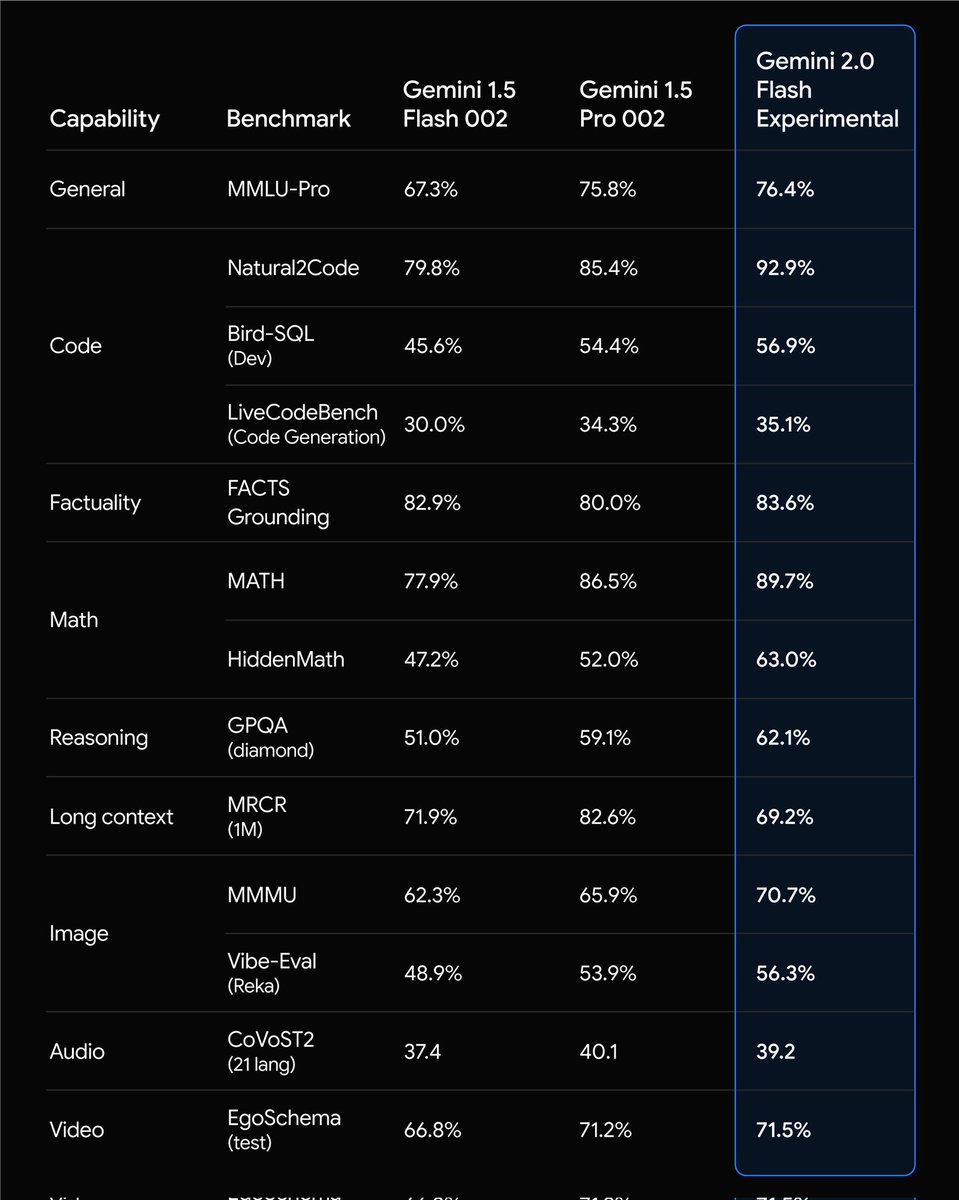
We’re kicking off the start of our Gemini 2.0 era with Gemini 2.0 Flash, which outperforms 1.5 Pro on key benchmarks at 2X speed (see chart below). I’m especially excited to see the fast progress on coding, with more to come.
Developers can try an experimental version in AI Studio and Vertex AI today. It is also available to try in @GeminiApp on the web today, mobile coming soon.
AWS (@awscloud) just dropped Automated Reasoning!
Automated reasoning was previously only available to the largest companies with massive resources.
AI changes that.
Let me show you why this is such a big deal 🧵
(AWS Partner)
The middle manager is the biggest culprit of the "quiet quitting" SWE epidemic.
They have 0 incentive to fire. The entire job is bargaining for more headcount so they can get promoted.
They'll say "we are understaffed, we need more people" no matter how little they do.
1/4
here’s the short version:
evo is a genomic foundation model with 7 billion parameters trained on 2.7 million genomes. it works like a universal decoder for dna, rna, and proteins—all the ingredients of life.
imagine giving an ai the genome of a bacterium and saying, “improve this.”
evo can.







![AndrewYNg's tweet photo. A “10x engineer” — a widely accepted concept in tech — purportedly has 10 times the impact of the average engineer. But we don’t seem to talk about 10x marketers, 10x recruiters, or 10x financial analysts. As more jobs become AI enabled, I think this will change, and there will be a lot more “10x professionals.”
There aren’t already more 10x professionals because, in many roles, the gap between the best and the average worker has a ceiling. No matter how athletic a supermarket checkout clerk is, they’re not likely to scan groceries so fast that customers get out of the store 10x faster. Similarly, even the best doctor is unlikely to make patients heal 10x faster than an average one (but to a sick patient, even a small difference is worth a lot). In many jobs, the laws of physics place a limit on what any human or AI can do (unless we completely reimagine that job).
But for many jobs that primarily involve applying knowledge or processing information, AI will be transformative. In a few roles, I’m starting to see tech-savvy individuals coordinate a suite of technology tools to do things differently and start to have, if not yet 10x impact, then easily 2x impact. I expect this gap to grow.
10x engineers don’t write code 10 times faster. Instead, they make technical architecture decisions that result in dramatically better downstream impact, they spot problems and prioritize tasks more effectively, and instead of rewriting 10,000 lines of code (or labeling 10,000 training examples) they might figure out how to write just 100 lines (or collect 100 examples) to get the job done.
I think 10x marketers, recruiters, and analysts will, similarly, do things differently. For example, perhaps traditional marketers repeatedly write social media posts. 10x marketers might use AI to help write, but the transformation will go deeper than that. If they are deeply sophisticated in how to apply AI — ideally able to write code themselves to test ideas, automate tasks, or analyze data — they might end up running a lot more experiments, get better insights about what customers want, and generate much more precise or personalized messages than a traditional marketer, and thereby end up making 10x impact.
Similarly, 10x recruiters won’t just use generative AI to help write emails to candidates or summarize interviews. (This level of use of prompting-based AI will soon become table stakes for many knowledge roles.) They might coordinate a suite of AI tools to efficiently identify and carry out research on a large set of candidates, enabling them to have dramatically greater impact than the average recruiter. And 10x analysts won’t just use generative AI to edit their reports. They might write code to orchestrate a suite of AI agents to do deep research into the products, markets, and companies, and thereby derive far more valuable conclusions than someone who does research the traditional way.
A 2023 Harvard/BCG study estimated that, provided with GPT-4, consultants could complete 12% more tasks, and completed tasks 25% more quickly. This was just the average, using 2023 technology. The maximum advantage to be gained by using AI in a sophisticated way will be much bigger, and will only grow as technology improves.
Here in Silicon Valley, I see more and more AI-native teams reinvent workflows and do things very differently. In software engineering, we've venerated the best engineers because they can have a really massive impact. This has motivated many generations of engineers to keep learning and working hard, because doing those things increases the odds of doing high-impact work. As AI becomes more helpful in many more job roles, I believe we will open up similar paths to a lot more people becoming a “10x professional.”
[Original text: https://t.co/svQYHp3XVW ]](https://pbs.twimg.com/media/GjM8eIGaMAA5fFz.jpg)