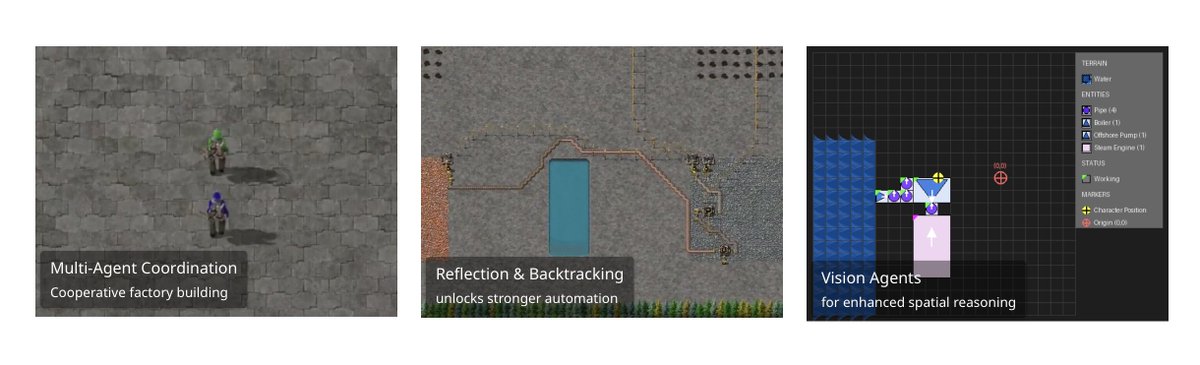
🎉Factorio Learning Environment 0.2.0 released!
📖Details: https://t.co/CuTd2RrMci
New Features:
- Multi-agent support
- Reasoning models + MCP
- Reflection & backtracking
- Vision-augmented inputs
and more frontier model results!
The initial release of FLE was met with great enthusiasm for an AI eval as it's unbounded, open-ended and highly dynamic. Version 0.2.0 expands on these qualities and cements FLE as an ideal testing ground for frontier agents.
Shoutout to Jack Hopkins, @Mbakler00, @akbirkhan and @marksaroufim
🧵 Deep-dive below!
Have you ever wished to view the world from a completely new perspective? This thread on cool maps is here to blow your mind.
1. The Mississippi River and its tributaries
Now available in the #rstats {mapgl} package: the `compare()` function allows you to swipe between layers on your map!
Compare demographic changes, development scenarios, alternative color palettes (shown here) and much more
Learn how: https://t.co/3uzOYMFmlT
Demos showing a LLM "generating" a working game of Space Invaders or Tetris with a single prompt would be *very* impressive if you could generate any game of similar complexity you might come up with. But you can't. You can only generate specific games that the model has memorized. Anything else, you're on your own. It's a glorified copy-paste function.
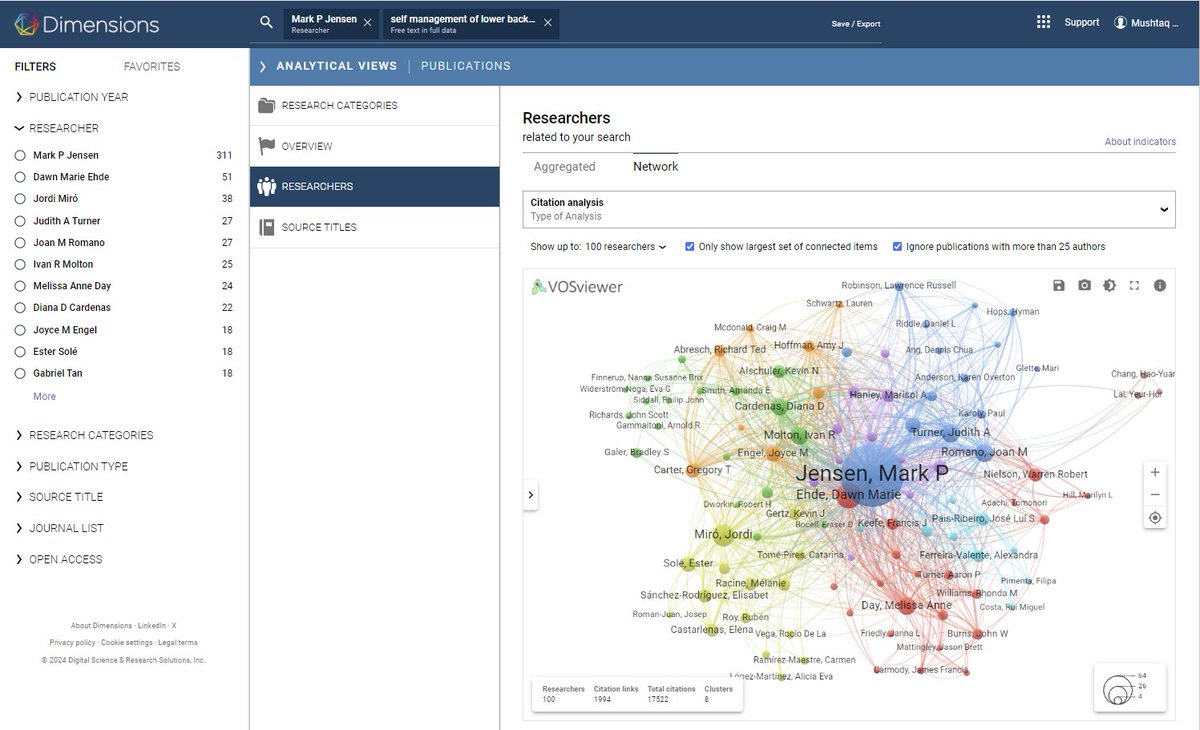
Dimensions is an AI-powered tool designed to make your literature review faster and easier.
It gives you AI-generated summaries of research papers — even those that are paywalled.
It also lets you create graphs of citation networks.
You can use Dimensions for free!
People ask me, "Hey unfashionable Bayesian man, how can I fit those rad generative network models from your course?" Well with @danielj_redhead @mindismoving we wrote a package to make it easy. Easier. Okay it's possible now. Open access and open source. https://t.co/1GOXbHA94k
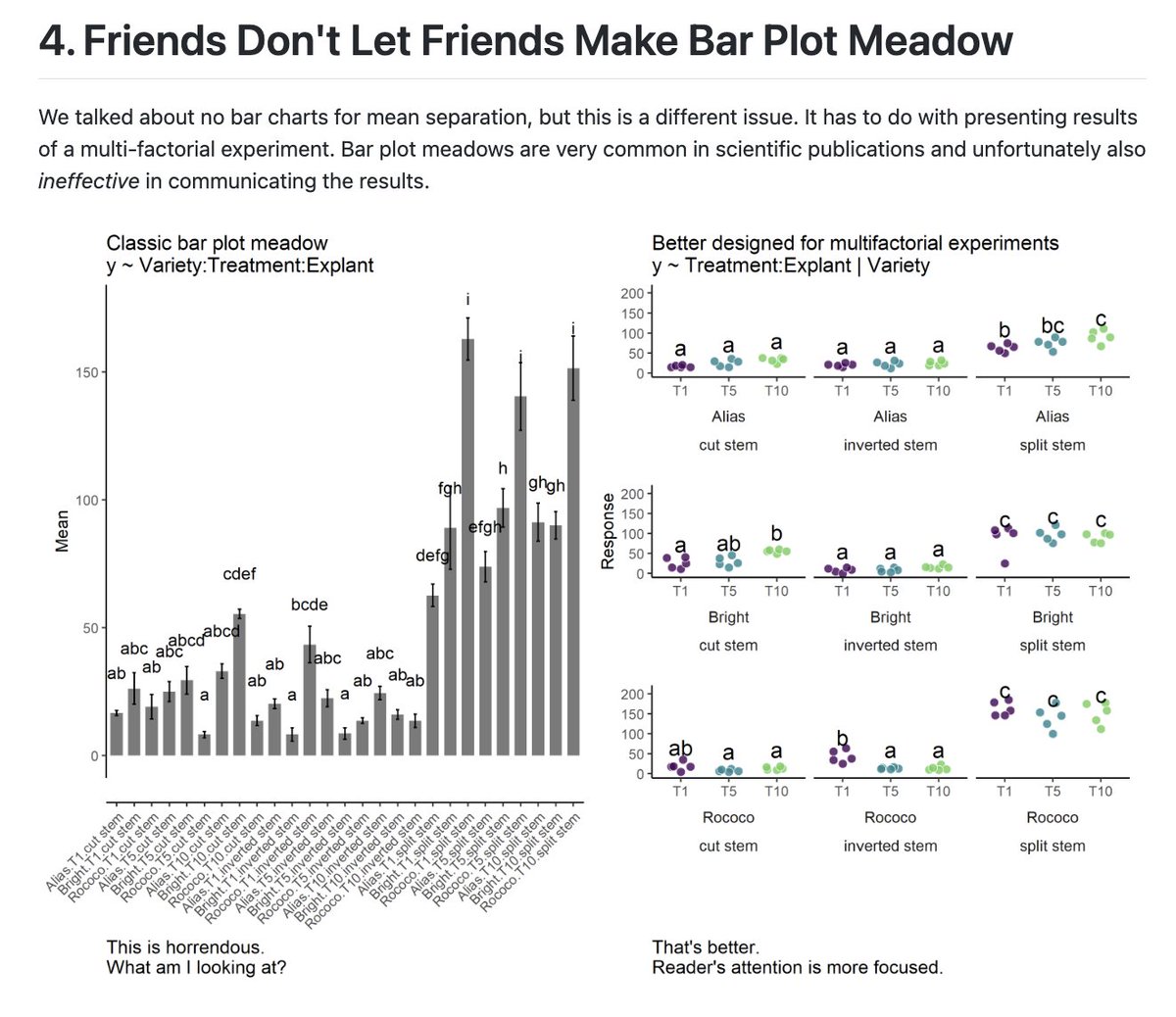
Friends don't let friends make bad charts!
Chenxin Li, pulled together a lot of great advice for data visualization, with clear "do this, not that" examples for each item.
Here are a few of my favorites, see the link below for more.
Oof. Sam Altman is out at OpenAI, and the language of the announcement blog post is just "knives out" level of hostility . This has the feel of the company desperately trying to get in front of something.
Otherwise he'd be taking time to "refocus" or "spend time with family."
Very interesting paper: using generative AI to produce text or images emits 3 to 4 orders of magnitude *less* CO2 than doing it manually or with the help of a computer.
https://t.co/ErIPs4jCpM
Claude is such a firm negotiator! "Crafted by expert artisans, unique and one-of-a-kind." 👨🏼💼
"We ask two LLMs to negotiate with each other, playing the roles of a buyer (GPT 3.5) and a seller (Claude), respectively. They aim to reach a deal with the buyer targeting a lower price and the seller a higher one.
A third language model, playing the critic, provides feedback to a player to improve the player’s negotiation strategies. We let the two agents play multiple rounds, using previous negotiation history and AI feedback as in-context demonstrations to improve the model’s negotiation strategy iteratively."
📝https://t.co/jsbnzZYaqx
Was GPT4 just lobotomized?
It responds to queries a lot faster but seems to perform a lot worse than just a few weeks ago (not following instructions properly, making very obvious coding mistakes etc)
Quite likely they replaced it with a distilled smaller model to save costs?
Next frontier of prompt engineering imo: "AutoGPTs" . 1 GPT call is just like 1 instruction on a computer. They can be strung together into programs. Use prompt to define I/O device and tool specs, define the cognitive loop, page data in and out of context window, .run().
Whoa.. still not convinced of AI Agents? This might change your mind...
I pretended to be a fake shoe company and gave AutoGPT a simple objective:
- Do market research for waterproof shoes
- Get the top 5 competitors and give me a report of their pros & cons
Here's how it went:
How do we compare the scale of language learning input for large language models vs. humans? I've been trying to come to grips with recent progress in AI. Let me explain these two illustrations I made to help. 🧵