Midterm candidates campaigning on AI is becoming a trend.
Take, for example, Mallory McMorrow, a Democratic primary candidate to represent Michigan in the Senate. She's not only just rolled out an uncharacteristically detailed AI agenda, but is speaking the language of AI safety, warning against the risks of AI as an "existential threat."
That may be in part because she's been meeting with employees at frontier labs and other AI researchers to formulate her ideas.
If her work with those researchers doesn't irritate accelerationists enough, she's practically daring super PAC Leading the Future to enter the race, invoking their name multiple times on the campaign trail though they haven't yet deployed any of their war chest against her.
It's a bold choice to pick such a fight, but she says she's watching what's happened in NY and is prepared for there to be a target on her back.
Profile of her agenda and the political implications in my latest for @ReadTransformer (l*nk in reply)
We've all heard lots about the growing anti-data center movement. In 2025, projects estimated to cost at least $156b were blocked or stalled.
But how, exactly, are activists successfully killing data center projects?
For @ReadTransformer, @issielapowsky interviewed a retired tech exec who successfully blocked a Microsoft project in rural Caledonia, Wisconsin — and is now teaching his blueprint to groups across the country.
Issie's piece is a detailed look at the very sophisticated tactics these groups are using — for better or worse.
https://t.co/sxHg86IXvp
If you happened to be wondering how to beat a tech giant that wants to build a data centre in your area (and you have a particularly good reason to), a retired tech exec seems to have figured out the trick...
https://t.co/qmM545LE2L
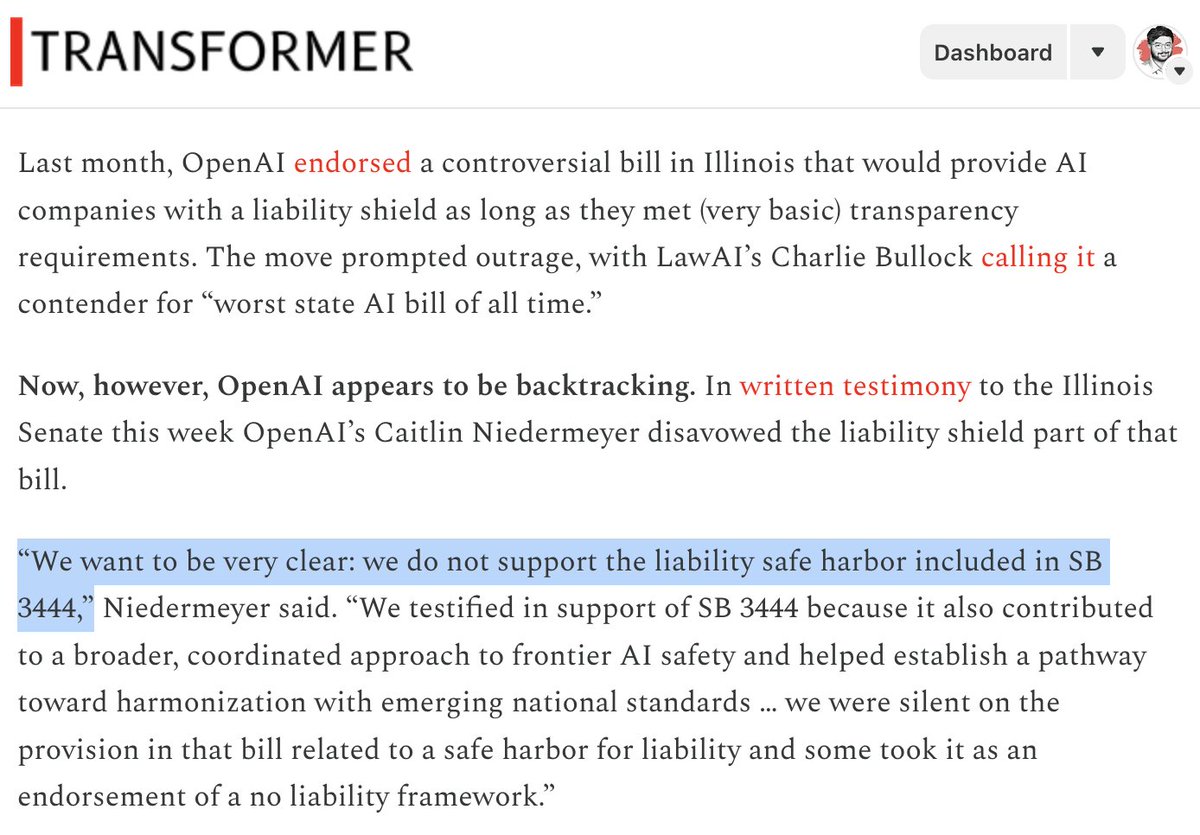
🚨Scoop: OpenAI has changed its tune on the controversial Illinois bill SB 3444.
"We want to be very clear: we do not support the liability safe harbor included in SB 3444," OpenAI's Caitlin Niedermeyer said in written testimony to the Illinois Senate this week shared with @ReadTransformer.
As @ZeffMax reported last month, OpenAI faced heavy criticism for supporting the bill, which would have given AI companies a liability shield in exchange for light transparency measures. @CharlieBull0ck called it a contender for “worst state AI bill of all time.”
In addition to disavowing the controversial SB 3444 clause, this week OpenAI endorsed another bill in Illinois, SB 315, saying that it supports its third-party auditing provisions.
It also said that "the CAISI – in partnership with national security agencies – is well positioned to develop auditing standards," which I don't think it's said before.
Here's something weird. Last week, AI super PAC Leading the Future endorsed three Democrats, including Oregon Rep. @ValHoyle.
When @vronirwin initially reached out to Hoyle, she seemed to distance herself from the PAC, saying she was "all for innovation, but not at the cost of people’s well-being". Hoyle's team said "she does not actively seek out the support of folks that are not her constituents in this race."
But shortly after Transformer approached Leading the Future for comment, Hoyle and her team appeared to backtrack.
They sent us a *new* statement that used much more industry-friendly language — saying "I refuse to ignore industry" and saying we need to make sure "the United States doesn’t get left behind." (They also kept revising that new statement, confusingly.) And they said that Hoyle had filled out a candidate questionnaire from Build American AI, Leading the Future's dark money affiliate.
https://t.co/0BJttLvJV9
"There's an open secret in DC: attach the word China to anything and you can get it done." — @SammSacks
In the past few years, the AI industry has embraced that adage, pushing the idea of an AI race with China as a way of getting the policies it wants.
In a fantastic new piece for Transformer, @yilingliu95 traces how we got here — and explores the very real damage this (not necessarily true!) story is doing.
The AI safety field was built on the idea that, with enough compute, money, and brainpower, a small group of very smart people can save the world. After all, public and political attention has consequences, many of them negative. It's natural (strategic, even!) to want to avoid that.
So the work of AI safety has largely excluded the public by design. The ~discourse~ largely unfolds behind closed doors, between researchers, executives, and the policymakers they have direct access to.
But in choosing to mostly operate behind the scenes, the AI safety community created a vacuum that's now being filled by industry lobbyists, populist politicians, and radicalized individuals. It's created this opaque aura that's riled up suspicion on both sides of the aisle.
And, without the AI industry’s money or the public’s buy-in, people who care about x-risk won’t have the power to pressure governments and corporations to change. Mass movements, by definition, include a lot of people — including those who don’t currently fit in the SF/DC “AI safety” bubble.
I'm not sure what the solution is. People I spoke with disagreed.
But in the world of left-wing community organizing, there’s a common refrain: "center the most impacted." Those who are currently, *viscerally* affected by AI today are exactly who you want in a potential coalition. You can draw a direct line from normie concerns about job loss, mass surveillance, and cyberattacks to x-risk-pilled concerns about gradual disempowerment and loss of control.
Outside Silicon Valley, though, most people don’t experience AI as a powerful coding tool or existential threat. Rather, it’s a symbol of the machine we’re meant to be raging against — not an extinction risk, per se, but something billionaires are using to forcibly strip humans of their humanity.
One argument I found compelling: if getting x-risk on the table is your goal, you have to get there by addressing problems with *existing* AI. Long-term existential concerns aren't separate from near-term populist anxieties. The AI safety community has a window of opportunity to make its case to the broader public.
Most people in the US feel uncomfortable about AI’s current trajectory, and this discomfort will likely turn into action sooner rather than later. Whether that manifests as voting power or bottles of gasoline flying over San Francisco depends on building a movement.
A thing I have always admired and respected about the AI safety ecosystem is how transparent it is. Even when transparency ends up causing problems, lots of orgs in this space are extra transparent just because it's the right thing to do.
That's why I think it's a shame that the Public First network of PACs are not particularly transparent — and less transparent, in fact, than their major opponent Leading the Future.
They use a 501(c)(4) "dark money" setup to hide the identity of many of their donors. By @vronirwin's count, there's $5.5m worth of donations from anonymous donors. That seems bad!
Such funding structures are totally common in political finance. But I personally wish AI safety orgs held themselves to a higher standard.
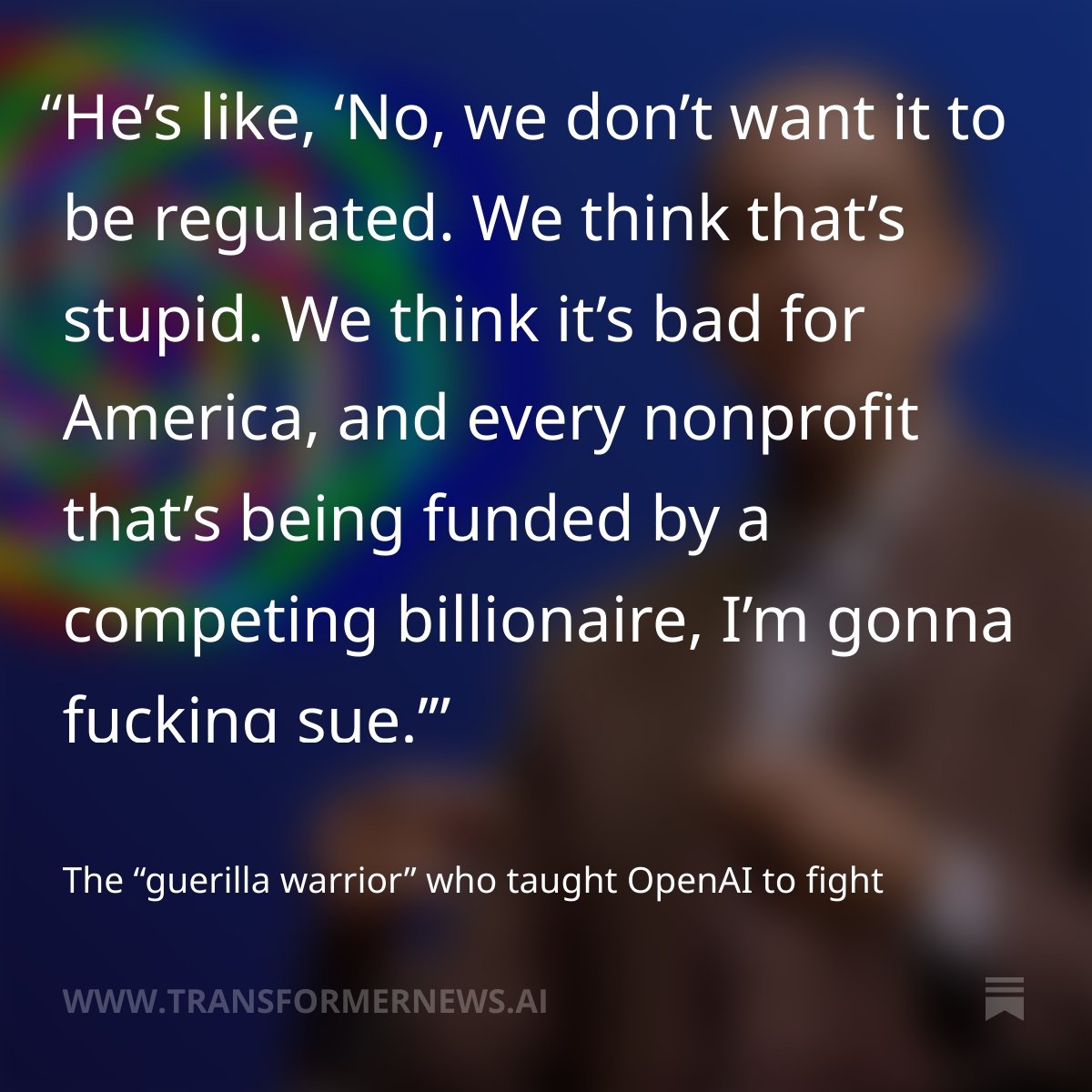
"He's like, 'No, we don't want it to be regulated. We think that's stupid. We think it's bad for America, and every nonprofit that's being funded by a competing billionaire, I'm gonna fucking sue.'"
That's a friend describing Chris Lehane, OpenAI's chief global affairs officer — a man with a reputation for being absolutely cutthroat.
if you're writing about AI and want a single normal person to read it (which is, I'd argue, important!), please for the love of god delete the words:
- bayesian
- priors
- manifold
- orthogonal
- epistemic
- alignment (without definition)
- utility
🚨 Big new report from UK @AISecurityInst.
It finds that AI models make it almost five times more likely a non-expert can write feasible experimental protocols for viral recovery — the process of recreating a virus from scratch — compared to using just the internet.
The protocols' feasibility was verified in a real-world wet lab.
Today's @ReadTransformer newsletter is my howl of rage at the past week's news.
The way Trump is governing is bad for AI safety *and* bad for accelerationists.
Between the H200 decision, the executive order, and the continuing pace of AI progress, it really seems we're living in the dumbest timeline possible.
"How we choose to act now will determine whether our shared basis for reality — what we see and hear — remains trustworthy." @witnessorg's @SamGregory on Sora's threat to visual truth: https://t.co/ZLy5kz4xi7
If Japan’s flexible approach proves successful, it could offer a model for countries seeking alternatives to regulatory extremes — through trust and adaptation rather than punishment.
https://t.co/sFs3nVBhyp
“Can you set an AI on a general task of, ‘Break into this network’ and have it do so? ... the results aren’t great ... They’re not zero, but they’re not great.” @stokel
on why experts aren't — yet — too worried about catastrophic AI-enabled cyberattacks. https://t.co/0hcjfW4j2G