A systematic program with no economic view and no human judgment beat Berkshire Hathaway by 5x.
A dollar in the S&P 500 since January 2000 is worth $7.48 today. A dollar in Berkshire Hathaway, the most celebrated investment vehicle in modern history, is worth $14.11.
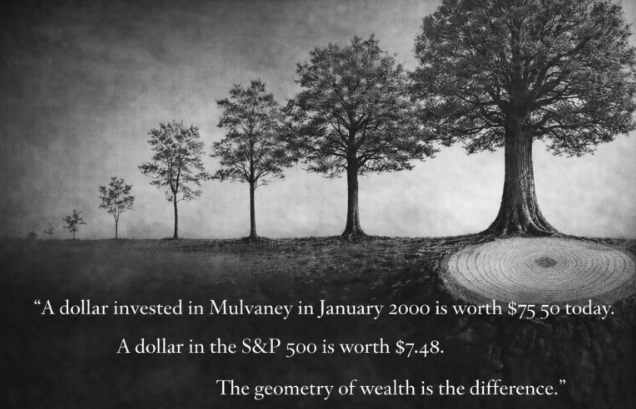
A dollar in Mulvaney's Global Diversified Program is worth $75.50.
No fundamental analysis. No view on the economy. No human judgment about which positions to hold. Just a process, followed for 26 years. The geometry did the work.
But the headline number is not the lesson. The lesson is in the spread. The same database holds a program that turned $1 into $1.32, barely outpacing cash. Same process, fiftyfold difference in outcome. In a multiplicative world, small differences in calibration compound into vast differences in wealth.
And then there is the trap. If one program extracts more compounding per unit of drawdown than any other, why not just lever it up and manufacture a higher return? The math says you can. The math is wrong. Maximum drawdown scales linearly with leverage, but the volatility tax scales with the square of it. Double the leverage and the tax at least quadruples. Lever Mulvaney 2x and the drawdown collapses past 90% for barely two extra points of CAGR, and the curve actually finishes below the 1.5x version. You cannot scale a path-dependent quantity and predict the result. This is the leverage fallacy, and it eliminates the investor before it rewards them.
This is where the theory meets 26 years of independent track records. Episode 10 opens the composite and examines the individual machines inside it: two archetypes, a controlled leverage experiment, and why casting a wide net is a geometric strategy rather than a risk preference.
https://t.co/KPCi0g6tcX
#TrendFollowing #SystematicInvesting #Compounding #RiskManagement
the greatest energy trader of all time on what being the best actually costs you:
"i would sit there from six in the morning to 6 at night staring at the screen. go out with people from the industry that night. dream about the industry. in the shower in the morning i'd be thinking about it. after doing that for 17 years, at some point i just had to step back."
nobody tells you this part. the people who become the best in the world at one thing are almost never the best at anything else while they're doing it.
The Punk Rocker of Trend Following
What does it take to survive a 50% drawdown, dial the heat back up, and come out the other side with a 40-bagger on your chart?
On Episode 13 of Turtle Talk, Rich Brennan, Jerry Parker, and Adam Havryliv sit down with special guest Mike Melissinos, one of the handful of genuinely uncompromising classic trend followers left standing.
From a quiet summer at Bear Stearns to watching the GFC validate everything, from the trend following blues to feeling nothing when the big returns finally land, this is the honest, no fluff conversation the polished finance pods never give you. Plus the April 2026 review, SanDisk's astonishing run, and why classic trend following is punk rock.
Listen here: https://t.co/49YiS7TcEC
#TurtleTalk #ClassicTrendFollowing #ManagedFutures #MikeMelissinos
I just gave away one of my actual systematic trading systems.
13 pages. Full rules. 26-year backtest, drawdowns and all. No signup, no email gate.
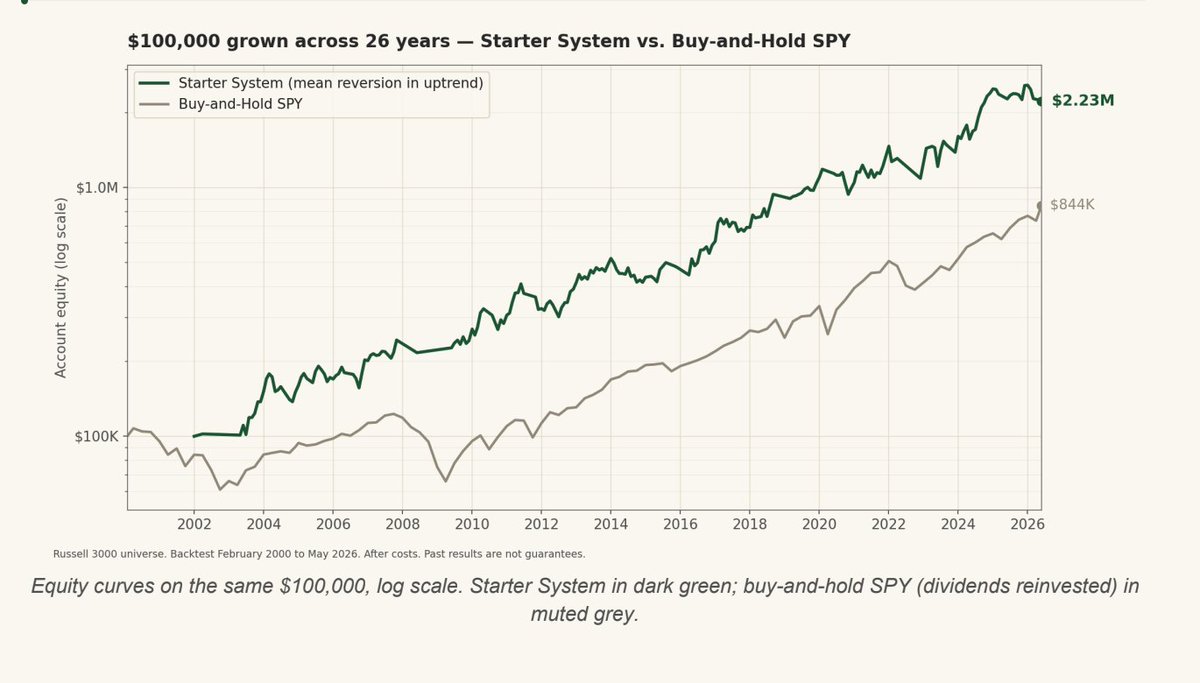
Across the backtest: $100K compounded into $2.23 million.
Worst drawdown was -26%.
Buy-and-hold SPY over the same 26 years: -46% worst drawdown.
Thread on what it is and why it works ↓
This week @kevinmuir & @PatrickCeresna welcome, Tony Greer @TgMacro. They discuss his trading successes and mistakes, as well as the current market environment and why he believes oil will go higher regardless of what happens in the war. https://t.co/UKSZhwAVqv
I dropped an absolute banger of an episode on Monday and y'all are sleeping on it.
We're talking token launches, market making deals in crypto, inventory risk management, spoofing, adverse selection, defi, arbitrage, and plenty of other buzz words.
https://t.co/Ba6zG3fuXj
This week @kevinmuir & @PatrickCeresna welcome, Leonid Mironov @leomironov. They discuss Leonid’s new gig with Louis Vincent Gave, why he thinks Chinese stocks are still a buy and Leonid wonders if the oil market is more right than the pundits realise. https://t.co/DRFIovf335
He has historically spent approximately 82% of months in a drawdown.
The average underwater value is around -15%, a persistent state of discomfort during which every instinct pushes toward changing something.
He has faced that pressure for a quarter of a century and never acted on it.
Such discipline is not a footnote to his track record: we believe it is a core ingredient of it.
https://t.co/PfXFgTeq12