Jesse Livermore made and lost multiple fortunes. He traded through the 1907 panic, the 1929 crash, and every boom in between.
His entire system fits in 14 rules. Save this.
Before you enter:
1. Is the market trending in your favor?
2. Is this stock a leader?
3. Has price confirmed your thesis?
4. Is timing right?
5. Do you have a stop loss?
If any answer is no, do not enter. Wait.
While in the trade:
6. Scale in, never all at once
7. Let winners run
8. Cut losses fast
When to stay out:
9. No setup? Do nothing
10. Ignore tips
11. Never average down
Mindset:
12. The market is never wrong
13. Fear losses, let hope ride with winners
14. Review every single trade
Most traders lose because they do the opposite of every one of these rules. They chase. They average down. They hold losers and sell winners. They trade every day.
Livermore's biggest profits came from sitting tight. Not from trading. From waiting.
"It never was my thinking that made the big money for me. It always was my sitting."
Recommended reading for the weekend:
1. Aswath Damodaran (@AswathDamodaran) — Information Timing and Release: The Gaming of Guidance!
2. Dwarkesh Patel (@dwarkesh_sp) — Why compute might get 10x+ more expensive in coming years
3. J.P. Morgan — Semiquincententacles
4. @citrini — Protection Matters: Cybersecurity’s Winners and Losers
5. Neil Shah (@neil_shah) — Innolight, Coherent, Lumentum: Who Wins and Loses in the Proposed FCC Ban on Chinese Transceivers?
Opus 5 in Sidekick is a cheat code.
Last week we asked it to find stocks with the most bullish sentiment from CEOs.
$COHR ranked near the top, then ripped nearly +50% this week.
So we pointed it at the top 20 $SPY performers YTD and asked for a fundamental ranking.
Memory, storage, drives... 👀
$MU $SNDK $WDC
I think the market ultimately has no choice but to go sell memory, long optical in the "short term." Actually, some hedge funds already seem to have this position on.
There are three main reasons.
1. With Korean leveraged ETFs effectively dead, LPs are in a redemption rush, which could bring out additional sell on flow.
2. Nvidia is nerfing Rubin Ultra's HBM and responding with optics, tying multiple racks together, so that even if Rubin Ultra's per rack performance is not superior to Rubin, at the cluster level optics let the Rubin Ultra cluster hold an edge over the Rubin cluster. This holds even if Rubin Ultra's HBM nerf is a supply problem rather than a demand problem.
3. Consensus is forming that memory prices will peak within the next two quarters.
Medium to long term I am still a memory bull, but short term I am somewhat bearish on memory. I currently have no memory position.
$MRVL is setting up well... still has technical damage to repair.
Bounced off institutional levels: 150 EMA + 61.8% fib, rallied +30% off LeoSold impulse low.
Now building constructively here: $205-$215 area.
Photonics names are finally reclaiming 50DMA, $MRVL could be next.
Let's talk about the $AXTI readthrough from $AAOI
I want to have fun today and get the brains working.
So much time spent listening to calls the last few days.
But,
AAOI said:
> Substrate supply is secured through YE27
> Their laser capacity could grow >10x
> They are already planning substrate needs for 2028/29
> And they are talking with 2-3 substrate suppliers about deeper partnerships, potentially even a JV
That is a pretty strong signal for AXT.
AAOI is already thinking 2-3 years ahead about how they are going to secure enough InP wafers for the amount of lasers they want to make.
And AAOI is just one customer.
Meanwhile AXT is saying demand continues to move faster than they can add capacity.
Their backlog extends into 2027.
They are literally limiting how many orders they accept because they only want to take orders they think they can actually deliver.
Morris even said:
“Whatever we can produce, we can sell.”
And they now want to exit 2027 around $130m/quarter of InP capacity, up from ~$60m exiting 2026.
So the demand signals from AAOI and AXT line up really well.
But then I remembered something from AXT’s Q1 call that I think got way more interesting after yesterday.
Needham literally asked them why they couldn’t do a China + 1 strategy.
Keep building in China to serve China, but also build another facility outside China to serve the rest of the world.
And AXT basically said yes, that is something they are considering.
Their focus through 2027 is Beijing because that is the easiest and lowest-risk place to add capacity quickly.
They already have the people, the furnaces, the processes, the manufacturing knowledge.
Everything is already there.
So if customers need wafers ASAP, that is obviously where you expand first.
But for 2028 and beyond, Tim said their next growth plan could include capacity outside China.
They said a meaningful new greenfield facility could cost roughly $220m-$250m.
So,
What if AXT eventually looks like:
China
> Huge Tongmei operation
> Serves China demand
> Keeps scaling with the Chinese optics ecosystem
And then:
+1
> New substrate facility in the U.S. or another allied country
> Serves LITE / COHR / AAOI / Western customers
> Bypasses the China export permit issue for those wafers
> Gives hyperscalers a second geographic source
And there is already some precedent for the funding model.
> LITE: $87M of deposits tied to reserved InP capacity through 2031
> COHR: $22.3M prepayment for dedicated 6-inch InP capacity
> Casela: $25.4M 2027 purchase commitment, with 50% prepaid
So customers are already basically saying:
"We need your wafers badly enough that we will give you money upfront to expand capacity for us"
Now go back to AAOI.
They are talking about potential substrate JVs for 2028/29.
AXT is talking about a potential ex-China greenfield expansion for 2028+.
I have zero evidence those two are talking about doing this together.
This is purely a thinking exercise.
But again the timing seems to be consistent.
And if Western optics companies keep pushing for U.S./allied supply, I could absolutely see some combination of:
AXT capital + customer prepayments/LTAs + government incentives funding a second manufacturing base outside China.
That would be a huge deal for the AXT thesis.
Because one of the biggest risks around AXT today is
that can be one of the most important InP substrate suppliers in the world but all of the wafer manufacturing sits in China.
China + 1 would change that risk profile a lot.
And after the AAOI call, I think this idea deserves a lot more attention.
You guys need to realize the best capital market wizard of all time is Elon followed closely by Jensen. You could do like 5 documentaries on both of their best trades of all time.
Ofc they weren’t going to let that thing go down after the lockup. Especially not during neocloud summer, can you feel the cool breeze of 200k gpu fans spinning?
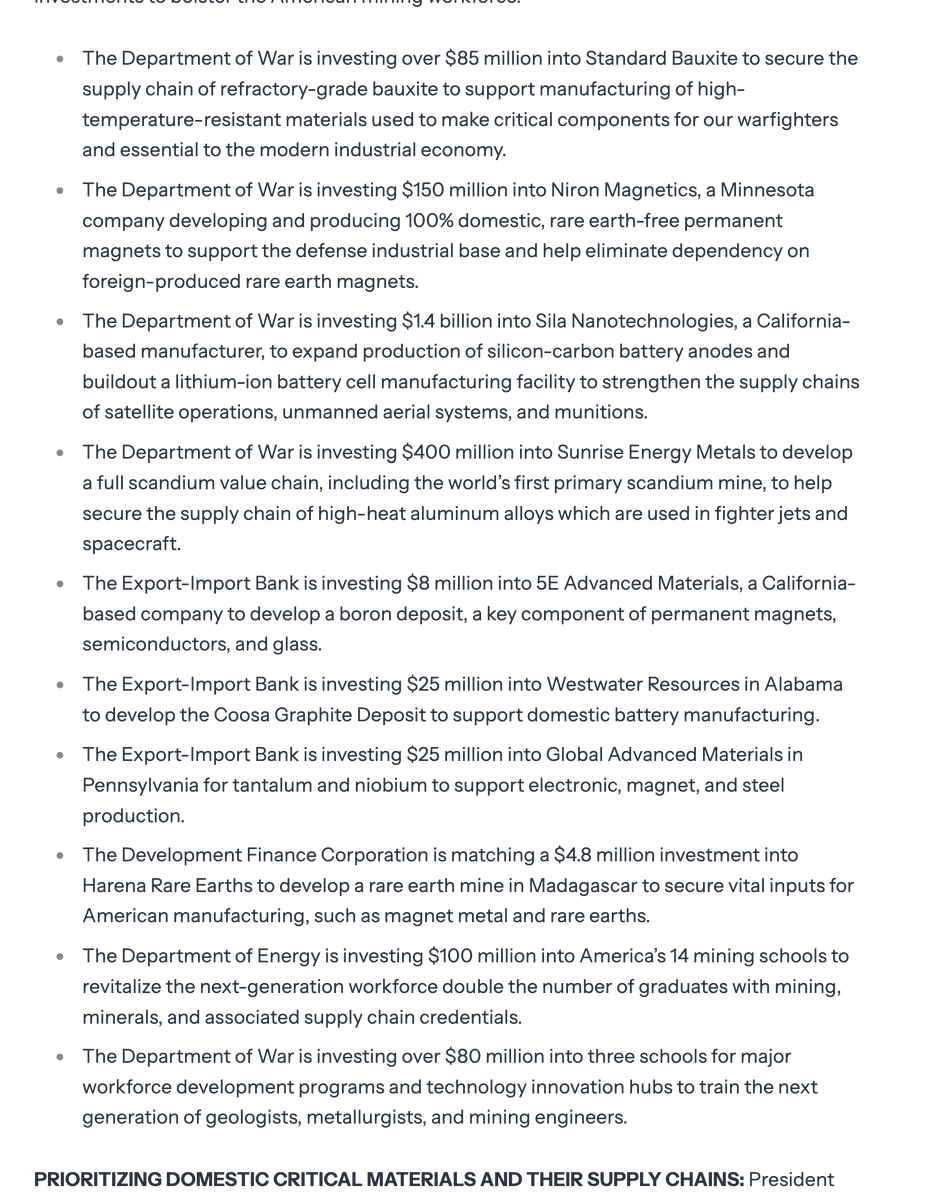
There we go, White House finally invests in more breath in critical minerals/materials. Amazing policy move, as a TLDR:
- $WWR receives $25M (graphite)
- $SRL (ASX) receives $400M (Scandium)
- $FEAM receives $8M (Boron)
- $HREE receives $4.8M (magnet rare earths)
out of the public companies.
With more private investments from $150 million into Niron Magnetics or $85 million into Standard Bauxite.
It's literally spare change to the US gov, for ENORMOUS amount of downstream applications.
More should be done with funding amounts to accelerate development and derisk supply chains (don't own any of the above, just support the policy move), but great announcement.
You have just 18 months to buy hyperscalers.
Then free cash flows will explode and they’ll be violently re-rated.
Time to accumulate.
$MSFT $AMZN $GOOG $ORCL
Updated with all of this week's $AAOI data and reanalyzed as of 8/5/26.
$AAOI ’s rally from the $73.995 extended-hours low reached $140.32, where confirmed 1H and 4H bearish RSI divergence produced the expected pullback. Price has now tested approximately $125.52, which sits inside the normal Wave 4 retracement area.
A controlled correction that holds $128.01–$120.39, followed by a break back above $140.32, would produce the fifth wave we MUST have to strengthen my bullish impulse count.
The decline from $233.67 still looks like a complex Primary Wave IV correction, with the low at $74 ETH / $76.01 RTH. The rally now needs to prove that Primary Wave V has started rather than remaining an extended A-B-C recovery.
Actually, something really important happened today we moved from a Bearish 1D to now a Bullish 1D. So, it's spreading. YAY! But, $AAOI MUST clear the major resistance cluster at $152.23–$153.83
Primary LONG $AAOI — Primary IV Low / Wave V Setup
Wave 1: $73.995 → $103.11
Wave 2: $103.11 → $88.15
Wave 3: $88.15 → $140.32
Wave 4: Potentially in progress
Wave 5: Pending confirmation
Preferred Wave 4 support zone:
$128.01–$120.39
A deeper but still valid Wave 4:
Below $120.39, provided price remains above $103.11
Bullish restart triggers:
→ Reclaim $135.40
→ Break above $140.32
→ 1H MACD histogram turns positive again
→ 4H RSI remains above 50
→ Daily RSI remains above 50 with a positive MACD histogram
Upside targets:
T1: $146.38
T2: $152.23–$153.83
T3: $160.87–$164.37
T4: $172.67–$178.10
Stretch: $195.99–$199.80
Risk levels
→ Below $128.01: Wave 4 is becoming deeper
→ Below $120.39: ideal shallow Wave 4 fails, but the impulse remains valid
→ Below $103.11: my impulse wave invalidates
→ Below $88.15: risk increases for a retest of the correction low
→ Below $73.995: candidate Primary IV low fails
→ Below $44.50: long-term bullish EW count is invalidated
I have made MILLIONS trading the AI Sector Rotation
Print this. Keep this. It’s how the next Millions will be made.
My Secret to catching it early?
Following the Sector ETF’s for strength and weakness
AI Ecosystem
• $AIQ: $AMD $INTC $SKHY
Semiconductors
• $SMH: $NVDA $TSM $AVGO
Memory
• $DRAM: $MU $SNDK $WDC
Photonics
• $EUV: $LITE $COHR $AAOI
Software
• $IGV: $PLTR $NOW $ORCL
Cybersecurity
• $CIBR: $CRWD $PANW $FTNT
AI Infrastructure
• $WGMI: $IREN $CORZ $HUT
Data Centers
• $DTCR: $EQIX $DLR $VRT
Physical AI
• $BOTZ: $ISRG $CGNX $TSLA
Space & Defense
• $ARKX: $RKLB $KTOS $SPCX
Nuclear
• $NLR: $CEG $CCJ $OKLO
Quantum
• $QTUM: $IONQ $RGTI $QBTS
Capital rotates through sectors long before most investors notice.
This is how we will catch them early.
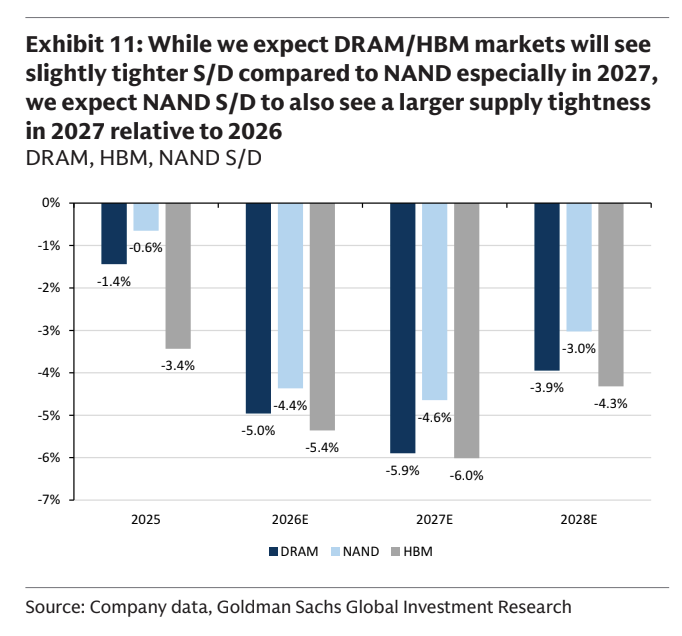
Goldman Sachs: Memory
> General Market Trend (2027 vs. 2026): While the DRAM and HBM markets are expected to see slightly tighter supply-demand conditions compared to NAND—especially in 2027—the NAND market itself is also projected to experience a larger supply tightness in 2027 relative to 2026.
> Peak Tightness in 2027: Supply tightness across all three segments generally peaks in 2027E, showing the most negative S/D percentages:
DRAM: Reaches its peak tightness at -5.9% in 2027E (up from -5.0% in 2026E).
HBM: Reaches its peak tightness at -6.0% in 2027E (up from -5.4% in 2026E).
NAND: Reaches its peak tightness at -4.6% in 2027E (up from -4.4% in 2026E).
> 2025 Starting Baseline: In 2025, market tightness was relatively lower across the board, with HBM at -3.4%, DRAM at -1.4%, and NAND seeing the least tightness at -0.6%.
> Projected Moderation by 2028: By 2028E, supply conditions are expected to ease slightly across all categories compared to the 2027 peak:
DRAM: -3.9%
HBM: -4.3%
NAND: -3.0%
$SNDK $DRAM $MU $EWY
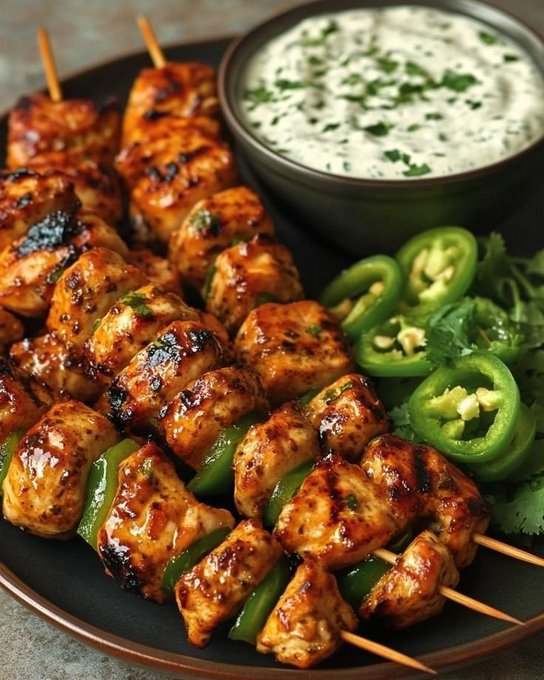
Grilled Chicken Skewers
Serves: 4 • Prep: 20 minutes • Marinate: 30 minutes to 4 hours • Cook: 10–12 minutes
Ingredients
For the chicken
1 1/2 lb (680 g) boneless skinless chicken breasts or thighs, cut into 1 1/2-inch chunks
1 green bell pepper, cut into chunks
1 tbsp olive oil
Wooden or metal skewers
Marinade
3 tbsp olive oil
2 tbsp lemon juice
2 tbsp plain Greek yogurt
2 garlic cloves, minced
1 tsp smoked paprika
1 tsp ground cumin
1 tsp chili powder
1/2 tsp onion powder
1 tsp salt
1/2 tsp black pepper
1 tsp honey
1 tsp hot sauce or 1/4 tsp cayenne, optional
Creamy herb dipping sauce
1/2 cup mayonnaise
1/2 cup plain Greek yogurt or sour cream
1 tbsp lemon juice
1 small garlic clove, grated
2 tbsp chopped cilantro or parsley
1 tbsp chopped dill or mint
1/4 tsp salt
1/4 tsp black pepper
For serving
Sliced jalapenos
Fresh cilantro
Lemon wedges
Instructions
1. Marinate the chicken
In a large bowl, whisk together olive oil, lemon juice, yogurt, garlic, paprika, cumin, chili powder, onion powder, salt, pepper, honey, and hot sauce if using.
Add the chicken and toss well to coat. Cover and marinate for at least 30 minutes, or up to 4 hours in the fridge.
2. Make the sauce
In a small bowl, stir together mayonnaise, Greek yogurt, lemon juice, garlic, herbs, salt, and pepper. Chill until ready to serve.
3. Skewer the chicken
If using wooden skewers, soak them in water for 20 minutes first.
Thread the chicken onto skewers, alternating with green bell pepper pieces if desired. Brush lightly with 1 tbsp olive oil.
4. Grill
Preheat grill or grill pan to medium-high heat.
Grill the skewers for 10–12 minutes, turning every few minutes, until the chicken is nicely charred and cooked through to 165°F (74°C).
5. Serve
Transfer to a platter and sprinkle with fresh cilantro. Serve with sliced jalapenos, lemon wedges, and the creamy herb dipping sauce.
Tips
Chicken thighs stay juicier and are more forgiving on the grill.
Do not overcook or the chicken will dry out.
A little yogurt in the marinade helps tenderize the chicken and gives that glossy grilled finish.
For extra smoky flavor, add a pinch of smoked paprika right before serving.
BofA released a major semiconductor update that memory investors should note carefully.
The key takeaway is a sharp upward revision in the AI capex outlook. 2026 is now seen rising 78% year over year and 2027 by 35%.
The four major US hyperscalers, Google, Microsoft, Amazon, and Meta, have reported stronger multi-year spending plans.
Hyperscale capex is tracking above $860 billion in 2026, up 80% year over year, and heading toward $1.2 trillion by 2027.
The spending is backed by more than $2.3 trillion in multi-year customer cloud commitments and backlog, which rose 16% quarter over quarter. That visibility is significant.
Free cash flow will face pressure as capital expenditures exceed operating cash flow. The big tech companies are funding it comfortably through debt and equity, and capital markets remain open.
The main beneficiaries are ranked as:
1Compute
2Memory (HBM, DRAM, SSD)
3Semiconductor equipment
4Power semiconductors
5Optics
As AI agents scale, memory demand is expected to grow even faster than GPU shipments.
Stronger cloud backlog leads to higher utilization, more accelerators, and ultimately more memory purchases.
This is not a short-term spike. It is a multi-year infrastructure buildout with improving return visibility.
Memory names have received another bullish signal.
How do you see this level of hyperscaler commitment affecting memory pricing and supply through 2027?
#semiconductors #AI