Testing Galileo's law of motion on the Moon!
55 years ago today, Apollo 15 astronaut David Scott performed his feather and hammer experiment on the Moon, demonstrating that without air resistance all objects fall at the same rate.
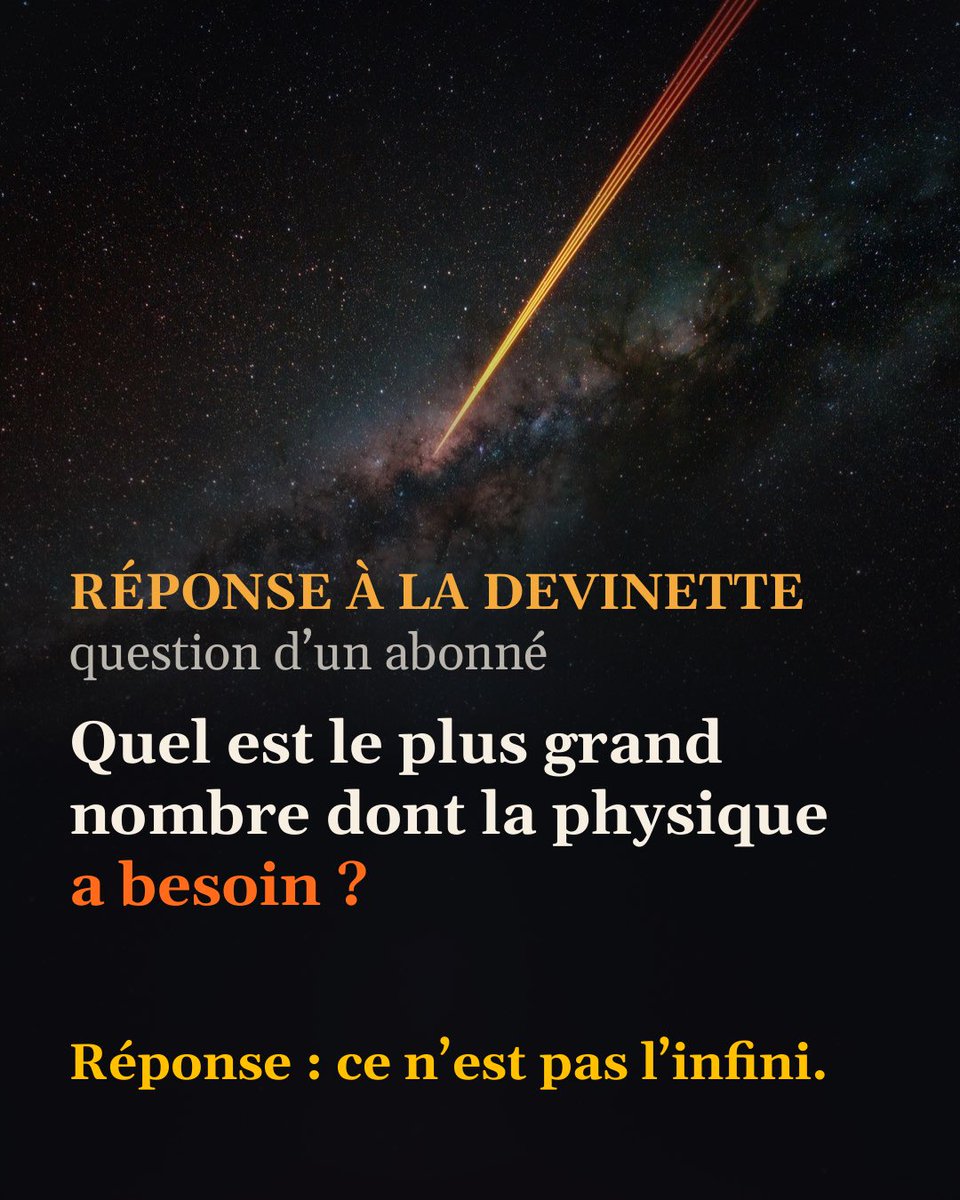
🔢 L'Univers entier tient dans un seul nombre. Et ce nombre n'est pas l'infini.
Un abonné m'a posé la question : quel est le plus grand nombre dont la physique a vraiment besoin ? Réponse : 10¹²². Un 1 suivi de 122 zéros.
C'est l'entropie maximale de notre horizon cosmologique. Donc 10¹²², c'est la quantité maximale d'information que peut contenir l'Univers observable. Au-delà, il n'y a plus rien à compter.
Petit piège au passage : 10¹²² est le nombre d'informations, pas le nombre d'états possibles de l'Univers. Celui-là vaut e^(10¹²²), une exponentielle de ce nombre. On n'ose même pas l'écrire, mais ça reste une nombre fini.
Alors oui, il existe pire. Le temps de récurrence de Poincaré. C’est le temps qu'il faudrait pour que l'Univers repasse près de son état de départ, vaut environ 10^(10^(10^(10^2,08))) années. Ce n'est toujours pas l'infini.
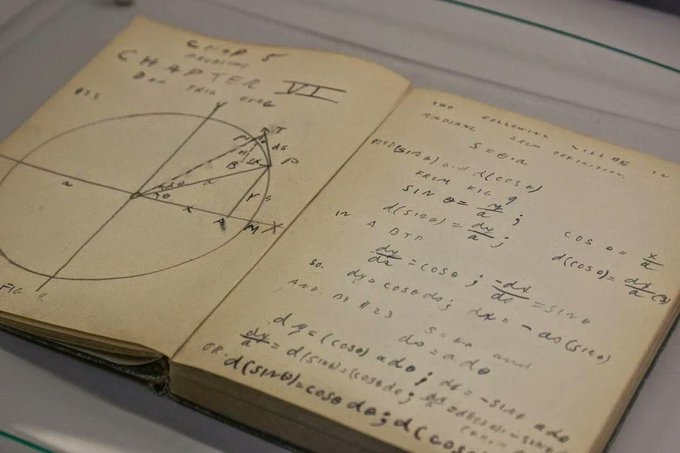
Ici, beaucoup vont m'arrêter : « et vos dérivées, vos intégrales ? Vous passez bien à la limite, donc vous allez bien à l'infini ! » Eh bien non, et c'est tout le malentendu. Dériver, c'est resserrer un petit intervalle h autour d'un point. Intégrer, c'est découper une aire en n tranches. Dans les deux cas on ne touche jamais l'infini. On prend h aussi petit que l'on veut, et n aussi grand que l'on veut. Ça reste un nombre fini.
Voilà pourquoi la Nature est économe comme un Arpagon. Elle utilise les entiers, les rationnels, les réels. Elle n'utilise ni les infinis actuels, ni les infinitésimaux, ni les surréels de Conway (magnifiques pour la théorie des jeux, sans la moindre application physique connue). L'infinitésimal du physicien n'est qu'un raccourci de calcul. L'infini en vrai, c'est pas nécessaire.
À l'échelle de Planck, 10⁻³⁵ mètre, rien ne garantit que le continu lui-même survive. La physique est en carafe. L'espace serait-il granulaire ? Personne ne le sait. C'est là que la mesure s'arrête.
🧮 Résultat des courses : entre la longueur de Planck et l'horizon observable, il y a 61 ordres de grandeur. Tout ce que la physique a jamais mesuré tient là-dedans. Elle n'a besoin ni de l'infiniment grand, ni de l'infiniment petit. La Nature suffit un monde fini.
Salukes
#science #physique #profbucella #lasciencepeuttout
I can see there's a connection between not following normal thinking and doing creative thinking. I wouldn't have had good scientific ideas if I had thought more normally.
-- John Forbes Nash, Jr.
Electrons are so identical that if you swap one electron with another anywhere in the universe, nothing changes—they are fundamentally indistinguishable.
This led physicist John Wheeler to propose the mind-bending idea that all electrons might actually be the same single electron, traveling back and forth through time to appear everywhere at once.
Hot inside and out! 🌋
NASA’s Juno mission has provided the first measurements of the temperature below the surface of Jupiter’s moon Io, revealing significant heating within the subsurface of the solar system's most volcanically active world. 1/2
Now, we're going back to the Moon, building humanity's first outpost on the lunar surface where astronauts will live, work, and explore. Follow along: https://t.co/nlot4OfwSo
Check! ✔️
For the first time, scientists used our IXPE telescope to measure the magnetic field of a pulsar—a spinning neutron star—located in the Lighthouse Nebula. This data helps us understand the structure of these extreme cosmic objects. https://t.co/AppFzUATwb