In the 1920s, a Stanford psychologist tracked genius children for 50 years.
Malcolm Gladwell breaks down what he discovered:
Rich families → successful. Poor families → failures.
Not average. Failures. Genius-level IQs that produced nothing.
He spent 60 minutes at Microsoft explaining why we're wrong about success:
The psychologist was named Terman. He gave IQ tests to 250,000 California schoolchildren.
He identified the top 0.1%. Kids with IQs of 140 and above.
His hypothesis: these children would become the leaders of academia, industry, and politics.
He tracked them. And tracked them. For decades.
The results split into three groups.
The top 15% achieved real prominence. The middle group had average, moderately successful professional lives.
And the bottom group? By any measure, failures.
The difference wasn't personality. Wasn't habits. Wasn't work ethic.
It was simple: the successful geniuses came from wealthy households. The failures came from poor families.
Poverty is such a powerful constraint that it can reduce a one-in-a-billion brain to a lifetime of worse than mediocrity.
There's a concept called "capitalization rate."
It asks a simple question: what percentage of people who are capable of doing something actually end up doing that thing?
In inner city Memphis, only 1 in 6 kids with athletic scholarships actually go to college.
If our capitalization rate for sports in the inner city is 16%, imagine how low it must be for everything else.
Here's something stranger.
Gladwell read the birth dates of the 2007 Czech Junior Hockey Team:
January 3rd. January 3rd. January 12th. February 8th. February 10th. February 17th. February 20th. February 24th. March 5th. March 10th. March 26th...
11 of the 20 players were born in January, February, or March.
This isn't unique to the Czechs. Every elite hockey team in the world shows the same pattern. Every elite soccer team too.
Why?
The eligibility cutoff for youth leagues is January 1st.
When you're 10 years old, a kid born in January has 10 months of maturity on a kid born in October. That's 3 or 4 inches of height. The difference between clumsy and coordinated.
So we look at a group of 10 year olds, pick the "best" ones, give them special coaching, extra practice, more games.
We think we're identifying talent. We're just identifying the oldest.
Then we give the oldest more opportunities, and 10 years later they really are the best.
Self-fulfilling prophecy.
The capitalization rate for hockey talent born in the second half of the year? Close to zero.
We're leaving half of all potential hockey players on the table because of an arbitrary date on a calendar.
Kids born in the youngest cohort of their school class are 11% less likely to go to college.
11% of human potential squandered because we organize elementary school without reference to biological maturity.
Now here's the part about math.
Asian kids dramatically outperform Western kids in mathematics. The gap is enormous and consistent across decades of testing.
Some people say it's genetic. It's not.
It's attitudinal.
When Asian kids face a math problem, they believe effort will solve it.
When Western kids face a math problem, they believe the answer depends on innate ability they either have or don't.
Here's the proof.
The international math tests include a 120-question survey. It asks about study habits, parental support, attitudes.
It's so long most kids don't finish it.
A researcher named Erling Boe decided to rank countries by what percentage of survey questions their kids completed.
Then he compared it to the ranking of countries by math performance.
The correlation was 0.98.
In the history of social science, there has never been a correlation that high.
If you want to know how good a country is at math, you don't need to ask any math questions. Just make kids sit down and focus on a task for an extended period of time.
If they can do it, they're good at math.
Why do Asian cultures have this attitude?
Gladwell's theory: rice farming.
His European ancestors in medieval England worked about 1,000 hours a year. Dawn to noon, five days a week. Winters off. Lots of holidays.
A peasant in South China or Japan in the same period worked 3,000 hours a year.
Rice farming isn't just harder than wheat farming. It's a completely different relationship with work.
There's a Chinese proverb: "A man who works dawn to dusk 360 days a year will not go hungry."
His English ancestors would have said: "A man who works 175 days a year, dawn to 11, may or may not be hungry."
If your culture does that for a thousand years, it becomes part of your makeup.
When your kids sit down to face a calculus problem, that legacy of persistence translates perfectly.
Now consider distance running.
In Kenya, there are roughly a million schoolboys between 10 and 17 running 10 to 12 miles a day.
In the United States, that number is probably 5,000.
Our capitalization rate for distance running is less than 1%.
Kenya's is probably 95%.
The difference isn't genetic. The difference is what the culture values and where it spends its attention.
Here's the most fascinating finding.
30% of American entrepreneurs have been diagnosed with a profound learning disability.
Richard Branson is dyslexic. Charles Schwab is dyslexic. John Chambers can barely read his own email.
This isn't coincidence. Their entrepreneurialism is a direct function of their disability.
How do you succeed if you can't read or write from early childhood?
You learn to delegate. You become a great oral communicator. You become a problem solver because your entire life is one big problem. You learn to lead.
80% of dyslexic entrepreneurs were captain of a high school sports team. Versus 30% of non-dyslexic entrepreneurs.
By the time they enter the real world, they've spent their whole life practicing the four skills at the core of entrepreneurial success: delegation, oral communication, problem solving, and leadership.
Ask them what role dyslexia played in their success and they don't say it was an obstacle.
They say it's the reason they succeeded.
A disadvantage that became an advantage.
Here's what Gladwell wants you to understand:
When we see differences in success, our default explanation is differences in ability.
We forget how much poverty, stupidity, and attitude constrain what people can become.
We refuse to admit that our own arbitrary rules are leaving talent on the table.
We cling to naive beliefs that our meritocracies are fair.
The capitalization argument is liberating.
It says you don't look at a struggling group and conclude they're incapable. It says problems that look genetic or innate are often just failures of exploitation.
It says we can make a profound difference in how well people turn out.
If we choose to pay attention.
This 60 minute Microsoft talk will teach you more about success than every self-help book you've ever read combined.
Bookmark this & give it an hour today, no matter what.
🚨🚨NEW EPISODE DROP Sally Kornbluth, President of MIT🚨🚨
"If you take a lick of the lollipop of mediocrity, you will suck forever."
I love this.
She was talking about how MIT sustains excellence after 150+ years. And it applies to founders and CEOs who are trying to scale, more than ever.
The thing is, the bar doesn't drop all at once. It drops one hire at a time, one exception at a time.
It's better to have nobody than to let the standard slip even once. Every hire, every door, every message has to carry the same signal. That's how MIT maintains it's intensity.....just look at the list of grads like @vkhosla@gdb@drewhouston@mansourtarek_@mntruell@_mohansolo@ChaseLochmiller
I’ve watched this play out with the companies I work with. They hit 150 employees, the founder stops interviewing everyone, and by 500 they're asking what happened to the culture.
Sally's answer: it's a lot easier to stop that slide than to recover from it. The fix is relentless consistency, clarity, and the willingness to say no far more often than you say yes.
Worth remembering when growth feels urgent.
------
Listen to the full conversation with MIT President Sally Kornbluth on Long Strange Trip.👇
I currently have three papers in review at "high impact" journals.
One of them has been sitting there for two years. In that time my daughter was born and learned how to walk, but apparently publishing a PDF was still not possible for me. For another one, after four months in review the editor told me they cannot find a second reviewer and asked me to suggest more reviewers. A third one sent me a message in 2026 saying the PDF I uploaded was larger than 10 MB and that I should please reupload everything to make the file smaller.
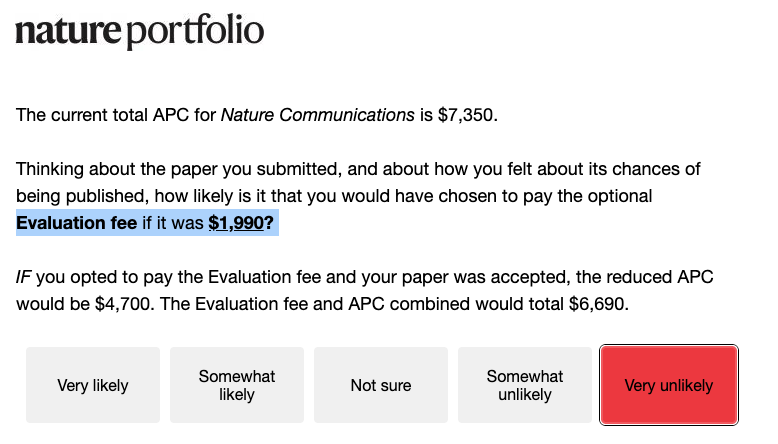
All of this just to eventually pay between 7,000 and 12,000 USD per paper so someone can officially approve that the science we do is "legitimate". Reminder: not a single reviewer will be compensated here.
I still don't understand how we as scientists can collectively be so smart when doing science and still tolerate a system like this when it comes to sharing our findings. We should move to preprints plus open review, whether human or AI, asap. So frustrated about it.
I'd suggest sharing your work on bioRxiv or medRxiv, reading and reviewing preprints when you can, and highlighting good research, especially if it is still a preprint. Try platforms like ResearchHub (that pay for peer review) and experiment with AI based reviewers for faster feedback.
Instead I read this as a proposed "revolutionary" measure:
Structural and mechanistic analysis of covalent ligands targeting the RNA-binding protein NONO. A study led by Charles S. Bond @UWAresearch & Benjamin F. Cravatt @scrippsresearch@CellChemBiol#bps2026 https://t.co/SlFVIPXZi3
So pleased to share that our work showing how Nucleosome spacing regulates DNA methylation by DNMT3A2/3B3 has been published today! Excellent collaboration the Jones and Liu labs.
https://t.co/1GIiLKeXXO
I am excited to share our latest paper published in @NatureSMB.
This research all started with a serendipitous observation of a peculiar heterochromatin distribution pattern of germ cells under the microscope.
Hope you find it interesting.
https://t.co/mQ2gI7u0j9
Our paper on the transcription-coupled H3K36me3 deposition is finally out! We found that histone methyltransferase Set2 deposits H3K36me3 specifically on the reassembled nucleosome in coordination with FACT.
Great collaboration with Sekine Lab!
https://t.co/2SSmAlS5rJ
Perturb2026 is an exciting conference about generating perturbation data, building AI models, and interacting with academic and industry attendees. Great lineup of speakers. Come and join us on March 18-19, Vienna, Austria! https://t.co/W4wYXO2nqG
In this review, we discuss an emerging role of the physical association between nuclear paraspeckles and chromatin in activating gene expression. These evidence stemmed from previous work from Kingston and Workman labs as well as our own recent paper in Cell Reports.
https://t.co/8BVP9IVpHk
We thank the EIC for this invited submission to Epigenetics Reports, a new @EpigeneticsSoc journal. Kudos to our postdocs @jefftu1027 and @cheni_hsu for all the hard work!
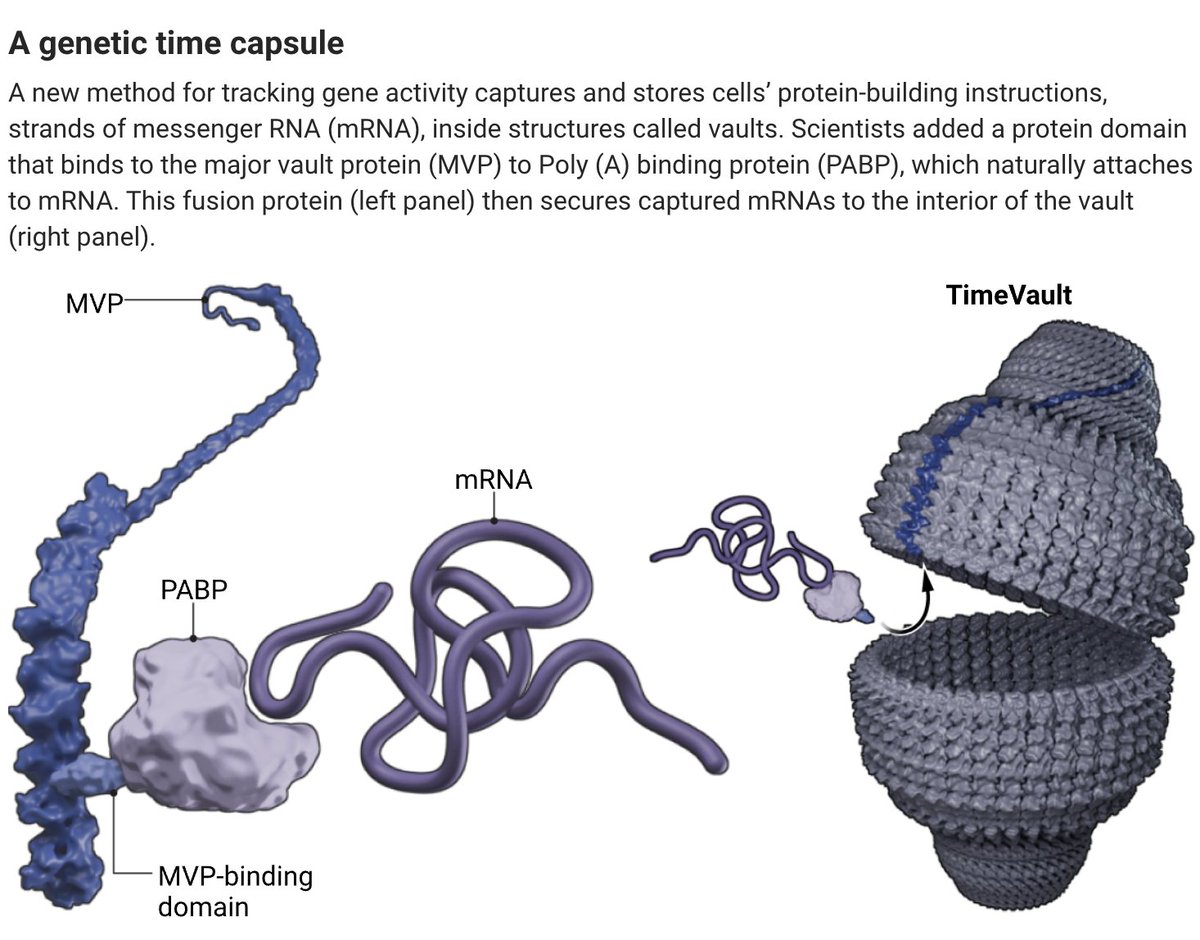
The barrel-shaped structures found by the thousands in most animal cells are one of biology’s biggest mysteries. But although researchers haven’t figured out the function of these “vaults,” they now report a new use for the puzzling particles.
Learn more: https://t.co/nIPZxqSllp
This is absolute required listening for anyone doing NIH-funded research. You will be surprised what Mike Lauer (former deputy director of NIH extramural research) has to say about how science should be funded. I think many academics would be shocked what even the old guard at the NIH honestly felt about science funding.
https://t.co/96WSrasoia
@LocasaleLab I was just in Asia a month ago and found there you can buy equipment with similar specs, manufactured by the OEM factories for US brands, for 1/5 of the prices. Not even mentioning the in-transparency of prices in the US market.
Faculty need to realize that to the institution, we are just employees. We are expendable employees who receive no loyalty from the institution. Sure, we love our scholarship and teaching. But we are still workers and better start acting that way if we want to save academia.
PhD students are admitted into biomedical research programs because these medical centers benefit financially from them. NIH training grants, indirect costs from research grants, and feel-good justifications for hospital surpluses all depend on maintaining a steadily expanding pipeline of graduate students. Little attention is paid to actual performance because the incentives point in one direction: graduate them on schedule, keep them quiet and funded, and give high praise regardless of whether they are genuinely interested in science.
If you hold higher standards and have a low retention rate, administrators will use that against you. Corporate audit offices monitor retention across units, and one upset student can trigger online mobs and new professionalism investigations. NIH even uses retention and time-to-degree as performance metrics.
Dear Colleagues,
I am recruiting 1-2 postdoctoral fellows to work on epigenetic and chromatin mechanisms in the context of 1. cancer dependencies/drug synergies and 2. bone and neurodevelopmental disorders. Interested candidates should email me directly at yuj12[at]vcu[dot]edu.
More details can be found here:
https://t.co/gxMvKGAgwk
Thanks!