We removed 93.25% of the connections in our Un-0 image model, fully expecting to pay for it in quality. But it got better.
FID 7.15 on ImageNet 64x64, roughly 1.9 ahead of the dense baseline at matched size. Same family of model, a fraction of the couplings, a better score.
Here is why that is not as strange as it sounds. Un-0 is a coupled oscillator model, and in the dense version every oscillator talks to every other one. That sounds like a strength, but it means the whole system can fall into catastrophic synchronization: everything locks into step, gradients go flat, and learning stalls.
Sparser connectivity leaves room for coherent and incoherent activity to coexist. The dynamics stay alive, and the model keeps learning.
Connectivity turns out to be a control knob, not a dial you turn up until it stops.
Learn more here: https://t.co/N4lIri8UQQ
🧠 Today we introduce Un-0 from @unconvAI : the first large-scale generative model build on physics as a compute primitive. This represents a “hello world” moment for physics-based models. We use the inherent time-varying behavior of physical systems to do compute for us. The result is a new way to build a computer that can be VASTLY more power efficient. 🧵
https://t.co/zYU0ezXJUq
Lewis Hamilton recently pointed to a mismatch between simulation and reality as a major factor behind a challenging race weekend.
It's a problem every systems engineer recognizes: how do you simulate a system operating at the edge of chaos?
In our latest blog, we explore how Unconventional AI builds digital twins that faithfully model hardware operating in these highly sensitive regimes, capturing the physical and numerical effects that can significantly influence real-world performance.
Read the full post: https://t.co/f1mv15xMcZ
A company you’ve probably never heard of raised $475M six months ago to create a radically new way of building AI. No Von Neumann bottleneck, no memory bandwidth issues, hugely less power required.
This is their first test chip expected this summer.
They are testing whether they can use fundamental electronic circuits to generate intelligent behavior.
NVIDIA, TPUs and similar chips will rule for the next five years at least, but at some point, a new way of building AI will emerge.
I don’t know if it’ll be found by @unconvAI or not, but I’m glad well funded companies like this are tackling this problem.
Short video by the CEO describing their work below.
Most real-world systems are dynamic.
So why do we still treat computation as static?
Our latest blog explores computation through motion using gyroscopes, rods, springs, and ordinary differential equations to perform handwritten digit classification.
A deep dive into:
• dynamical systems as compute
• differentiable ODE solvers
• physics-inspired machine learning
• emergent computation through interaction
Read here: https://t.co/pIwwvT72Bw
If you were considering submitting an application for the Unconventional Grant, please get on it! We're closing submissions tomorrow! We'll announce the winners soon and are excited to see the work that comes from it
Tomorrow, May 15, is the final day to submit pre-proposals for the Unconventional Grant.
Over the past several weeks, we’ve seen proposals spanning:
• computation as dynamics
• in-memory and in-physics compute
• architectures that minimize data movement
• new abstractions beyond linear algebra
Many converge on the same intuition: meaningful efficiency gains in AI will not come from scaling existing approaches alone, but from fundamentally different ways of representing and computing.
We are looking for technically grounded ideas that challenge assumptions across hardware, systems, and learning.
We’re not looking for taller ladders to the moon. We’re looking for rockets.
https://t.co/7ups8vMcdZ
Getting to 1000x energy efficiency in AI isn’t about one breakthrough.
It’s about solving two hard constraints:
1. Data movement dominates energy
2. Amdahl’s Law caps system-level gains
Which means you have to rethink everything: models, hardware, and how they’re designed together.
If this kind of problem excites you, you’ll enjoy our latest blog: https://t.co/3FFKWIm1nc
Analog vs. digital. Which is actually better?
As AI systems hit efficiency limits, it might be time to rethink the abstractions we’ve taken for granted and focus on using the right tool for the job.
Explore the case for a mixed-signal future in our latest blog post “Analog is dead, long live analog.”
https://t.co/wnwafD16qq
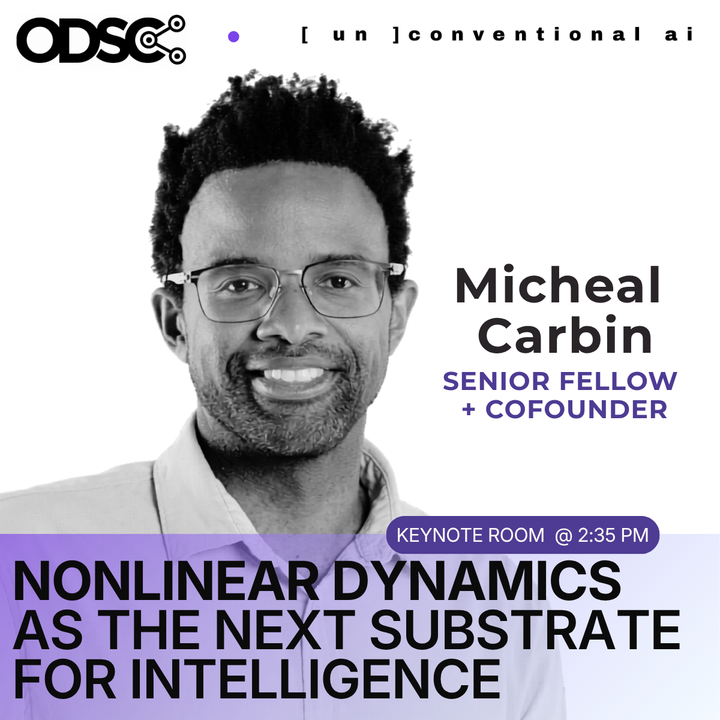
Attending #ODSCAIEast today? Join our cofounder @mcarbin at 2:35 PM ET in the Keynote Room.
“Nonlinear Dynamics as the Next Substrate for Intelligence” explores a fundamental idea: we may be building AI on the wrong substrate.
The human brain runs on ~20 watts. Today’s AI systems require orders of magnitude more. That gap isn’t just engineering, it’s architectural.
Michael will share why moving beyond digital computation toward nonlinear physical dynamics could unlock a radically more efficient path to intelligence.
We’re hiring people who are endlessly curious, comfortable with discomfort, and drawn to the edge of chaos.
If this sounds like you, apply here: https://t.co/yx0XhaJBAd
We’re introducing the Unconventional Grant.
A new research grant program supporting bold, unconventional ideas in AI.
We’re allocating $500,000 in total funding, awarding up to five $100,000 grants to researchers exploring new paradigms in efficient, scalable, and biologically inspired AI systems.
We’re especially interested in ideas that challenge how AI systems are built today, from unconventional circuits and architectures to new approaches in neural networks and theory.
Not incremental work.
Not safe bets.
Ideas that push the field forward.
https://t.co/nkSvjhZE12
Stop copying the past. Is modern AI just a "cargo cult" worshipping the GPU?
For 60 years, hardware and software have lived in completely separate worlds. But AI is forcing us to tear down those walls. The industry is stuck optimizing old abstractions and linear algebra not because it’s the best way to build intelligence, but because it’s what we inherited.
We’re flipping the script at Unconventional AI and introducing neural co-evolution.
We are building hardware and neural networks together from day zero to bypass the limits of traditional computing and unlock mind-blowing 1000x efficiency gains. The era of siloed design is over.
Ready to see the future of compute? Read the full breakdown in our latest blog post.
https://t.co/DA8uxkecFZ
In a recent episode of the @ThisWeeknAI, our CEO @NaveenGRao joined @jason for a roundtable discussion with @chaselochmiller (@CrusoeAI) and @ml_angelopoulos (@arena).
Naveen discusses the long-term limits of scaling AI on today’s computing architectures and why new approaches to hardware and computation will be needed as the field continues to grow. The discussion also touches on infrastructure constraints, evaluation challenges, and how engineers can stand out as the industry matures.
These are the kinds of questions we are exploring every day at Unconventional AI.
Watch the full conversation below.
https://t.co/UDdXdjRurH
1/10 Reimaging computing using dynamical systems raises a host of fundamental questions, among them: How programmable/steerable is a candidate system? This week, we ran an experiment to test the limits of programmability by asking: is a toy 4-oscillator system expressive enough to dynamically sweep out any arbitrary pattern in phase-difference space? After testing our “[un]” logo, we concluded these systems are highly steerable. Here’s how we did it.
Unconventional AI is designing a new computational substrate for intelligence.
This requires extreme codesign across AI algorithms, systems, compute models, analog circuits, and hardware architecture.
We are hiring across all of these areas. Learn more about our open roles on our careers page. https://t.co/tzPAGsdj7r
The biggest problem for AI in 2026 is not prompts or architectures. It is energy, throughput, latency, and scale.
Unconventional AI is solving that.
https://t.co/YoKB4oSVwq @lightspeedvp@NaveenGRao