@ZackKorman https://t.co/HjYvWqmJkm He talks about it here. The whole episode and his view on the path to superintelligence was really, really interesting.
Why are these guys all like this.
Dude, you have a tool sitting right in front of you that will enable you to explore the mathematical landscape in ways that would have been unimaginable a year ago. And you're sobbing in your Chardonnay.
Judging by my tl there is a growing gap in understanding of AI capability.
The first issue I think is around recency and tier of use. I think a lot of people tried the free tier of ChatGPT somewhere last year and allowed it to inform their views on AI a little too much. This is a group of reactions laughing at various quirks of the models, hallucinations, etc. Yes I also saw the viral videos of OpenAI's Advanced Voice mode fumbling simple queries like "should I drive or walk to the carwash". The thing is that these free and old/deprecated models don't reflect the capability in the latest round of state of the art agentic models of this year, especially OpenAI Codex and Claude Code.
But that brings me to the second issue. Even if people paid $200/month to use the state of the art models, a lot of the capabilities are relatively "peaky" in highly technical areas. Typical queries around search, writing, advice, etc. are *not* the domain that has made the most noticeable and dramatic strides in capability. Partly, this is due to the technical details of reinforcement learning and its use of verifiable rewards. But partly, it's also because these use cases are not sufficiently prioritized by the companies in their hillclimbing because they don't lead to as much $$$ value. The goldmines are elsewhere, and the focus comes along.
So that brings me to the second group of people, who *both* 1) pay for and use the state of the art frontier agentic models (OpenAI Codex / Claude Code) and 2) do so professionally in technical domains like programming, math and research. This group of people is subject to the highest amount of "AI Psychosis" because the recent improvements in these domains as of this year have been nothing short of staggering. When you hand a computer terminal to one of these models, you can now watch them melt programming problems that you'd normally expect to take days/weeks of work. It's this second group of people that assigns a much greater gravity to the capabilities, their slope, and various cyber-related repercussions.
TLDR the people in these two groups are speaking past each other. It really is simultaneously the case that OpenAI's free and I think slightly orphaned (?) "Advanced Voice Mode" will fumble the dumbest questions in your Instagram's reels and *at the same time*, OpenAI's highest-tier and paid Codex model will go off for 1 hour to coherently restructure an entire code base, or find and exploit vulnerabilities in computer systems. This part really works and has made dramatic strides because 2 properties: 1) these domains offer explicit reward functions that are verifiable meaning they are easily amenable to reinforcement learning training (e.g. unit tests passed yes or no, in contrast to writing, which is much harder to explicitly judge), but also 2) they are a lot more valuable in b2b settings, meaning that the biggest fraction of the team is focused on improving them. So here we are.
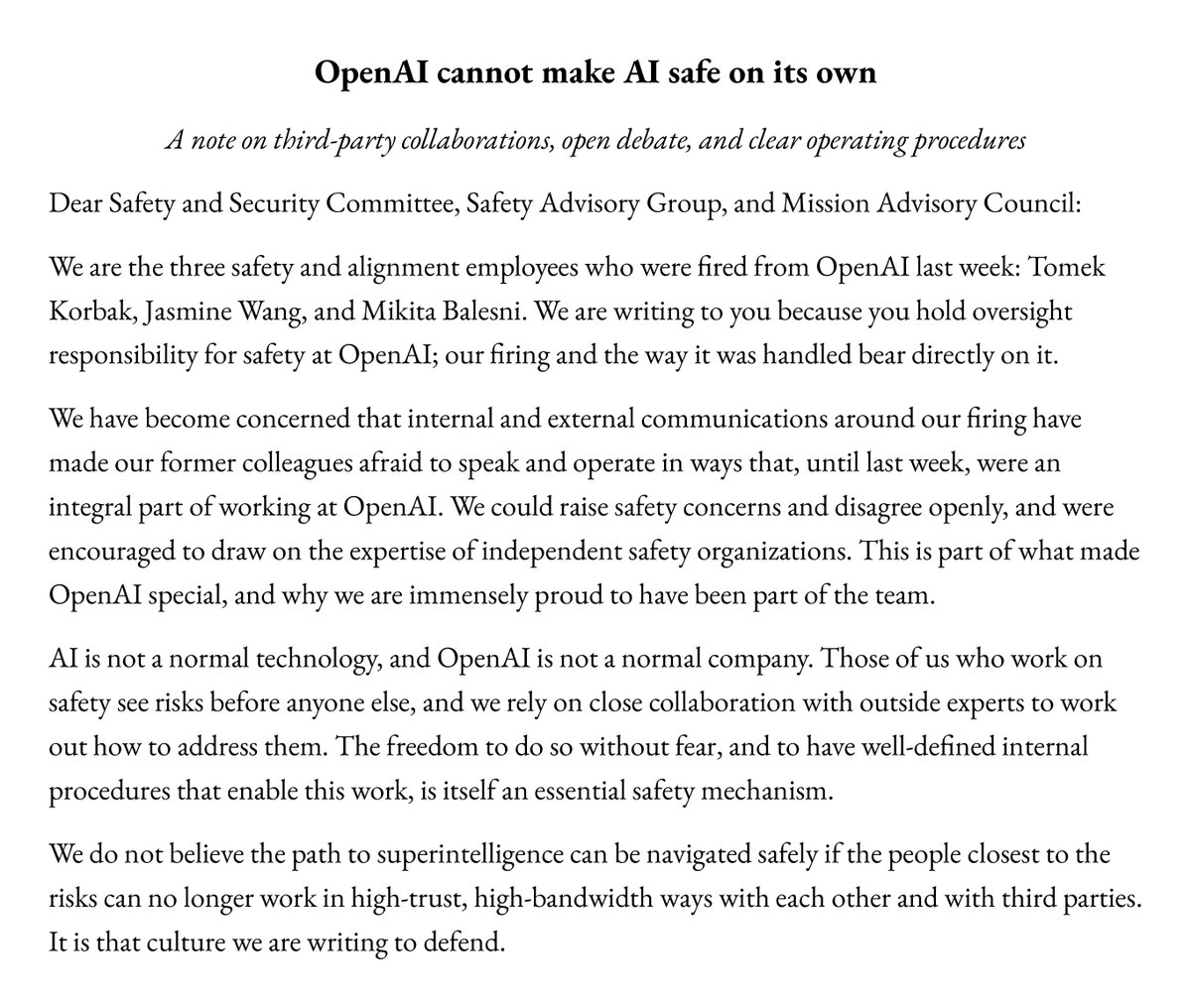
Two other safety researchers and I were fired from OpenAI last week. We wrote this letter to leadership.
I believe we were fired for prioritizing safety over the near-term interests of OpenAI as a corporation.
In July 2025, Eric Schmidt predicted "world-class AI mathematicians will emerge in the next one year."
@GaryMarcus said this prediction was "pure fantasy."
I think the evidence now shows Schmidt's prediction has been vindicated.
TRON (1982) was disqualified from receiving an Academy Award nomination for special effects, because the Academy felt that the use of computers was cheating.
You are on the wrong side of history.
So @dhh just told 1000 rails programmers “accept that it’s over”
Last words of the opening #railsworld keynote were “don’t be a f*cking loser” and then he walks off
Glad I’ve been through the existential dread phase already, cos I’m ready to run through a damn wall right now!!
Es braucht eine neue Partei in Deutschland, die sich in den kommenden 2-3 Jahren formieren muss um dann Anfang der 2030er Jahre stark genug wird um Deutschland zu retten. Hier sind ein paar Zutaten, die es dafür braucht:
1.) Eine charismatische Führungsperson, die politisch nicht vorbelastet ist und nicht von dem politischen Betrieb abhängig ist —> Einer wie Kloppo käme in Frage.
2.) Die Partei sollte in ihre Satzung schreiben, dass sie sich wieder auflöst nachdem sie ihr Programm umgesetzt hat —> Man würde niemandem etwas wegnehmen und über 20 Jahre kann dann der ganze Legacy-Apparat sich neu aufstellen.
3.) Aufgrund von 2.) würde die neue Partei laut Satzung NUR Regierungsverantwortung übernehmen, wenn sie a.) die absolute Mehrheit bekommt oder b.) einen Koalitionspartner, der ALLES mitgeht —> Die Partei KANN und DARF nicht regieren, wenn sie nicht regieren kann. Ein Feature, kein Bug.
4.) Alles auf Innovationen, Wirtschaftswachstum, einen nachhaltigen Haushalt und eine zukunftsorientierte, soziale Marktwirtschaft ausrichten —> Zurück zu gesundem Menschenverstand in allen Bereichen.
Ich glaube wenn sich personell und inhaltlich eine glaubwürdige Bewegung formieren würde, dann könnten Wahlkampfbudgets in niemals dagewesener Form mobilisiert werden. Ich glaube eine solche Partei könnte innerhalb weniger Jahre, wenn sie professionell geplant wird, Mehrheiten organisieren.
Mal gesponnen: Wenn sich so ein Ansatz in 2-3 Jahren formiert, dann könnte eine neue Kraft zwischen 2033-2035 stark genug sein um zu regieren. Eine kompromisslose Reformagenda würde sich umsetzen lassen und um 2045 würden wir dann (vielleicht) ein neues Wirtschaftswunder erleben dürfen.
Jetzt muss nur Kloppo zustimmen :)