@net_science@gozzi_nicolo@alexvespi@mattk7@jessicadavis_@marcoajelli Hey, if you are interested, I also wrote a library for Bayesian inference of disease parameters. It includes fewer convenience functions (no contact matrices etc.) but is, in principle, more powerful in inferring parameters as it uses Hamiltonian MC. https://t.co/IQDGBSrqxd
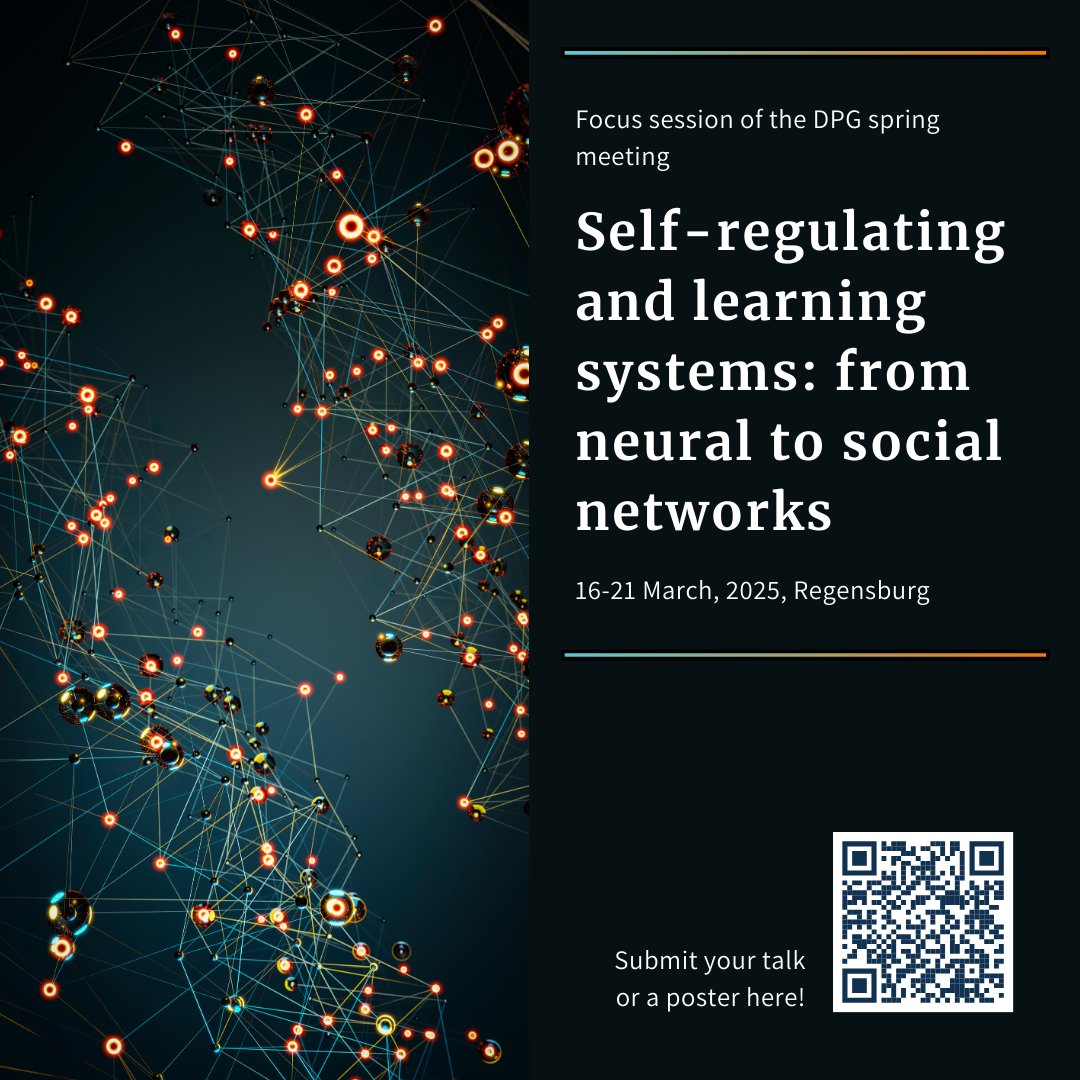
We are organizing a focus session on "Self-regulating and learning systems: from neural to social networks" at the DPG Frühjahrstagung (Spring meeting of the German Physical Society from March 16-21, 2025 in Regensburg).
Abstract Deadline: 01.12.2024
https://t.co/SXdEg08URc
Was in Göttingen aktuell vor sich geht, lässt mich sprachlos. Ein ganzer Wohnblock wird kriminalisiert und von der Polizei kontrolliert, unter dem Vorwand, die Lebensumstände dort zu verbessern 1/
Absolutely over the moon to see this finally out, big thanks to the reviewers and to the team for dragging it kicking and screaming over the line
@vdplasthijs, @mattiloidolt, @robmlees, Josh Keeling, @JonasDehning, Thomas Akam, @ViolaPriesemann, @paqio
https://t.co/OQEInUnvr5
Paper by Jonas Dehning and Sebastian Mohr, et al: 2023:
https://t.co/d8DMptTn5i
Addressing the question: How strong was the impact of social gatherings around the soccer/football #Euro2020 on the spread of #COVID19?
Many countries employed an age-ranked vaccine allocation strategy to combat COVID-19. How effective was this strategy at preventing infections and severe cases? We study this and other questions using simulation-assisted causal modelling. 🧵 1/
preprint: https://t.co/PJPvM53lua
Join us!
We have open PhD/PostDoc positions at the Max-Planck-Insitute @mpids
Göttingen to investigate the complex interactions between information spread and disease spread:
https://t.co/woNDJBp3OC
Mitigating the spread of #COVID-19 relies on voluntary and mandatory action.
In our recent paper, we show how voluntary contributions can greatly mitigate the spread --- if the mandatory rules are moderated well.
https://t.co/XLAeouV8Vm (1/17)
The brain is built on a principle of division of labour, where anatomically distinct regions perform specialised tasks. But how are messages sent round the brain allowing regions to communicate? Read on and see our preprint to find out the answer! https://t.co/ryZU4DBUz0
Mass vaccination offers a promising exit strategy for the COVID-19 pandemic, with the promise of increasing freedom. However, if this freedom is not taken responsibly, progress could quickly be lost. It depends on us that all the effort is not in vain [thread]
"Thus, the recommendation is to keep case numbers as low as possible to facilitate test-trace-and-isolate programs, reduce mortality and morbidity, and offer better preparedness against emerging variants [...]"
out now on @PLOSCompBiol .
https://t.co/pN9kJ5ZV8p
In our preprint https://t.co/8wA3DLw7re, together with colleagues of the Institute of Public Health of Chile (@ispch), of the University of Chile (@uchile, @CeBiB_Chile) and the Max Planck Institute, we quantify the transmissibility of predominant SARS-CoV-2 variants in Chile
This report is "a red alert for our planet" says UN Secretary General @antonioguterres
As long as this doesn't dominate the news we stand no chance of reaching the targets of the Paris Agreement and thereby securing future living conditions for humanity.
#FaceTheClimateEmergency
Pandemie-Modellierung in a nutshell.
Im Grenzfall, dass ALLE modellieren, wären wir in zwei Wochen SARS-CoV-2-frei.
@JonasDehning@ViolaPriesemann#PyMC3
@theotherphilipp@ViolaPriesemann Ja, am Ende von einer Publikation gibt es immer einen Abschnitt "Data availiability" oder so was ähnliches, dort schreiben wir immer rein wo unser Code zu finden ist.