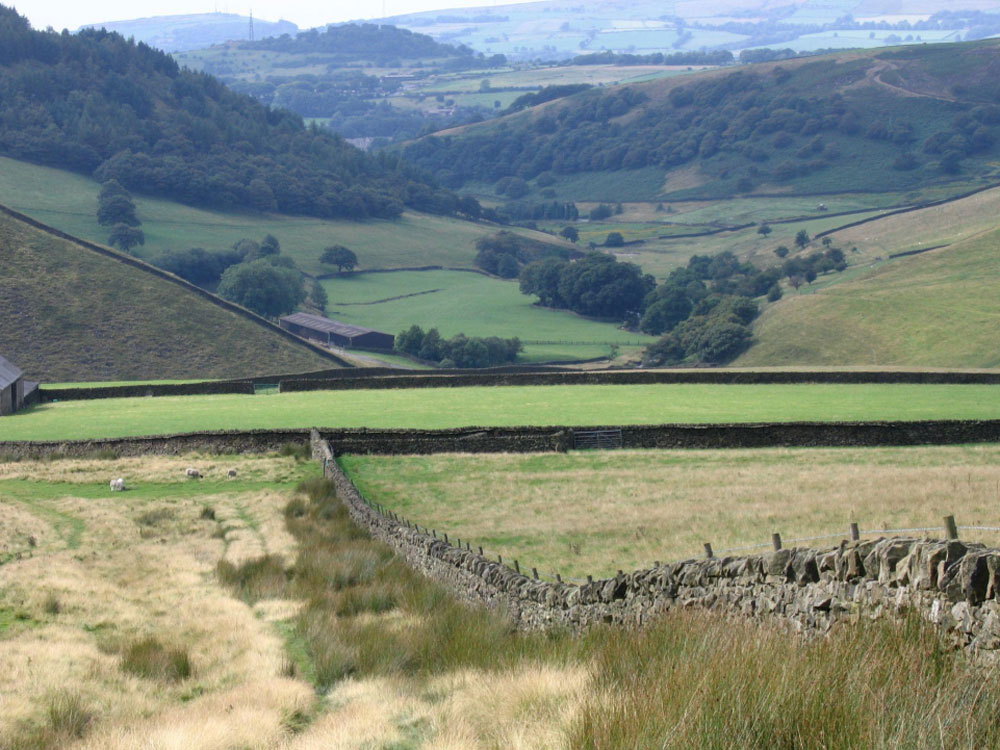
Very happy that work with @DGAlexander84 & co on mapping high-res land cover in the @peakdistrict has now been published! Our ML method was able to map small and rare habitats, creating new possibilities for spatially explicit biodiversity restoration:🧵
https://t.co/pzIrSvgyci
All right I'm attempting the move to Blue Sky too, find me at https://t.co/uRuk90F4tf
(Btw, the Chrome extension 'Sky Follower Bridge' is useful for finding the bluesky-accounts of people you follow on twitter.)
2024 physics laureate Geoffrey Hinton used a network developed by his co-laureate John Hopfield as the foundation for a new network: the Boltzmann machine. This can learn to recognise characteristic elements in a given type of data.
The Boltzmann machine can be used to classify images or create new examples of the type of pattern on which it was trained. Hinton has built upon this work, helping initiate the current explosive development of machine learning.
#NobelPrize
❓ How is AI empowering habitat mapping?
Learn about this brilliant use of AI for the environment, with the Turing, @CranfieldUni & @PeakDistrict.
🌐 Why AI?
🌱 Environmental impact
🖇️ Collaborative working
📖 https://t.co/umWaaVssgq
#AI#AiForGood#Conservation#TuringImpact
Do you have outstanding spatial analysis as well as GIS skills and want to help us shape the recovery of nature and the economy at the landscape scale? If yes, we'd love to hear from you! We're looking for a
👉 Spatial Analyst - Up to £30,000
https://t.co/fwIdXYpDMa
@robmarkcole @DGAlexander84 @peakdistrict .. actually be easier! Such as moorlands/mosaics. It's a balance (or could we use different scales for different classes?). 3) With higher-res, the model receives more input data (pixels) per annotated area. Really interesting question whether this boosts accuracy or not!
Very happy that work with @DGAlexander84 & co on mapping high-res land cover in the @peakdistrict has now been published! Our ML method was able to map small and rare habitats, creating new possibilities for spatially explicit biodiversity restoration:🧵
https://t.co/pzIrSvgyci
@robmarkcole @DGAlexander84 @peakdistrict Hi Robin, thank you!! In short, no, we went with highest res available. Great idea though, some thoughts that come to mind: 1) Obviously some small features (trees, wetland vegetation patches, ..) eventually become harder/impossible to pick up on, but 2) other classes might.. 1/n
This model can be used for various applications in landscape ecology and biodiversity monitoring, especially when important habitats are small and mixed. As an example, we show how this can be used to quantify habitat fragmentation at landscape-scale.
We could then use this to predict land cover across the entire Peak District (1,439 km2) at 12.5 cm resolution! Creating the first updated land cover map at this level of detail since the previous (manually drawn) map from 1991.
The brain is built on a principle of division of labour, where anatomically distinct regions perform specialised tasks. But how are messages sent round the brain allowing regions to communicate? Read on and see our preprint to find out the answer! https://t.co/ryZU4DBUz0
Very pleased to share that our work (with co-first authors @neuromantic99 @mattiloidolt ) on propagation of neural activity and perception has now been published in @NatureNeuro !!
Open-access link:
https://t.co/Lho9z2jeFy
PS. A little easter egg for those that made it to the end of this thread (or the paper's method section): a double dactyl (https://t.co/rYErS3fsQx) poem summary of the paper's main ideas. Thanks for reading!
10/10
We are delighted to be offering a PhD studentship in partnership with @sheffielduni philosophy department.
The project: understanding landscape change
Full details...
👉 https://t.co/x36ZtMwKcX
Expressions of interest by 26 April.
@WRoCAH#Careers#Studentship#PeakDistrict