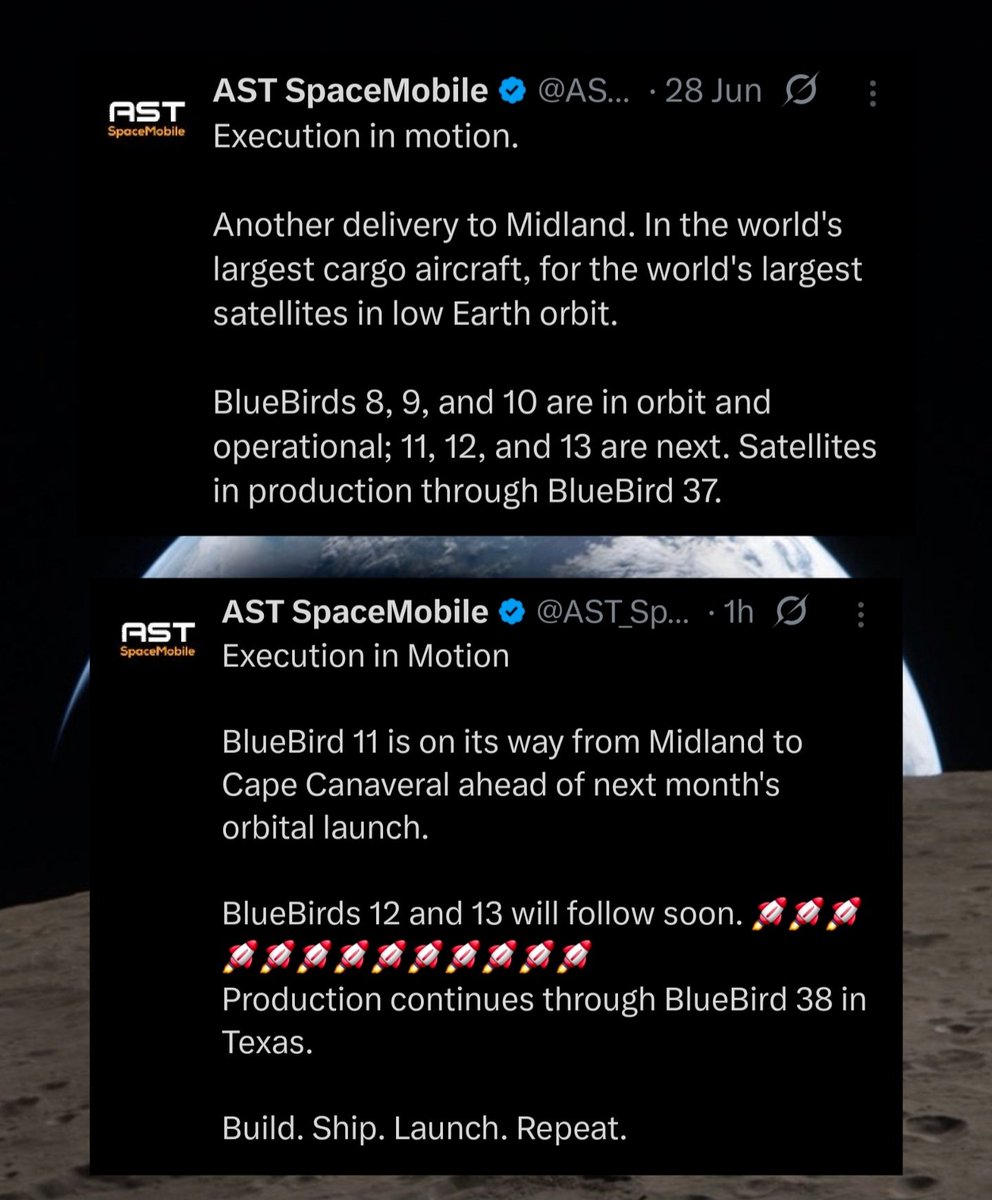
@BenJawanda I know it’s a easier to do when your average is at 33$ but can’t ever see this going back to the 40’s and maybe even 80’s once PR news hits with more catalysts and successful launches 🚀
$ASTS Can $ASTS become bigger than SpaceX?
That sounds crazy at first.
After all, SpaceX is the world’s largest space company.
But here’s the interesting part:
AST SpaceMobile and SpaceX aren’t trying to solve the exact same problem.
SpaceX’s Starlink was designed primarily to bring internet to homes, businesses, airplanes, ships, and remote locations using satellite terminals.
AST SpaceMobile is trying to do something much harder.
Turn every existing smartphone into a satellite phone.
No dish.
No special hardware.
No extra antenna.
Just your existing iPhone or Android connecting directly to space.
That’s a completely different opportunity.
One investor recently argued that ASTS may actually have a technical advantage for direct-to-cell communications.
According to the bullish thesis, AST SpaceMobile’s BlueBird satellites could eventually deliver speeds of up to 200 Mbps, while current direct-to-cell satellite services are much slower.
If those performance levels can be achieved consistently at commercial scale, it would allow users to browse the web, stream videos, use messaging apps, and make voice calls directly through satellites.
That’s a major leap beyond basic emergency texting.
But the bigger investment story isn’t about speed.
It’s about distribution.
There are roughly 6 billion smartphones in use worldwide.
ASTS doesn’t need consumers to buy new hardware.
Instead, it partners with mobile network operators, allowing existing customers to gain satellite coverage where traditional cell towers don’t exist.
That’s an enormous addressable market.
Imagine hiking in the mountains…
Sailing across the ocean…
Driving through a desert…
Or living in a rural village…
And your normal smartphone simply keeps working.
That’s the vision ASTS is pursuing.
But investors should also understand the risks.
Unlike SpaceX, AST SpaceMobile is still in the early stages of commercial deployment.
The company still needs to:
🛰️ Launch more satellites.
📡 Scale its network globally.
🤝 Expand partnerships with telecom operators.
💰 Generate meaningful recurring revenue.
🚀 Prove the business can produce sustainable cash flow.
Execution matters.
A great technology doesn’t automatically become a great investment.
The bigger picture
Many investors think the future space economy will have only one winner.
History suggests otherwise.
The internet created winners in chips…
Cloud computing…
Software…
E-commerce…
Digital advertising…
Cybersecurity…
The space economy will likely be just as diverse.
SpaceX may dominate launch services and broadband.
AST SpaceMobile is pursuing something different:
Building the first truly global cellular network in space.
If the company succeeds, it won’t replace SpaceX.
It could create an entirely new market.
The question isn’t whether ASTS is “better” than SpaceX.
The real question is:
Can AST SpaceMobile solve a problem that no one else has solved at global scale?
If the answer is yes, today’s valuation could look very different over the next decade.
But investors should also remember that this remains a high-risk, high-reward story. The technology is promising, yet the company still has to prove it can execute, scale, and monetize its vision.
$ASTS: This secures all 3 of the Top 3 MNOs in Spain
The broader Spanish mobile market totals around 62 million active lines.
✅ @orange ~41.3% share
https://t.co/zoPVf2pXvH
✅ Movistar (@Telefonica) ~26.2% share
https://t.co/Vlfmgtk4x3
✅ Vodafone Spain ~18.7% share
https://t.co/Pr6vtq4PUL