Fascinating and frightening in equal measure.
OpenAI took down two covert influence operations using ChatGPT to spread geopolitical propaganda. The key finding of their investigation? The ops achieved more through publishing articles in real media outlets than through social media manipulation. 😒
https://t.co/fKUNEhBUDH
The great British historian Chris Wickham passed away this week. In April 2017, I published (in Spanish) a review of his book Medieval Europe, titled “The Middle Ages: Fiscal Capacity, State Strength, and Economic Growth.” In his memory, I reproduce the same review but translated into English.
This past week, later than I should have, I finished Chris Wickham’s Medieval Europe. Readers of this blog may remember that I have occasionally mentioned my admiration for an earlier work of Wickham’s, Framing the Early Middle Ages, and for his incredible ability to synthesize our knowledge of the early Middle Ages in Europe and the Mediterranean world, both conceptually and geographically. Since that monograph, I have regularly worked my way through every new book by Wickham, and it has always been an experience with an extraordinary intellectual payoff.
Medieval Europe is no exception. The amount of material condensed into 352 pages is so extraordinary that, merely to absorb even a minimal amount of its detail, I have had to let a few other obligations slide over the last few days. The end result has led me, almost by necessity, to write this post.
Before continuing, however, I should warn our readers. Medieval Europe is an uncompromising academic monograph. The prose is clear and, on many occasions, brilliant in its precision, but this is not a book to take to the beach for a little light entertainment that requires no thought. Wickham is not going to tell you about Eleanor of Aquitaine’s love affairs. He is going to tell you how the fiscal capacity of the Anglo-Saxon kingdoms before the Norman conquest of England in 1066 would prove crucial to the evolution of the political economy of northern Europe in the centuries to come. This is not a world of lances and tournaments; it is a world of productive systems and administrative structures.
But even within contemporary historiography, questions of representation and understanding, the construction of mentalities, or exercises in collective memory play, for Wickham, a secondary role compared with modeling the material foundations of a society. Perhaps it could hardly be otherwise, since Wickham has never hidden his conviction about the usefulness of the more classical Marxist historiographical tradition and its insistence on the primacy—though not the exclusivity or determinism—of material explanations, especially when compared with the favorite themes of the cultural turn.
Paradoxically, this is a point of contact between that Marxist tradition and mainstream economists like me, who also assign a place of preeminence to factors such as technology and the institutions it creates in the development of societies (this is an argument I developed more calmly in a post on G. A. Cohen many years ago). As a friend of mine says, ironically but with some truth, we neoclassical economists are right-wing Marxists. And as such, we have much to learn from Wickham’s work.
In particular, there is the central role played by fiscal structures in political forms and in their evolution over time. For Wickham, it is above all the collapse of the fiscal capacity once enjoyed by the old Roman Empire in the West that explains the weakness of its successor states during the first centuries of the Middle Ages. Without fiscal capacity, one cannot finance a standing army or an efficient administration; and without these two instruments of power, political structures eventually fracture. The only way to finance military activity without taxes on land or on the (minimal) trade that existed is to grant land to nobles and knights in exchange for military service.
Although the feudal revolution of the eleventh century (which, despite recent historiographical advances and the qualifications they have introduced into older conceptions, Wickham still regards as a useful interpretive framework) was not inevitable, it was a very likely consequence of early medieval land politics. As Wickham reminds us, Marc Bloch was the author who most eloquently explained that this policy of financing states by handing land to elites is inherently unstable: the more land a sovereign grants in order to build a winning coalition among the elites, the less land remains to distribute as future payments and, therefore, the more difficult it becomes to maintain the stability of the coalition.
To illustrate the power of this argument, Wickham recounts what happens in those parts of the Roman Empire where fiscal capacity does not collapse and which today we anachronistically call the Byzantine Empire (its inhabitants always called themselves Rhōmaîoi, or Romans in Greek). The continuities in political, economic, and ideological structures with late antiquity are far stronger than in the West and, with them, the future of these societies would be very different. In two chapters central to the book’s argument (3: “Crisis and Transformation in the East, 500–850” and 9: “1204: The Failure of Alternatives”), Wickham insists on the crucial need to understand Byzantium and its successor states (the caliphates and the Ottoman Empire) in order to understand what happens in western and northern Europe. Counterintuitively, there is much more that is “Roman” in the domains of Mehmed II than in Tudor England, Valois France, or Trastámara Castile.
To reinforce this idea, the book goes on to explain how only the slow and gradual reconstruction of fiscal capacity makes possible the emergence of organizations such as the kingdoms of England, France, and Castile that I mentioned in the previous paragraph and that would shape the centuries to come. But these kingdoms are very different creatures from Rome, Byzantium, or even the Merovingian and Ottonian states. They are experiments in government in which the consent of an important part of society (lords, urban elites, ecclesiastical potentates, and often relatively modest landowners) is indispensable to the exercise of fiscal power. And this consent would crystallize, to a large extent, through parliaments.
These parliaments are an institution without parallel anywhere else in the world. They probably appear first in Spain, with the Cortes of Alfonso IX of León in 1188, as a combination of monarchical weakness and fiscal necessity. Their key feature, which Wickham perhaps does not emphasize enough, is their own legal personality. This legal form—so important in a Europe rediscovering classical Roman law as a central organizational technology—makes them radically different, in both their legitimacy and their persistence over time, from the old Germanic assemblies so common in Merovingian Europe and from the royal councils that rulers have had throughout history. The conflicts between kings and parliaments would become a fundamental axis of European history until the ultimate victory of the latter, sometimes concealed beneath other garb, centuries later. But already in the thirteenth century we see, especially in England, the idea that the oligarchy is fundamentally involved as a co-director of public life, in forms, practices, and understandings that do not exist in the Islamic world, India, or China in the same centuries.
The reorganization of state power during the twelfth and thirteenth centuries thus appears not in opposition to the cellular structure of European politics, but as a counterweight to it. More powerful states sharpen the need of lords, cities, the Church, and even peasants to defend their own spheres of action, thereby creating a social dynamism whose long-run consequences would be incalculable (however often Wickham repeats, somewhat half-heartedly, that he does not want to cross the Rubicon into such a triumphalist interpretation).
The best example of this idea is England. It is no accident that England is probably the best-organized state in medieval Western Europe (the famous 14.5 kilograms of wax used every week to seal letters in the English chancery in the mid-thirteenth century) and, at the same time, the state in which a relatively broad oligarchy has most systematically penetrated the co-direction of public affairs. Parliament and the Common Law—as Dicey explained to us decades ago—popular sovereignty (or, at this point, elite sovereignty) in Parliament and the effective rule of law embodied in the Common Law do not contradict one another, as superficial commentators so often claim; they reinforce one another. There is no Henry III without Henry II, numerically or conceptually.
But—and this is a road Wickham does not want to travel either, though I am quite willing to explore it—it is also no accident that England is the birthplace of the Industrial Revolution. If there is one thing we have learned from the recent and vibrant literature on state capacity, it is that state power and markets are not opposites in the process of economic growth (an interesting and comprehensive survey of the literature appears here, by Noel Johnson and @MarkKoyama; Mark, incidentally, is very critical here of some of Wickham’s interpretations of the economic evolution of late antiquity). Far from being substitutes, as is too often argued in a thoroughly ahistorical way from both sides of the political debate, states and markets complement one another, sometimes in subtle ways.
Growth emerges when states can provide defense against society’s external and internal enemies; when states ensure that the rule of law is supreme (including, in a substantive conception of the rule of law, respect for property rights); when states create an integrated internal market; when states build infrastructure (or make its construction possible); when states provide education (or ensure its provision); when states create the conditions under which financial markets can function. All of this costs money—a lot of it. In eighteenth-century England, perhaps around 10 percentage points of GDP in tax revenue. Today, at least 20; and if we include social transfers, which redistribute risks that markets often cannot insure because of asymmetric information and without which society could not function properly, probably 30 or 35 points. England does not grow in the eighteenth century because property rights were particularly well protected. It grows because, compared with France, the Parliament born of the Glorious Revolution of 1688 can create the Bank of England, finance the battle fleet, impose land enclosures, or force the construction of railways against the opposition of localities that the railways will drag out of their backwardness. The road to Manchester’s cotton mills runs through the hills of Blenheim: there is no James Watt without a John Churchill.
At the same time, the historical evidence is crystal clear that when states try not to complement markets but to replace them, the result is disastrous. Strong states create internal markets in which automobiles can be sold; substitutionist states want to build automobiles themselves. Worse, by trying to do what they cannot do well, far from strengthening state power, they paralyze it through constant struggles among dozens of pressure groups over the rents created by state activity. We need only look at the modern states of Europe. Is Spain a strong state? It is certainly a large state, but not one capable of stopping constant regulatory capture, ensuring the unity of its internal market, or providing a high-quality education. Robust property rights require a powerful power of eminent domain, but a powerful power of eminent domain can succeed only alongside robust property rights. At present, we have neither.
I imagine these are not the conclusions Wickham himself would draw from his book, and I am almost certain he would object to most of my inferences. My response, however, is that when one writes a book as magnificent as this one, one must be aware that the text takes on a life of its own, and that the conceptual avenues, interpretive frameworks, and cognitive structures of reference it reveals can take the reader to unexpected places. We are slaves to our own logics.
🛢️ Namibia’s offshore oil boom could create a waste problem of its own.
A drill ship recently brought 1,200m³ of drill waste into Walvis Bay for processing and disposal.
Namibia currently has just three approved hazardous waste sites.
Where will the waste go as drilling expands?
🧵
Makers Valley is the creative heartbeat of Joburg.
In this episode of The Hope Dealers, we visit Victoria Yards in Makers Valley.
Stretching across the eastern inner city, spanning neighborhoods like Lorentzville, Troyeville and Bertrams, Makers Valley is a dynamic grassroots movement and creative ecosystem where social enterprise meets urban rejuvenation. #TheHopeDealers
Out now: My new report for @GI_TOC on assassinations and mass killings in South Africa. In just nine months, at least 42 people affiliated with political parties, civic movements, and traditional leadership have been gunned down. And more than 210 people have been murdered in 45 mass shooting incidents linked to gang and taxi violence, extortion, and illegal mining. https://t.co/YTNX7f24Mg
Raslouw Private Hospital in Centurion has successfully performed its first two living donor liver transplants, marking a significant milestone for the hospital and South Africa’s transplant services.
The procedures were led by Dr Imraan Sardiwalla, Lead Hepatobiliary Surgeon, and Dr Neha Kumar, Transplant Surgeon.
Both doctors recently completed intensive international fellowships at leading transplant centres, gaining expertise in advanced living-donor and ex-situ techniques.
Living donor liver transplantation involves two surgical teams operating simultaneously- one removing part of the healthy donor’s liver and the other transplanting it into the recipient.
The liver’s regenerative capacity allows both the donor’s remaining liver and the recipient’s graft to grow and regain full function.
Both donors and recipients are recovering well under the care of the hospital’s multidisciplinary intensive-care team.
CEO and Founder Dr IO Ebrahim described the achievement as a major step for the hospital and highlighted the potential of living-donor programmes to address South Africa’s shortage of donor organs.
Hospital Director Dr I Mitha and Hospital Manager Mrs Maryke Lotz also praised the medical and nursing teams.
Raslouw Private Hospital has established a new liver-transplant capability, expanding access to highly specialised transplant care in South Africa.
NEW from me:
Over the last four years, America has lost more than 200k jobs in creative fields like publishing, film, TV, or graphic design. It's the worst stretch for arts jobs outside of major recessions.
How much is AI to blame? And can the arts' business model survive?🧵
When you see how ephemeral even massive glaciers like this can be it becomes even more mind-blowing that there's still ice on Antarctica that has remained frozen at every moment since the late *Miocene*, 6 million years ago
For those interested in finding out more about the insurgency, here are three superb reads: @PerryAlexJ's Blood Will Flow: https://t.co/vb35GDI5Ej, The Islamic State in Africa by @warnjason, @ryanmofarrell, Héni Nsaibia and @Pol_Sec_Analyst https://t.co/lKT5XEPTtl and Eric Morier-Genoud's Towards Jihad? Muslims and Politics in Post-Colonial Mozambique: https://t.co/mOUVRFkypg.
Fana Hlongwana, has a fascinating profile as a fixer equal to none currently appearing either in courts or commissions. Trained & fluent in Russia, was the 'state advisor' during the biggest arms procurement in the history of SA. He remans untouched & unknown & probably feared☺️
The State does not need to prove the quid pro quo. That is an important aspect that has been lost in recent discussions about corruption in general.
If the State proves that A gave gratification to B, and the requirements of s24 of PRECCA are met, then, unless there is a lawful explanation or evidence raising a reasonable doubt, it can be presumed that the gratification was given for B to act or not act in a particular way. (Gratification has a very broad definition in the Act, but apart from what you usually think of, includes "any other service or favour or advantage of any description".)
This provision exists precisely because corruption is difficult to prove. These agreements are often secret. There is seldom going to be a contract or message setting out exactly what one person expects in return.
The important issue is the corrupt relationship: one person gives something to another and, in doing so, creates an obligation. There does not have to be an explicit agreement. The person does not actually have to do what was expected of them. They do not even have to have the power or ability to do it.
In Selebi, the SCA held: “…(Selebi) must have realised that Agliotti’s generosity and the payments he received from him created a dynamic, whereby he, in his post as head of the nation’s police service, would be indebted to him and would have to remain willing to do him favours. This leads to the conclusion that the (Selebi), on his own version, abused his position of authority and breached the trust placed in the position that he held in contravention of s 4(1)(a)(ii). Strictly speaking, this finding obviates the need to investigate whether (Selebi) gave any quid pro quo for the payments that he received.”
Once the State has proved that dynamic, it dispenses with the need for the State to prove the kickback.
So, put simply, if the State proves that a defence contractor paid millions to a defence minister, and there is no lawful explanation for those payments, the fact that the State cannot point to the exact favour that was expected in return does not mean it has failed to prove corruption.
Think of the following example. A man gets pulled over at a traffic stop. The police officer approaches his vehicle. Without a single word being exchanged between them, the driver takes out some money and gives it to the traffic officer.
At that point, without any express agreement, and without the police officer having committed to anything or actually done or not done anything, does it constitute corruption?
Of course it does. The dynamic exists. There is no lawful explanation for the driver giving a police officer money in these circumstances. If the officer accepts the money, he must realise that the driver’s generosity has created a dynamic where he is indebted to the driver and would be expected to do him a favour.
Now, if an alert police colleague stepped in to question what was happening, the two parties might say that it was just a loan and the police officer was going to pay it back. Don’t we hear this often? A loan is itself a form of gratification.
The public discourse needs to move away from this idea that there must be a specific quid pro quo for the corruption to have been completed. Look for the dynamic. Where one party gives something to another party who is not entitled to that benefit, the corrupt dynamic may already have been created.
And where one party says to another, “If you give me this, I will do this for you,” whether the person actually delivers on what was promised is irrelevant to whether corruption has been committed.
The answer lies in the creation of the corrupt dynamic, not whether the favour was ultimately carried out.
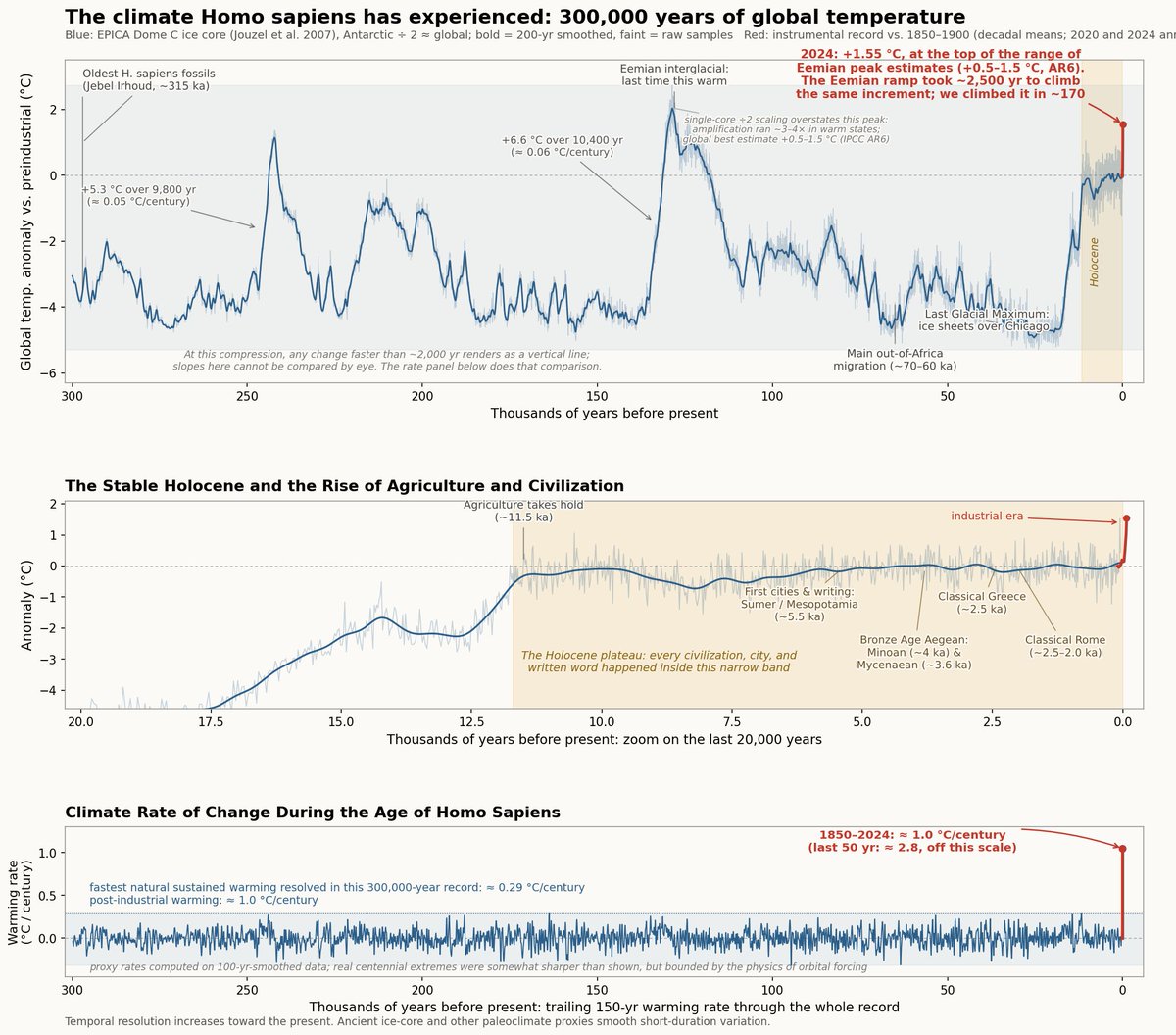
Earth has been this warm before during Homo sapiens’ 300,000-year history. The scary part is the current speed of warming. Past swings unfolded over millennia. Today’s warming occurred in decades. Even allowing for smoothed ice-core proxies, the rate of change is immense. Source: https://t.co/89MLQf18Qt
Interesting to consider that he probably would not have been put on trial if this had happened more recently, considering the general trend against international law and international courts. His trial was largely a result of the 1990s and the concept at the time that there was a world order and that international courts, such as the UN-established International Criminal Tribunal for the former Yugoslavia (ICTY), had merit.
According to data from the Copernicus Climate Change Service, average global sea surface temperatures have reached a new high, rising to nearly 70 degrees Fahrenheit late last week — potentially for the first time in millennia. https://t.co/q7YXSaPNAP
Reading one of my international sources and the scale of the Super El Nino that is slamming into the Pacific Ocean and the countries in South America is said to becoming "extreme" with forecast now foreseen a strong possibility of reaching extraordinary strength over the next months and extending until the end of the austral summer 2027.
I track this for my works in fishing and soft commodities as its crucial to understand the ripple implecations
August 2026 will be the hottest August in recorded history on Earth. Thus begins the next 12+ month streak of each new month being the hottest on record, driven by El Niño + climate change. August 2027 will likely be hotter than 2026. During the last El Niño in 2023–24, we went 13 straight months setting a new all-time record warm month. This year's El Niño is forecast to be nearly twice as strong. Buckle up.
"Official" projections for how much the world will warm are already catastrophic, and now it appears they significantly underestimate future warming.
New scientist reports that we may have been underestimating the amount of global warming that is coming.
And some scientists believe even this itself is a massive underestimation
https://t.co/sLfI46ZhTB