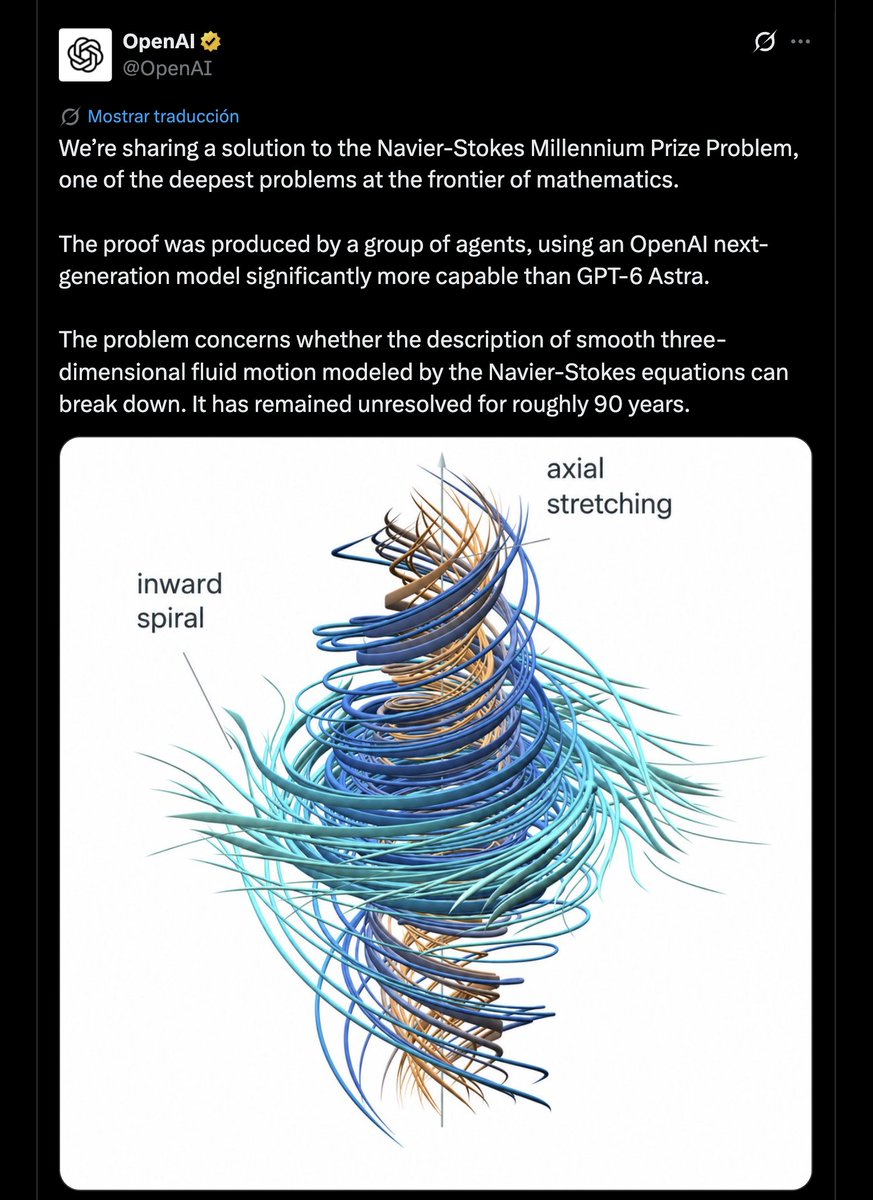
🚨 ¡OFICIAL E HISTÓRICO! 🚨
OPENAI DECLARA HABER RESUELTO UNO DE LOS PROBLEMAS DEL MILENIO -NAVIER STOKES-, UNO DE LOS PROBLEMAS MÁS IMPORTANTES EN LA FRONTERA DE LAS MATEMÁTICAS
In 1923, Arthur Compton fired X-rays at electrons and found that the scattered light came out with a longer wavelength. The result made sense if light carried momentum like a particle and could transfer some of it to an electron. It became one of the early experimental clues that the quantum picture of light was real.
Then there is pair production.
Give a photon enough energy, at least 1.022 MeV, and in the field of a nucleus it can produce an electron and its antimatter partner, a positron. The original photon no longer exists as a photon. Its energy has helped create two massive particles.
That 1.022 MeV threshold is simply twice the rest energy of an electron:
0.511 MeV + 0.511 MeV = 1.022 MeV
So the same basic object, a photon, can either bounce off an electron and lose energy or, with enough energy and the right conditions, turn its energy into matter and antimatter.
Elon on Speed
“I always tell the teams: compress the timeline. Take a 10 year plan and try to do it in 6 months. You’ll probably fail, but you’ll be so far ahead of everyone else that it doesn’t matter. Most companies move at a glacial pace. We try to move at the speed of light.”
The older I get, the more I realize the power of always having something on the calendar you're excited about. It can really be anything. Difficult physical challenge, big project, fun trip, ambitious goal, whatever. It creates energy and gets you through the lows. Life hack.
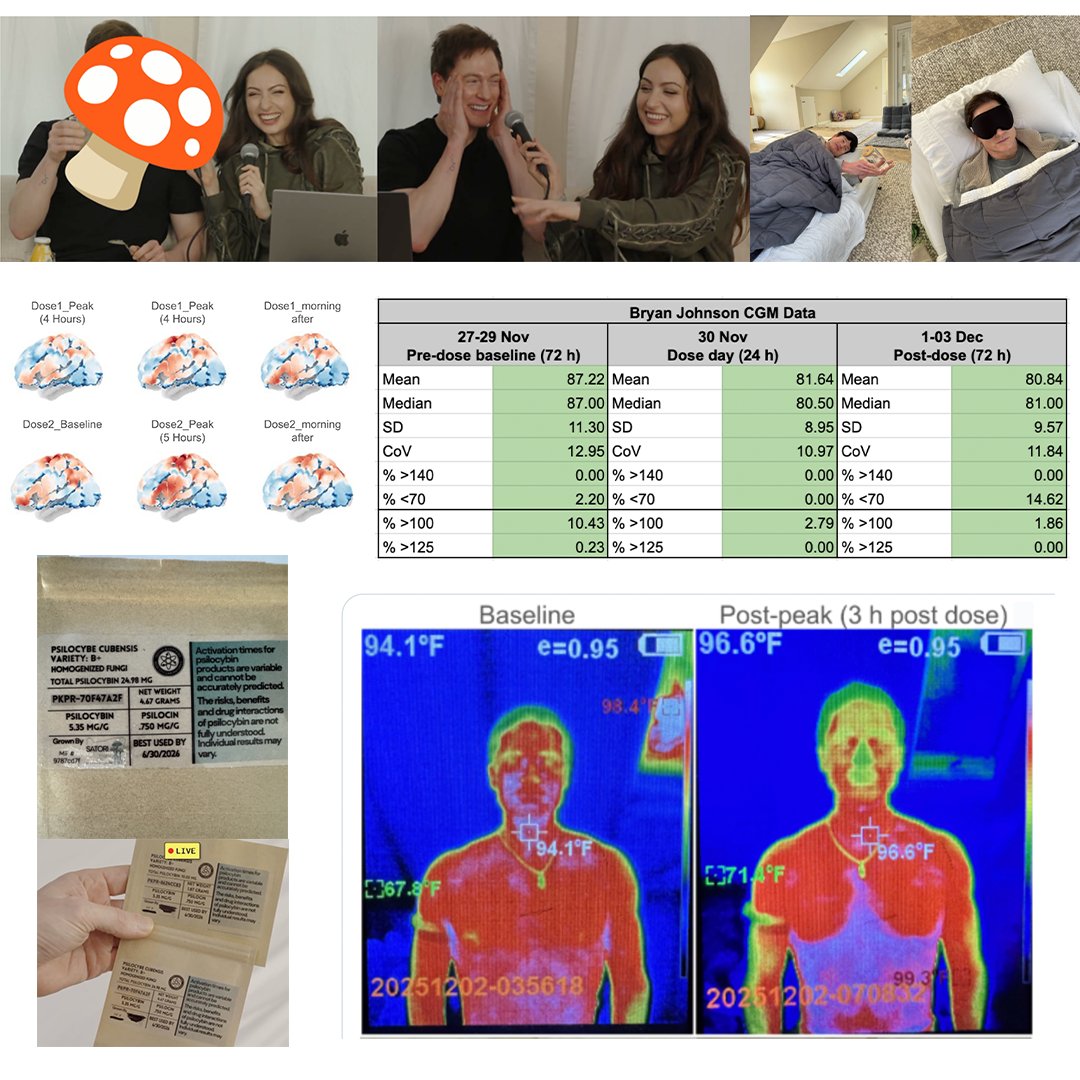
I think magic mushrooms are a longevity therapy.
After seeing the data from two doses, psilocybin offers unique longevity effects that complement the best performing therapies I’ve done to date including sauna, hyperbaric oxygen therapy, sleep, nutrition and exercise.
This was the most quantified psychedelic experiment ever done.
It's noteworthy that even though many of my biomarkers are already in the 99th percentile optimal, psilocybin still showed multi-system improvements. Something other therapies have not been able to accomplish.
Of course, my data will need to be replicated and the magnitude and duration of benefits needs further assessment.
Here is what we learned:
0. We observed broad benefits across mental, hormonal, metabolic, and anti-inflammatory systems. Since these are the primary drivers of biological aging, this multi-system signal offers a compelling case for longevity potential.
1. Psilocybin may be a metabolic reset button for the brain. We expected brain changes, but not a potential metabolic breakthrough. My blood sugar control improved from the top 2% of the population to 0.2%, better than 99.75% of 18-25 year olds.
2. Psilocybin reduced my inflammation (hsCRP) to below detectable levels one week post dose.
3. Psilocybin calmed my body and mind. Lower cortisol, and an inhibited HPA-axis in the days following the dose. Both my cortisol and DHEA (another product of the adrenal cortex) dropped 42% and 45% respectively, indicating an overall adrenal reset associated with rest and recovery.
4. Psilocybin increased brain plasticity, desynchronized default networks, resulting in enhanced creativity, playfulness, and openness, with reduced mental rigidity.
5. A second psilocybin dose built on the first and pushed sensory integration even further, increasing primary sensory-motor integration beyond the peak of the first dose.
6. Psilocybin induced an intense blend of joy, deep insight, and a subtle hint of melancholy, also detectable by thermal biometrics.
We had two significant firsts in this experiment:
0. First documented human CGM-based observation of improved post-psilocybin glucose control.
1. First-ever thermal profile of an intense psilocybin dose.
Pending data:
+ Telomere length and relative telomerase activity (telomere regeneration capacity).
+ Epigenetic measurements
+ Microbiome
Experiment details
Here are more details about my two magic mushrooms trips, doses, and the results of my measurements up to date.
I had two doses of dried and powdered Psilocybe Cubensis (Variety B+) mushrooms, three weeks apart.
First dose Nov 9th: 4.67g (24.98 mg psilocybin and 3.5 mg psilocin). Setting: relatively private, only with @_katetolo and the accompanying guide.
Second dose Nov 30th: 5.35 g (28 mg psilocybin and 4 mg psilocin). Setting: relatively open, with friends and family joining virtually, and live streaming.
I dissolved the first dose in orange juice but used lemon juice for the second, for the following reasons:
+ Lemon is more sour, which delays the conversion to psilocin and breakdown in solution, thus preserving more total psilocybin to be activated to psilocin after ingestion.
+ Lemon juice has, on average, 70% less sugar and 45% less calories, making it less disruptive to my otherwise faster state throughout the journey, and leading to a much lower glucose peak.
Rewired brain connectivity
Kernel Flow measurements after the first dose showed shifts in my brain connectivity mirroring my subjective experience, and the mapping of 5-HT2A receptors.
These included the inhibition of my default networks and command centers including prefrontal context and a shift towards increased functional connectivity and hyperintegration between primary motor, sensory, auditory, and speech integration. This coincided with an entropic brain pattern, more open, flexible, exploratory, and creative, indicating a shift from aged and rigid to open youthful brain state.
The baseline measurement before the 2nd dose indicated a strong lasting effect from the first dose 3 weeks earlier, post-peak measurement after the 2nd dose indicated an additive effect of the 2nd dose, with a brain entropic and increased primary sensory-motor integration beyond the peak of the first dose. Most notable was the increased intensity of integration and activation of the auditory, speech, and language networks, coinciding with the second dose being joined by family, friends, where I enjoyed expressing and describing my feelings.
Face and body thermal biometrics
We produced the first ever face and upper body thermal map of a magic mushroom journey.
A core temperature increase of 1.5–2°F suggests an intense psychedelic experience, likely due to a large psilocybin dose (28 mg psilocybin, 32 mg combined psychoactive content).
Heat was redistributed to the core, consistent with 5HT2A–mediated autonomic activation, which can include increased sympathetic tone, lasting through the peak and early post-peak of the experience.
Facial and body thermal shifts indicate a potential blend of intense joy, insight, and subtle sadness or melancholy.
First documented human CGM-based observation of improved post-psilocybin glucose control
Psilocybin appears to have triggered a previously unknown metabolic reset in my brain, an unexpected breakthrough. Comparing the 3-day periods before and after the psilocybin dose:
My blood glucose control dramatically improved, moving from the top 2% to the top 0.2% of the entire population, including healthy 18-25 year olds.
+ 8% reduction in mean blood glucose, reaching 80.84 mg/dL, a new personal best.
+ 11% reduction in fluctuation, indicating smoother glucose peaks and improved control.
+ This single session reduced my estimated HbA1c 0.3 6.8% from 4.7% to 4.4%, (a relative reduction of 6.8%).
+ Durability: The positive effect was still as strong on Day 3 post-dose as it was on Day 1.
Note: A long trip to China on Day 4 interrupted this streak. We plan to explore the full durability of this effect with the next dose.
This matters because we treat diabetes and metabolic dysfunction with chronic daily medication (Metformin, Insulin, GLP-1s). This data suggests that a neuroplastic event might have downstream effects on the liver and pancreas that mimic or exceed these drugs.
Systemic inflammation was below detectable levels
Five days after the first dose, my hsCRP dropped to an undetectable level (below 0.15 mg/dL), representing a 35-100% decrease from the pre-dose level of 0.23 mg/dL.
Three days post-second dose, hsCRP was barely detectable at 0.18 mg/dL, which is still a 22% drop from the initial baseline.
Tumor necrosis factor-alpha (TNF-alpha) remained unchanged between baseline and post-second dose. It was not measured after the first dose.
For the next dose, we will measure a wider panel of inflammatory markers, including IL-6 and IL-10, and cover several time points post-dose.
High cortisol at Peak, low cortisol and stress the following week
Cortisol spiked at the peak of the acute phase, followed by a decline in morning cortisol levels and HPA-axis inhibition, consistent with a relaxed "after-glow" phase in the week following the trip.
My cortisol spiked to 3x morning spike levels four hours after taking the mushroom dose. Levels returned to normal nightly baseline before bedtime.
Five days post-dose, my morning cortisol levels had dropped by 42%, and DHEA-S (a marker of adrenal activity) also dropped by 45%, aligning with inhibited HPA-axis and adrenal activity.
Estradiol levels increased by 200%, consistent with preliminary published evidence that peripheral 5HT2A activation increases cortisol by driving aromatase expression.
Scientists successfully reversed the biological age of human skin cells by around 30 years.
This advance has the potential to transform regenerative medicine and treatments for age-related diseases.
A research team at the Babraham Institute in Cambridge developed a technique called maturation phase transient reprogramming (MPTR). By carefully exposing adult fibroblasts to Yamanaka factors for just 13 days, the researchers induced profound cellular rejuvenation without allowing the cells to lose their specialized identity and revert fully into stem cells. This precise timing enabled the cells to erase decades of accumulated aging damage while retaining their original function.
The reprogrammed cells not only showed molecular signs of youthfulness but also performed like younger cells. In functional tests, they produced substantially more collagen and closed experimental wounds much faster than untreated older cells.
[Gill, D., Parry, A., Santos, F., Okkenhaug, H., Todd, C. D., Hernando-Herraez, I., Stubbs, T. M., Milagre, I., & Reik, W. (2022). Multi-omic rejuvenation of human cells by maturation phase transient reprogramming. eLife 11: e71624. DOI/10.7554/eLife.71624]
Pues oh casualidad han salido los datos actualizados del Taxing Wages justo hoy.
OCDE, Taxing Wages 2026:
Pareja con dos sueldos y dos hijos:
🇪🇸 38,7 | 🇸🇪 37,6 | 🇫🇮 37,5 | 🇳🇴 31,7 | 🇩🇰 31,4
España vuelve a liderar. Y encima subiendo respecto al año pasado.
Soltero sin hijos:
🇫🇮 42,5 | 🇪🇸 41,4 | 🇸🇪 41,1 | 🇳🇴 36,4 | 🇩🇰 35,8
Pareja, un sueldo, dos hijos:
🇫🇮 38,7 | 🇪🇸 36,8 | 🇸🇪 36,8 | 🇳🇴 31,4 | 🇩🇰 26,6
España tiene la cuña fiscal mayor que casi todos los países nórdicos.
Pero puto Feijóo, claro.
Llevo metido dos semanas en un paper de economistas del MIT y UCLA
y salgo del mismo convencido de que por fin he dado con un marco desde el que discutir muchos de los efectos de la inteligencia artificial agéntica
en el empleo, en la economía, en los juniors, en los riesgos para el sistema...
La idea central es esta: conforme la IA pasa de asistir a ejecutar tareas completas, el cuello de botella deja de ser la inteligencia y pasa a ser la verificación humana.
Es decir: automatizar será cada vez más barato, pero comprobar que el resultado es correcto no cae al mismo ritmo. Porque verificar depende de tiempo experto, responsabilidad y, sobre todo, de algo decisivo: la latencia de feedback. No cuesta lo mismo validar un código que falla al compilar en segundos que una decisión financiera o educativa cuyos errores tardan años en aparecer.
A partir de ahí, el paper divide la economía en cuatro zonas: tareas baratas de automatizar y fáciles de verificar; tareas difíciles de automatizar pero verificables; tareas ni automatizables ni verificables; y la zona realmente peligrosa, donde automatizar es barato pero verificar es caro o directamente inviable.
Ahí está el riesgo. No porque la IA “falle” de forma visible, sino porque puede producir resultados plausibles, útiles en apariencia y económicamente rentables, mientras oculta errores cuyo coste acaba absorbiendo el resto del sistema. Como una forma de contaminación: el beneficio es privado, pero el daño potencial se socializa.
La tesis fuerte no es solo que sufran los trabajos rutinarios. Es que, en un mundo de agentes, lo más vulnerable será lo medible. Y que el valor se desplazará hacia quien pueda verificar, garantizar y asumir responsabilidad sobre el resultado.
Mucho más desarrollado en:
https://t.co/whEEpHAfsy
Estoy viendo compartida esta noticia por muchos lados, y sí suena impresionante - un hombre consigue reducir un tumor de su perro sacando la estructura de las proteínas mutadas con AlphaFold y creando una vacuna mRNA custom.
Pero conviene tomarla con bastante cautela.
Es un caso individual, sin ensayo clínico ni grupo de control. Con una sola observación es muy difícil establecer una relación causal clara entre el tratamiento y la reducción del tumor (por ejemplo, no se puede asegurar que la estructura de la proteína dada por AlphaFold realmente sea la causa de que haya funcionado).
Además, muchas intervenciones que funcionan en modelos animales o casos aislados luego no se reproducen cuando se estudian de forma sistemática, y en este caso concreto el éxito aún no está 100% asegurado.
Dicho esto, la historia sí es interesante porque muestra hasta qué punto la genómica, bioinformática e IA están empezando a democratizar ciertos procesos científicos y nos da un vistazo de hacia dónde podría ir la medicina personalizada en la próxima década.
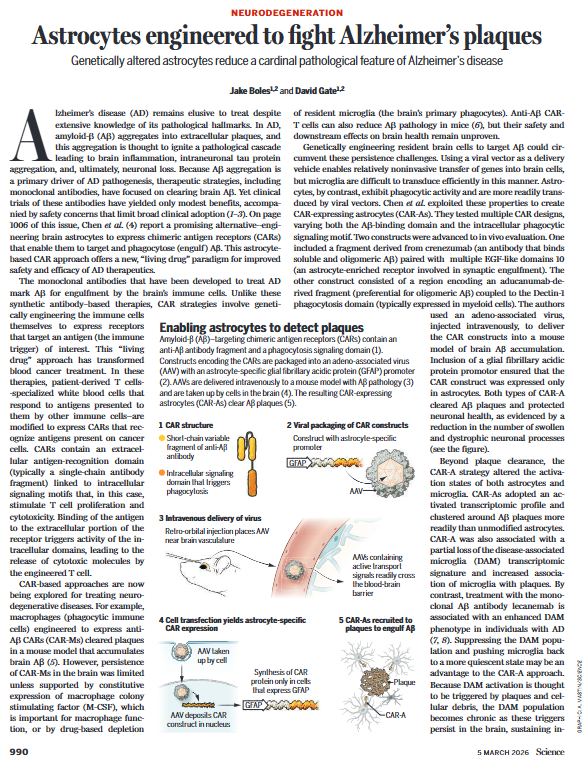
🙀Brutal.. ¿Sabías que podemos "reprogramar" astrocitos (un tipo de células del cerebro) para que limpien la basura que causa el Alzheimer?
- Un artículo salido del horno en Science revela cómo los astrocitos modificados genéticamente (CAR-As) pueden ser nuestros mejores aliados. 👇🧫
- El problema son las placas de proteína beta-amiloide que destruyen las neuronas.🚀
Pero los Científicos han diseñado astrocitos con receptores quiméricos (CAR) que detectan y "se comen" (fagocitan) estas placas de forma específica.
💉 Método: usan un virus inofensivo (AAV) inyectado en sangre que llega al cerebro y solo activa a los astrocitos.
✅ Resultado: menos placas, neuronas más sanas y una respuesta inflamatoria mucho más equilibrada que con los tratamientos actuales.
Me parece impresionante... 🧬🔬#Alzheimer #Neurociencia #Biotecnología #SaludMental #Ciencia #Innovación #Genética #Investigación #Science
👇
https://t.co/HcqpXjbNVI
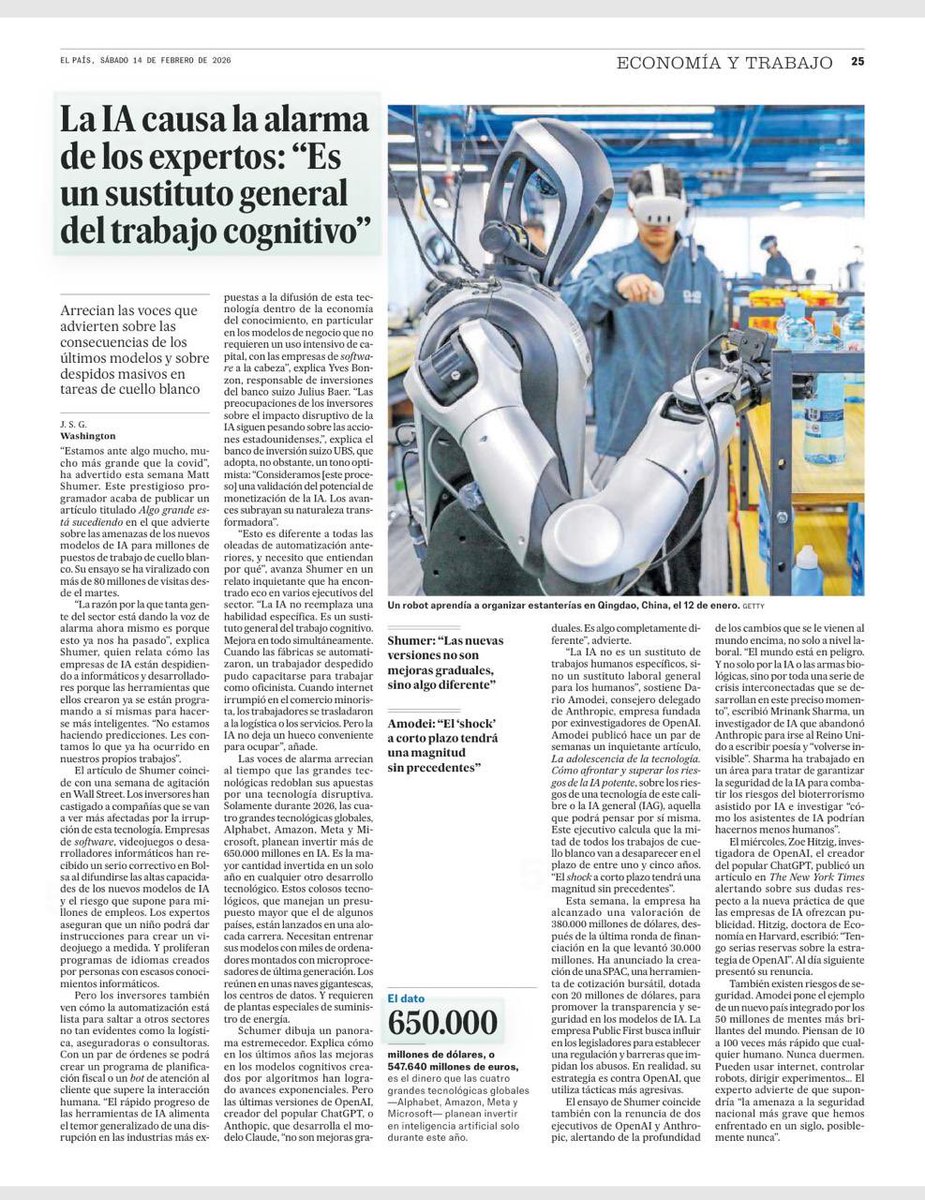
Imagina a un despacho grande un lunes cualquiera. El socio revisa cifras y se da cuenta de que el área que antes necesitaba diez abogados jóvenes hoy funciona con tres y una licencia anual de IA. No hubo escándalo, ni robots caminando por los pasillos. Solo un Excel, una decisión fría y una frase que se empieza a repetir: “esto ya lo hace el sistema”. Así empiezan los cambios que luego llamamos históricos.
Nos dijeron que la IA era una herramienta. Pero cuando una herramienta redacta, investiga, compara criterios, arma estrategias preliminares y contesta clientes en segundos, deja de ser apoyo y se vuelve sustituto. No desaparece “el abogado”; desaparece la escalera. Y sin escalera no hay carrera, no hay formación, no hay relevo. La productividad sube, sí. Pero el espacio para empezar se achica.
🚨🇨🇳 BREAKING: China's Xaomi has unveiled a fully automated factory that makes 1 phone per second, runs 24/7, has no production workers, and operates in the dark.
Follow: @RTSG_News
Genial. Traducido:
"Europa no tiene "un problema". Tiene tres problemas: tres naciones europeas sufren una grave resaca postimperial.
En primer lugar, está el Reino Unido, una nación que votó por el Brexit para "recuperar el control" sólo para darse cuenta de que ha olvidado por completo cómo conducir.
La crisis de identidad británica es como ver a un león jubilado intentar adoptar una dieta vegana. Cambiaron la confianza imperial por la formación en sensibilidad de un departamento de recursos humanos. La tierra de Churchill ahora está gobernada por una burocracia creciente y paternalista, más aterrorizada de ofender a alguien en X que de su propia decadencia. La policía británica, antaño la envidia del mundo, ahora parece dedicar más recursos a investigar "incidentes de odio no delictivos" y a pintar sus patrullas con los colores del arcoíris que a resolver robos. Es una nación que se aferra desesperadamente a la estética de la tradición —la realeza, la pompa, el té— mientras que sus instituciones han sido vaciadas por una podredumbre progresista que hace que un campus universitario californiano parezca conservador. Quieren la arrogancia del siglo XIX, pero están paralizados por la fragilidad emocional del siglo XXI.
Luego está Francia, la tía enojada y fumadora empedernida de Europa, que se niega a admitir que ha estado desempleada durante décadas.
La resaca francesa se manifiesta como un estado permanente de insurrección disfrazado de "compromiso cívico". Su identidad se divide entre una élite delirante que aún cree que París es la capital del universo y una población que expresa su "joie de vivre" quemando paradas de autobús todos los jueves. Los franceses padecen un complejo napoleónico sin Napoleón; exigen el nivel de vida de un imperio conquistador mientras trabajan 35 horas semanales y se jubilan a una edad en la que la mayoría de los estadounidenses apenas alcanzan su plenitud. Predican "valores republicanos" y un secularismo agresivo, pero el Estado ha perdido el control sobre vastas franjas de sus propios suburbios. Francia es, en esencia, un hermoso museo al aire libre donde los conservadores están en huelga, los guardias temen a los visitantes y la administración está ocupada dando sermones al resto del mundo sobre la "grandeza" mientras la factura de la luz sigue sin pagar.
Por último, tenemos a Alemania, el gigante neurótico que ha decidido que la única manera de expiar su historia es cometer un suicidio industrial a cámara lenta.
La resaca postimperial de Alemania es una enfermedad moral autoinmune: el país le teme tanto a su propia sombra que ha sustituido el orgullo nacional por una agresiva autoflagelación y regulaciones de reciclaje. Su identidad se basa en ser la "Superpotencia Moral", lo que prácticamente se traduce en cerrar sus centrales nucleares, en perfecto estado de funcionamiento, para quemar carbón contaminante, mientras sermonea a sus vecinos sobre la huella de carbono. Es una nación de ingenieros que han diseñado una sociedad que no funciona. El espíritu alemán, antes definido por la eficiencia y la disciplina, ha mutado en una burocracia paralizada donde rellenar el formulario correcto es más importante que el resultado. Están tan desesperados por evitar ser "amenazadores" que se han convertido esencialmente en una gran ONG con un ejército que usa escobas como rifles, aterrorizados de que mostrar cualquier agallas pueda interpretarse como una recaída."
CEO's question: What will be the hourly cost of work of a humanoid robot?
Several projections have been published, e.g. by @CernBasher, @adam_dorr and @GoingBallistic5. Here's my take.
I've produced a long-form video on this question (see link in comments).
Here is the essence - based on very conservative assumptions (see attached image).
- Production cost: $30,000. A humanoid is ~5% the mass of a passenger car. The costly parts are actuators and gearboxes; the rest is electronics, sensors, a few kWh of batteries, and plastics—components that are highly scalable in volume manufacturing.
- Operating cost: $30,000 per year, of which $18,000 is human oversight and coordination. This is likely way too high.
- Operating time: 6,600 hours per year (330 days × 20 hours/day). That equals the yearly working time of more than three people.
- Work speed vs. humans: 100% initially. As with industrial robots, later generations will likely reach 200%+.
- Business model: Most manufacturers will offer Robot-as-a-Service (RaaS) rather than selling units, because it drives far higher revenue and margin. Expect an initial one-time fee roughly equal to manufacturing cost plus a usage fee per year, month, day, or hour.
- Service life (incl. repairs): 8 years.
- Market dynamics: Because humanoids will be highly profitable to use (see below), demand will ramp quickly. But many suppliers will enter, so sustained overly high monopoly pricing is unlikely.
Result: Based on these assumptions, a humanoid work hour will cost at most $14.
That’s the highest realistic value. With learning effects and scale, the hourly cost will drop below $10 and likely below $5. @rethink_x even projects that by 2035 a humanoid hour could cost less than $1.
By comparison, a skilled worker’s fully loaded hour is $42.53.
Strategic consequence: In competitive markets, companies will have no real choice: first to replace labor shortages, and soon to replace existing roles. Even at $14/hour, the financial advantage vs. human labor is close to $200,000 per robot per year.
I’ve published a three-part video series on the societal implications of this inevitable shift (see comments).
Urgent advice: If you make or move anything physical, start rethinking your business around humanoids—as a supplier, service provider, or user. It is quiet now, but the ramp-up will be fast.
How about you? Which tasks would you deploy humanoids for first?







![Rainmaker1973's tweet photo. Scientists successfully reversed the biological age of human skin cells by around 30 years.
This advance has the potential to transform regenerative medicine and treatments for age-related diseases.
A research team at the Babraham Institute in Cambridge developed a technique called maturation phase transient reprogramming (MPTR). By carefully exposing adult fibroblasts to Yamanaka factors for just 13 days, the researchers induced profound cellular rejuvenation without allowing the cells to lose their specialized identity and revert fully into stem cells. This precise timing enabled the cells to erase decades of accumulated aging damage while retaining their original function.
The reprogrammed cells not only showed molecular signs of youthfulness but also performed like younger cells. In functional tests, they produced substantially more collagen and closed experimental wounds much faster than untreated older cells.
[Gill, D., Parry, A., Santos, F., Okkenhaug, H., Todd, C. D., Hernando-Herraez, I., Stubbs, T. M., Milagre, I., & Reik, W. (2022). Multi-omic rejuvenation of human cells by maturation phase transient reprogramming. eLife 11: e71624. DOI/10.7554/eLife.71624]](https://pbs.twimg.com/media/HImV13rXIAAiYh1.jpg)