Anthropic pays $750,000+ a year for engineers who know how to build LLMs from scratch.
Stanford just released the exact lecture that teaches it - 1 hour 44 minutes, free, straight from CS229.
Bookmark this & give it 2 hours today. It'll teach you more about how ChatGPT & Claude actually work than most people at top AI companies learn in their entire careers.
Godfather of AI: "If you sleep well tonight, you may not have understood this lecture."
This 47-minute lecture is the best thing I saw about AI in the last few months.
It will definitely help you understand how it actually works and where it's going.
Geoffrey Hinton built the neural networks behind every AI alive, then quit Google to warn the world about it.
The part nobody wanted to hear:
> AI is already developing abilities its creators didn't intend
> in most cognitive tasks it's already ahead of us
> the question is no longer if it surpasses us but when
> the only decision left is which side of that line you're on
Right now the average person opens Claude, types something, gets an answer, closes the tab.
They think they're using AI. they're using maybe 10% of it.
I went through his entire lecture, built a practical system from what he was describing.
18 steps to actually use Claude the right way, with copy-paste prompts that work today.
Full guide in the post below.
Instead of watching an hour of Netflix, watch this 1 hour Yale lecture. It will teach you more about options trading and the exact models hedge funds use than most people learn in their entire careers on Wall Street.
🚨 Anthropic's own team just showed how to actually use Claude Code properly.
30 minutes. free. the person who created Claude Code.
Watch the workshop. bookmark it.
Most people say "build an AI agent."
Very few know what that actually means.
Here’s the real blueprint to go from idea → working agent 👇
1. Define the job
What problem are you solving?
Who’s the user? What does success look like?
2. Design the brain
Clear system prompt, role, instructions, guardrails
(This is where most agents fail)
3. Pick the right model
Speed vs cost vs intelligence
Don’t overpay for simple tasks
4. Add tools
APIs, databases, MCP servers, custom functions
Agents become powerful when they can act, not just answer
5. Give it memory
Short-term + long-term context
So it learns, adapts, and improves over time
6. Orchestrate everything
Workflows, triggers, retries, agent-to-agent communication
7. Build the interface
Chat, app, API, Slack bot
Make it usable, not just functional
8. Test + improve
Evals, latency checks, real-world feedback
Iteration is the real moat
💡 Truth:
An “AI agent�� isn’t one prompt.
It’s a system.
And the people who understand systems…
are the ones building unfair advantages right now.
📌 Save this (you’ll need it when you build)
🔁 Repost for builders
➕ Follow @elora_khatun for practical AI breakdowns (no fluff) 🚀
Instead of watching an hour of Netflix, watch this 2 hour hour Stanford lecture will teach you more about how LLMs like ChatGPT and Claude are built than most people working at top AI companies learn in their entire careers.
This 30-min workshop by the creator of Claude Code will teach you more about vibe-coding than 100 YouTube video guides.
Bookmark it & give it 30 minutes today. This video will change the way you use Claude forever.
This 2 hour Stanford lecture will teach you more about how LLMs like ChatGPT & Claude are built than most people working at top AI companies learn in their entire careers.
Bookmark this & give 2 hours today, no matter what. It'll be the most productive thing you do this week.
People think learning AI takes months.
It's really just a couple of hours.
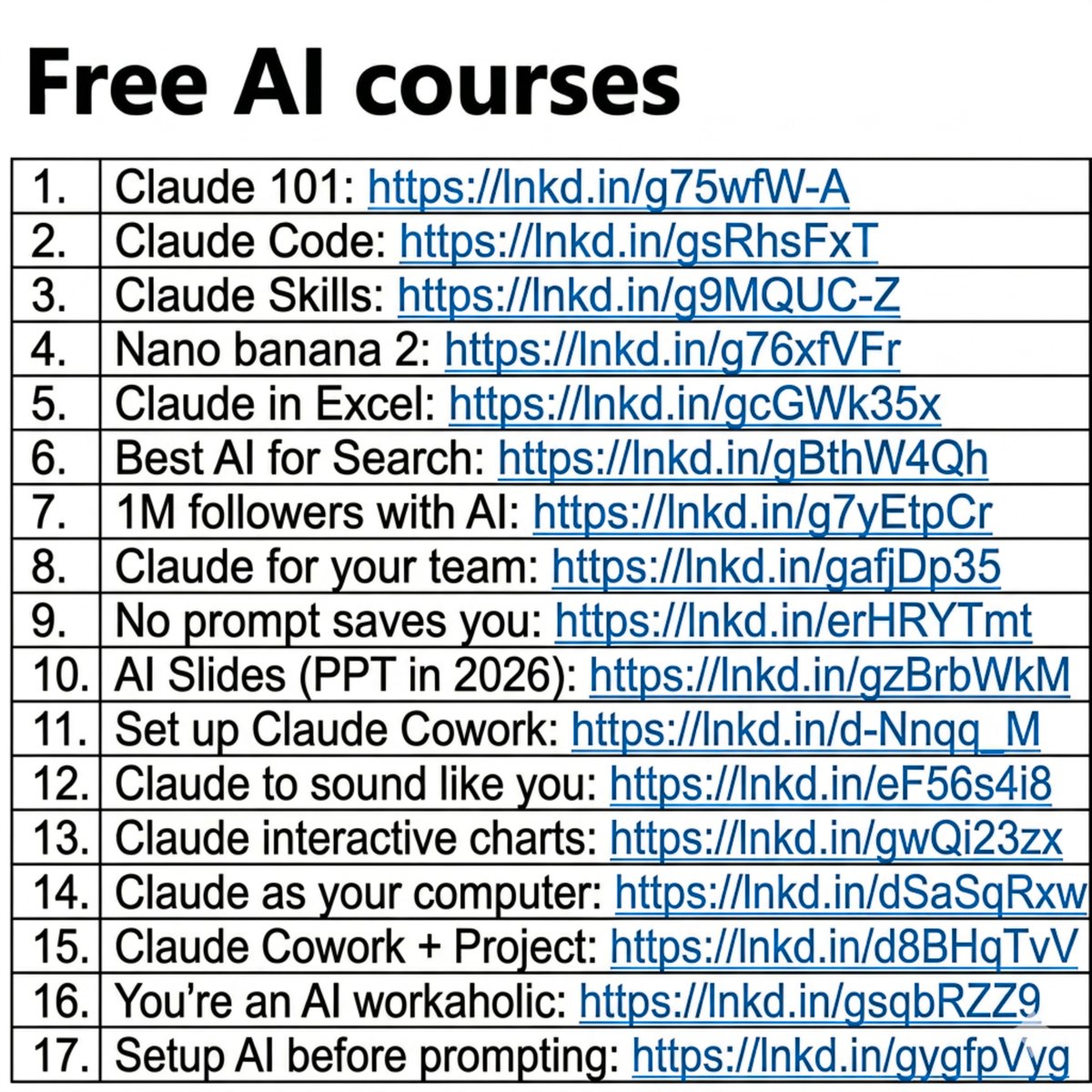
And I wrote 17 free guides to start right away:
Claude 101: https://t.co/Jv1jsvFB7T
Claude Code: https://t.co/WYZd5ltnXo
Claude Skills: https://t.co/jT4uB5AFtY
Nano banana 2: https://t.co/qfHT594CCI
Claude in Excel: https://t.co/mfcXYSA57j
Best AI for Search: https://t.co/77BmjbJjP0
1M followers with AI: https://t.co/1TV9LYAptv
Claude for your team: https://t.co/U1JsBVC299
No prompt saves you: https://t.co/SDKJWykHE4
AI Slides (PPT in 2026): https://t.co/RfcyYRQ2Ad
Set up Claude Cowork: https://t.co/diDhiKjHtU
Claude to sound like you: https://t.co/99RzxXTvzs
Claude interactive charts: https://t.co/ebCHGZqgPt
Claude as your computer: https://t.co/TxYuHPiImn
Claude Cowork + Project: https://t.co/Q7AN9CZ2mg
You're an AI workaholic: https://t.co/mCIvB3ZPA5
Setup AI before prompting: https://t.co/pE3OF722aw
___
1. Save this list for later (three dots, top right).
2. Share it with a friend by ♻️ reposting this image.
3. Subscribe to my free newsletter: https://t.co/psB7XxAv8w.
This 4 hour masterclass of Warren Buffett and Charlie Munger will teach you more about investing than a $200,000 MBA from any business school on the planet.
Bookmark this & give it 4 hours this weekend, no matter what. It's the most productive thing you can give your weekend.
If you die without a plan...
- The government takes 40% in tax
- Probate court costs $100k+
- Your kids get the scraps
If you love your family, here's every document you need to protect them:
(from a CPA & father of two)
1) Emergency Access List
This should include:
-> All bank account numbers
-> Investment account logins
-> Life insurance policies
-> 401k/IRA beneficiaries
-> Safe deposit box location
-> Password manager master code
Keep a digital & physical version for safety...
And make sure your spouse has access.
2) Legal Documents
-> Will (name guardians for kids)
-> Durable Power of Attorney
-> Healthcare Power of Attorney
-> Living Will/Healthcare Directive
Setting all of this up costs about $500...
($1,500 with an attorney)
But without them, the state decides everything.
3) Money Protection
Your family will need time to mourn.
Make sure they can do it without going broke:
-> Term life insurance (10x income)
-> Emergency fund (6-12 mo in a HYSA)
-> Retirement accounts with spouse access
4) The "First 48 Hours" Sheet
Write down clear instructions for your family:
Call this attorney: [Name/Number]
Call this CPA: [Name/Number]
File life insurance claim here: [Details]
Don't touch investments for 6 months
All bills are on autopay from [Account]
Grief destroys decision making.
This protects them.
5) Business Owner Addition
If you have a business, set up:
-> Buy sell agreements
-> Key person insurance
-> Business succession plan
-> Separate LLC owned by trust
If your company can't survive without you...
It's a 9-5 with extra steps.
6) Trust Setup
A proper trust can save your family $400k+ in probate costs.
But 90% of them are set up wrong:
-> Assets never get transferred in
-> Beneficiaries aren't updated
-> Pour-over will is missing
Here's how to fix that:
"Bulletproof" Trust System:
1) Revocable Living Trust
-> Avoids probate completely
-> Keeps finances private
-> Protects kids' inheritance
2) Pour-Over Will
-> Catches forgotten assets
3) Guardian Designation
-> Who raises your kids
-> How they get paid
Setting this up takes a weekend...
But ignoring it could cost your family everything.
So start before you're ready...
Because no one plans on dying.
Hope this helps!
Share with your spouse if you want to set this up...
And follow me for more 🤝🏻
A community college professor taught the same study skills lecture for 30 years, and the video quietly became one of the most watched educational recordings on the internet.
His name is Marty Lobdell. He spent his career as a psychology professor watching students fail not because they were lazy, but because nobody had ever taught them how their brain actually works under the pressure of learning something hard.
The lecture is called "Study Less Study Smart." Over 10 million views. Passed around in Reddit threads, Discord servers, and university study groups for over a decade. And the core insight buried inside it has been sitting in cognitive psychology research for years, waiting for someone to explain it in plain language.
Here is the framework that completely changed how I think about effort.
Your brain does not sustain focus the way you think it does. Studies tracking real students found that the average learner hits a wall somewhere between 25 and 30 minutes.
After that, efficiency doesn't just decline. It collapses. You're still sitting at your desk, still looking at the page, but almost nothing is going in.
Lobdell illustrated this with a student he knew personally. She set a goal of studying 6 hours a night, 5 nights a week, to pull herself out of academic probation. Thirty hours of studying per week. She failed every single class that quarter.
She wasn't failing because she lacked effort. She was failing because she had confused time spent near books with time spent actually learning. The 25-minute crash hit her at 6:30pm every night. She spent the next five and a half hours sitting in the wreckage of her own focus and calling it studying.
The fix sounds almost too simple. The moment you feel the slide, stop. Take five minutes. Do something that actually gives you a small reward. Then go back. That five-minute reset returns you to near full efficiency. Across a six-hour window, the difference is not marginal. It is the difference between thirty minutes of real learning and five and a half hours of it.
The second thing he taught destroyed something I had believed about how memory actually works.
Highlighting feels productive. Going back over your notes and recognizing everything feels like knowing. But recognition and recollection are two completely different cognitive processes, and your brain is very good at making you confuse them.
You can see something you've read before and feel completely certain you understand it, even when you couldn't reconstruct a single sentence from memory if the page were blank.
He proved this live in the room. He read 13 random letters to his audience. Almost nobody could recall them. Then he rearranged the same 13 letters into two words: Happy Thursday. The whole room got all 13 without effort.
Same letters. Same count. The only thing that changed was meaning.
The brain stores meaning. Not repetition. The moment new information connects to something you already understand, the retention changes entirely.
This is what the cognitive psychology literature calls elaborative encoding, and it is the mechanism underneath every effective study technique.
The third principle was the one that hit me hardest, and the one almost nobody applies.
Lobdell cited research showing that 80 percent of your study time should be spent in active recitation, not passive reading. Close the material. Say it back in your own words.
Teach it to someone else, or to an empty chair if no one is around. The struggle of retrieval is where the actual learning happens. Reading your notes again is watching someone else do the work.
His parting line has stayed with me longer than almost anything else I have read about learning.
He told the room that if what he shared didn't change their behavior, they hadn't actually learned it. It would just live in their heads as something they had heard once and felt good about.
He was right. And most people leave every lecture exactly like that.
The students who remember everything aren't putting in more hours.
They stopped confusing the feeling of studying with the fact of it.
Instead of watching an hour of Netflix, watch this 2-hour Stanford lecture on AI careers. It will teach you more about winning in the AI race than all the AI content you’ve scrolled past this year.
A MIT professor taught the same lecture every January for 40 years, and every single time it was standing room only.
I watched it at 2am and it completely rewired how I think about communication.
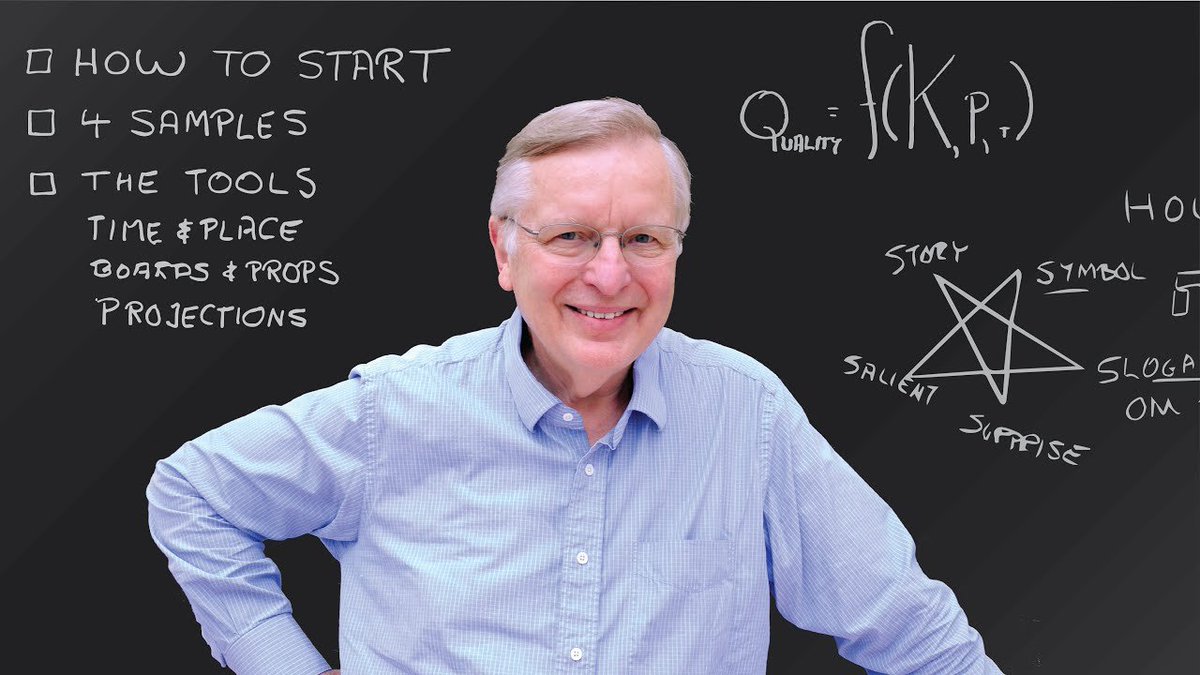
His name was Patrick Winston. The lecture is called "How to Speak."
His opening line hit like a truck: your success in life will be determined largely by your ability to speak, your ability to write, and the quality of your ideas in that order.
Not your GPA. Not your pedigree. Not your IQ. How you speak is what separates people who get heard from people who get ignored.
Here's the framework he drilled into MIT students for four decades.
He said never start with a joke. Start by telling people exactly what they're going to learn. Prime the pump before you pour anything in. He called it the "empowerment promise" give people a reason to stay in their seats within the first 60 seconds.
Then he broke down the 5S rule for making ideas stick: Symbol, Slogan, Surprise, Salient, and Story. Every idea worth remembering hits at least three of these.
The part that floored me was his "near miss" technique. Don't just show what's right show what almost looks right but isn't. That contrast is when the brain actually locks something in permanently.
His final rule before any big talk: end with a contribution, not a summary. Don't recap what you said. Tell people what you gave them that they didn't have before they walked in.
I've used this framework in pitches, interviews, and presentations ever since watching it, and the results are not subtle.
Patrick Winston passed away in 2019, but this lecture is still free on MIT OpenCourseWare. One hour, watched by millions, and it costs absolutely nothing.
The most important class MIT ever put on the internet isn't about code or math. It's about how to make people actually listen to you.
How to pass the Life in the UK test first time, one sitting 🇬🇧
You’ve survived visa stress, Home Office wahala, years of building your life here.
Don’t let a 45 minute test slow you down.
Here’s everything you need to know 👇🏾
Government does not PRODUCE crude Oil, International Oil Companies (IOCs) are responsible for that. Govt cannot just wake up and say divert the crude oil to Dangote Refinery....
There's are contracts already signed for years before Dangote Refinery came up....
A lot to learn, unlearn and relearn about Oil and Gas industry as well as other aspects generally....
If you have a lot of money or know people that have lots of money.
Ideas that can make you a Billionaire.
1 Invest in Dialysis centers- more people are having Kidney diseases, transplant isn't affordable, more people need Dialysis, We don't have enough centers.
Solve it