I'm pleased to share my research group's latest preprint.
We discovered that nuclear pore complex subunits gate the nuclear import of UVR8 under UV-B stress!
https://t.co/W22JP2rEUE
Excited to share our newly published "A Multidimensional View of Biomolecular Condensates in Plant Biology" in the Annual Review of Plant Biology!
We discuss emerging mechanisms, biological functions, and future directions. 🌱🔬 - https://t.co/qTpzGvG3Mv
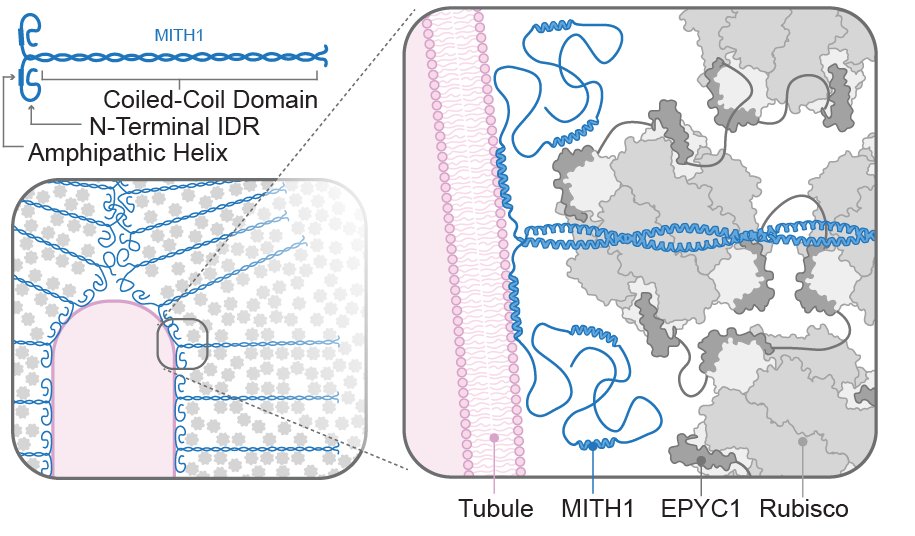
The algal pyrenoid fixes ~1/3 of global carbon, relying on a unique membrane-within-condensate architecture. How is this architecture built? We discovered that the protein MITH1 draws membranes into the pyrenoid condensate by promoting wetting! 🌿💧https://t.co/tzPIs1aHif
Age-dependent nuclear accumulation of a membrane-associated NAC transcription factor GER1 activates SA biosynthesis to promote leaf senescence in Arabidopsis
https://t.co/hxBkICKzyY
In my lab's most recent publication in Nature, entitled" Cellular water-potential sensing through biomolecular condensation", we describe how plant cells directly sense the availability of water molecules.
The @IBaurle lab at Uni Potsdam is very happy to present our latest review on plant heat stress responses. Here we cover some fascinating new developments in the field, including biomolecular condensates, phenotypic plasticity and epigenetic memory:
https://t.co/Qy4ghumLg6
AI can now design antibodies that bind with atomic precision, but not ones that cells can produce. Our preprint closes this gap, delivering a structural principle, an AI-guided rescue pipeline, and adalimumab variants with 20-100x in vivo potency.
https://t.co/GvfgHA5EcU
How do plants respond to wounding to initiate regeneration? We show wounding stimulates HSFA1 accumulation in the nuclei, activating a transcriptional program that drives cellular reprogramming!
@ThePlantCell@duncan_coleman2@JST_ASPIRE@JST_info
https://t.co/8NbcvDFPx1