Head of Sports Analytics @ The Crowd's Line. Building betting models via crowd-sourcing & ML/AI. Former quant futures PM. MIT: physics & math. From rural Texas.
As a CTFC regulated contracts market, Kalshi’s is required by federal law (17 CFR §38.152) to prohibit wash trading, improper prearranged trading, and money passes. §38.156 requires automated surveillance capable of detecting and investigating potential trading violations.
The CFTC has penalized two individuals for coordinated, prearranged trades intended to negate market risk. Large-scale self-dealing is punishable by fines in the millions, giving back profits, and being temporarily or permanently banned from the exchange.
https://t.co/D0tj61XdyK
https://t.co/Twd2iSlKfV
@Autonomous_Chad@CFTC They cover that too. Full KYC. When we opened our institutional kalshi account for tcl, I was no longer allowed to use my personal one.
I'm thrilled to announce that PitPro has deployed our first production unit to Kal Tire in Calgary!
In robotics demos are easy but deployments are hard. Getting our robot onto the floor of a Kal Tire store is a defining moment for us and proof ready for the real world.
@andrew_n_carr https://t.co/XZ2apOXR0W
The exposed student’s bloodwork came back clean. It is unclear if dimethyl mercury was synthesized but certainly can’t blame them for going straight to the ER.
Our new AI model, SparksMatter, discovered CaMg₂Si₂ - a Ca-filled Mg-Si Zintl silicide - as a thermoelectric built only from stable, non-toxic, earth-abundant elements. Thermoelectrics are solid-state materials that convert heat directly into electricity (and electricity into cooling) with no moving parts, which makes them a key technology for harvesting the vast amounts of waste heat from engines, industry and electronics, and even fusion - but today's best ones rely on scarce or toxic elements like tellurium, lead and bismuth. This is why an earth-abundant, non-toxic candidate matters.
Our model's physical reasoning to come up with the design: Mg₂Si is a known earth-abundant thermoelectric but conducts heat too well; a heavy, weakly bound Ca cation in the Mg-Si framework should scatter phonons while keeping a moderate band gap. It generated 100 Ca-Mg-Si crystals with MatterGen, kept the six within 0.05 eV/atom of the convex hull (via MatterSim), and predicted band gaps of 0.44-0.57 eV and bulk moduli of 53-54 GPa (CGCNN). Follow-up lattice dynamics found three CaMg₂Si₂ polymorphs dynamically stable, with lattice thermal conductivity ≈6 W m⁻¹ K⁻¹ at 300 K and ≈2 at 1000 K. The AI proposed a chemical hypothesis first, then developed and applied a separate generative/physics pipeline to test it, and six surviving structures came back with that hypothesized composition. The video replays the reasoning process.
New paper out with Alireza Ghafarollahi in npj Computational Materials: SparksMatter, an AI that runs the full in-silico inorganic materials discovery cycle - ideation, planning, computational experimentation, critique and reporting - from a single plain-language query.
Why this matters: conventional ML models for materials are typically single-shot predictors or generators. They can predict a property or propose a structure, but they do not organize the next scientific step. Discovery, instead, works as a loop: hypothesize, test, critique, revise. The key advance here is a deep reasoning layer that incorporates physics to decide which scientific tool to use, how to interpret the result, and what to change as next step.
How it works: SparksMatter spawns a suite of AI agents - scientists, planners, coders, reviewers and critics - that write and execute code against materials tools: Materials Project retrieval; MatterGen for generative crystal design conditioned on chemistry, band gap or bulk modulus; MatterSim for relaxation and convex-hull stability; CGCNN for property prediction. Adversarial agents check each phase, the system revises its ideas, plans and code from execution results, documents its own limitations, and delivers a scientific report with a validation roadmap spanning DFT, phonons, transport, synthesis and characterization.
Two more discovery tasks SparksMatter ran autonomously:
1⃣Soft inorganic semiconductors: generated 112 structures conditioned on low stiffness and narrowed them to 59 candidates absent from the Materials Project after toxicity, stability, electronic, mechanical and database screening - bulk moduli 11-24 GPa, band gaps 0.4-3.9 eV.
2⃣Lead-free perovskites: filtered 154,879 Materials Project entries to 162 Pb-free ABO₃ candidates meeting structural, toxicity, stability and band-gap criteria, including LaAlO₃, BaZrO₃, SrSnO₃, CaTiO₃ and SrTiO₃.
Benchmark: the same three tasks were given to frontier reasoning models acting as expert materials scientists with web browsing but without the generation and prediction tools. A blinded LLM evaluator scored every response ten times on relevance, scientific soundness, novelty, and depth and rigor. SparksMatter scored highest in aggregate, with its strongest advantages in novelty and depth & rigor. Its main limitation was scientific soundness because much of the core screening still relied on surrogate models rather than direct first-principles or experimental validation - a gap the system identified, documented, and mapped out how to close.
Takeaway: putting generative models, executable code and physics-based simulators inside the reasoning loop lets an AI propose structures outside existing databases, test them, reject weak candidates, and say what evidence is still missing.
@ClosingDime When I asked one of the offshore books why they removed all player props (the only thing I bet), they responded that I was using their site strategically and not recreationally.
You can thank your state government for refusing the Medicaid expansion.
Obama did not foresee governors forfeiting free federal funds that would subsidize people in between the poverty line and when the federal subsidies kicked in.
Your governor screwed y’all over just to make the ACA look bad. And, it worked.
“Despite the Affordable Care Act offering states the opportunity to expand Medicaid, these 10 Republican-led states continue to resist fully expanding this critical program. Republicans in Alabama, Florida, Georgia, Kansas, Mississippi, South Carolina, Tennessee, Texas, Wisconsin, and Wyoming are leaving billions of federal dollars on the table, continue to lose funding for rural hospitals, and represent a broader GOP willingness to risk the lives of their constituents.”
https://t.co/5xNFp30wSi
@rohanpaul_ai@drfeifei There is no combustion-based energy sources in nature but jets got a lot faster than birds.
Evolution is notoriously locally greedy. Not so good at finding global maximum.
@SawyerMerritt@Tesla Data quality matters. The Waymo paper can only inform us what happens when Waymo scales up their high-quality multi-modal data. It does not necessarily follow that Tesla’s vision-only, noisier data would benefit in the same way.
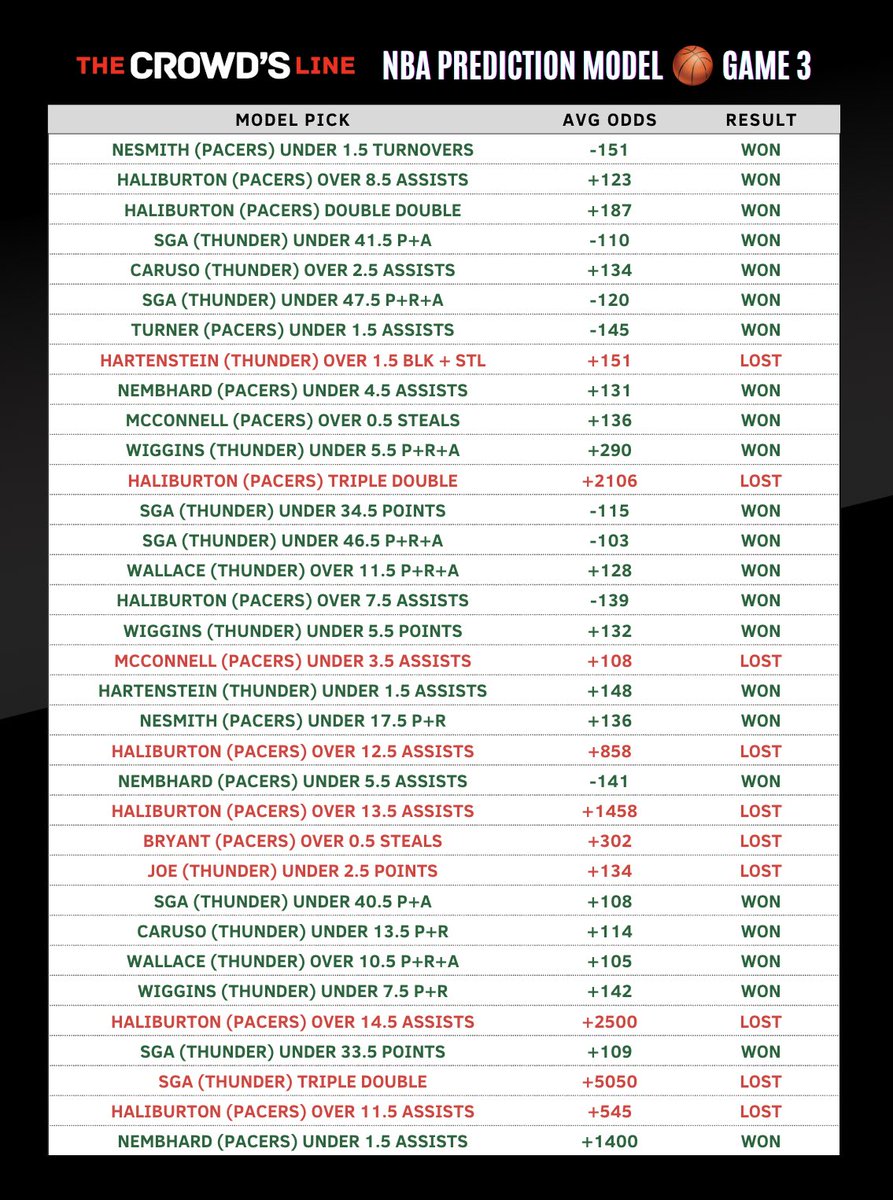
NBA Finals Game 3 Recap 📈
Model was wildly accurate last night
🔥 Overall: 24-10 (71%)
🎯 Average Odds: +164
🔥 Unders: 17-2 (89%)
🎯 Average Odds: +120
Avg Profit: +3.4 units 💰 ROI: +96%
1 of the 10 losses? Haliburton triple double @ +2100. Fell 1 board short!
Here’s the model’s performance by month since going live last season ⬇️
After a disappointing April (+7.4U), we rallied for our 2nd best month of the season in May (+59.1U) 📈
Model’s been consistently good at predicting assist props throughout. +172 units combined L2 seasons!
May 2025 NBA Model Recap 🗓️
Overall, we gained +59.1 units 📈
Most of that 💵 came in Round 2. Conference finals proved challenging
Top 3 markets by PnL:
🥇Assists (+15.3u)
🥈Points (+14.7u)
🥉Pts+Ast (+13.8u)
For the year, we’re now up +240 units
More details in thread 🧵⬇️
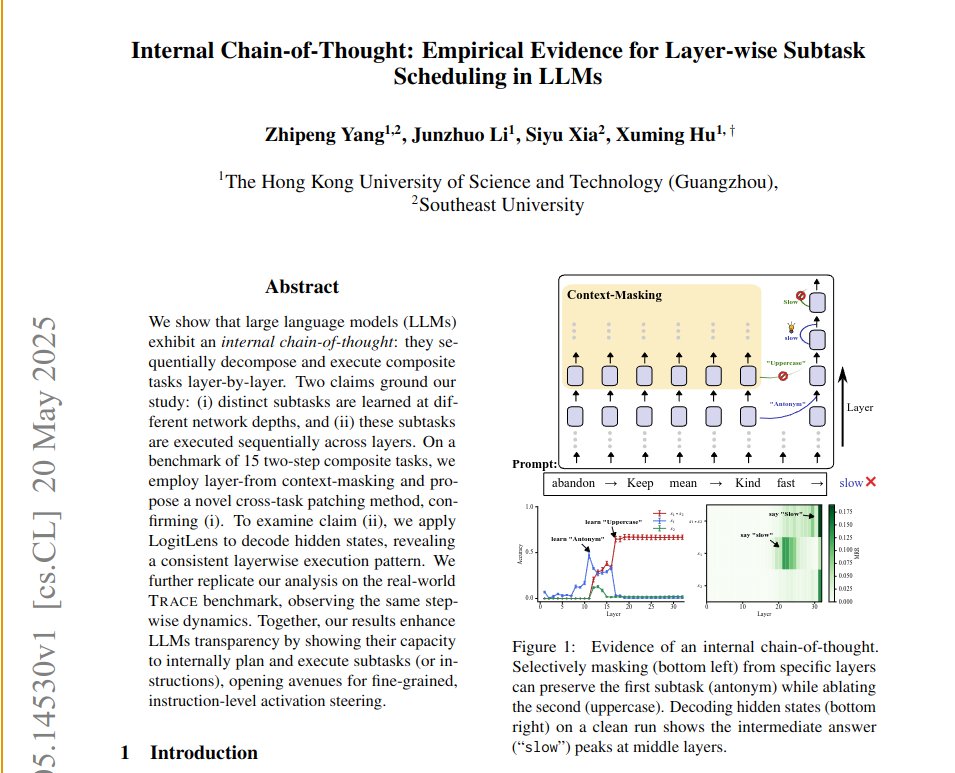
This paper shows LLMs internally break down composite tasks.
They process components sequentially across layers.
Methods 🔧:
→ Layer-from context-masking selectively blocks in-context example access from a specific layer onward.
→ This technique reveals sequential subtask learning points via an "X-shape" accuracy pattern across layers.
→ Cross-task patching injects activations from composite tasks into zero-shot subtask prompts.
→ It demonstrates composite task processing generates distinct, transferable subtask vectors, averaging 0.66 strength in Llama-3.1-8B.
📌 Layer-wise task execution enables precise intervention points.
📌 Task vectors offer a handle for steering learned behaviors.
📌 Internal processing mirrors explicit reasoning steps without outputting them.
----------------------------
Paper - arxiv. org/abs/2505.14530v1
Paper Title: "Internal Chain-of-Thought: Empirical Evidence for Layer-wise Subtask Scheduling in LLMs"