A closed surface can reveal every source inside it.
The Divergence Theorem equates outward flux through boundary S with the total divergence inside volume V:
∫_S F · dS = ∭_V ∇·F dV
Zero divergence means nothing is created or destroyed — magnetic fields have no monopoles; incompressible fluids conserve volume.
That local-to-global identity underpins Gauss’s law, climate models, and conservation laws in physics and simulation.
Surfaces often know the interior better than the interior knows itself.
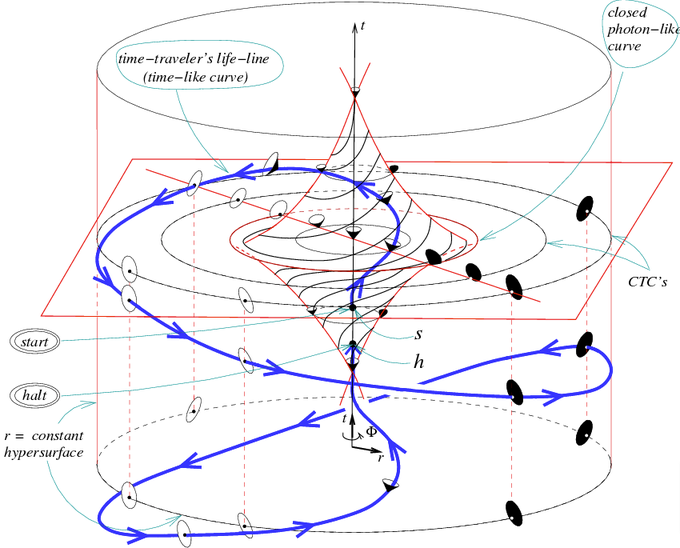
Kurt Gödel, who was one of Albert Einstein's best friends in his later years, found a solution to general theory of relativity that modelled a strange, unusual and rotating universe allowing for backward time travel.
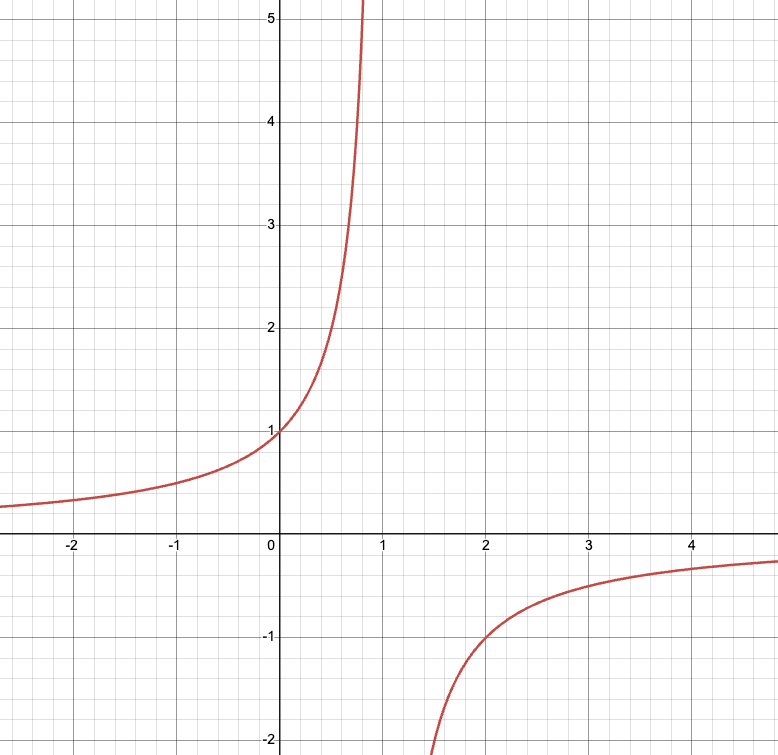
Lots of differential equations have solutions that blow up. One simple example is:
y' = y^2
with say y(0)=1. This is elementary to solve (see below), and the answer is:
y = 1 / (1-x)
So of course if you start with y(0)=1 and run the equation forward, it blows up when x gets to 1.
In 1915, Einstein published his general theory of relativity, explaining how mass curves spacetime according to his differential equation.
In 1916, just a few months later, Karl Schwarzschild published an exact solution to those equations in a special case.
You look at the solution in the natural coordinates for a minute and realize, parts of it appear to blow up at a finite radius!! What the hell? Physics doesn't just blow up like that! It's not possible for space to just get "sucked in" so you get a finite radius "hole" where everything turns "black" because not even light, which travels at a finite speed, can escape. Duh! So Einstein's equations are nonsense!?!
(A few decades later: "Well I'll be!")
I'm not saying that we're about to learn some exotic new physics, that you can make a "black hole of water". More likely, it would drive the continuum model to scales where molecular physics can no longer be ignored. Still, there's some great science fiction waiting to be written here... :)
Oh, and I promised you a solution to the equation: first separate variables:
dy/y^2 = dx
and integrate:
-1/y = x + C.
Solve:
y = -1 / (x+C)
and plug in y(0)=1 to get C=-1.
This is the visualization we've all been waiting to see. Read the questions and insightful replies by @joonas_nattila in the thread below. I learned a lot from reading his answers. And his supercomputer visualization is really instructive!
The solution found doesn’t “explode”. There is a vortex in which speeds diverge to infinity in finite time. But, the vortex also shrinks to a point. And does it quick enough that its energy and angular momentum also drop to zero.
It is a vortex which shrinks to nothing
When a fluid PDE like Navier-Stokes develops a finite-time singularity, it is not a prediction of a physical explosion. It is a mathematical warning sign.
The warning basically says: "The assumptions made when forming this model have reached their limit, and this equation cannot reflect physical reality in the situation you're trying to model."
For what it's worth, let me remind everybody that the n-body equations of celestial mechanics (Newtonian gravity + Newton's laws) can exhibit collisionless blowup in finite time, i.e., you can arrange planets and moons in such a way …
Btw the Navier Stokes problem comes down to: if we lived in a truly continuous universe, fluids might sometimes explode. It’s an issue for the universe of classical mathematics, but does not apply to the computational universe we are in.
a visualization of the flow field of the navier-stokes finite-time blowup solution. it's a good model sir
(singularity at t = 1 with viscosity matching water, unit distance ~ 1 mm. leading and first order background terms)
https://t.co/PkjGXaizNC
In case anyone doubted we would get real science from the Falcon 9 lunar impact:
A new paper estimated the impactor was 4,000 kg at 2.43 km/s, kinetic energy equiv to 2.8 tonnes TNT. The resulting crater is 18 m across and <3 m deep.
Here is the interesting science: natural crater impact scaling predicts it should have been a 46–57 m crater, 3x larger than actually occurred. Comparing it to other rocket impacts did better.
Conclusion: It is incorrect to treat spacecraft impacts like meteoroid impacts of equal mass. For a hollow, elongated rocket stage, the geometry and mass distribution determine the crater size.
See?! Real science came from this event.
https://t.co/7I12EsjYW4
15/ So my current mental picture is not “water makes an infinitely fast tornado.” It’s stranger and more beautiful:
Smooth flow → vortex stretching → smaller scales → stronger vorticity → still smaller scales → …
all the way to a singularity in finite time.
Some thoughts on the Navier-Stokes news from a professor of aerospace engineering:
1) take a deep breath
2) posts indicating we "solved Navier-Stokes" are incorrect and overblown. A very specific mathematical proof involving a niche scenario for Navier-Stokes has *potentially* been shown (that a perfectly smooth incompressible initial condition with finite energy could produce a singularity--note the assumptions here piled on to an equation set that already involves some assumptions).
3) there is no general closed form solution for N-S and that's not what this news is about
4) this is more of a mathematical curiosity than anything else and could matter a lot to mathematicians but basically changes nothing in the way N-S are used in practice
5) there are already very useful exact solutions to Navier-Stokes that greatly simplify the equation set with the right boundary conditions/geometry like laminar flow through a pipe or a 2D Taylor-Green vortex
6) in aerospace, we already treat N-S as an approximation in many instances and are well aware of its limitations. we don't outright solve these equations anyway and regularly chop off terms or simplify parts (at the expense of accuracy) to make them easier to deal with.
7) to be honest I have never found this specific problem to be particularly interesting because we know a core assumption of N-S is a "continuum" fluid where you ignore molecules and assume hydrodynamic scales >>> molecular scales. We know a real fluid cannot have infinite velocity or energy. But clearly you can push equations outside of their bound of validity and make them produce funky results and singularities.
Will the $1m Millennium Prize be awarded to OpenAI? Or the staff who prompted the agents? Or the engineers who developed the model? Or those who created the transformer architecture? Or to Tristan & Levent who developed the same proof and may be OpenAI agent stole it from them?
Let me tell you - knowledge is universal. People's minds, and now AI, are only distilling it from the universe. We are only awarding the effort at this distillation. Not any creation of new knowledge itself.
wtf another huge breakthrough: Prof Anima Anandkumar and colleagues used a physics-informed neural network to find a promising candidate for a singularity in the 3D Euler equations, without external forcing or boundaries.
Their neural network found a candidate in the 3D Euler equations, which describe an ideal fluid without viscosity. It needs no external force or surrounding walls to drive the process.
That makes it particularly interesting: the flow itself could generate increasingly extreme behavior until the smooth mathematical description breaks down.
A successful proof would resolve a major open question about ideal fluids. The Navier–Stokes Millennium Problem, which adds viscosity, would remain a separate challenge.
Suppose you get a 2 billion line of code (LoC) Lean proof of the Riemann Hypothesis or the Collatz Conjecture. What have you actually learned?
The proof of Fermat’s Last Theorem is ~13M LoC in Lean, but at least there’s a human-readable mathematical spine underpinning it: Wiles/Taylor-Wiles, and you can follow the argument end to end.
A kernel-verified proof with no human-compressible argument feels like it could be a genuinely different object: proof without understanding.
What happens when the shortest known proof certificate is machine-scale, but the shortest known explanation is nonexistent?