Everyone is talking about NIST’s 2030 deadline. Almost no one is talking about how long a cryptographic migration actually takes.
Some say it still feels far away. Others say we’re already running out of time. So what should we actually do?
Follow the real timeline, with analysis from our CRO @ShankaraPailoo2
AuditHub launches Scout!
This AI code reviewer maps your system’s threats and ranks every finding by severity, the way auditors review code.
Built for teams shipping L1s, L2s, bridges, oracles and proving systems.
Try it today, it is FREE!
https://t.co/RRIqitWOg5
Shankara Pailoor just stepped off the Devcon stage.
His point: quantum attacks won't come with a countdown. The first signs may look like unexplained key compromises.
Post-quantum migration takes years. Waiting for certainty is the risky strategy. Start planning now.
To add on to this a bit, the point here is to discuss the potential impacts of quantum threats on current cryptographic systems. To make this as clear as possible, we'll spend less time explaining how quantum computers break cryptography and focus instead on the impacts
This incident is insane! From the lengths the attackers went to, to how it was detected, it shows just how drastically security and trust boundaries have shifted.
One sad reality is that if you're a @Ledger owner, you have to follow the news here to be aware of the compromise. I haven't seen any notifications through official channels.
The backdoored Ledger story keeps getting crazier. Attackers used the backdoor to grab $90+ million in crypto from users who bought hardware wallets precisely because hackers steal crypto keys from normal computers.
1) Someone built an implant into Ledgers to steal keys, with an “LTE module, Antenna, e-SIM, a MCU connected to the Ledger’s SPI bus.” (c/o @MagicalTux)
2) It looks like the attackers acquired CryptoBilis, a Ledger authorized retailer, and tampered with their inventory.
3) @MagicalTux found the implant by accident. He was tearing down Ledgers for unrelated reasons and bought them from the cheapest place possible, which was, unsurprisingly, the malicious CryptoBilis.
4) Once the implant was detected, the attackers quickly used the keys they’d stolen to drain the wallets.
5) There appear to be multiple generations of implants.
We know that the asymmetry between attackers and defenders has broaden since the beginning of this year. That impacts any tech firm regardless their size, not only big tech. This is a good time for everyone to reassess their security priorities. Happy to chat if you are looking to harden your security in a any way!
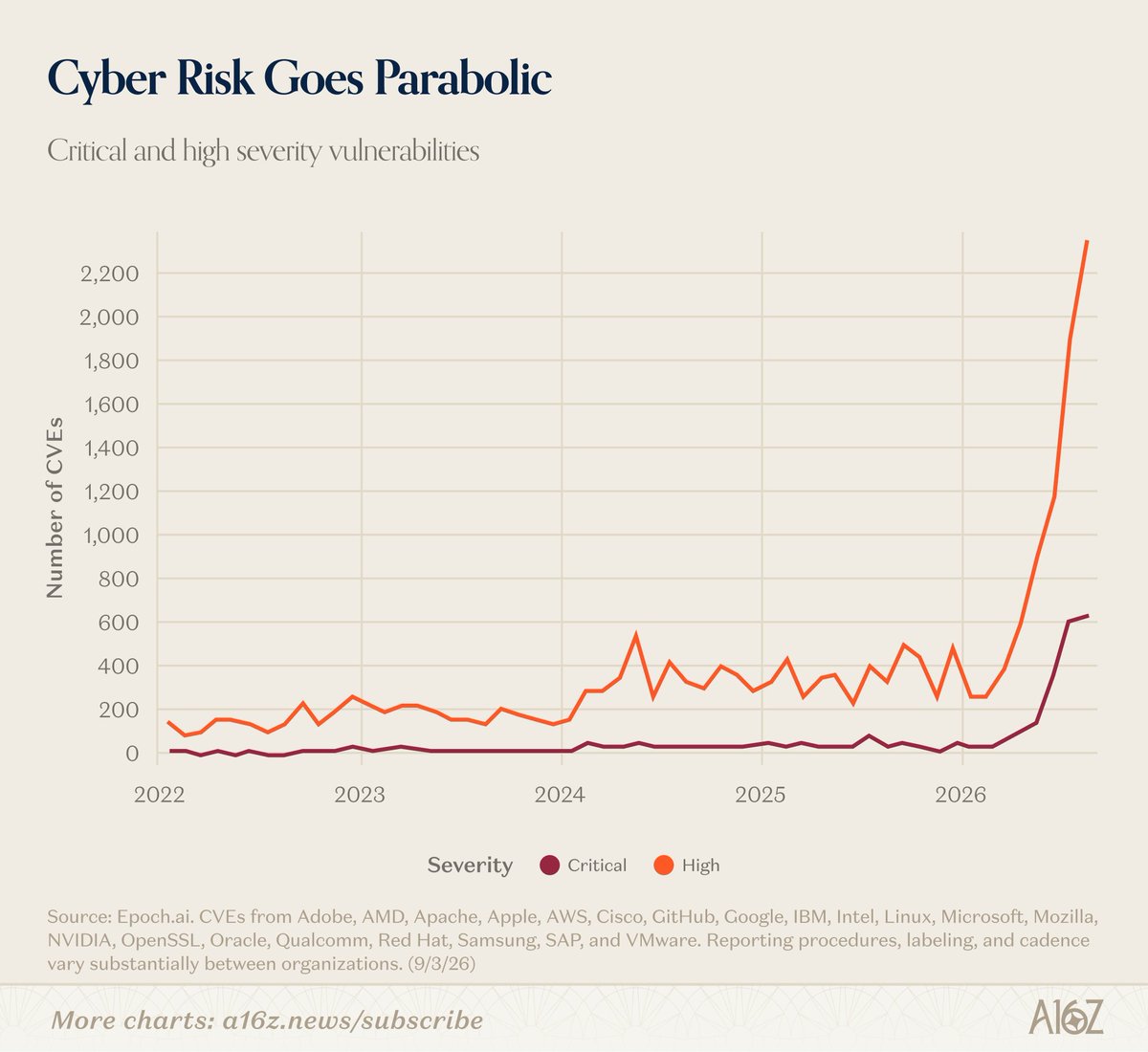
Cyber is having a moment
Across 21 major software companies, including Apple, AWS, Microsoft, and Google:
- Reported critical vulnerabilities never cleared 100 per month in four years
- Since spring they've jumped to over 600 per month
Happy to have shared at the Solana Summit today our new Solana wallet support for Midnight!
@solana users will be able to do private swaps and interact with private DeFi directly from their Solana wallets (no separate install required!)
1/ The next stage of Midnight is here.
Permissionless smart contract deployment is now live on Midnight mainnet.
That means builders can deploy contracts directly without additional security reviews, while contracts can also dynamically deploy other contracts on behalf of users.
Give your app real-time decision-making with Decisions API, powered by GPT-6 Luna.
Define questions and possible answers to classify content, route requests, or choose an agent’s next action.
Available in limited preview.
If true, the era of AI subsidies is coming to an end. Let's start discussing how we can use tokens/inference more efficiently :) Get the most value out for what you pay!
OPENAI 🔥: The upcoming ChatGPT Pro Max plan will cost $500.
So far, this will be one of the most expensive AI subscriptions available on the market.
I hope "it will be worth the wait" 👀
Glad to see that formal method techniques are becoming mainstream.
However, I wished things were as simple as saying to an LLM "verify this." Verification is a more thorough and rigorous process, where you need to clearly define what you need to prove. Leaving that up to the LLM tends to result in poor coverage and the software might still contain critical bugs. And when this happens these days, it's usually formal methods that takes the blame.
Even in this post, the main output of the chat was how many bugs were found and fixed via lean. But the most interesting part when you are using lean is *what properties* you proved.
I used Opus 5.5 to formally verify the Claude Agent SDK using Lean. A couple short prompts = 16 PRs fixing various bugs and race conditions. Video attached.
TLA+ also works well. I sometimes combine Lean and TLA+ to look for issues around data flow, concurrency, and state mgmt.
I don't know either language well, but Claude is excellent at both. This approach is super useful for formally modeling your code and finding bugs that a human probably wouldn't have spotted.
Is formal verification the future of coding (or at least, bug finding)?
Sad but true. Apart from a marketing tool, "rogue" agents have also become a proof of LLM cyber capabilities. I can't wait for the hype to be over and the actual work to start. As white hats, we must be pointing the agents on the other direction and help secure projects!
An interesting "pre-mortem" this week. See how running continuous checks on your code can help you catch bugs even in the cases where you deem an external audit is not necessary.
A function that forwards caller-supplied calldata into a low-level call can perform any operation the target's interface exposes.
Nobody designed that set. No auditor reviewed it.
New Auditor's Take from @FormallyJon covers the class.
https://t.co/JQPRc9kmVF
Completely agree! Although, creating a reliable and consistent defensive agentic solution has become a weird art form. You need to jump through hoops like bypassing cyber restrictions (imposed by the frontier itself), which will make this an uphill, but interesting, battle.
Terrifying in two ways:
1. how people are weaponizing AI
2. how LLM providers can trace what you do
I get the latter for malicious actors, but to what extend this happens for "regular" users? Regardless, I think solutions like @usewisp_io should be the ultimate way to go!
We're publishing our most detailed threat intelligence report to date.
It covers how people tried to misuse Claude—for cyberattacks, influence operations, surveillance, biology, and building weapons—and how we found and stopped them.
We disrupted every operation in the report, and used the lessons from them to strengthen our safeguards. Where appropriate, we also shared what we found with authorities and other AI companies.
These cases are not typical: we’re highlighting some of the most sophisticated misuse we’ve seen. But they’re especially important to discuss, because they show us where AI misuse is headed, where our safeguards work, and where they need to improve.
We’re publishing this report so others can spot the same activity on their own platforms, and so we can give the public a clearer view of how emerging threats develop.
Read the report: https://t.co/0EJUnYEgfz