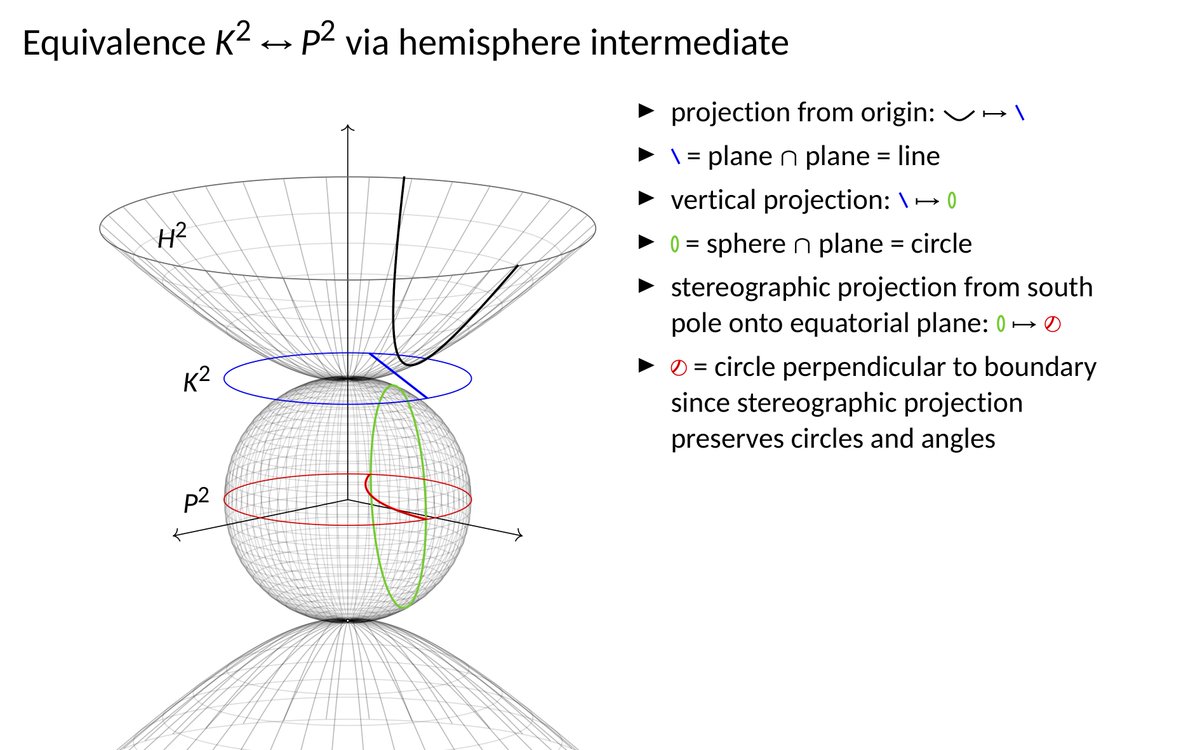
I have been teaching geometry and made a million figures in TikZ. My lecture slides are basically a "proofs without words"-style intro to Euclidean, spherical, hyperbolic, affine, and projective geometries: https://t.co/4xL4DTHpLT
An icosahedron {3,5} rolling on a plane with triangular tiling {3,6}, with a hyperbolic tiling {3,7} (hyperboloid model) rolling under the plane. On the middle plane, triangles from all three shapes meet. This is my take of the "three worlds" (cf Escher) @neozhaoliang
Twitter video compression destroyed the original so trying again: turned some job-market-stress induced lack of sleep into a dynamical system integrator. You can play with it here!
https://t.co/53h9FMbc4K
The (2,11) torus knot complement. At first I figured making nice images of torus knots might look “boring,” but I think this is my favorite knot so far!
New video!
Learn how asking the right question about Newton's method leads to a hidden Mandelbrot set, in the context of a general primer on holomorphic dynamics.
https://t.co/WL2CaxcOrN
I see no images of regular star pseudohedra in the Internet, so let's change this. This is {7,7/2} in the Poincare ball model. Its faces are heptagons and they intersect each other (a similar structure to a great dodecahedron). It looks some some kind of a fantasy shield. (1/6)
Mathematics, reality, physics, motion.
The central dodecahedron continues to rotate, but its face-penetrating umbilical cords never become tangled. Source: https://t.co/oaKniJ9xzW
Imagine flying through space over what looks like hills... then realize that these hills are (intrinsically) flat, it is the space itself that is curved.
Can you tell what it is? (hint: this scene is built from spaces with different geometries, and seamless portals between them)
Sometimes I envision my work’s place in math/physics using flowcharts. Together these paint a pic of the research process: We need to navigate a vast sea of possibilities with a blurry map. Understanding steadily brings this into focus, until we can chart a course and set sail :)
Portals between different geometries! Like, Euclidean on one side, non-Euclidean on the other side. Here we go from ℍ²×ℝ to 𝕊²×ℝ to 𝔼³ back to ℍ²×ℝ. (1/5)