Excited to share our review @NatureRevCancer! We cover all that we, as a field, learned from our efforts to understand genotype to phenotype interactions in cancer and somatic evolution. We also cover what future measurement technologies can take us in this domain.
PDF link 👇
Lineage tracing with cell state readouts (scRNA-seq, etc.) offers a wealth of information! Navigating such data and extracting biological insights can be tricky, especially with sparse clonal sampling. Sergey's thread and our preprint describe a new analysis tool for such data:
(2) Meet (again) clone2vec – a method for building clonal embeddings. In short: it measures similarity between clones based on their distributions in gene expression space. Sounds simple, but apparently it's not.
Ever stare at your spatial DE results and wonder if something's off? Segmentation errors might be the culprit. Our new paper shows how pervasive this problem is - and introduces a fix using matrix factorization of local molecular neighborhoods.
https://t.co/ujnfXa1vkX
As part of our embryo clonal tracing and perturbation efforts with @adameykolab, a quick twittorial from Sergey on generating stable and informative representations of clonal fate variations from sparse and noisy barcode-based lineage tracing data.
(1) Hi, X!
Don't miss Igor's thread about our recent preprint, it’s a very cool reading! Here I will try to go a bit deeper into the computational part of the study — our new method clone2vec, how we developed it, what it does, and what it doesn't do. Grab a drink, and let's go!
Our pre-print with @adameykolab on continuous spectra of progenitor fates during mammalian development. Using multiplexed clonal tracing, mosaic perturbations, and robust computational representations, we look at spatial and temporal modulation of cell fates in mouse embryos.
(1) How can we build complex structures from a limited set of progenitors and cell types? In our new preprint, we describe patterns of cell fate decisions during early development and (in some cases) identify molecular correlates of different behaviors. https://t.co/G7RmnubkSe
Great to be part of this collaboration with @baryawno and @KharchenkoLab among others!
Joint single-cell WGS/mRNA seq is an important tool to understand evolutionary processes in tumors!
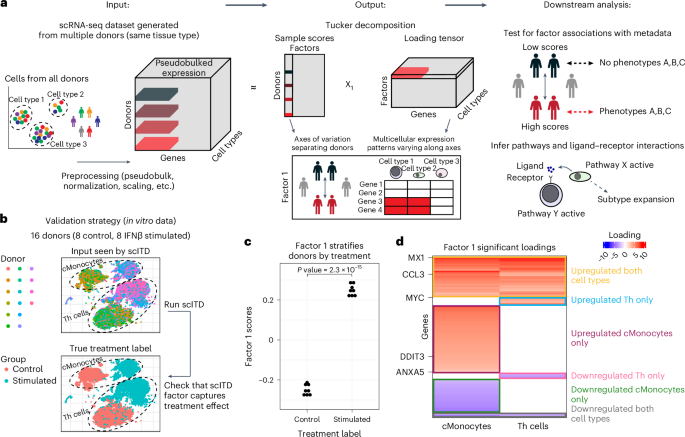
Happy to see our work with Jimmie Ye's lab on coordinated variation of different cell types in healthy and diseased individuals published! At the core of it is the scITD tool for tensor decomposition, rotation and interpretation strategy. Great effort by @J_E_Mitchel et al.!
Coordinated, multicellular patterns of transcriptional variation that stratify patient cohorts are revealed by tensor decomposition https://t.co/syRAP8pka7
New preprint 🎉 led by @AervaI 👇! We introduce an approach to prioritize biological driver genes by recalibrating differential expression fold changes with population variance. This extracts new meaning out of DE analysis, which is a cornerstone of computational biology!
Just finished teaching another semester of genomic #datavisualization 🥳
Discover the awesome #dataviz made by students in the class for various #singlecell#spatialtranscriptomics data
Check out the course notes + #Rstats code to explore for yourself: https://t.co/eikhx46fOb
Our latest out today in @Nature. We profiled 12 million single cells from mouse embryos spanning gastrulation to birth, defined cell type tree from zygote to birth, and unexpectedly found crazy fast changes within first hour of extrauterine life. OA PDF: https://t.co/7PsCcqaQS8
@BoWang87 I think the date of bioRxiv posting should be treated by us and the journals as the date of record for manuscripts! Though I heard that in physics this has led to flag planting, where people would post a nearly empty paper claiming an interesting result and then slowly revise it
Our latest collaboration on metastatic renal cell carcinoma to the bone is published @GenomeMedicine. the bone metastatic environment is not well-defined, hindering progress towards therapeutic targets. Our group developed a unique translational research model.
Congrats to our talented diverse team across @karolinskainst@harvardmed, @MGHCancerCenter led by @baryawno 👏
https://t.co/fEjfBReS5Z
Excited to share two new papers, published today in @Nature!
Check them out here:
(1) Slide-tags, a new method to unite single-cell and spatial profiling:
https://t.co/7z9bb9JCJX
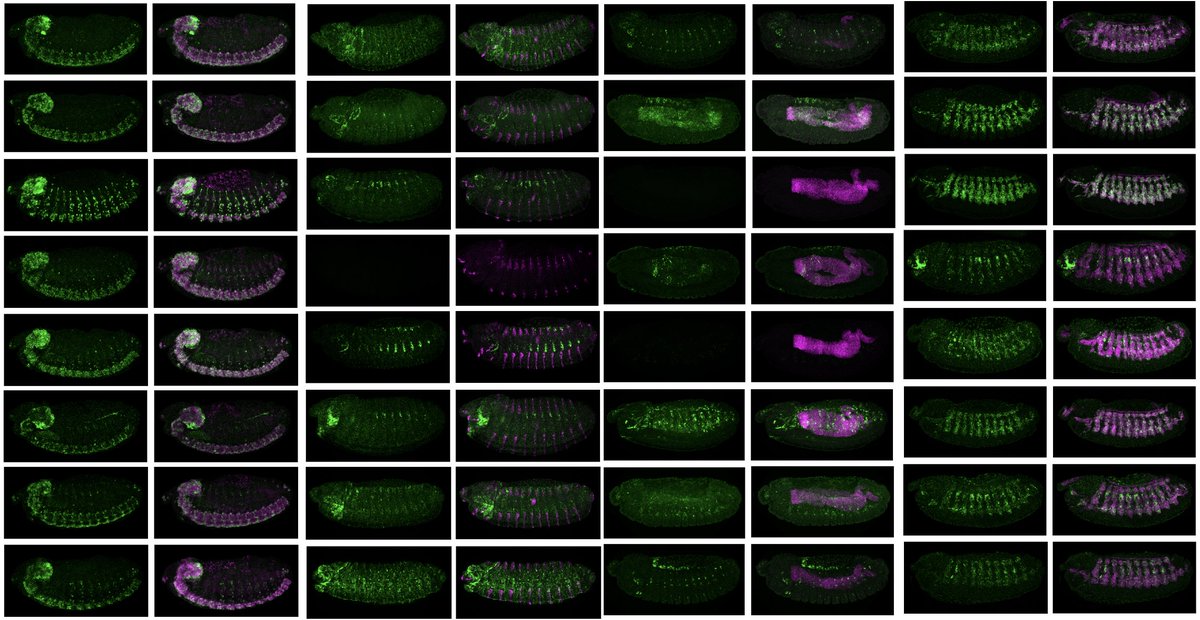
We are very excited to present a major breakthrough achievement – the de novo design of synthetic enhancers for selected tissues in fruit fly embryos in vivo using deep- and transfer learning, @deAlmeida_BPet al published today in @Nature https://t.co/TIlPrBKYaK. Thread 👇(1/N)
Very excited to share two papers published today in @CellCellPress describing stem cell plasticity in CRC. (1/22)
https://t.co/jQxR7PCwh7
https://t.co/P9QaEsqkko