Elon Musk: "If somebody executes well, I'm a huge fan, and if they don't, I'm not.
I generally think it's a good idea to hire for talent, and drive, and trustworthiness. And I think goodness of heart is important—I undervalued that at one point.
So, are they a good person, trustworthy, and smart, talented, and hardworking. If so, you can add domain knowledge. But those fundamental traits, those fundamental properties, you cannot change."
For 100 years scientists called it superstition.
Then they put bare feet on grass and measured what happened to the human body.
They were not prepared for what they found.
(Must read till end🧵)
The problem is not people being uneducated.
The problem is that people are educated just enough to believe what they have been taught, and not educated enough to question anything from what they have been taught.
—Professor Richard Feynman
Elon Musk criou, em um único dia, 4.400 novos milionários.
Quase 400 deles ultrapassaram os US$ 100 milhões.
Não são banqueiros nem investidores de risco. São funcionários da SpaceX: soldadores, técnicos, mecânicos e até funcionários da cantina. Durante vinte anos, a empresa pagou gente de todos os níveis com ações, não só com salário alto. Quem produziu colheu.
Juan Hernandez, imigrante mexicano, aceitou um emprego de soldador por US$ 28 a hora em 2015, sem nem saber direito o que era a SpaceX. Recebeu uma pequena participação de US$ 10 mil e pôde comprar mais por desconto em folha. Hoje sua fatia vale US$ 880 mil.
Trevor Hise ignorou os conselhos dos pais para pegar um emprego “seguro” na General Electric. Escolheu a SpaceX, ficou 12 anos e acumulou mais de 100 mil ações. Ao preço da listagem, são US$ 13,5 milhões. Aos 37 anos, ele já pode se aposentar. Palavras dele: “A magnitude disso é ridícula.”
O detalhe mais eloquente veio antes mesmo da abertura de capital: mais de 100 funcionários se uniram discretamente para contratar uma gestora de fortunas capaz de cuidar de até US$ 5 bilhões. Muitos nunca tinham precisado de wealth manager na vida.
Há décadas os IPOs de empresas de tecnologia enriquecem programadores. Desta vez, o dinheiro chegou ao chão de fábrica. Isso é capitalismo de verdade: quem arrisca, quem trabalha e quem entrega valor colhe frutos proporcionais.
A esquerda odeia esse tipo de história. Porque ela prova que a verdadeira ascensão social não vem de dividir a miséria alheia, mas de criar riqueza que eleva quem tem coragem de construir.
Nvidia CEO Jensen Huang:
"AI will create more millionaires in 5 years than the internet did in 20."
But he didn't stop there...
He revealed exactly how it'll happen and how you can capitalize on it:
We could be the last humans to age and die on schedule.
One injection from David Sinclair's lab already made old, blind mice see again, and in 2026 the FDA cleared it for people.
Here's the science nobody's ready for (THREAD):
Stupidity is knowing the truth, seeing the truth but still believing the lies.
And that is more infectious than any other disease.
—Professor Richard Feynman
To understand why modern society feels so broken, you need to look at the underlying laws that drive all human behavior...
Here're 11 mental models, cognitive biases and rules that run the world...
1. The Zebra Effect
This explains why people are terrified to stand out.
Biologists found they couldn't track a single zebra because the herd's stripes acted as visual noise.
When they marked one zebra with a red dot, the lions immediately isolated and killed it.
The modern urge to conform isn't cowardice; it's evolutionary biology at work.
-
2. The Tocqueville Paradox
As living standards rise, people become *less* satisfied, not more.
When social conditions improve, the remaining inequalities or irritants become more glaring and intolerable.
This explains why the most prosperous generation in human history is also the most outraged and resentful.
-
P.S. If you want my complete collection of the BEST, most useful mental models, cognitive biases, and mental fallacies, grab a free copy here:
https://t.co/u2q1uUm9vD
-
3. Gall's Law
A complex system that works is invariably found to have evolved from a simple system that worked.
You cannot design a complex system from scratch (like a new economy or government program) and expect it to function.
It will fail. This is why modern technocratic "top-down" solutions almost always end in disaster.
-
4. Mimetic Desire
René Girard’s theory that we don’t truly know what we want. We only want things because *other people* want them.
We don't desire objects; we desire the status of the model who owns the object.
Social media has weaponized this, creating a global feedback loop of envy and "borrowed" desires that leads to infinite competition.
-
5. Chesterton’s Fence
If you see a fence in a field, don’t tear it down until you understand why it was put there.
Ancient traditions and social norms may look useless to the modern eye, but they are often holding back wolves you’ve never had to fight.
Dismantling "outdated" structures without understanding them is suicide.
-
6. The "Ruler’s Paradox" (Principal-Agent Problem)
The person in charge is rarely in charge.
An executive cannot implement ideas on the ground because the bureaucrats (middle management) have their own incentives and act as a filter.
Nicholas II realized this too late: “I never ruled Russia. 10,000 clerks ruled Russia.”
-
7. Parkinson’s Law
Work expands to fill the time available, and bureaucracy expands regardless of work.
When the British Navy decreased its ships from 68 to 20, the number of dockyard officials increased by 78%.
Institutions inevitably become bloated, slower, and worse over time as clerks manufacture work for other clerks.
-
8. Preference Falsification (New)
Timur Kuran’s concept that people lie about their private beliefs to fit the perceived public consensus.
This creates a "house of cards" society where a view seems dominant (because everyone is parroting it), but is actually fragile.
Once a few people speak the truth, the facade collapses instantly.
-
9. The Medici Effect
Innovation happens at the intersection of fields.
The Renaissance occurred because the Medicis funded sculptors, philosophers, and scientists to live and work in proximity.
Today, the internet is the ultimate Medici engine, allowing for a cross-pollination of ideas that traditional education tries to segregate.
-
10. The Centipede's Dilemma
If you ask a centipede which leg moves fastest, it will trip and forget how to walk.
Hyper-analysis destroys natural competence.
We are currently seeing a culture of endless self-reflection, therapy-speak, and navel-gazing that is ironically eroding our ability to function as resilient human beings.
-
11. Minimal Self Hypothesis
Narcissism is actually a "strategic retreat."
When the world feels random, dangerous, and overwhelming, people retreat into the only thing they can control: themselves.
The self becomes "minimal" to reduce surface area to pain.
This is why people are abandoning long-term commitments (marriage, career, community) to conserve energy for vague, upcoming disasters.
P.S. If you want my complete collection of the BEST, most useful mental models, cognitive biases, and mental fallacies, grab a free copy here:
https://t.co/u2q1uUm9vD
Charlie Munger was a philosopher who's net worth was $2.6 billion.
In 1986, he gave a speech teaching how to guarantee a miserable life.
Most heard the comedy. Few caught the framework.
50 years later, it's the most underrated tool in self-help.
Here's the move: 🧵
Elon Musk just told a story that should terrify every AI company on Earth.
His son Saxon is autistic.
Saxon couldn’t understand why the family went to restaurants.
You can get the same food delivered.
You can call your friends over.
You can eat better at home for half the price.
So why go?
Musk: “He had an epiphany and said, ‘Oh, the reason people go to restaurants is to hang out with strangers.’”
A kid who takes the world literally just decoded something the rest of us never thought to question.
We like being around people we’ll never know.
Look at what we already built.
Delivery apps so you never wait in line.
Remote work so you never share an office.
Self-checkout so you never talk to a cashier.
Every innovation of the last 20 years was a bet against human proximity.
Every one paid off.
Until it didn’t.
Loneliness is now a public health emergency.
Depression has doubled since the smartphone.
The average American has fewer close friends than any generation in history.
We didn’t remove friction.
We removed the thing friction was hiding.
Now look at what’s coming.
AI agents that handle your emails.
AI companions that replace your conversations.
AI assistants that make every human interaction optional.
Same playbook. Same bet.
Except this time we’re not engineering out strangers.
We’re engineering out humans entirely.
The coffee shop where nobody knows your name.
The subway where no one speaks.
The restaurant where you’ll never see that couple again.
Those aren’t failed connections.
They’re the background radiation of belonging.
We don’t just need people who know us.
We need to exist in rooms full of people who don’t.
That’s what a kid understood at a dinner table that billion-dollar companies still can’t grasp in a boardroom.
We spent 20 years building a world you never have to show up to.
AI is about to finish the job.
And nothing it builds will ever replicate sitting in a room full of strangers and not feeling alone.
If I could give my younger self one piece of advice, it would be this: Your capacity to learn is far greater than your current knowledge.
Many people let the need to be "smart" get in the way of open-mindedness. But if you can view life as an adventure and approach disagreement with curiosity instead of anger, you'll find yourself evolving to higher and higher levels.
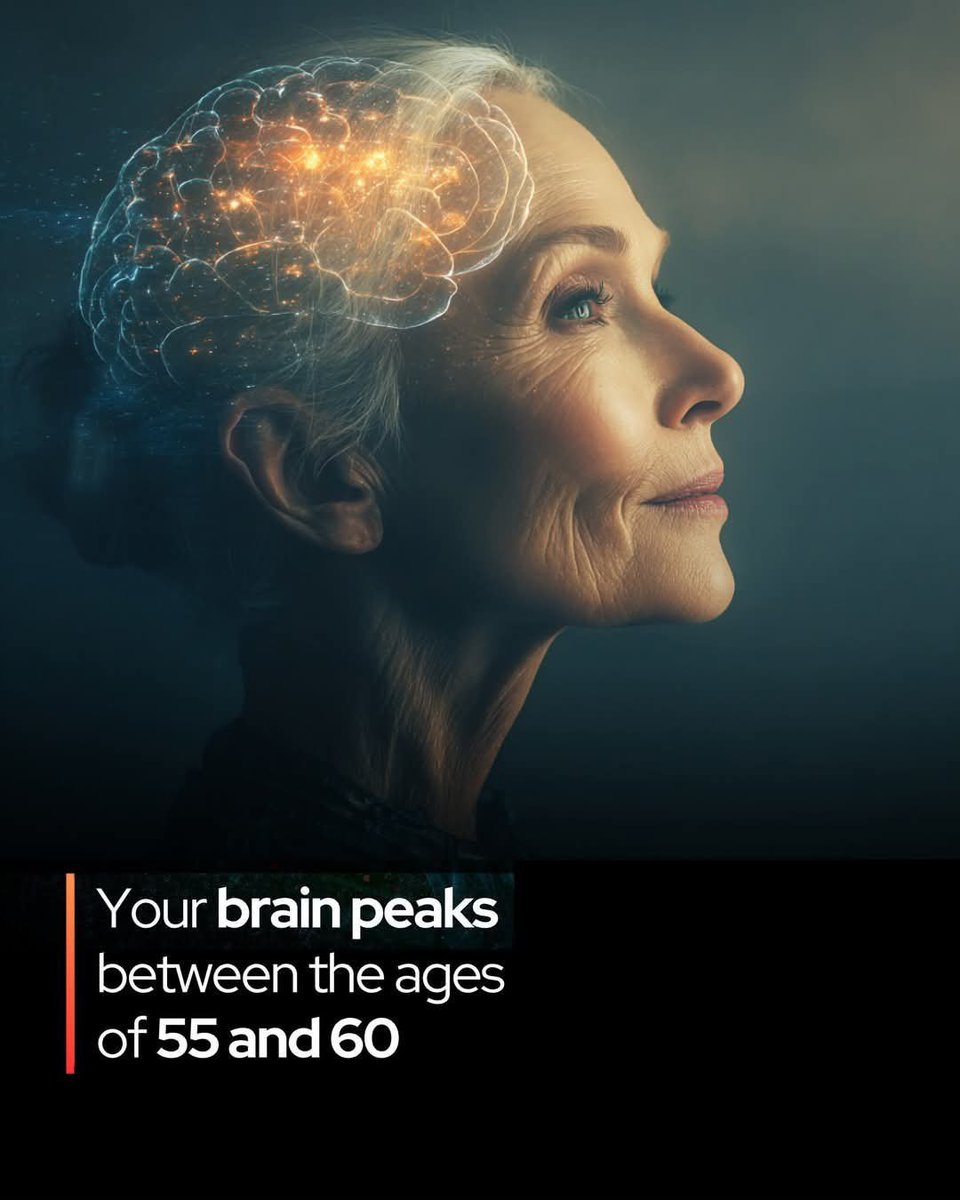
🧠 New research shows the smartest age in life is 55 to 60 – not in your 20s.
While youth is often seen as the peak of brainpower, science now suggests the smartest age in life may actually be between 55 and 60.
Although raw cognitive abilities like memory and processing speed tend to peak earlier—typically in a person’s 20s or 30s—new research shows that overall psychological functioning continues to improve well into later adulthood.
A comprehensive study analyzing 16 traits across the lifespan found that key dimensions like emotional intelligence, conscientiousness, and resistance to cognitive biases don’t just hold steady—they often get better with age.
For example, conscientiousness, which affects reliability and focus, tends to peak around age 65. Emotional stability continues to rise into the mid-70s. Even moral reasoning and the ability to sidestep mental traps like confirmation bias improve as people get older. When all of these traits were combined into a single performance index, late middle age stood out as the brain’s all-around high point—decades after society typically labels us as past our prime. This may explain why leaders and thinkers often hit their stride later in life: experience, emotional regulation, and wisdom create a kind of intelligence that can’t be rushed.
Source: "Worried about turning 60? Science says that’s when many of us actually peak." The Conversation, 14 Oct 2025.