Exciting news today in melanoma. What steps would be needed to develop a personalized Multiple Myeloma vaccine? Or is it not possible because of biology (immune escape, lack of neoantigens, etc)? Asking for a friend.
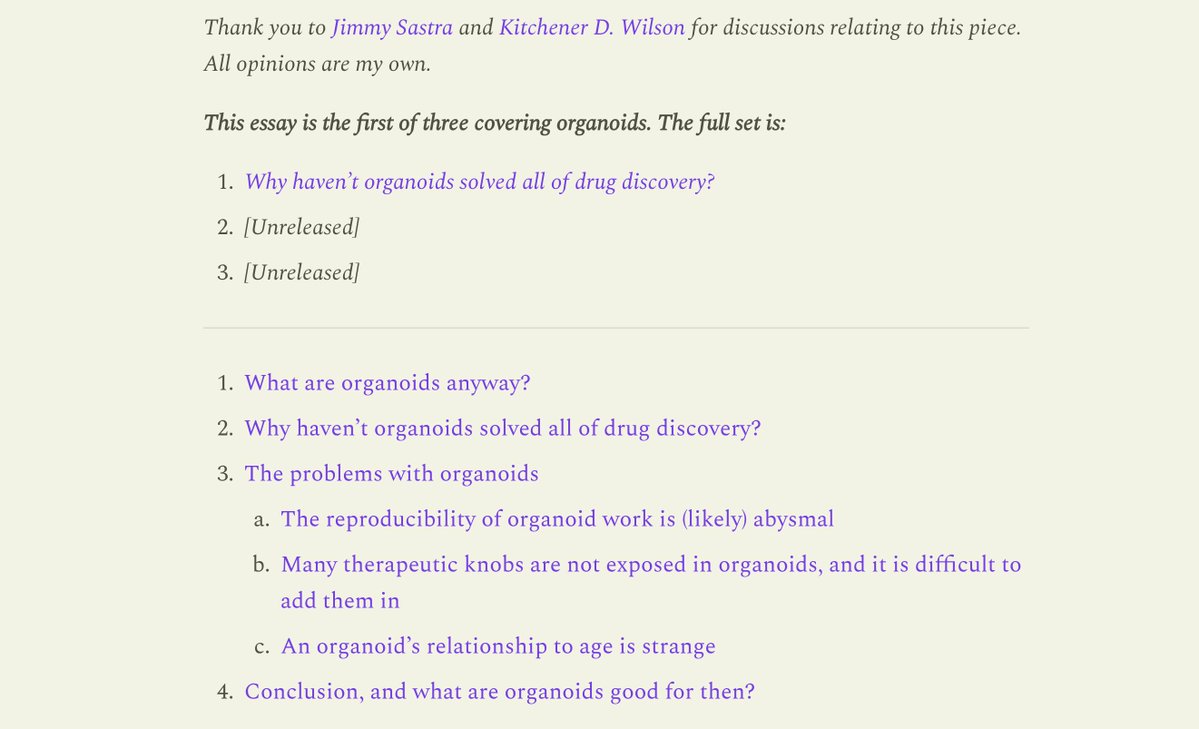
Why haven't organoids solved all of drug discovery?
(5.8k words, 26 minutes)
here, i try to answer a question that i imagine has been on peoples minds for awhile. first essay of a three part series over organoids, because this subject is complicated
https://t.co/b25zgVlt2M
After getting awarded the Medal of Honor, Maverick agreed to run Top Gun, taking Iceman's old job.
But he hates not flying, so he decides to retire and sail around the world with Penny.
But then he learns that pilots are getting replaced by AI piloted drones. After all, every plane shot down in Iran cost a hundred million dollars. Drones are cheaper, expendable, no lengthy training required. Dog fighting is going the way of the calvalry and the cannon ball, anyway.
The Admiral tells Maverick that Top Gun is transitioning to drone pilot training--this will be the last class of recruits. They need him to use the new recruits to train the AI to replace them. They need Maverick to teach the machine everything he knows.
But, in the final battle, the experimental AI drones will fail -- because they aren't human and will never, ever have the need for speed.
Maverick will save the mission and also save Top Gun itself by proving that no machine can replace a human fighter pilot.
He and Penny finally sail around the world -- but he does install an AI captain on the boat so he and Penny can relax. After all, he doesn't know anything about sailing.
THE END
@JackChambersGB Every born/raised ex-Santa Barbaran who's moved away from our quiet little paradise is convinced we'll return for good before we die. This gives us peace while out in the big noisy world.
Our member @rosebudbiosci is rethinking how rare disease drugs are discovered by starting where biology is most predictive, in human systems. Learn how their approach to disease modeling is helping generate more relevant data earlier in development by reading the full Member Spotlight: https://t.co/RmKbvKHKRk
#RareDiseaseAwareness
iXCells and Rosebud Biosciences Partner on Organoid-Based Rare Disease Models
#Organoids are an important component of translational research, particularly for evaluating #drugtoxicity and tissue-specific responses
@iXCells@rosebudbiosci#rarediseases
https://t.co/HPKhsnxYtA
The combination of stalled SBIR reauthorization at the federal level, and VC resistance to new entrant early stage biotech funding, is a giant clusterf*ck for American healthcare. Full stop.
I think this was part of the implicit premise of the first incarnation of Hammer Lab at Mount Sinai, about a dozen of us with math/CS backgrounds ditched tech for biomedicine.
And we got humbled hard: most of what we did flopped & techies don't understand experimental design.
Excited to report our study in @NEJM on the discovery of deletions in a long noncoding RNA gene 🧬 (𝘊���𝘈𝘚𝘌𝘙𝘙) as the cause of a newly defined human neurodevelopmental disorder 🧠. 🧵1/10 https://t.co/a0V99Xqjaw
6/According to @NatureBiotech’s excellent 📊 we can see that VC funding varies according the different therapeutic areas. While #Cancer still vastly dominates venture capital funding, other areas like #obesity, #neurology, #immunology & #AI can also get oversubscribed rounds $XBI
Gene therapy landscape
Pulled together 42 companies and charted the preclinical and clinical assets of each, segmented by approach and vector
Some takeaways:
I've been blown away by the progress of medicine over the past decade
And one startup doing gene therapy really got my attention
You may be asking "What's gene therapy?"
Gene therapy uses genes to treat diseases
If you've got a genetic disease like Parkinson's, cancer, heart disease, etc., gene therapy can help in correcting it - straight Sci-fi shit
However gene therapy is a fairly recent field, but also fast-growing:
- until 2017 the FDA had approved 2 gene therapies
- in 2022 alone 3 therapies were approved
But that doesn't seem like that many. Why haven't we gotten 100's of gene therapies yet?
Because it can take years or even decades to find cures for certain diseases using traditional methods. And 90% of clinical trials fail, leading to wasted time and resources.
A company called Rosebud Biosciences is seeking to change that
@rosebudbiosci has developed an innovative approach for screening drugs and their effectiveness for children with rare diseases
Children account for 50% of all people with genetic diseases, and only 5% of genetic diseases have approved gene therapies.
Rosebud is seeking to find solutions for the other 95%
And how they do this is mind-blowing
In their lab they use stem cells to grow 1000s of "micro-organs" (mini organs) that have the target gene mutations they want to treat
This allows for testing a large number of therapies across these organs and seeing which ones work, saving a ton of time and money, while also leading to better probability of getting through clinical trials
More gene therapies getting through clinical trials quickly = more diseases that can be treated
Gene therapy as a whole seems to be having a breakthrough moment and I'm excited to see how this space continues to grow!
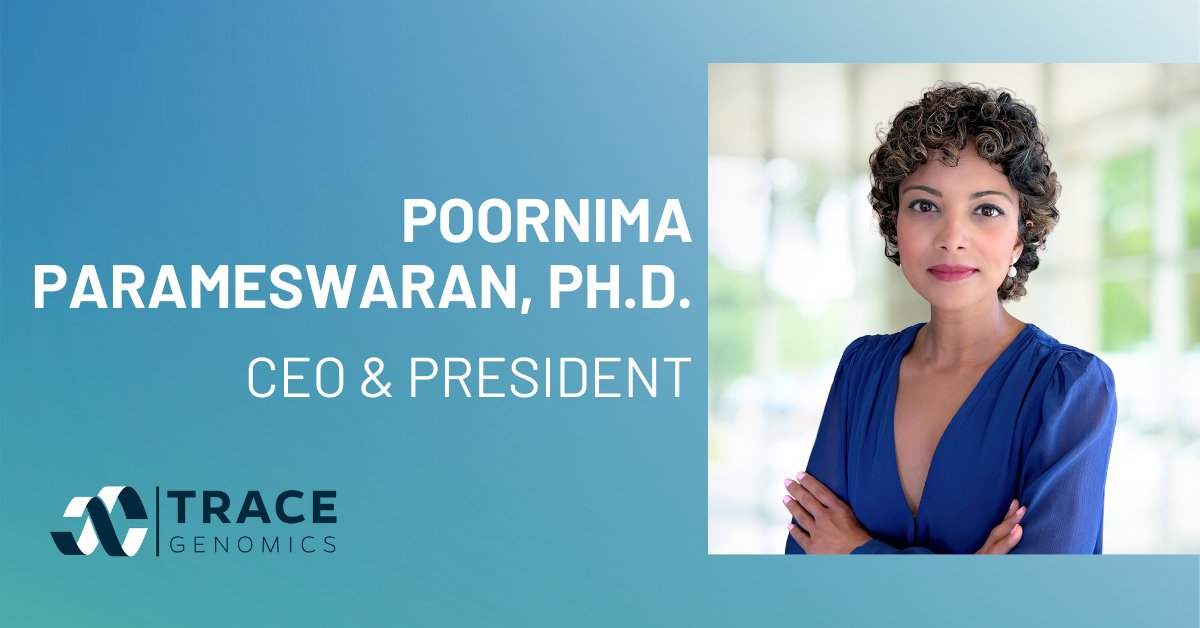
So incredibly proud of my wife, @PoornimaParam. Those of you who know her personal story since cofounding @tracegenomics, its ups and downs and twists and turns, can appreciate the smarts, courage, and dogged determination that have led to this moment. Well deserved, my love.
The Board of Trace Genomics is pleased to announce the promotion of Poornima Parameswaran, Ph.D. to Chief Executive Officer & President. Please join us as we extend our congratulations!
Read the full announcement: https://t.co/uI4EPkgFAq