Pancreatic cancer will look very different in 5 years
✅ KRAS is no longer "undruggable"
✅ Neoantigen vaccines may stop recurrence
✅ AI can identify 'occult' tumors from routine scans
We tackle these stories in our new episode!
#onlyoncologistsinthebuilding
Detecting lung cancer 5 years before it happens, in @CellCellPress courtesy of the @CharlesSwanton group.
Astonishing translational work !
https://t.co/EvUmIGVLgs
An experimental drug called daraxonrasib nearly doubled overall survival rates for patients with advanced pancreatic cancer, according to the results of a newly published study. @DrLaPook has more on the findings. https://t.co/jl4OMupucA
My other hat in clinic than NET/GI is unknown primary cancer (CUP) and rare cancers that do not fit neatly in other tumor groups. One such cancer is extramammary Paget's disease (EMPD). It is almost as if I like to work in the data-free/data-limited zone... 😉
Metastatic EMPD is a rare malignancy, in fact, extremely rare. Therefore, very little is known about the management.
Thanks to @SuleimanRiham, @hfuentesbayne, @StephanThomeMD and others, we now have a little more information.
A few highlights:
-- Median overall survival (OS) 20.0 months
-- IHC showed universal CK7 and GATA3 positivity, with 80% androgen receptor (AR) expression.
-- HER2 was positive (3+) or amplified in approximately one-third of cases.
-- NGS revealed frequent mutations in TP53 (68.8%), ERBB2 (50%), and CDKN2A/B (50%). A “triple-hit” deletion at the 9p21 locus (CDKN2A/B/MTAP) was identified in 25% of cases.
-- Genomic profiling showed strong similarity to HER2+ breast and urothelial carcinomas.
-- HER2-directed therapy was associated with longer overall survival (median OS 73.0 months [95% CI, 0–177.9] vs. 19.0 months (NS)
https://t.co/ZTaX8b7qq8
In HER2-positive gastroesophageal adenocarcinoma, progression-free survival was longer with zanidatamab plus chemotherapy, both with and without tislelizumab, than with trastuzumab plus chemotherapy. Full phase 3 HERIZON-GEA-01 trial results and Research Summary: https://t.co/ShqcYpSvVb
Day 3 #ASCO26 5 plenary highlights:
1. #PROTEUS: PeriOp/PostOp Apa in Prostate Ca
2. #SARC041: Adj Abema in dediff liposarcoma
3. #LIBRETTO432 : Adj Selpercatinib in NSCLC
4. #HARMONi6: 1L Ivonescimab in Sq mNSCLC
5. #RASolute302: 2L Daraxonrasib in Panc Ca
@ASCO
1/6
Paul Oberstein, co-author and investigator on the #ASCO26 daraxonrasib plenary presentation and @NEJM paper in pancreatic cancer describes the key findings of the study (which received a standing ovation!) @nyulangone@nyugrossman@Perlmutter_CC@Aiims1742
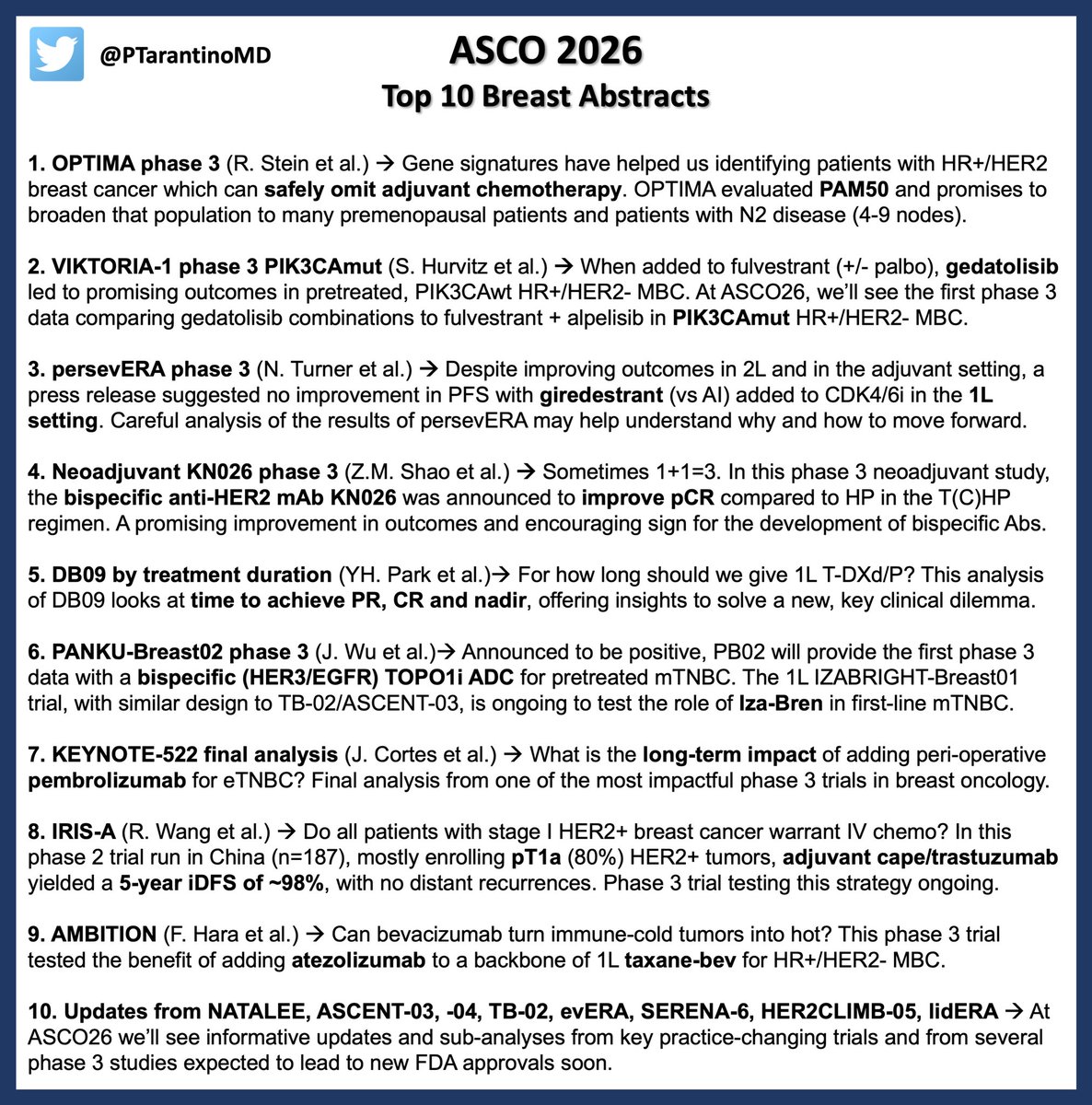
Only few days to #ASCO26. For breast oncologists, this edition will deliver a new promising biomarker to spare unnecessary chemo, informative updates from practice-changing trials across subtypes, and major innovations coming from China. See you in Chicago next week! #bcsm
At #ASCO26, the @UTMDAnderson Thoracic Medical Oncology Department will deliver an incredible 9 oral presentations💐💐💐 highlighting advances across ##EGFR, #HER2, #KRAS, #KEAP1/STK11, #SCLC, IO, #peri-operative, all lung cancer subgroups. For perspective, thoracic medical oncologists from China have 16 oral presentations.
👩⚕️🧑⚕️ 👩🔬🧑🔬Our entire MDA Thoracic team @FSkoulidis@NIVokes@LaurenByersMD@lungoncdoc Drs. Heymach, Cascone, Zhang, @mvnegrao@YYElamin@AnneTsao2 are deeply proud and excited 😀to help shape the future of lung cancer research and patient care alongside outstanding collaborators and industry partners.
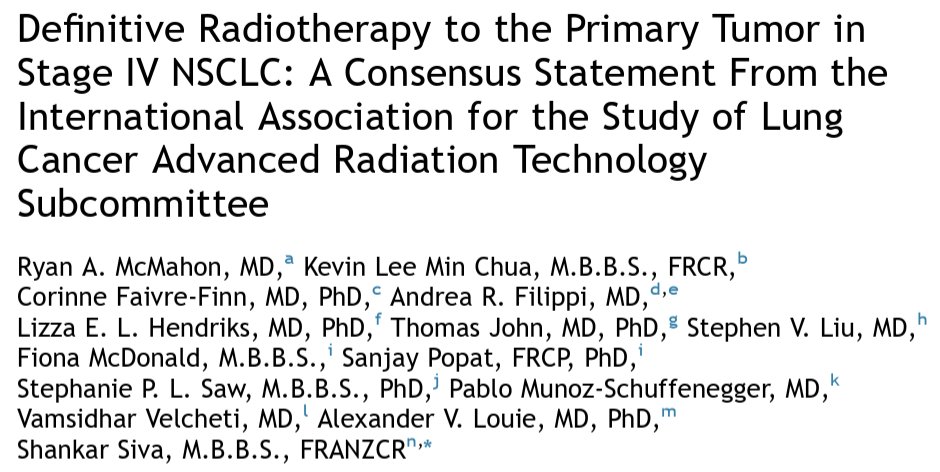
An honor to be part of this consensus statement from the @IASLC Advanced Radiation Technology Subcommittee @JTOonline on radiotherapy to the primary tumor in stage IV NSCLC, led by Drs. Ryan McMahon and @_ShankarSiva. Is it time to rethink management of metastatic lung cancer?
How does somatostatin PET perform in detecting nodal metastases in patients with pancreatic NETs evaluated for resection? Not so great...
130 patients w/ pNETs who all had SSTR PET followed by resection. 42% had path proven LN mets but only 24% were seen preop on PET (sensitivity 46%). Specificity much better, 92% with PPV of 81% and NPV of only 29%.
As expected, larger nodes and a higher Krenning score were more likely to be found on SSTR PET.
Be careful with multifocal pNETs such as in MEN1 as multifocality can resemble nodal mets.
@TELL_Starlinger@ThielsCA@PackardAnnie@MayoRadiology@MayoClinicSurg@MayoCancerCare@MayoHemeOnc
https://t.co/pJg3IMNAmP