Postdoc position in the Faculty of Health Sciences @SFU in Vancouver in Environmental Epidemiology! Come work with us to study the effects of air pollution on children's respiratory, neurocognitive and cadiometabolic development @SFU_FHS
#JOBALERT: We're hiring for a postdoc position in environmental epidemiology! Work with Ryan Allen and @LCMcCandless to study the effects of air pollution on children's respiratory, neurocognitive and cardiometabolic development.
Learn more: https://t.co/Bh0Xd1B6Qd
From Reprints and Reflections in IJE. A paper from 1991.
How Independent Are “Independent” Effects? Relative Risk Estimation When Correlated Exposures Are Measured Imprecisely
https://t.co/QMbhgTkC9w
P-value function depicts the full range of hypotheses that are compatible with the data.
They allow a more nuanced interpretation of evidence versus significant/nonsignificant.
I first encountered them in Epidemiology: An Introduction by @ken_rothman
This is a must read.
Spoiler alert: case-control studies are not the problem...
Discussion of Schuemie et al: “A plea to stop using the case‐control design in retrospective database studies” https://t.co/rDIewYweuG
Congrats to Harry Zhuang for NSERC PGSD: "Bayesian factor analysis for high-dimensional correlated exposure variables with application to environmental epidemiology."
@sfu_fhs doctoral students win awards to support their interdisciplinary research.
https://t.co/lIHQLctENP
Quantile regression should be more widely used to measure weak effects in epidemiology. Great example:
Associations between ambient air pollutant concentrations and birth weight: A quantile regression analysis.
https://t.co/QcbNTtDt1i
Using simulation studies to evaluate statistical methods
Tutorial in Biostatistics in Statistics in Medicine
https://t.co/g4kDySKP0E
https://t.co/JBkWeRlM0y
New paper by @GhassanHamraPhD on Bayesian analysis of 25 highly correlated biomarkers of environmental chemical exposures.
Prenatal exposure to endocrine disrupting chemicals in relation to autism spectrum disorder and intellectual disability.
https://t.co/KpXroAU111
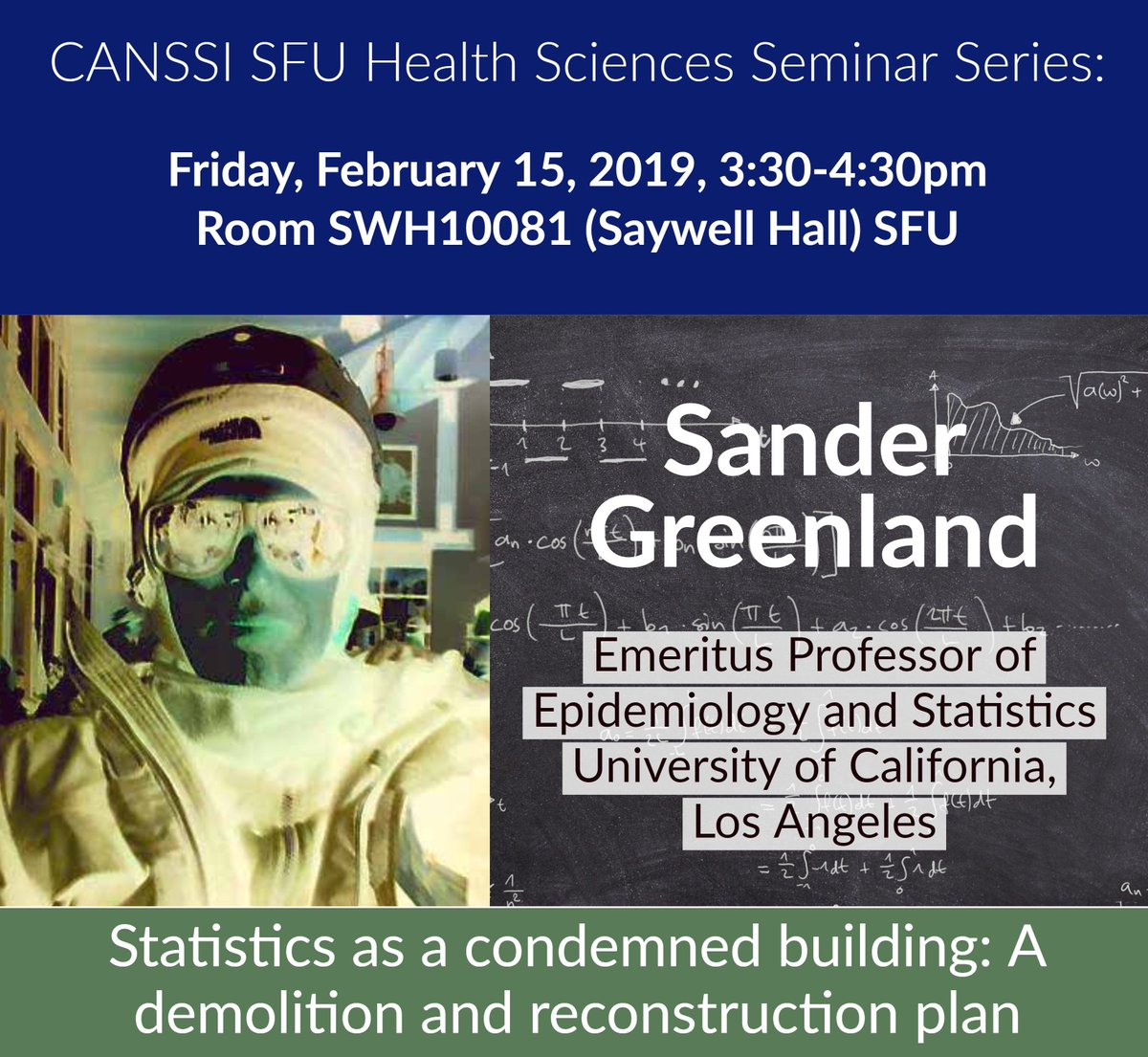
Missed Sander Greenland's presentation of "Statistics as a condemned building: A demolition and reconstruction plan" on February 15 at #SFU?
Watch the video recording online here: https://t.co/KdLYfPMY8e
@Lester_Domes@CANSSIINCASS
New study led by my trainee Brendan Bernardo using Bayesian analysis of the MIREC Study. We examine PCB exposure during pregnancy and autistic behaviour in children, with new Bayesian measurements of uncertainty and effect size
https://t.co/a1GaWHFylg
New study by trainee Tian Li. We analyze data from an RCT of Housing First as a means of ending homelessness for people living with mental illness in Vancouver. Used Bayesian sensitivity analysis to measure the impact of non-ignorable dropout
https://t.co/xhSeW5B13a
47 editors of 35 respiratory, sleep, and critical care journals made recommendations for increasing rigor and validity in observational studies. What do you think? https://t.co/gcKbPriZTv
Delighted to announce that Sander Greenland will present: “Statistics as a condemned building: A demolition and reconstruction plan.“
Feb 15 1530-1630 at Simon Fraser University, Faculty of Health Sciences, room SWH10081 (Saywell Hall)
@SFU_FHS@Lester_Domes@CANSSIINCASS
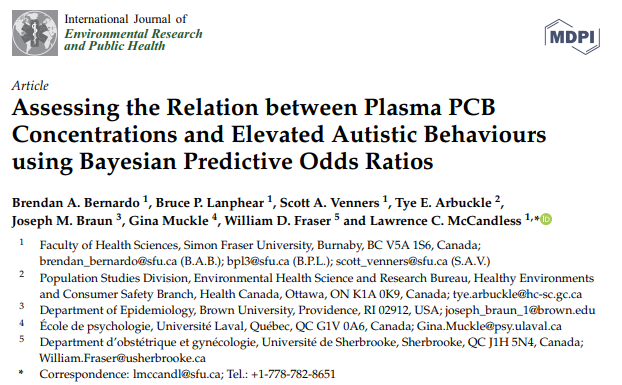
Interesting article on Assessing the Relation between Plasma PCB Concentrations and Elevated Autistic Behaviours using Bayesian Predictive Odds Ratios.
#autism#PCB
https://t.co/AvNE6uJ2rh