The brain is metabolically hungry but most accounts of cognition do not consider the energy cost of neural activity
Here we review the metabolic budget of neural homeostasis + cognition; associated evolutionary constraints; plus disturbances in disease
https://t.co/cCnmzLUSxz
'Unravelling consciousness and brain function through the lens of time, space, and information'
by Andrea Luppi @loopyluppi, @_Fernando_Rosas, @PedroMediano, Athena Demertzi @ADemertzi, David Menon @Menon_Cambridge & Emmanuel Stamatakis @estamatakis
https://t.co/fZddQ1bAjd
Latest one out!
Ultrafast, lossless analysis methods for high-dimensional time-series - application to neuroimaging.
First for @GAlteriis, congrats for seeing it over the line :-)
and with @FranHancock1, @eilidhmacnicol, @brain_kcl, Federico Turkheimer
Psychedelics have started to show promise for treatment of depression.
We wanted to understand what causal mechanisms are relevant in driving this success. Our latest brain comms paper attempts to shed light on it. https://t.co/Xwm0l8upOm
New paper out investigating the effect of anesthesia-induced loss of consciousness on the integration/segregation balance (https://t.co/9ylvxLsQOi) lead by the fantastic @LDLord13, with @teo121270, @henrique_frnnds and Federico Turkheimer, supported by @imera_amu
New preprint!
This is the last chapter for my PhD dissertation to see the light of day: I wrote it to be an accessible introduction to information theory explicitly written for the aspiring complex systems scientist. 1/n
https://t.co/9TKcNQ3Qmm
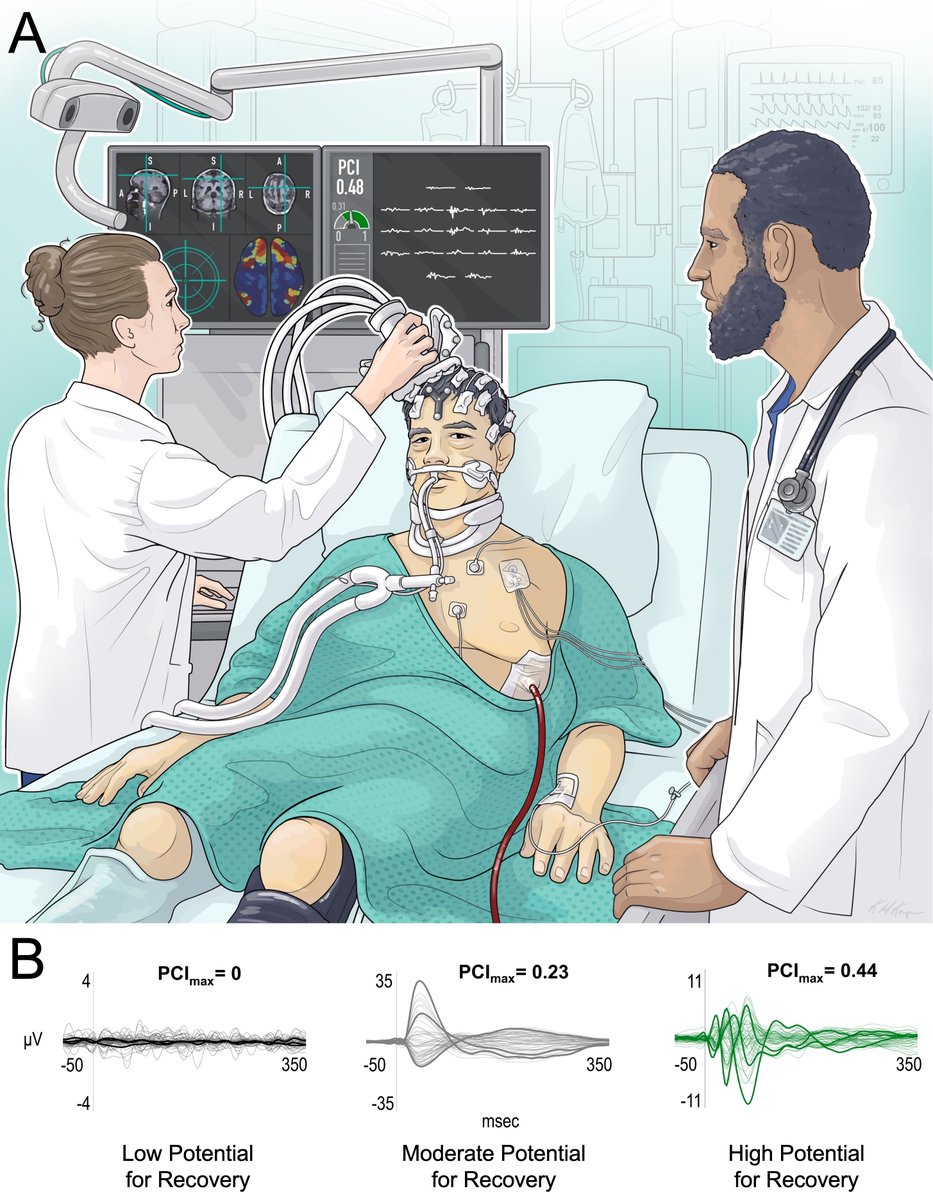
What is the best test to detect consciousness in the ICU? Behavioral exam? fMRI? EEG? Or is it TMS-EEG?
We discuss the potential for TMS-EEG measurements of brain complexity to improve care for patients with severe brain injuries in the ICU.
https://t.co/Fkq5uG9aZP
@CuringComa
Big paper day! Our first data showing that fMRI can be used diagnostically and prognostically in acutely unresponsive patients in the ICU. @lorettaenorton@karnig_kazazian @jpeelle @DebickiDerek @daviniaferes and others (not on twitter).
https://t.co/qrUuYhxRdu
Brain rhythms have been detected for a century, but their generative mechanisms remain under debate. Here's our hypothesis and how we tested it (1/6) https://t.co/89ortfoMdx
@Castaldo_Fr@VohryzekJakub@LitvakVladimir@RenaudLambiotte@BickMath, Friston, Kringelbach & Deco
New preprint out: "Altered dynamical integration/segregation balance during anesthesia-induced loss of consciousness"
https://t.co/lbqI3N5pLc
With the legendary: @LDLord13@teo121270@henrique_frnnds and Federico Turkheimer
and support from @imera_amu
"Altered dynamical integration/segregation balance during anesthesia-induced loss of consciousness" 🧠
in collaboration with: @ExpertPol@teo121270@henrique_frnnds and Prof. Federico Turkheimer
supported by @imera_amu 🇫🇷
https://t.co/B5szNwHlt3
Ketamine gets a lot of attention, but I don't think we put enough emphasis on how crazy it is that a single molecule can take you from rich dissociative hallucinations to complete anesthetic oblivion, with dynamics comparable to both classical psychedelics & GABAergic anesthesia.
A long-waited paper coming from our long term collaboration with Bechir Jarraya's lab. This time we used DBS to induce anesthesia awakening. We measured the impact in behavior, static/dynamic fMRI FC, and EEG.
A proper thread next monday!
https://t.co/zeHN5pPXjR