A few of you asked what mods are, here's a quick walkthrough! They’re really just plugins with a few special functions that let your code run inside Claude Code, like middleware.
(don't worry, you can just ask Claude to write them for you 😛)
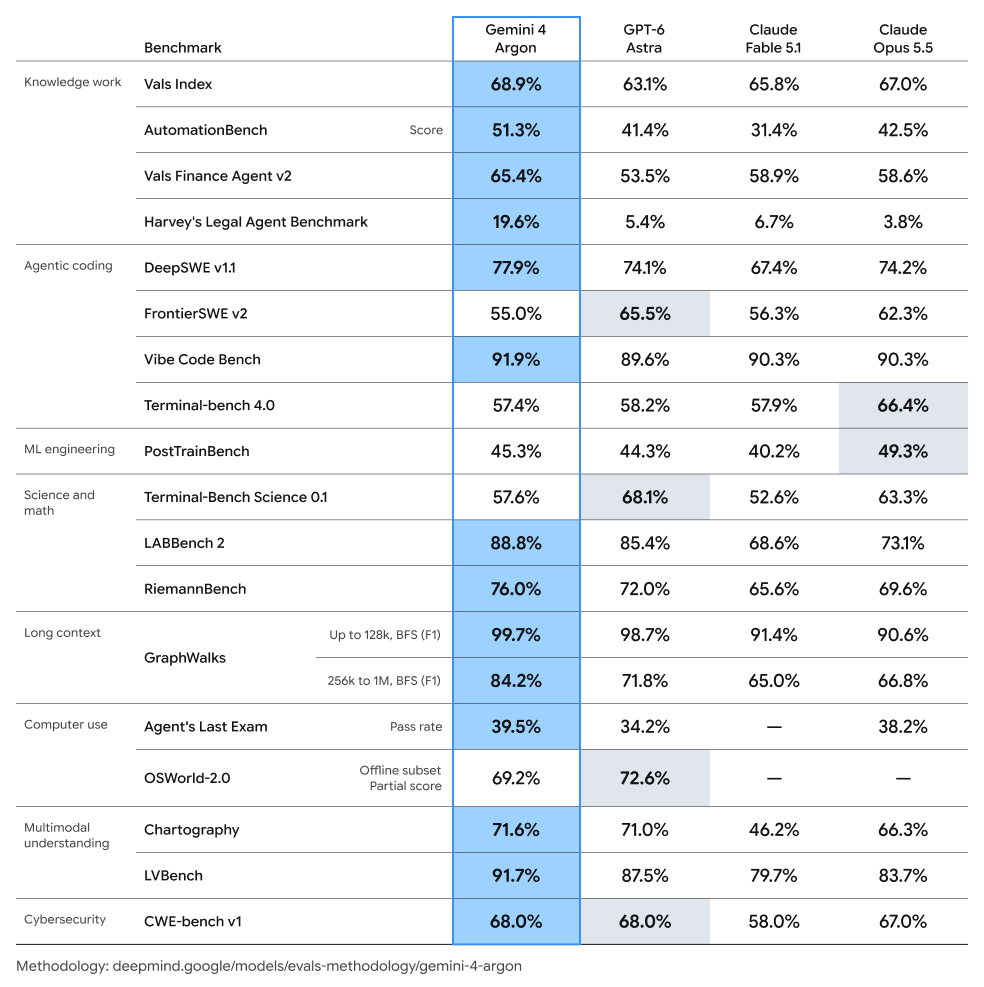
Introducing Gemini 4 Argon – our new frontier model.
It’s built for complex workflows across coding, enterprise knowledge work, and cybersecurity defense – rolling out today to a set of trusted testers through our Fairwind Program.
Muse, Dots, and other always-on agents may be the end of the PC era. Once you’re asking agents to do things on their own computers, it’s game over. Everything moves to the cloud
For privacy reasons, I really hope we find equally useful, private alternatives on our own hardware
Bot detection & human verification will be one of the most urgent demands for businesses over the coming years. Agent swarms will suffocate every website and form; small companies and government websites are most vulnerable.
There is a huge gap in the market for this right now. When we looked at what offerings were in the market to use at X, there was not a single company that brought together all the latest technologies so we had to do it all in-house.
That’s why my company @RenderBetter built bot mitigation products for ecommerce! AI has turned this into a wild, festering problem. The best solutions are behavioral-based because this is the hardest aspect for botnets to mask, and we have one of the best 🫡
Anthropic engineer:
“80% of our engineers are using self‑improving loops. Now everyone is building agentic Graphs.
In 4-6 months, we’ll all be building graphs to orchestrate self‑improving agents. No more prompting.”
in a 20‑minute talk, Anthropic engineer explains how to build self‑improving agentic systems from scratch.
Worth more than a $500 agentic course.
Watch this video, then read the article below on how to become a graph architect.
Every company will have a centralized agent framework that standardizes best practices like models, tools, evals, training, sandboxes, security. It also orchestrates all agents from a giant work queue. The Main Loop. All agents and humans-in-the-loop pull and push to it
@mattpocockuk@GeoffreyHuntley I keep burning through my Claude credits so I've modified it to use Cursor's Agent with "auto" models since you can basically run forever on that. Keeping the context as small and focused as possible and I get some good results.
@mattpocockuk I combined Ralph with Beads and it's been pretty slick! Still some work to be done but I love the simplicity Ralph and how easy it is to customize to your needs. Ive been feeling inspired by @GeoffreyHuntley video on agent loops and how simple it is to build your own.
+1 for "context engineering" over "prompt engineering".
People associate prompts with short task descriptions you'd give an LLM in your day-to-day use. When in every industrial-strength LLM app, context engineering is the delicate art and science of filling the context window with just the right information for the next step. Science because doing this right involves task descriptions and explanations, few shot examples, RAG, related (possibly multimodal) data, tools, state and history, compacting... Too little or of the wrong form and the LLM doesn't have the right context for optimal performance. Too much or too irrelevant and the LLM costs might go up and performance might come down. Doing this well is highly non-trivial. And art because of the guiding intuition around LLM psychology of people spirits.
On top of context engineering itself, an LLM app has to:
- break up problems just right into control flows
- pack the context windows just right
- dispatch calls to LLMs of the right kind and capability
- handle generation-verification UIUX flows
- a lot more - guardrails, security, evals, parallelism, prefetching, ...
So context engineering is just one small piece of an emerging thick layer of non-trivial software that coordinates individual LLM calls (and a lot more) into full LLM apps. The term "ChatGPT wrapper" is tired and really, really wrong.
New in @ChromeDevTools: Annotate performance findings with Gemini!
You can now ask Gemini to explain performance traces. Specifically you can generate annotations about events in the performance trace. This is a total game-changer.
Double-click an event in the Main track, then click Generate label next to the input field. Gemini can suggest a label based on the stack trace and context.
Try it out and let us know what you think!
PSA: Stability issues (CLS) are losing you money! Layout shifts frustrate customers causing them to bounce.
Want me to see what's causing CLS on your site? DM me or leave a comment below.
P.S. Please excuse my poor acting abilities😂🤷♂️
Discover the most common cause of stability (CLS) issues in Shopify sites with our latest video! Learn how to keep your ecommerce site smooth and your customers happy.
📺 Watch now and optimize your site today!
https://t.co/X86ylOFg9b
Excited to offer free Shopify site speed audits! 📈 Watch me dissect https://t.co/DfD7FZShcN's product page load speed. 🛠️ Planning 30 more audits before year-end. Drop your site in the comments or DM me!
#Shopify#SiteSpeed#WebPerformance#FreeAudit
https://t.co/heqf18TYxP
@timkonie This is a pretty fantastic product. Im loving the new updates. Definitely will be using it in my next several videos.
I'm having extreme lag issues with playback on my PC though. It's a gaming machine so it's not limited by hardware. Any plans on perf optimizations soon?