My 30th was truly the greatest year of my life. God gave me an early lifetime birthday gift 3 weeks ago and I can't stop thinking about how blessed and favored I am. Cheers to another year of God's goodness. 🥳🍾🥂
The marchers are Congolese Tutsis protesting against the governments of Burundi and the Democratic Republic of the Congo.
They accuse both states of anti-Tutsi violence and say the U.S. isn’t doing enough to help.
@DailyCaller
Never Again! The Banyamulenge and Tutsi Under Attack”
The ongoing, systematic targeting of Banyamulenge and Congolese Tutsi communities in eastern DRC raises a fundamental and disturbing question: why is the international community choosing silence in the face of an increasingly genocidal violence?
As early as 2017–2018, Congolese authorities acknowledged the killing and destruction of Banyamulenge villages, livelihoods, and cattle, yet deliberately downplayed these crimes as “intercommunal clashes” despite clear evidence of support to armed Mai-Mai groups responsible for these attacks.
In November 2022, this dangerous ambiguity escalated into open complicity. The Congolese government formalized and rebranded these militias as “Wazalendo,” legitimizing and empowering them as auxiliary forces. At the same time, Banyamulenge were explicitly singled out as “foreigners” and enemies fueling hate, incitement, and organized violence against a targeted minority.
Today, daily reports indicate continued attacks, including aerial bombardments of civilian areas in Minembwe using advanced CH-4 drone technology. These are not isolated incidents, they reflect a pattern of coordinated violence against a vulnerable population.
Rwanda is the only country that continues to openly denounce the genocidal killing of Banyamulenge and Congolese Tutsi in eastern Congo, while the broader international community remains largely silent.
Yet, instead of decisive action, many global actors appear to prioritize geopolitical arrangements particularly regional deals over the protection of human lives. This silence is not neutral; it enables continued abuses.
The situation in Minembwe echoes one of the darkest failures of the international community: Bisesero in 1994, where thousands of Tutsi were abandoned after promises of protection. The consequences of inaction are not theoretical, they are historically documented and morally indefensible.
The United States and other global actors have both the influence and responsibility to act. Choosing strategic convenience over human protection risks repeating the very failures the world has vowed never to allow again.
Banyamulenge and Congolese Tutsi lives matter.
The international community must not remain indifferent to targeted violence that bears the hallmarks of genocide.
We call for and remind the need for:
Immediate, independent investigations into the attacks
Protection of civilians in Minembwe and surrounding areas
Accountability for all actors (DRC, Burundi and Wazalendo and FDRL militias) involved in incitement and genocidal violence
A shift from political expediency to principled action
Silence, delay, and denial only deepen the tragedy. The time to act is now.
@realDonaldTrump@EmmanuelMacron@antonioguterres@prevotmaxime@PaulKagame@CyrilRamaphosa@KagutaMuseveni@WilliamsRuto@ida_sawyer@OpenSociety@FrontLineHRD@fidh_fr@omctorg@bbcafrique@voxafrica@FigaroVox@VOAAfrique@VoiceOfCongo@vpecresse@jumuiya@Fkaniki@bbisimwa@CNangaa@TataCardinal@cnalive@VaticanNews@Presidence_RDC@FARDC_officiel@FARDC_Info@unjhro@MONUSCO@UNOSAPG@MofaQatar_EN@US_SrAdvisorAF@jumuiya@_AfricanUnion@MoiseNyarugabo@moise_katumbi@OlivierKamitatu@LawrenceKanyuka@USEmbKinshasa@radiookapi@gateteviews@MaishaRdc@ManasseMuller
“Banyamulenge are being used.”
At first glance, that may sound like concern. But in reality, it reflects one of the most dangerous mindsets shaping conversations around the Great Lakes region, and across Africa more broadly:
People who know very little, yet speak with absolute confidence as though they know better than everyone else.
That kind of ignorance, when mixed with certainty, is deadly.
We talk a lot about the war of narratives, but not enough about the mindsets behind those narratives. And that is the deeper issue.
Because the mindset behind misinformation is often far more dangerous than the misinformation itself.
For example, we are witnessing a pattern in the way the Banyamulenge story is discussed, one that distorts their truth, minimizes their suffering, and fuels division.
1. At first, they claimed that Banyamulenge are “playing victims,” as if real suffering could be reduced to performance. As if a people facing violence, displacement, and targeted persecution are simply acting in a movie.
2. We challenged that narrative with facts, evidence, testimonies, and reality itself, and showed that this was not performance, but lived experience.
At that point, any honest and rational person would have reassessed their assumptions.
3. But that’s not what happened.
Because for some people, the goal is not truth, the goal is to protect their ego and preserve the narrative they already committed to.
4. So once the “stop playing victim” narrative collapsed under facts, they did not correct themselves. They simply moved to another false narrative:
“Banyamulenge are being used.”
This is a common pattern of deflection:
When someone can no longer deny reality, they reframe it in a way that still allows them to feel right, even when the facts say otherwise.
That is not truth-seeking.
That is ego management.
That is illusion.
5. And let’s be clear: saying “you are being used” is not neutral.
It carries a hidden message:
“You are too incapable of understanding your own reality, but I do.”
That is not concern. That is intellectual arrogance disguised as analysis.
6. The assumption that outsiders know a people’s suffering better than the people living it is one of the most dangerous mindsets of all.
People with shallow understanding overestimate what they know, while dismissing those with direct experience.
In simple terms:
“The less they know, the more certain they sound.”
It’s like someone who has never been sick trying to explain your illness to you, dismissing your pain and your story, and then, when proven wrong, telling you that you’re being manipulated.
At no point do they question themselves.
Only you.
7. That is the actual root of so many of our problems:
People thinking they know better, when in fact they know very little.
And instead of learning, they double down.
8. The pattern is always the same:
• First, deny the suffering
• Then, when facts expose the lie, invalidate the voice of the victims
• And when that fails, question their intelligence
9. That is how truth gets buried.
Not always because evidence is lacking, but because too many people are more committed to being right than to being accurate.
10. The real problem is not just ignorance. It is confidence without knowledge.
And that is always, very dangerous.
11. If we truly want change, then some of these loud, ignorant voices need to find the courage to educate themselves instead of remaining intellectually lazy.
Too many people speak with authority on realities they have never seriously taken the time to understand.
12. Until humility, rigor, and truth become more valued than ego and empty confidence, we will keep reproducing the same divisions, the same distortions, and the same harm.
And perhaps that is where real change must begin: when we no longer allow ignorance to speak with authority unchecked, and when illusion is no longer mistaken for insight.
– Aneza
Pour les plus jeunes qui ignorent encore les "Dix Commandements des Hutu", qui ont inspiré le général Sylvain Ekenge, porte-parole parole de l'armée congolaise FARDC, je rappelle qu'ils ont d'abord été publiés en septembre 1959 par Joseph Habyarimana Gitera, un leader politique extrémiste Hutu (ayant conduit aux pogroms contre les Tutsi en 1959 et au génocide de Gikongoro de 1963), avant d'être remis au goût du jour en décembre 1990 par Hassan Ngeze du journal Kangura, le journal suprémaciste Hutu (commandements qui ont servi de base au génocide contre les Tutsi en 1994).
Voici ci-dessous, le texte original de ces "Dix Commandements des Hutu", publiés dans le numéro 6 du journal Kangura de décembre 1990, dont le premier commandement a largement inspiré le porte-parole des FARDC et accessoirement porte-voix d'une idéologie du génocide sponsorisée par le gouvernement congolais.
#DRCongo
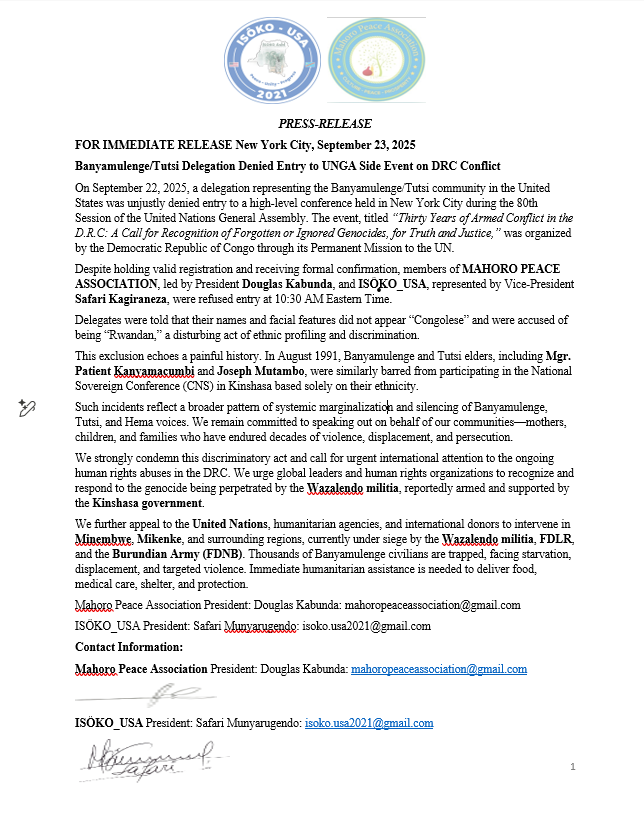
PRESS-RELEASE
FOR IMMEDIATE RELEASE, New York City, September 23, 2025
Subject: Banyamulenge/Tutsi Delegation Denied Entry to UNGA Side Event on DRC Conflict
On September 22, 2025, a delegation representing the Banyamulenge/Tutsi community in the United States was unjustly denied entry to a high-level conference held in New York City during the 80th Session of the United Nations General Assembly.
The event, titled “Thirty Years of Armed Conflict in the D.R.C: A Call for Recognition of Forgotten or Ignored Genocides, for Truth and Justice,” was organized by the Democratic Republic of Congo through its Permanent Mission to the UN.
Despite holding valid registration and receiving formal confirmation, members of MAHORO PEACE ASSOCIATION, led by President Douglas Kabunda, and ISÔKO_USA, represented by Vice-President Safari Kagiraneza, were refused entry at 10:30 AM Eastern Time.
Delegates were told that their names and facial features did not appear “Congolese” and were accused of being “Rwandan,” a disturbing act of ethnic profiling and discrimination.
This exclusion echoes a painful history. In August 1991, Banyamulenge and Tutsi elders, including Mgr. Patient Kanyamacumbiand Joseph Mutambo, were similarly barred from participating in the National Sovereign Conference (CNS) in Kinshasa based solely on their ethnicity.
Such incidents reflect a broader pattern of systemic marginalization and silencing of Banyamulenge, Tutsi, and Hema voices. We remain committed to speaking out on behalf of our communities—mothers, children, and families who have endured decades of violence, displacement, and persecution.
We strongly condemn this discriminatory act and call for urgent international attention to the ongoing human rights abuses in the DRC. We urge global leaders and human rights organizations to recognize and respond to the genocide being perpetrated by the Wazalendo militia, reportedly armed and supported by the Kinshasa government.
We further appeal to the United Nations, humanitarian agencies, and international donors to intervene in Minembwe, Mikenke, and surrounding regions, currently under siege by the Wazalendo militia, FDLR, and the Burundian Army (FDNB). Thousands of Banyamulenge civilians are trapped, facing starvation, displacement, and targeted violence.
Immediate humanitarian assistance is needed to deliver food, medical care, shelter, and protection.
Contact Information:
Mahoro Peace Association President:
Douglas Kabunda: [email protected]
ISÔKO_USA President: Safari Munyarugendo: [email protected]@UsambUN@US_SrAdvisorAF@SecRubio@AsstSecStateAF@USAmbUN@UKUN_NewYork@realDonaldTrump@KagutaMuseveni@PaulKagame@WilliamsMkenya@Fatshi13_pro5@RDCongoMAE
Today, I signed an Executive Order to launch the first-ever self-deportation program. Illegal aliens who stay in America face punishments, including—sudden deportation, in a place and manner solely of our discretion. TO ALL ILLEGAL ALIENS: BOOK YOUR FREE FLIGHT RIGHT NOW!