Happy to share that our paper on new markers of a neurotoxic, reactive astrocyte sub-state is out! Huge thanks to @JunminPengLab, @Calabre04804429, @LiddelowSA, and most of all @fossati_v and @nyscf who made this possible. A 🧵. https://t.co/OWSzQ9lM1M
Very excited to share our lab's latest work exploring the shared and divergent aspects of human astrocyte development and glioblastoma. This effort spans many fields from developmental glial biology to stem cells and tumor biology. https://t.co/AmJBADOxLG A 🧵(also come to 🦋!)
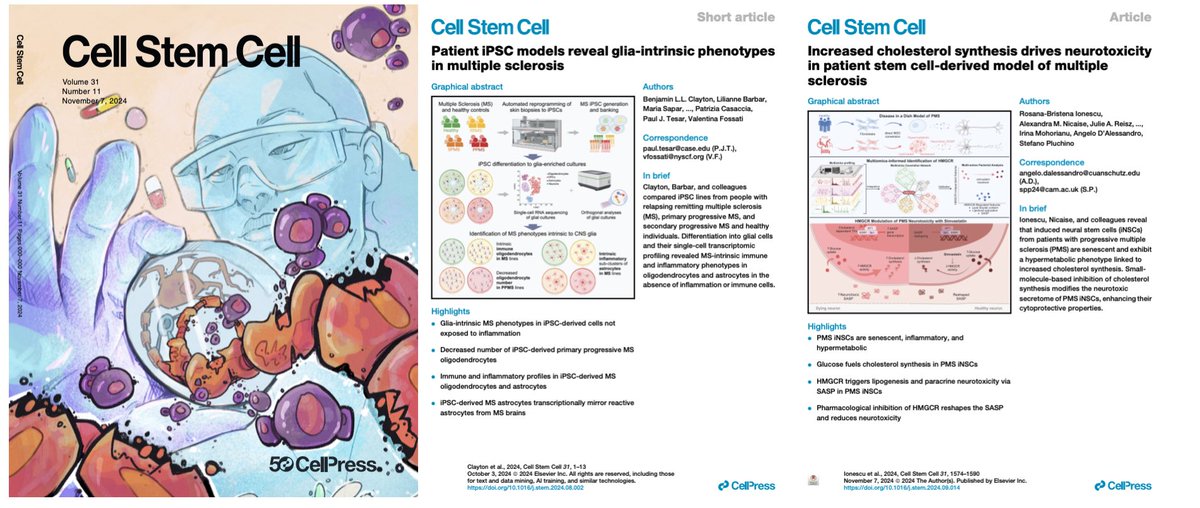
Proud to see our image selected for the November @CellStemCell cover, spotlighting two papers from my lab and @Pluchinolab that showcase the power of patient stem cell-derived models to study multiple sclerosis. (1/2)
I am excited to present my latest research at the @ISSCR Athens International Symposium, taking place in Athens, Greece on 3-4 April 2025. Register to hear my presentation! https://t.co/vhYpvOBwUE
No longer active on social media, but I had to come back to share the joy for this study. A long journey and a bold goal when I decided a decade ago to use stem cell models to study MS, despite the many challenges. Thanks @TesarLab@bllclayton @liliannebarbar and all co-authors!
Happy to share our paper “Proteomic profiling of Interferon-Responsive Reactive Astrocytes in rodent and human” out now in @GLIA_Journal! 🧠✨@NYULH_Neuro@NYULH_postdocs Thread👇🏽 (1/7) https://t.co/JUzIbXfXkC
A large longitudinal (298,000 cells and nuclei) transcriptomic investigation of glial differentiation in mouse embryos and hiPSCs used to optimize a mouse astrocyte differentiation protocol
New from @LiddelowSA and colleagues
https://t.co/0reFfg14Ug
“When I grow up, I want to be a __”. Most of us had to answer this question at some point; however, we don’t understand how the nervous system answers it.
We investigated how CNS cells decide what identity (‘job’) they should acquire when they mature (‘grow up’).
(thread: 1/12)
today, after i narrowly missed my subway, a woman came up to me and ask if i spoke spanish. i said yes and she asked me how to get to east harlem. i told her that we would be transferring at the same stop, so she should just stick with me. we sat down and started talking
Great turnout so far at the #ISSCR2022 poster session! Come visit more posters TODAY on high-content phenotypic #screening for drug discovery (by @dan_paull) and the role of #microglia-related genetic risk variants in #Alzheimers (by @chandrrrika) from 3-4pm!
Happy to share the latest publication from the lab, focused on the role of astrocytes in neurodegeneration relevant to glaucoma. Led by fantastic co-first authors @kirstin_8 and @catiasvgomes!
https://t.co/gokgPa6hIM
Stop by our poster if you would like ti know more about our studies on reactive astrocytes and neurodegenerative diseases #ISSCR2022. Poster #363 @LabibDavidA
Happening today at #ISSCR2022! Come visit @LabibDavidA at poster #363 from 6:30-7:30pm to hear about NYSCF’s research on novel markers of human reactive #astrocytes!
It brings me great pride to share this new preprint from our lab! This was a true team effort spearheaded by the superstar undergraduate (soon to be PhD student @PennNGG) @avoss2022 who pivoted to this project when pandemic rules kept undergrads at home https://t.co/p4JpSkNIOd
New Research: Proteomic Alterations and Novel Markers of Neurotoxic Reactive Astrocytes in Human Induced Pluripotent Stem Cell Models: Astrocytes respond to injury, infection, and inflammation in the central nervous system by… https://t.co/NsZU6gRln4 #Molecular#Neuroscience
Excited to share our paper in @FrontImmunol describing a new role for NLRP3 inflammasome modulation in postoperative neurocognitive disorders. The start of a great collaboration with @Duke_Shinohara@Duke_Anesthesia@DukeMedSchool
https://t.co/at29m53aPk