Technology-Innovation-Futurology-Energy industry torchbearer-Outdoor enthusiast-Fitness chaser-Husband-Father of boys. BA @CollegeofIdaho MBA @IdahoStateU
Half the cost of a lithium-ion battery is the cathode. China makes roughly 90% of the world's supply. Tesla just switched on the first plant in North America producing it at large scale.
America finally makes the hard part.
For twenty years the deal was that we design the product and China makes the chemistry inside it. A car could be assembled in Texas, with cells built in Texas, and still be strategically Chinese, because the powder inside those cells crossed the Pacific. In 2025 Beijing even added cathode production technology to its export control list. Governments don't restrict the export of things that don't matter. China looked at its cathode position and decided it was leverage worth protecting.
Tesla built it anyway.
And they didn't copy the Chinese process. They leapfrogged it. Conventional cathode lines need solvent slurries, football-field drying ovens, and a solvent recovery plant. Tesla's dry coating deletes all three. The material fought back for years, cracking and delaminating under compression, and Tesla only confirmed fully dry production of both electrodes in January 2026. Seven years after buying Maxwell for the technology, it works at scale.
The permit for this building was filed in 2022 under the codename Project Cathode. Four years from dirt to powder, sitting next door to the cells it feeds.
Every other automaker on the continent still imports theirs.
$MRNA if anyone is interested in how AI is used to make the new Moderna cancer vaccine, here you go.
I can’t imagine what we will be doing just 5 years from now.
As a chip designer who has spent nearly three decades in Non-memory SoC, I still remember the exact second I first heard about Cerebras.
Someone said a Silicon Valley company was trying to turn an entire 300 mm wafer into one single AI chip — 46,225 mm² of silicon, 4 trillion transistors, ~900,000 tiny cores, and 44 GB of distributed on-chip SRAM delivering 21 PB/s of bandwidth… with zero HBM.
My first reaction was identical to every experienced designer I’ve ever talked to:
“That’s insane.
Yield will be catastrophic.
You can’t test something that big.
You can’t route around that many defects.”
I have designed advanced nodes down to 2 nm. I know exactly how brutal those problems are supposed to be.
Then I studied the actual architecture.
Tiny, identical, fault-tolerant cores.
Massive built-in redundancy.
Dynamic re-routing fabric that simply maps around defective regions.
And the most radical decision of all: keep the model weights permanently resident in pure on-chip SRAM so you never pay the classic GPU memory-wall tax.
Suddenly the “insane” idea flipped into pure, shocking genius.
I’ve had this conversation many times — over dinner with semiconductor design veterans, during after-lunch walks at the office. The first reaction is always the same: “They’re nuts. Yield close to zero.” Ten minutes of architecture explanation later the tone completely changes to “Wait… that actually makes sense. I need to study this properly.”
That is why I have been a consistent $CBRS believer since before the IPO at $175. I even added more to my 401k the same way Korea’s National Pension did in addition to IPO and individual brokage accounts.
The technology was never the open question for me.
The open question was always the one I wrote months ago:
“Earning money is the next problem with this amazing technology.”
Today, on a +15% day that took the stock to $252, we are finally starting to get real answers.
OpenAI’s GPT-5.6 Sol Ultrafast mode is now live in limited preview — powered by Cerebras — delivering up to 750 output tokens per second, roughly 14× faster than standard. Same frontier intelligence. Dramatically lower latency. Coding agents, research systems, and enterprise agents that can finally respond in real time without making users wait.
This is not a product demo.
This is the first clear, public proof that the multi-year OpenAI capacity commitment is converting into actual paid inference workload and revenue.
Wedbush correctly framed it as commercial progression of the relationship. Tiger Global’s large disclosed position, the AWS partnership built exactly for the inference shift (Trainium prefill + CS-3 decode), and even the “father of HBM” (KAIST’s Jungho Kim) ranking Cerebras #1 on his personal roadmap all point in the same direction.
Inference is where the real money lives.
Cerebras was purpose-built for exactly that moment.
Is the stock still volatile? Of course.
Are there still important milestones ahead (broader Ultrafast access → sustained usage growth → RPO conversion → gross margin expansion)? Absolutely.
But as someone who designs chips for a living, today feels different.
The architecture that every seasoned engineer initially dismissed as impossible is now running OpenAI’s most capable model at speeds the industry thought required painful trade-offs.
The “insane” bet is starting to speak the only language the market ultimately respects: real product, real customers, real tokens per second.
Proud to have been watching this one from the very beginning.
$CBRS
#Cerebras #WaferScale #AIHardware #Semiconductors
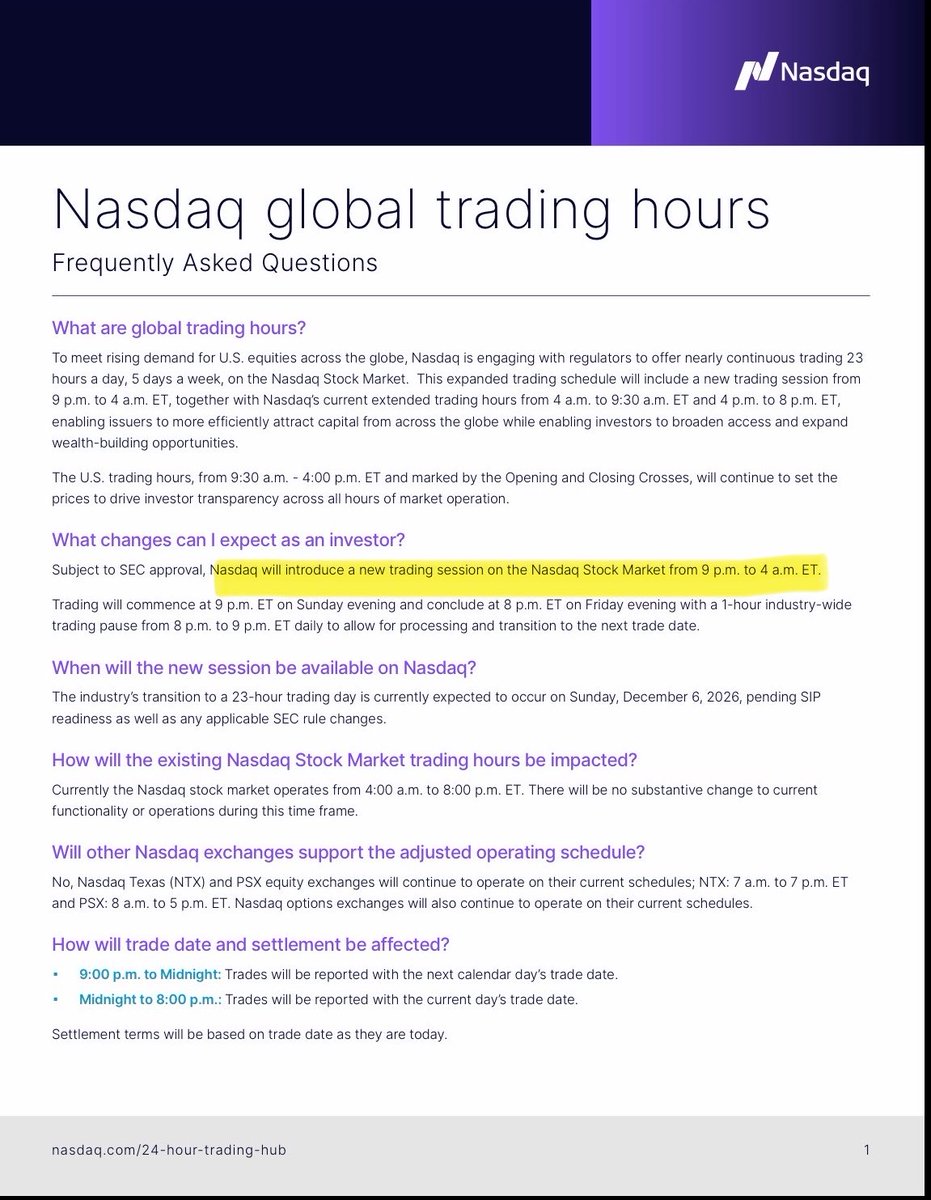
BREAKING: 🇺🇸 Nasdaq to launch overnight stock trading from 9 pm to 4 am ET starting December 6, 2026.
Nasdaq plans to offer continuous trading for nearly 23 hours a day, five days a week.
The Buss family just sold its last piece of the Los Angeles Lakers. Not the majority, that went to Mark Walter a year ago. This is the final 17.8 percent, sold to Josh Kushner and Bob Iger, and it removes the family from the franchise completely. Jeanie Buss loses the governorship along with it. After 46 years, the Busses no longer own any part of the Lakers, and the thing that finally ended it was the same structure Jerry Buss built to make sure it never would.
Jerry Buss bought the Lakers in 1979 for $67.5 million and spent the rest of his life making sure his children would never lose them. When he died in 2013, he didn't hand the team to one heir. He put his controlling stake in a trust and split it evenly among all six of his kids, an equal 11 percent each, so nobody would be favored and nobody would be cut out. He prepaid the estate taxes. He wrote in buyout provisions and safeguards designed specifically to keep the team from being sold under financial pressure. He built the trust around a tontine, an old structure where a sibling's share passes to the surviving siblings when they die, because in his final years he had become obsessed with the family holding the Lakers together, permanently, as one unit.
The whole architecture had one purpose. Make selling unnecessary, and make it hard. Any sale required four of the six children to agree, a supermajority meant to ensure no single disgruntled kid could ever break up what he'd built.
That supermajority is exactly what sold the team.
Here's what Jerry Buss didn't account for. He engineered the finances perfectly and forgot the people. The equal shares he thought would prevent resentment instead locked six siblings with different lives and a long history of feuding into a business none of them could individually leave. Jim and Johnny tried to force Jeanie out in a 2017 coup. Jeanie fired Jim. The family that was supposed to run the kingdom together spent a decade in lawsuits and cold wars, held together by a father who was no longer there. People close to the Lakers said Jerry himself was the only glue, and when he died, the glue died with him.
Then came the number no trust provision can survive. When Jerry Buss bought the Lakers they cost $67.5 million. When his family finished selling, they were valued at $12.5 billion. At that price, holding on stops being a family decision and becomes almost impossible to justify. You can build safeguards against creditors, against a bad year, against financial pressure. You cannot build a safeguard against your own asset becoming so valuable that keeping it feels irrational. Sentiment survives a lot of things. It does not survive a billion-dollar check per sibling, handed to a group that was already barely speaking.
The family's own statement said it plainly. They love the Lakers, they wrote, but it was time to move on and "exit gracefully while we still can." That last phrase is the tell. This wasn't taken from them. They chose to get out at the top, together, because the alternative was watching the feud grind on while the number kept climbing.
And the cruelest detail is what it does to Jeanie. When Walter bought the majority last year, the deal let her stay on as governor for five years, the last real piece of Buss control. But NBA rules require a governor to own at least 15 percent of the team. Selling the family's final 17.8 percent drops her to zero, which means she doesn't just lose the shares. She loses the chair. The daughter who chose the Lakers over her own family in 2017, who fought her brothers in court to keep control, is now completely out of the franchise her father built his life around.
Jerry Buss wanted his children to hold the Lakers for generations. They held them for twelve years after his death. The plan he spent his final years perfecting, the trust designed to make selling nearly impossible, is the exact instrument that took the family from majority owners to nothing in barely a year. He protected the Lakers against everything except what actually happens to families, and to money.
🇨🇳🇺🇸Watch what China just showed off at their AI conference.
Meanwhile American schools are still arguing over whether students should be allowed to touch AI at all.
One country is teaching kids to build with the technology, the other is teaching them to hide it.
Which approach do you think produces the better engineers in ten years?
One pattern I find useful for working with LLMs is a nice long ramble session. Sometimes the LLM needs more bits to understand what you're trying to achieve, but you're too lazy to type them. In these cases I like to lean back, switch to /voice and just ramble for like 10 minutes, total mess, anything goes, full stream of consciousness. Sometimes I declare it up top, something like "switching to speech recognition sorry for any typos...". Sometimes I turn it into a small interview of a few turns. But I find that the LLMs are somehow very good at reconstructing long incoherent rambles and often their echo of your own tangle of thoughts comes out quite a bit cleaner than what you started with. The result is that you improve the mind meld and have to correct things less from that point on.
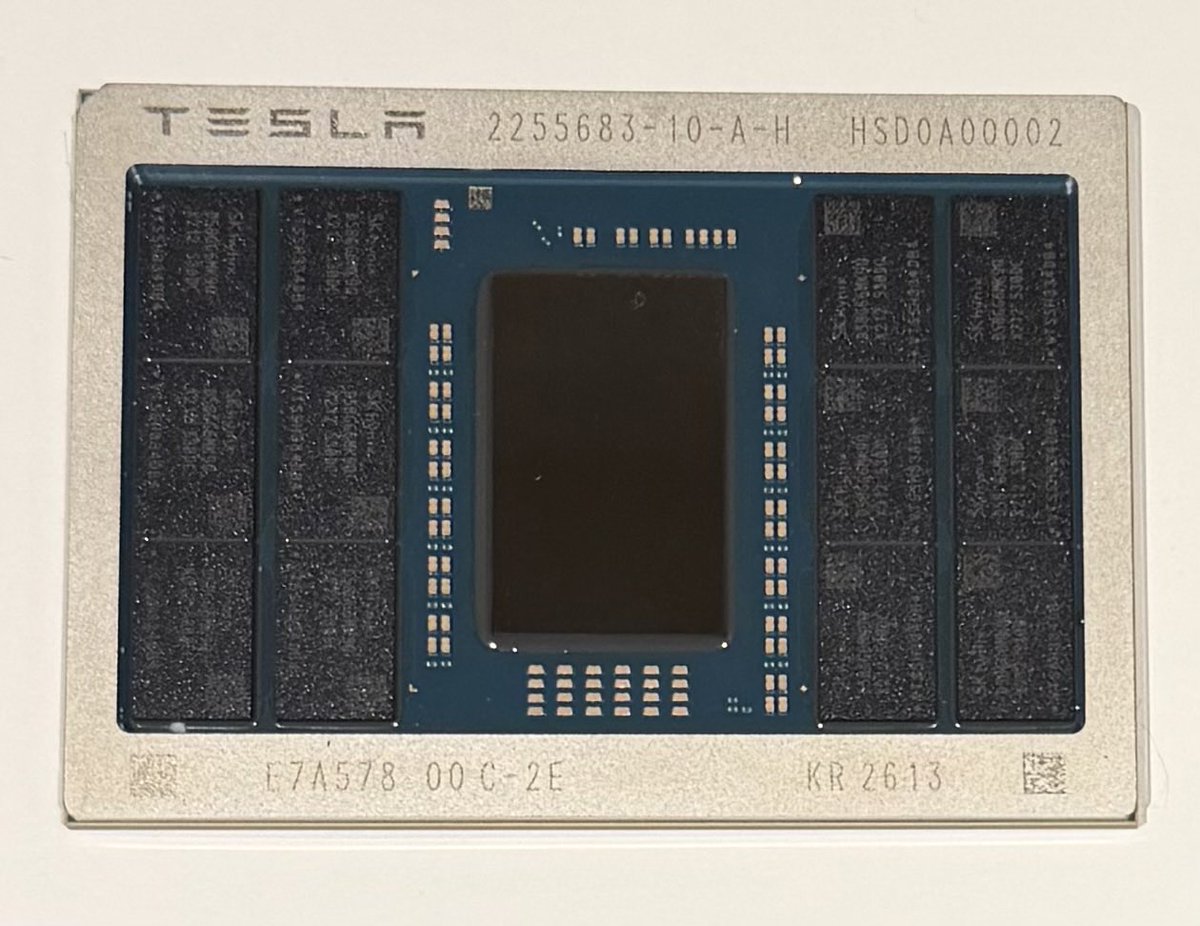
Samsung Foundry’s Principle Engineer has announced that “the @Tesla-Samsung Al5 chip has reached tape-out. It is scheduled to be manufactured at the Taylor fab using our latest 2nm process and will soon be integrated into Tesla's newest products.”
Volume production won’t start for a while, but good to hear things are still moving along.
Picture of Tesla’s upcoming AI5 chip on the right:
@sama We start flying them next year. Maybe you can come see them if your parole officer approves.
After stealing an open source AI charity, you then stole all of Apple’s phone technology! Wow.
What do you plan for an encore? That’s tough to beat.
This is WILD!
Nvidia just launched something that could compress the most expensive process in medicine from 12 years to 12 months.
BioNeMo Agent Toolkit is an open, agent-ready platform that turns AI agents into autonomous scientific workers, giving them the ability to run real drug discovery workflows instead of just generating ideas.
And more than 50 companies are already using it, including Anthropic, OpenAI, Eli Lilly, Databricks, Snowflake, Dassault Systèmes and Schrödinger.
Here is what it actually does.
Traditional drug discovery costs an average of $2.6 billion per drug and takes over a decade.
Most of that time and money goes into screening millions of compounds, designing proteins that bind to disease targets and running countless lab experiments to validate whether something works.
BioNeMo agents now do all of that computationally before a single lab experiment begins.
The demo Nvidia shared makes the speed impossible to ignore.
An agent was asked to design 10 protein binders for PD-L1, a critical cancer immunotherapy target and it completed the full design, co-folding, scoring, and 3D structural analysis on GPU in under 90 seconds.
What used to require weeks of wet lab work and PhD-level expertise now runs as a callable tool inside an AI workflow.
The four core capabilities are virtual drug screening, protein binder design, genomic analysis, and medical imaging each one compressing tasks that previously took weeks into minutes.
The institutional validation behind this is unusually strong.
Nvidia and Eli Lilly announced a joint investment of up to $1 billion over five years to build a co-innovation lab running entirely on BioNeMo.
The University of Washington's Institute for Protein Design is already running RosettaFold3 at 2x faster performance than the prior generation.
And the market this unlocks is enormous, and Nvidia is sitting right at the center of it.
The AI drug discovery market is projected to grow from $2.9 billion in 2026 to $13.8 billion by 2033 and McKinsey estimates generative AI could deliver $60 to $110 billion in annual economic value to pharma.
Bullish on drug discovery!
@UberEats your support is AI based and is terrible. It won’t let me reverse a tip in any way. We had a priority order and I’m an Uber One member with many orders. Fix it, allow tip reversal after delivery.
The laptop hasn't changed in 30 years. NVIDIA just changed it
RTX Spark is their first PC chip ever.
- RTX 5070 level GPU
- 128GB unified memory
- 1 petaflop of local AI
- thin, light, barely throttles unplugged
Your AI agent lives on the machine. 24/7. No cloud.
This is step one of the agentic AI PC, and everyone else is about to copy it.
2026 Tesla Model Q — Ultra Luxurious Electric Beast With a Stunning New Design. It sets a new benchmark in the world of premium electric cars. This next-gen Model Q features a fully upgraded luxury interior, enhanced autopilot systems, a futuristic cockpit.
Tesla road trips are starting to feel different.
FSD handles the driving.
Grok handles the curiosity:
"Hey Grok, what's that mountain?"
Ask about anything.
Geology.
History.
Landmarks.
Local stories.
Nearby attractions.
You drive through a place once.
Now you actually learn something about it too.
Having an xAI tour guide permanently riding shotgun is a surprisingly cool future.
@Tesla@Grok
Do you understand what NVIDIA just did?
They didn't announce anything.
Just coordinates: 25.0528, 121.5990
That's Taipei.
Computex starts June 2.
And three words — "A new era of PC."
Here's what I think is coming.
- NVIDIA has been quietly building an ARM-based chip for Windows PCs.
- Developed with MediaTek.
- Designed to run AI natively on your laptop.
- Not a GPU.
- Not a data center chip.
- A processor. For your PC.
And if the leaks are right — it could match RTX 4070 performance
in a thin, efficient laptop. 👀
Intel. AMD. Qualcomm.
They've owned this space for decades.
NVIDIA is walking in.
Jensen Huang also hinted at a "surprise new product nobody knows about yet" for the second half of 2026.
This tweet might be that first signal.
A company that makes the world's most powerful AI chips now wants to power your everyday PC.
That's not an upgrade. That's a new era...